A Fourier multiplier can recover analytic regularity in a direction if its inverse operation has a holomorphic extension of polynomial growth in a complex cone. This criterion applies to convolution by a tempered distribution, including kernels that are neither compactly supported nor differential operators. We prove the directional estimate, account for the noncompact part of the forcing, and then extend the result to convolutions defined by proper addition of supports.
Throughout , , and the inverse transform has factor . The complex square is bilinear; is a norm.
1. The reciprocal condition is a distribution identity
Let . A nonzero real covector is called noncharacteristic for this convolution kernel if there are a complex open cone containing , , and a holomorphic function on such that
The cone is invariant under multiplication by positive real numbers. We may increase to a nonnegative integer. The second equality is an equality of distributions on the indicated real open set: multiplication by the smooth restriction of is defined there. It does not assert that is a function or that is nowhere zero.
Write for the complementary set of nonzero real covectors. It is closed in the punctured real space and positively conic: each permitted cone supplies an open conic set of noncharacteristic directions. Scaling a real direction does not change the permitted large-frequency region.
Fix a noncharacteristic unit covector . Choose smooth real cutoffs , with values in , as follows. Their supports avoid a large ball, their angular supports lie in a small real cone about whose complex enlargement is inside , and both are homogeneous of degree zero beyond a larger ball. Arrange
Also arrange that in a larger angular neighborhood of that ray at large frequencies. Nested spherical caps and radial cutoffs give these choices; the radial transition of finishes before that of begins. Derivatives of either cutoff of order are outside a fixed ball.
Let
The second integral is defined for . The normalization uses the Euclidean sphere measure from U078, including total mass two on .
Lemma 1 (complex estimates for the amplitude). After shrinking the chosen complex cone and increasing the excluded ball, put . It is holomorphic near all contours used below. For some fixed exponent and every fixed multi-index ,
where , the square root has positive real part, and the real angular variables stay in the chosen cone.
Proof. For , the real part of is at least . The right-half-plane square root is therefore holomorphic, lies in a fixed closed sector strictly inside the right half-plane, and is comparable with . Real rotation invariance gives , with from U078. Both and are holomorphic in this cone and agree on its real open part; they agree throughout a smaller connected complex cone. To justify the real-set identity, all real derivatives of their difference vanish at each interior real point, hence all complex Taylor coefficients vanish there by the Cauchy–Riemann equations and the supplied polydisk expansion; the identity principle then applies.
The zero-location and sector estimates in U078 give
In particular the denominator has no zeros here. Together with (1), this proves (4) for , with .
Use two nested complex cones. For sufficiently large , a polydisk of fixed radius about every point of the smaller cone lies in the larger permitted cone. On that polydisk the polynomial weights are comparable. Also is uniformly bounded on the larger closed cone, so the real part of changes by a bounded amount on the fixed polydisk. Applying the polydisk Cauchy estimate to the zeroth bound gives (4) for every , with its own constant but the same polynomial exponent. The fixed excluded ball absorbs all low-frequency issues.
2. Deforming the kernel and keeping every decay estimate
Define
For , these are holomorphic, and each real slice is Schwartz. Indeed all fixed frequency derivatives of either amplitude decay exponentially, using (4) and the real reciprocal estimates for . Integration by parts with gives arbitrary decrease in the real variable, and differentiation in only inserts a fixed polynomial in frequency. On compact subtubes the same estimates are uniform.
The factor excludes an angular neighborhood of at large frequencies. There is consequently such that
there. Bounded frequencies contribute an entire function, and the remaining integral in converges with every derivative when . Thus extends across every point .
Lemma 2 (off-origin continuation with Schwartz bounds). For every , there is such that has a holomorphic continuation to a neighborhood of
On a slightly smaller such region, for every and every multi-index ,
The width is uniform for all the real points outside the ball.
Proof: the phase estimate. Write . For a real , deform the frequency to
and use the homotopy with replaced by , . Choose so small that all deformed points over remain in the admitted complex cone and outside its excluded ball. Elsewhere the contour is unchanged.
If , then
; hence
.
For , , this yields
For the second inequality, the function in parentheses is convex in : the second derivative of the negative square root is nonnegative. Its values at zero and one are and . A convex function lies below the chord between those endpoints. This proves the estimate, including .
Proof: the contour identity. For , (10) along the homotopy gives exponential decay at least , times a polynomial. The Jacobian is bounded uniformly in , because is bounded and is bounded. The parameter derivative of the homotopy is . The coordinate determinant identity of U090 Lemma 1 therefore permits the deformation with a large compact radial cutoff. Its outer boundary error is bounded by a fixed polynomial in the cutoff radius times this exponential, and tends to zero.
The weight causes no interior error: its derivative is zero on a neighborhood of , while the deformation velocity is zero elsewhere. Thus every term involving a derivative of the weight in that identity vanishes. We obtain exactly
The argument uses no division by the determinant and remains valid if the parameterized graph has a singular Jacobian.
Proof: continuation. At sufficiently large frequencies, in a fixed cap about . Outside that cap,
.
For , put . At the final contour, (10) gives a gain of at least in that cap when , and at least outside it. These are positive uniform gains.
For holomorphy near a particular , keep the contour fixed as varies. A change of real part from to changes the exponent by at most . Choose a radius , uniformly for , with . Along the homotopy the gain then remains nonnegative. At the final contour choose smaller than
. High frequencies retain a fixed positive multiple of in the negative exponent. Frequencies in a fixed bounded set are harmless; on them , so their integrals are also bounded uniformly in .
The fixed-contour integral is holomorphic in this neighborhood by uniform convergence of all differentiated integrals. It agrees with in its intersection with , by the same homotopy estimate. These extensions agree on overlapping small balls: their centers have common imaginary part , so the convex intersection of any two overlapping balls meets the original tube after a small displacement toward its interior. The identity principle gives equality throughout the intersection. Uniformly small balls therefore supply (7), as well as a uniform bound for there.
Proof: rapid decrease. A uniform bound alone would not justify pairing with every tempered distribution. For any integer , integrate by parts in the original tube to obtain
The right side is a finite sum of integrals with weights
and holomorphic factors .
For , the contour argument applies unchanged. For , the weight and all its derivatives vanish near the support of the cutoff ; thus the deformation is again valid and actually leaves its support fixed. These differentiated weights lie in bounded frequencies or in angular directions separated from .
Each holomorphic factor has (4), so every continued integral in (12) is uniformly bounded on a common region (7). Equation (12) continues there by holomorphic uniqueness. The imaginary part is bounded on this region. For sufficiently large ,
Consequently (12) proves arbitrary inverse powers of ; bounded real with are covered by the preceding uniform bound. Finally apply the polydisk Cauchy estimate in a fixed smaller neighborhood, using the result with and a slightly wider imaginary margin. Real weights are comparable on those polydisks. This proves (8) for every derivative.
3. The boundary kernel has only one possible direction
Lemma 3 (one positive boundary covector). The limit
satisfies
On every set , it is represented by the holomorphic continuation of Lemma 2 at imaginary part , with all the bounds (8).
Proof. The real lower bound for makes the multipliers in (14), before and after the limit, bounded by one fixed polynomial for , because . They converge pointwise. Dominated convergence against any Schwartz test proves the asserted tempered limit and its formula.
Consider the shifted function . If an open convex cone has
then for small ,
Indeed when , and division by proves the claim. The defining integral, (4), and a radial exponential integral give a bound for , with some finite integer , uniform in . To see the integral bound directly, enlarge to a nonnegative integer and compare with
; expand the polynomial and substitute .
On every such cone the boundary distribution is the same : the multiplier is now
, still uniformly polynomial because , and the same dominated-convergence argument applies. U075 Theorem 2 therefore puts its analytic wavefront in the dual of every cone (16).
The intersection of these dual cones is precisely . For a covector not in that closed ray, there is with and . If the component of perpendicular to is nonzero, take with sufficiently large . If that component is zero, is a negative multiple of , and works. A small circular cone about satisfies (16), and its dual excludes . This proves the directional part of (15). Lemma 2 makes the boundary analytic at every nonzero base point, proving the remaining base restriction and the stated bounds.
4. Two continuation steps for local and distant forcing
Lemma 4 (an analytic boundary gives a full extension). Let be holomorphic in , with a bound on each compact real neighborhood under consideration. Suppose its radial distributional boundary exists near . If is real analytic near , then extends holomorphically to a full neighborhood of .
Proof. The real analytic function representing has a holomorphic extension to a complex ball about . Explicitly its convergent real power series is the same normally convergent series on a smaller complex polydisk:
The convergence and termwise holomorphic derivatives follow from the factorial estimates and geometric-series proof in U073 Proposition 3 and U015 Section 3.
Take a small circular cone about satisfying (16). The shifted function is holomorphic on its truncated tube over a smaller real ball and has uniform polynomial growth by (17). U015 Theorem 2.1 supplies its full-cone boundary; the radial limit identifies that boundary with . Its zero-boundary uniqueness theorem, Theorem 3.2, makes the difference zero on this tube. Thus agrees with on an open subset of a small complex ball about intersected with the original unit tube. That intersection is convex, hence connected. The identity principle extends equality throughout it. This proves the required extension to the full ball.
Lemma 5 (a separated tempered source). If vanishes on , then , initially defined in the unit tube, extends holomorphically near .
Proof. Choose a smooth equal to zero on and to one outside , so that . For close enough to , every has . Lemma 2 supplies the continuation used in
The function of inside this pairing is Schwartz, uniformly on a small closed complex neighborhood. Indeed, each derivative is a sum of a bounded derivative of times a derivative from (8). The real variable stays bounded, so arbitrary decay in is arbitrary decay in .
Polydisk estimates on a slightly larger neighborhood give the same bounds for all -derivatives, and uniform convergence of their difference quotients in every Schwartz seminorm. The pairing with the continuous tempered distribution is therefore holomorphic. In the original tube it agrees with the convolution because . The argument retains the order in the kernel; no reflection of the selected covector occurs.
5. Analytic regularity passes through the convolution equation
Theorem 6 (analytic convolution estimate). If and , then
Proof. Put . This convolution is tempered and
Here is smooth with polynomially bounded derivatives. For clarity, if is Schwartz, the function
is Schwartz: use the finite order of on its fixed compact support and compare with . This defines the tempered convolution and agrees with the proper-support pairing on compact tests. To check (21), test against a Schwartz function in frequency and insert its Fourier integral. The two expressions both become
.
Interchanging the compact finite-order pairing and the rapidly convergent Fourier integral is justified in every required Schwartz seminorm. This proves the identity with the stated normalization.
Take , with noncharacteristic, and make the preceding construction. Cauchy's estimate applied directly to (1) gives polynomial bounds for every derivative of on the smaller cone. Thus , extended by zero outside its real cone, is a Schwartz multiplier. Multiplying (1) by this cutoff and by gives
The first equality is distributional; the second follows after multiplication by and inverse Fourier transformation. All the convolutions on the second line have their indicated smooth holomorphic representatives. This step needs only (1), even if has real zeros.
The term extends across , since is compact and extends across every point with that imaginary part. Choose a compact cutoff near , and decompose , where and vanishes on a ball about . Lemma 5 extends across the same point.
For the compact part, Lemma 3 and the compact-distribution Fourier identity imply
One can check the limit directly: the multipliers in (14), multiplied by the polynomially bounded , still have a common polynomial bound and converge pointwise on Schwartz tests. Near , , so ; this uses locality, not analytic preservation by an arbitrary smooth cutoff.
By (15) and the exact analytic convolution bound,
There is no wavefront covector over . The analytic projection theorem makes real analytic near . The function has polynomial growth toward the unit-tube boundary: its compact distributional order costs only a fixed number of derivatives of , each estimated by the same radial exponential integral as in Lemma 3. Lemma 4, applied to (23), therefore gives a full holomorphic extension near .
Every term on the right of (22) now extends there. The left is the actual spherical representation of . Its exact boundary characterization, U079 Theorem 3, excludes from . Positive conicity proves (20) for all nonzero covectors.
Corollary 7 (the proper-support version). The same estimate holds for , without a temperedness assumption on , whenever
is proper.
Proof. Theorem 1.1 of the convolution lesson defines under exactly (25). Fix and a compact ball having in its interior. The pairs in (25) whose sum lies in form a compact set. Its projection to the -variable is compact. Choose equal to one near that projection and near . Then
Indeed, no pair from
can have its sum in . This support pair still has proper addition, as a closed subset of the original proper pair. The convolution support inclusion makes its convolution zero on . Apply Theorem 6 to the compact distribution , and use the two local equalities (26) for the fiber over . The point was arbitrary.
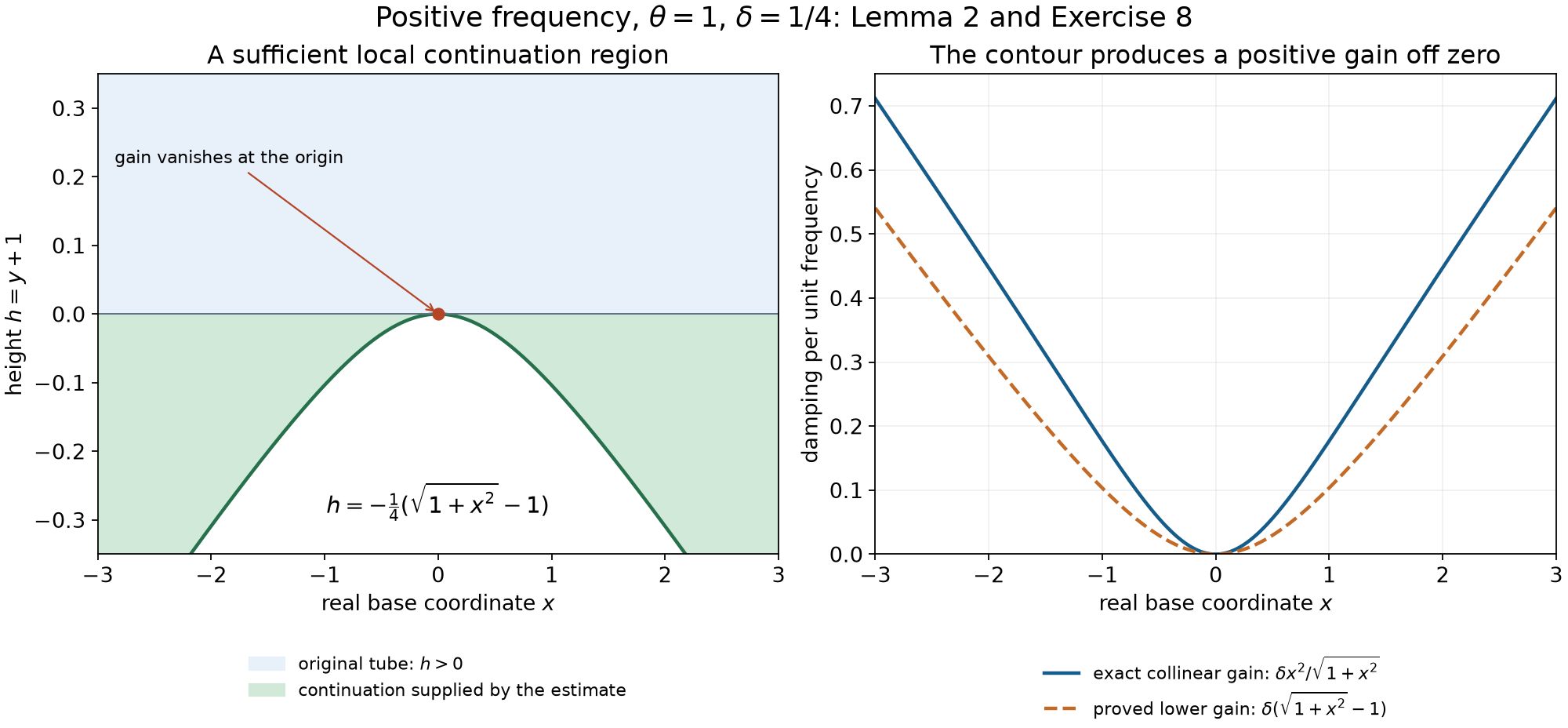
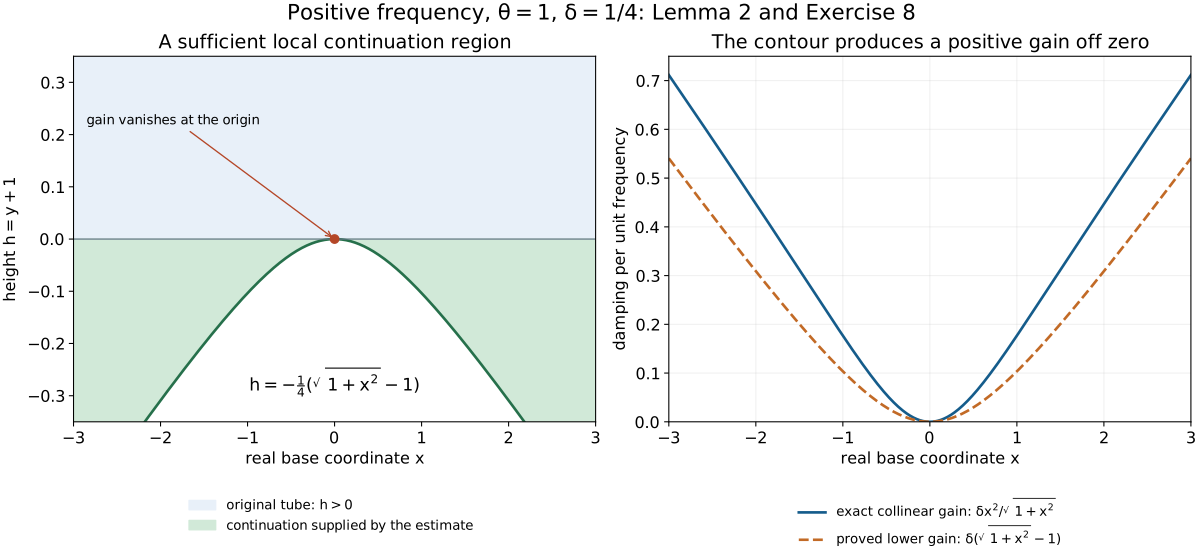
The one-dimensional positive-frequency model uses , , and as height relative to the boundary. Left: the curve is the sufficient boundary given by (10) in the high-frequency cap where ; the displayed continuation region is a local band about . At the gain vanishes. Right: Exercise 8 compares this proved gain with the exact collinear phase gain , per unit frequency. The illustration concerns the phase estimate, not a claim that every kernel has a singularity at the origin. Vector figure · Plotting source.
6. Exercises with complete solutions
Exercise 1 (intermediate: a reciprocal may vanish). Construct a tempered kernel with empty for which the permitted has real zeros in every dimension .
Solution. Define in frequency. Its action is
The limit and tempered bound follow by subtracting on a symmetric interval . The difference divided by is bounded by the supremum of on that interval; integrate in using a Schwartz weight of power greater than . On , a weight greater than makes the tail integrable. These estimates use finitely many Schwartz seminorms. Multiplication by removes the denominator, and the omitted strip has integral tending to zero, proving the identity in (27).
Let . The entire polynomial satisfies (1) in every direction, so the characteristic set is empty, although on a real hyperplane. Directly, , and hence for compact . This also explains the regularity implication: differentiation with analytic coefficients cannot create analytic wavefront directions. The construction and identity work in dimension one too, but there the zero of is only the excluded origin.
Exercise 2 (foundation: differential operators are included). For a nonzero polynomial with highest homogeneous part , set . Prove
Solution. If , continuity on a small complex angular neighborhood gives there. Lower terms have size at most for . At sufficiently large frequency,
.
The holomorphic reciprocal has polynomial growth and satisfies (1), because . If , the reciprocal is a nonzero constant everywhere. This proves (28). Theorem 6 recovers the noncharacteristic analytic differential estimate. No assertion about equality of the two characteristic sets is needed here.
Exercise 3 (intermediate: fractional elliptic multipliers). For any real , let be the tempered distribution with Fourier transform . Show that its analytic characteristic set is empty.
Solution. The displayed smooth function and all its derivatives have polynomial growth, so it defines a tempered distribution and hence its inverse Fourier transform. In a complex cone , ,
.
Use the holomorphic logarithm on the right half-plane, proved in Complex powers at a boundary, Lemma H0, and put
For real , its absolute value is . The upper and lower quadratic bounds give a polynomial bound, for either sign of , and its real product with is one. Every real direction has such a complex cone. Thus , and analytic regularity of at any covector implies that of a compact at the same covector. The result includes noninteger powers and is not confined to differential kernels.
Exercise 4 (advanced: translation is not local inversion). Determine for .
Solution. Its Fourier transform is . A function satisfying (1) would have to equal on a real open cone. Holomorphic uniqueness from a real open set, proved in Lemma 1, forces the same equality on a smaller complex cone. For small fixed , the points lie in that cone at large , whereas
This exceeds every polynomial as , by the exponential series. Thus no real direction is noncharacteristic. This is consistent with : the equation connects different base points, whereas (20) concerns the same base point. For , gives the empty characteristic set.
Exercise 5 (intermediate: composition of compact convolution kernels). For compact distributions , prove
Solution. Outside the union choose a common smaller complex cone and a common sufficiently large excluded ball for the two functions . Their product is holomorphic and has polynomial growth. The compact-convolution Fourier identity is
, with both factors smooth. Hence
on the real cone. The product supplies (1), proving (31). Compactness ensures that both the convolution and every displayed Fourier product are defined; the argument does not multiply two arbitrary distributions.
Exercise 6 (foundation: why growth is part of the hypothesis). Give a convolution that makes every compact input analytic but whose formal reciprocal fails (1).
Solution. Take
The Gaussian Fourier identity and normalization are proved in the Fourier foundation. The Gaussian is entire in the complex variable , and pairing its translates with a compact distribution gives an entire function: finite test-order bounds justify all complex derivatives on compact parameter sets. Thus is analytic for every compact . But (1) would force on its real cone, already violating polynomial growth there. In particular is singular while is analytic. Nonvanishing on real frequencies alone cannot replace the full condition.
Exercise 7 (advanced: a proper convolution with a non-tempered input). On the line let , the Heaviside function, and . Verify that Corollary 7 applies and identify the convolution and a permitted .
Solution. Both supports are . A bound on bounds both nonnegative variables, so their addition is proper. The distribution is not tempered: pair it with translates by positive integers of one fixed nonnegative bump supported in . Those pairings grow at least like a positive constant times , whereas every fixed Schwartz seminorm of the translated bump grows only polynomially in . This contradicts any tempered continuity bound.
Direct proper integration gives
Since , Fourier transformation gives
as distributions. Thus satisfies (1) in both directions and the analytic characteristic set is empty. Differentiating (33) distributionally gives , as also follows from the proper convolution derivative identity. The non-tempered growth of does not obstruct this local regularity conclusion.
Exercise 8 (intermediate: the continuation gain closes quadratically). In the one-dimensional positive-frequency cap, take , , and . Compare the exact phase damping with (10).
Solution. The positive-real-part square root of is . Therefore the exact real part of the phase is . The magnitude per unit frequency dominates the bound in (10):
For , the ratio of the first expression to the second is
, between one and two. The displayed lower gain divided by tends to at zero. Thus the uniform extension width outside shrinks quadratically as . It gives no continuation at the base origin itself. This is the quantitative distinction shown in the figure.
Proof locations and mathematical source
U078 Lemmas 1–3 supply the spherical exponential and its zero-free sector estimate. U090 Lemma 1 supplies the coordinate contour identity. Lemma 2 above checks its weights, boundary errors, complex neighborhoods and all Schwartz decay bounds for the present amplitude.
U015 Theorems 2.1 and 3.2 and U075 Theorem 2 supply full-cone traces, zero-boundary uniqueness and analytic covector bounds. U074's analytic projection and U084 Corollary 7 give the compact forcing step; Lemmas 4–5 explicitly supply the continuation and noncompact pairing steps.
U079 Theorem 3 identifies holomorphic extension of the spherical representation with absence from analytic wavefront. U021 Theorem 1.1 supplies the proper-support definition and exact localization in Corollary 7. The half-plane logarithm used in Exercise 3 is U017 Lemma H0.
Lars Hörmander, The Analysis of Linear Partial Differential Operators I, second edition, 2003 reprint, Theorem 8.6.15 and its proper-support remark, pp. 315–317, is the mathematical antecedent. The detailed contour estimates, explicit continuation steps, exposition, examples, exercises and figure here are independently expressed.