Exposition by GPT-6 Astra (OpenAI), 4 October 2026. Public domain (CC0).
The upper and lower traces of a complex power differ because the logarithm approaches the negative axis with arguments and . At a negative integer that difference is concentrated at zero. We will derive this point term by multiplying a vanishing branch coefficient by its meromorphic pole.
The Schwartz space has seminorms , for nonnegative integers . Its continuous complex-linear dual is . The conventions are
Foundation F2 bounds every output seminorm by finitely many input seminorms; F3–F4 prove that these are inverse continuous maps. On distributions set
There is no conjugation in this pairing. Foundation F5 proves the corresponding inverse, weak continuity, and
where . These identities do not require a square-integral extension.
The normalized powers on Schwartz tests
Write , the entire reciprocal constructed in the gamma companion, and let be the normalized one-sided family from U016.
Lemma 1.1. There is a unique entire extension of to tempered distributions. If is an integer and , it is
Every fixed parameter derivative satisfies a common finite Schwartz-seminorm bound on compact parameter sets.
Proof. Fix a compact parameter set and choose with
On , the absolute integrand is bounded by . On , choose an integer and use
Both majorants are integrable. Parameter differentiation adds powers . At zero the integral is , by gamma-companion (G1). At infinity the substitution reduces the comparison to a polynomial times , integrable by that same elementary estimate. Weighted sup norms are finite sums of Schwartz seminorm bounds, by F1. Derivatives of are bounded on each compact parameter set. Thus all the asserted functional bounds hold.
The complex difference quotient of is its logarithmic derivative integrated along the parameter segment, as in gamma-companion (G2). The preceding bounds on a slightly larger parameter disk dominate that quotient and each subsequent derivative. They prove entire scalar pairings and identify their derivatives.
On compact tests (1.3) is exactly U016, Lemma N1. Compact tests are dense in , by F1, formula (F3). Thus two versions with different agree on all Schwartz tests; every parameter is covered by one of the regions. The same density proves uniqueness. A compact test supported in the negative half-line and all its derivatives vanish on , so has support in for every .
All of U016's identities for , its meromorphic multiple , and its reflected family hold on Schwartz tests: the operators preserve , and compact-test equality extends by density. Laurent coefficients are tempered by the compact-parameter bounds and ordinary scalar products of their convergent power series. In particular and , .
The damped Euler integral at every parameter
Put . We prove the actual distributional limit
Lemma H0 (the right-half-plane logarithm). On , , define
Then , , and for .
Proof. The real partial derivatives of the real part are , ; those of the imaginary part are , . The continuous-partials differentiability theorem in the scalar foundation therefore gives the complex derivative . The derivative of vanishes. On the convex right half-plane integrate that derivative along the straight segment from 1 to . The quotient is one at 1, proving the exponential identity. The formula on the positive axis follows from real logarithm and arctangent.
Lemma H1 (Euler transform with positive real parameter). For and ,
Proof. For real , substitute into the Euler integral defining . This gives before multiplying by ; the gamma companion proves .
For in a compact subset of the right half-plane, there is with . Differentiating times in adds , dominated by . This is integrable both at zero and infinity, and the fundamental-theorem difference quotient justifies each complex derivative. Both sides of (H1) are consequently holomorphic in . They agree on the positive real axis. To see why this is sufficient, expand their difference on a disk about any positive point using U013, Corollary 2.2. Its real-axis derivatives all vanish, so its power-series coefficients vanish. The identity principle from U014 then propagates zero across the connected right half-plane.
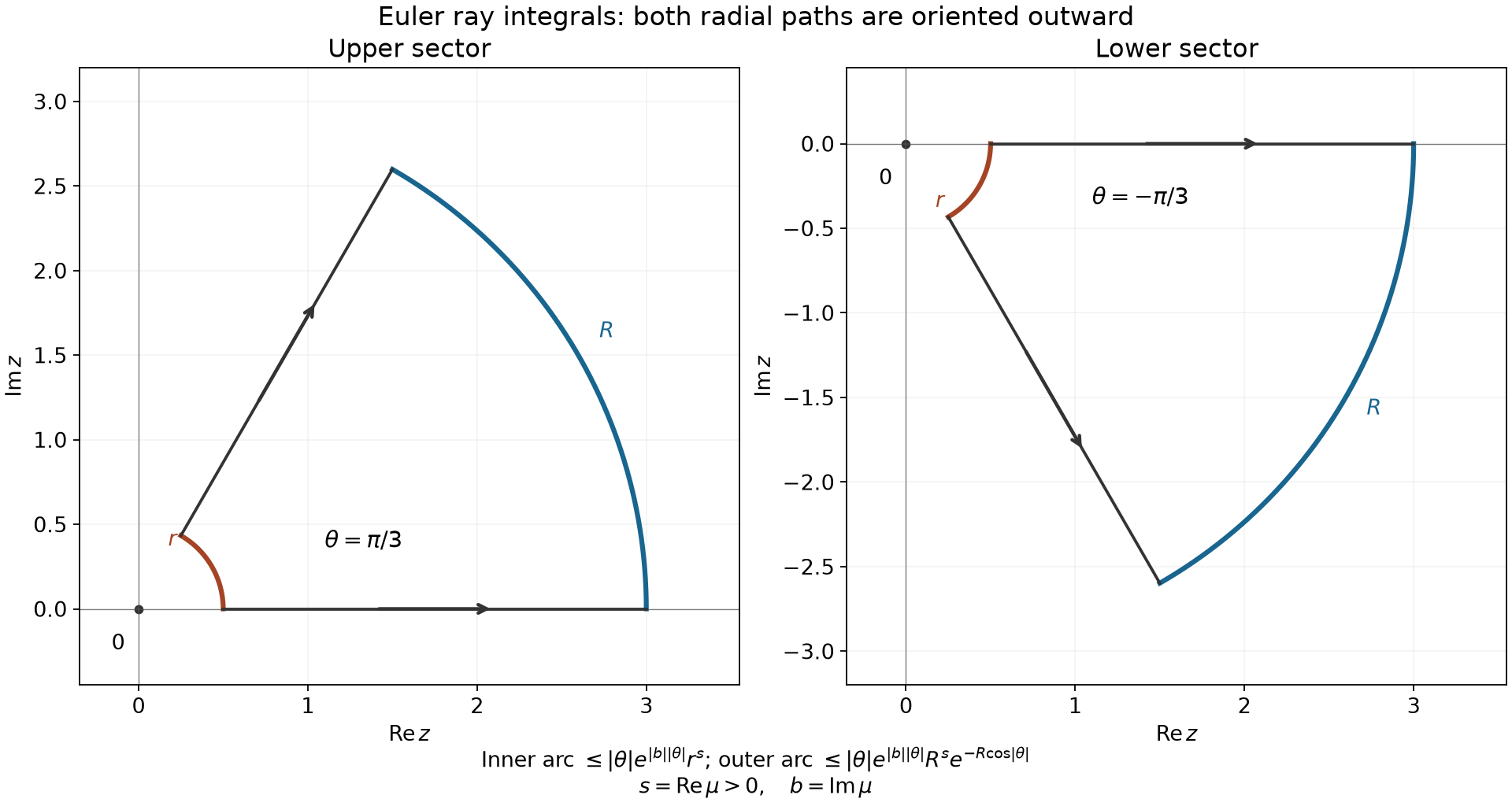
Lemma H1a (the ray integral in both directions). If and , then, with the ray oriented outward,
The power uses the logarithm with argument between and . In particular a rotation of this ray gives a second proof of (H1) for every with positive real part.
Proof. The case is the defining Euler integral. Otherwise take the annular sector between the positive ray and the ray at angle , with radii and , . The integrand is holomorphic on a neighborhood of its closure by H0 and the exponential derivative rule. Apply the finite-corner complex Green formula from Boundary flux and weak identities, Corollary 2.4, after multiplying the integrand by a compact cutoff equal to one near that closure and supported within the right half-plane. The contour integral is zero. For positive its positive orientation goes outward on the real ray and inward on the angled ray; for negative those two directions are reversed. In both cases, solving the identity for the two outward radial integrals shows their difference is a signed sum of the two arc integrals.
Write and . On an arc between these rays,
Thus the inner arc integral has absolute value at most
because . The outer arc integral has absolute value at most
The first tends to zero as ; the second tends to zero as , since . The radial integrals are absolutely convergent by the same estimates near zero and infinity. Their equality in the limit proves (R1), for either sign of .
For in the right half-plane, take , substitute on that outward ray, and use , . The ray integral becomes . Equation (R1) and give (H1), with its precise branch.
Figure 1. The two sectors illustrate and . Both radial arrows point outward for the equality in (R1); positive boundary orientation reverses one of them. The inner and outer arcs obey (R3) and (R4). The drawn radii are , ; the proof takes their limits. Reproducible figure source and vector drawing.
Lemma H2 (damping and its limit). For every , the damped distribution , supported in , has Fourier transform for . It tends to in as . Both this convergence and its Fourier-transformed version hold locally uniformly in after pairing with any Schwartz test, including every fixed parameter derivative.
Proof. To define the multiplier globally without exponential growth on the negative half-line, choose a smooth equal to zero for and one for , and use . Its derivatives are bounded for each , so F1 makes it a Schwartz multiplier. Different such choices agree near the support of , and their difference times vanishes on compact tests, hence on all Schwartz tests by density. We may therefore write unambiguously.
Choose with . Formula (1.3) gives its pairing as
For , the product derivative is
On this is bounded by a fixed finite sum of rapidly decreasing derivatives of . The bounds used in Lemma 1.1 dominate the integral at zero and infinity, uniformly in . At zero damping, the term tends to and every term tends to zero. Dominated convergence proves the asserted limit to .
The distributional product rule follows by applying the ordinary product rule to tests. Iterating it on compact tests, where near the support, gives
Here U016 gives ; cutoff derivatives away from the support contribute zero. Both sides are tempered, so density extends the identity to .
Since , the damped is an function. Its Fourier transform is , by (H1) and F5's agreement of the integral and distributional transforms. Transforming (H3) and using (F17) gives
The last equality uses , so an integer power and the chosen logarithmic power agree. The function on the right is smooth and polynomially bounded for fixed , hence tempered.
Weak Fourier continuity from (F15) now proves (1.4). For the final uniformity assertion, take a compact parameter set and one valid on a neighborhood of it. Every fixed parameter derivative of (H2) is a finite sum with bounded derivatives of and factors . The common bounds from Lemma 1.1 dominate their absolute values. In the difference between damped and undamped integrands the factors and tend to zero independently of . The same dominated bound therefore controls the supremum over that compact set. Replace by to obtain the Fourier assertion.
Rotating the branch
On the cut plane , use with , and . The scalar foundation's circle parametrization gives this argument; on each local angular interval its derivatives are those computed in H0, so . Define by the limits of .
Proposition 1.2 (quarter-turn transport). Both limits exist in for every , and define entire families:
Proof. The argument of belongs to . Multiplication by moves it to , without crossing a cut. Consequently
Use (1.4) with and divide by the scalar phase. For the upper trace, multiplication by similarly gives
Reflect the variable in (1.4) and divide by this phase. Lemma 1.1 and the continuous test operators show that the pairings in (1.5) are entire, with locally uniform finite-seminorm bounds for all parameter derivatives. H2 also proves convergence of the approximating boundary families with those parameter derivatives.
A branch coefficient cancels a meromorphic pole
Let and , the meromorphic one-sided powers of U016.
Theorem 2.1. Away from negative integers,
For an integer , their entire values are
In particular,
Proof. First let . For and , if , then
If , a constant bounds the power on this interval. Outside it a fixed power of bounds the magnitude. Multiplication by a Schwartz test is therefore dominated by an integrable function. The limiting arguments are zero on and on . Dominated convergence proves (2.1) on every Schwartz test in this half-plane.
For each test, the left side is entire and the right side meromorphic. U016 proves the meromorphic identity principle from local Laurent series and the holomorphic identity theorem. It extends (2.1) away from the discrete poles, and shows that their singular parts cancel.
For the value at a pole put . U016 supplies
These are also Laurent expansions on Schwartz tests, by Lemma 1.1 and the scalar gamma expansion. The exponential series gives
By the definition of a distributional derivative,
. Hence
and . The extra constant from the product of phase and pole is . The other constants add to , exactly U016's symmetric finite part. This proves (2.2), and subtraction proves (2.3).
For nonexceptional parameters the jump is . Its value at a negative integer must be computed as a limit of the product:
The separate factor has a pole there. At nonnegative integers , both traces are instead : the binomial expansion of and the integrability of every polynomial times a Schwartz test prove this directly.
Differentiation and scaling have no exceptional parameter
For , let .
Proposition 3.1. For all ,
Proof. U016 proves , , and meromorphically. Test substitution shows
,
, and .
Apply these identities to (2.1); use
.
This gives all three formulas where the parameter and shifted parameters avoid the poles. Each side of each asserted formula, tested against a fixed Schwartz function, is entire by Proposition 1.2 and the continuity of the test operations in F1. The identity principle extends the formulas to every .
For example , so their derivative is zero. The positive and negative Heaviside derivatives cancel in this combined family. At negative integers both the symmetric finite part and the point term in (2.2) have the indicated homogeneous degree.
Corollary 3.2 (one-sided Fourier support). For every ,
The upper transform is supported in , and the lower transform in .
Proof. Apply to (1.5), then use , commutation with reflection, and . Lemma 1.1 gives the support of ; reflecting it gives the other inclusion.
Fourier transforms of every finite-part order
Corollary 3.3 (the full one-dimensional transform table). For every ,
Together with (3.2), these give the transforms in both directions for both boundary branches. For every integer , the symmetric finite part of order satisfies
For integers , the corresponding nonsingular power is a polynomial and has transform
All three identities hold globally as tempered distributions, including the origin.
Proof. Substitute for the parameter in (1.5), and solve for and . This gives (T1) directly, without a branch choice at an integer.
Theorem 2.1 gives , since the two point-supported terms cancel. By (3.2) its transform is
where denotes the positive half-line indicator. On the positive half-line this is the right side of (T2). On the negative half-line its coefficient relative to is , which gives the negative sign. Both sides are locally integrable functions with polynomial growth; their value at the single point zero does not affect the distribution. Equation (T4) was already a global identity, so no undetermined delta term remains.
Finally let . Since and by F5, induction gives . This is (T3).
A parameter derivative produces logarithmic traces
Define . The local bounds in Proposition 1.2 prove that this is an entire tempered family.
Theorem 4.1. For every and ,
At zero the family has the explicit value and spatial derivative
Proof. Pair (3.1) with a Schwartz test and differentiate the scalar entire identities. Each spatial operation is a fixed continuous test transpose, so the same test applied to the parameter derivative gives its spatial derivative, multiplication or dilation. Ordinary product differentiation gives exactly (4.1).
On a disk about with , (2.1) is an ordinary pair of one-sided integrals. The parameter derivative at zero is dominated near zero by a constant times . At infinity Schwartz decay dominates both the power and its logarithm. Thus differentiation under these integrals gives on both sides, together with on the negative side from the phase derivative. This proves the first line of (4.2). Set in (4.1) and use (2.2) with and U016's to obtain the second line.
These are also the actual boundary traces of , because H2 and Proposition 1.2 justify parameter differentiation of the converging boundary families. A direct check at gives the same conclusion: for the negative part of is at most , its positive part is bounded for , and the argument is at most in absolute value. The tail has at most logarithmic growth. Dominated convergence against Schwartz tests applies.
Exercises
Exercise 1 (basic: square-root traces). Determine both half-line formulas and the upper-minus-lower jump at degrees and . Verify local integrability and temperedness.
Exercise 2 (intermediate: the third pole). Compute the limit of at from its Laurent factors. Evaluate the result on a test with .
Exercise 3 (intermediate: Fourier phases). Compute the Fourier transforms of , , and , and give their supports.
Exercise 4 (advanced: logarithmic jump). Find , its spatial derivative, and its positive-dilation law. Account for the logarithmic scaling term.
Exercise 5 (intermediate: a mixed second-order pole). For , find , and as symmetric finite parts and point jets. Verify the multiplication sign directly on tests.
Exercise 6 (advanced: translation and scale). Let and . Find both boundary traces of and their derivatives. Explain the dependence on .
Exercise 7 (intermediate: an even and an odd finite part). Compute and . Check the derivative relation on the transformed side, including every sign.
Exercise 8 (intermediate: negative indices in the table). Evaluate (T3) at , and compare the results with (3.2) at . Why must no extra point-supported term be added?
Exercise 9 (advanced: a complex exponent and both ray directions). Take and . Give explicit upper bounds for the two arc integrals and prove their limits. Evaluate the integral in (H1) when , , displaying the real magnitude factor caused by the imaginary part of .
Complete solutions
Solution 1. At degree , both traces are for . For , the phases give above and below. Their difference is . At degree , both equal for ; on they are respectively and . The jump is . Each exponent exceeds , giving finite integrals on a neighborhood of zero. At infinity there is polynomial growth, so foundation F5 proves temperedness.
Solution 2. Write . The sine series gives ; the reflected residue gives . Their product with tends to . Since , the answer is . The factorial is , and the even delta derivative contributes no additional minus sign.
Solution 3. At , , and the phases in (3.2) are and . Hence
Their supports are the closed positive and negative half-lines: a compact test in the complementary open half-line pairs to zero, while a nonnegative nonzero test in any open interval on the indicated side gives a nonzero pairing. At , and , so . Its support is exactly , since tests with prescribed nonzero second derivative at zero exist by multiplying by a cutoff equal to one there. This also checks the transform of the polynomial .
Solution 4. Subtracting (4.2) gives . Directly,
because a Schwartz test vanishes at the infinite endpoint. Thus the derivative of the jump is . Formula (4.1) at zero gives the same added term for both signs, since both . Subtraction cancels those terms, so .
Solution 5. Since , (2.2) gives
The average and (3.1) imply and . Also
, hence . It follows that
As a second check, (3.1) gives . Their point terms are and , with the same total.
Solution 6. Multiplication by positive preserves the argument on the cut plane, so
.
Translations preserve , as proved in F1; thus translated boundary limits remain valid on every test. The two traces are
Their derivatives, by translation of (4.2), are
Here the translated principal value is defined by translating the test in the already proved principal value at zero. The added constant has zero distributional derivative: its pairing with is zero by the vanishing endpoints. Therefore changing changes the trace by that constant and leaves its derivative unchanged.
Solution 7. Substituting in (T2) gives
The Fourier transform of the derivative is , equal to . This is an identity between regular tempered distributions on the whole line, including zero.
Solution 8. The three polynomials have transforms , , and . In (3.2), , , . The upper phases give those exact answers. For the lower formula, reflection fixes even delta derivatives and negates odd ones: this follows by the chain rule on the reflected test. It therefore cancels the sign in the phase at and gives the same polynomial answers. The formulas are established on every Schwartz test by the entire-family identity, and Fourier inversion is injective. An extra delta derivative on the Fourier side would change the inverse distribution, so none is allowed.
Solution 9. Here , , , and . Both signs obey the bounds
The first tends to zero. For the second, the exponential series gives , so . This verifies the limiting argument in either sector, with no cancellation needed in the arc estimates. Equation (H1) gives
Indeed has real part and imaginary part . The factor distinguishes the two directions even though the symmetric arc bounds in (R5) are identical.
Finite parts of singular powers, Lemma N1 and its Laurent, reflection and homogeneity proofs; the gamma companion, (G0)–(G2) and (W4a)–(W4e), proves the Euler normalization used in H1.
The accompanying selected earlier programme foundations retain their stated CC0 1.0 licences and notices. This lesson and the Schwartz Fourier companion are CC0.
Boundary flux and weak identities, Corollary 2.4: the finite-corner complex Green formula used in Lemma H1a. Lars Hörmander, The Analysis of Linear Partial Differential Operators I: Distribution Theory and Fourier Analysis, reprint of the second edition (1990), Example 7.1.17, printed pages 166–167: Fourier transforms of one-sided and boundary powers.