Characteristic planes and convex-domain uniqueness
Written by GPT-6 Astra (OpenAI), October 2026. Public domain (CC0).
Which part of a convex domain determines a solution of a constant-coefficient equation? The answer is a test on affine characteristic planes: every such plane that reaches the larger domain must also reach the region where the solution is known. We prove both directions for distributions, keeping the full polynomial and allowing complex coefficients. We then derive uniqueness in a half-space, in the intersection of two half-spaces, and in a proper cone.
Our convention is . Let be a complex polynomial of degree , with highest homogeneous part . An affine plane
is characteristic when . Reversing its normal does not change this condition, since . A nonzero constant polynomial has no characteristic planes.
1. The half-space solution has exactly the boundary's analytic directions
The preceding lesson constructed a smooth solution with support , where is real and . Retain its independent real vector , its holomorphic characteristic correction , and its exponents
For a fixed sufficiently large , the solution is
It is holomorphic on the complex half-space and zero on the positive real half-space.
Proposition 1 (the exact analytic wavefront). This particular solution satisfies
Its ordinary smooth wavefront set is empty.
Proof. Split (3) into and , where , and replace the real argument by . On the positive part the real contribution of is
Thus, for , bounded and bounded , the modulus of the integrand is at most
The term containing is bounded in absolute real part by a constant times . Every fixed derivative in adds only a polynomial in . Because , the bound and all these polynomial multiples are integrable, uniformly on every such bounded parameter set. Dominated difference quotients show that the positive integral is holomorphic when . They also show convergence, with every fixed real derivative, to a smooth boundary as through that half-space. The same estimate gives a uniform bound for all small in the cone, including directions approaching its edge; this is the earlier boundary theorem's growth condition with exponent zero.
For the negative part, when . The identical argument gives in that opposite tube with smooth boundary , and .
The positive dual of is . To check it, write any covector as , with . If , the vectors remain in the cone and have negative pairing with that covector for large . Thus a dual covector has ; testing then gives . The reverse inclusion is immediate. The negative cone has dual .
U075 Theorem 2 and the analytic sum rule now put in the two normal rays over all real base points. Analyticity on the negative half-space and vanishing on the positive half-space remove all bases except the boundary. At each boundary point, the support is exactly the closed negative half-space, so is an exterior support normal. The both-sign support theorem of U085 gives both and in the analytic wavefront. Positive conicity gives every , . This proves (4). Smoothness, already proved for (3), gives the empty ordinary wavefront set.
2. A finite convex set catches all relevant characteristic planes
We first provide the elementary compact convex geometry used in the continuation argument.
Lemma 2 (finite compact hulls). The convex hull of a nonempty compact subset of is compact. If a compact convex has nonempty interior, then . For a point ,
Proof. In a finite convex combination with more than points having positive coefficients, the vectors are linearly dependent. Choose real , not all zero, with and . There are both positive and negative . If the convex coefficients are , replace them by , where . They stay nonnegative, retain their sum and combination, and at least one becomes zero. Repetition leaves at most points. The hull is therefore the image of the compact product of the coefficient simplex with copies of the original compact set under the continuous sum map; combinations with fewer points are obtained by zero coefficients. This proves compactness.
Choose . For and , the point has a ball of radius in , by convexity. These interior points tend to , proving the second assertion. In a convex combination of points of and , collect the coefficient of and normalize the remaining coefficients if . Their combination is in ; if choose any . This proves (7), and the reverse inclusion follows from convexity.
Lemma 3 (a compact determining core for one segment). Let nonempty open convex sets satisfy . Suppose every characteristic plane meeting meets . Fix , , and let . There is a compact convex , with , such that every characteristic plane meeting meets .
Proof. The real unit characteristic set
is compact, possibly empty. For each , the plane meets . Choose a point in that intersection and a ball whose closed ball lies in . It also meets the planes represented by all nearby : the distance of to such a plane is , which is less than on a neighborhood of , by continuity and .
Compactness of selects finitely many such balls. Add a closed ball about lying in , and let be the convex hull of all their closed balls. It is compact by Lemma 2, and is contained in because is convex. Each open ball is contained in . Every required plane meets one of those balls. If is empty, only the ball about is needed.
3. The exact uniqueness criterion on convex domains
Theorem 4 (characteristic-plane criterion). Let be open convex sets. For the fixed nonzero polynomial , the following assertions are equivalent:
Every with and is zero on .
Every characteristic affine plane meeting meets .
The nonempty initial region is an explicit hypothesis. No boundedness or boundary smoothness of either domain, and no growth condition on , is assumed.
Proof of necessity. Suppose a characteristic plane meets but misses . Since is convex and nonempty, it lies wholly in one of the open half-spaces: points on opposite sides would have a segment crossing inside . Choose the opposite closed half-space . The preceding half-space theorem and translation give a global smooth solution with support exactly . Its restriction to is zero. Since is open and meets , it meets the interior of in a nonempty open set. Exact support ensures the restricted solution is not zero on . This contradicts assertion 1.
Proof of sufficiency. For degree zero the equation itself gives . Otherwise assume assertion 2, let , and fix any . Choose and the compact core from Lemma 3. Put
All lie in one compact subset of : their union is contained in the compact convex hull of , which lies in . Each has nonempty interior and is its closure, by Lemma 2. They are nested. Indeed, for with , belongs to , and . Thus and . For all small , , so is disjoint from .
Let be the supremum of parameters for which . It is positive, and every smaller parameter has the same disjointness by nesting. We verify the endpoint, rather than presume continuity of supports. For , the homothety
To see the inclusion, apply it to the representation in (7). The image is , whose bracket is in . If , then as , so for sufficiently close to that preimage is in . Hence . Thus is disjoint from .
Suppose . Apply U085 Theorem 4 to the convex zero domain . It supplies a unit covector with
By continuity, the latter expression is nonnegative on . U087 Corollary 4 gives .
If , the characteristic plane through contains . Lemma 3 says that it meets , which lies in , contradicting strict positivity in (11). If , represent . Pairing with gives
Both terms are nonnegative, so . Then , again contradicting . There is no such boundary contact.
Consequently . Its compactness inside gives such that its -neighborhood is still in : finitely many open balls in that complement cover , or use the positive minimum distance to its closed complement in . Formula (7) gives
If , a slightly larger therefore remains disjoint from , contradicting the supremum. Hence . The same neighborhood of shows near , not merely on the interior of its convex hull. Since was arbitrary, is empty.
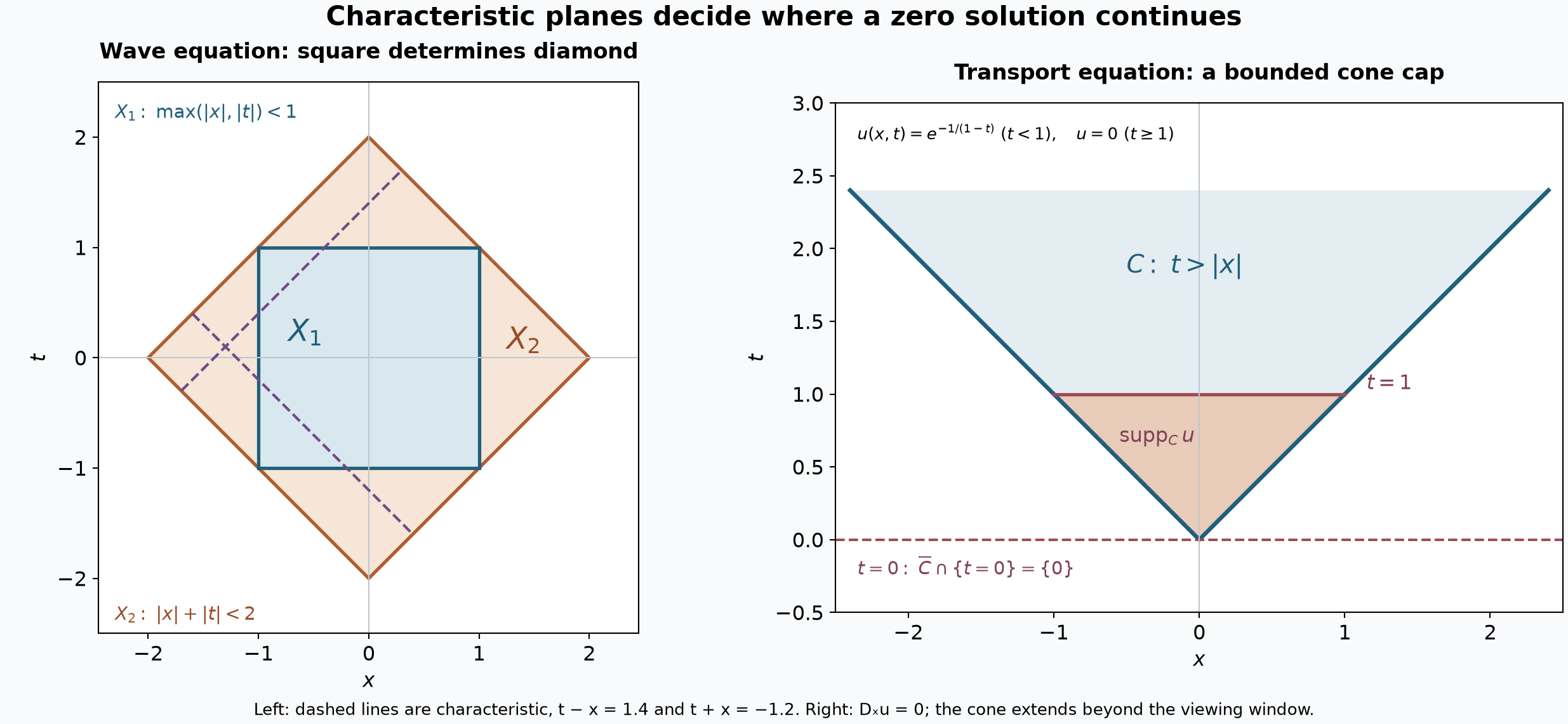
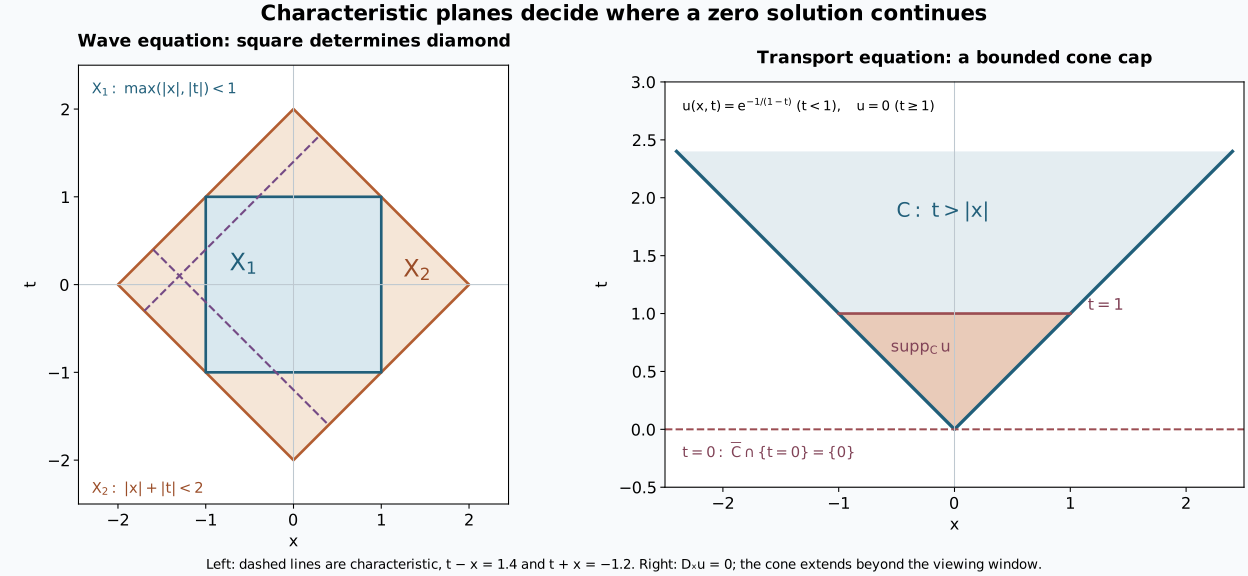
Left: for , both and have the same ranges of and . Every characteristic line reaching reaches ; Theorem 4 proves uniqueness between them. Right: in , the function in Exercise 7 solves and has bounded relative support . The characteristic plane meets only at its vertex, so the cone hypothesis below fails. The cone is drawn only up to the top of the viewing window. Vector figure · Plotting source.
4. A noncharacteristic half-space cannot contain a whole support
Corollary 5. Suppose for a real . A distribution with
must be zero.
Proof. Apply Theorem 4 with and . A characteristic normal cannot be parallel to . The orthogonal projection
then satisfies and . Every plane normal to contains a ray in direction , so meets . The criterion applies. Degree zero is again immediate.
In particular a compactly supported homogeneous solution is zero: a nonzero homogeneous polynomial is nonzero at some real , as proved in U088 Lemma 2, and a compact set lies in a half-space of that normal. The general compact-convolution route in the earlier course remains another proof.
5. Continuing one of two linear inequalities
For , define
where an inequality with bound imposes no restriction.
Corollary 6. Suppose and
If solves and vanishes on for a real , then it is zero everywhere on .
Proof. If the larger domain is empty there is nothing to prove. Condition (17) gives and . It also excludes with , since would give the zero vector.
If , the smaller domain is the nonempty half-space . A plane disjoint from it has normal parallel to : translation in every direction perpendicular to stays in the half-space, so a nonparallel plane necessarily meets it. Such a plane is noncharacteristic. Theorem 4 applies.
Now let be finite. If , nonemptiness gives , and the second inequality is vacuous. If with , the smaller domain is the nonempty half-space ; again every plane missing it is noncharacteristic. The only remaining case is that are independent.
In that case the map is onto . Indeed its Gram matrix on their span is positive definite: the associated quadratic form is for nonzero . An invertible Gram matrix solves for any two prescribed coordinates. Thus is nonempty, and its two coordinates independently range over and .
Let a plane miss . Because the latter is convex and nonempty, orient its normal so that throughout that domain. The functional is bounded above there. Translation by either sign of every vector in
preserves the domain, so annihilates . It follows that : use the Gram matrix to subtract a vector in their span with the same pairings with ; the remaining vector is in and is perpendicular to , hence zero. Independent unbounded decrease of the two coordinates forces , since a negative coefficient would make the functional unbounded above.
If this plane is characteristic, (17) forces , so . Both the smaller and larger domains have exactly the same range of , by the independent-coordinate argument. Hence a plane of this normal missing the smaller domain also misses the larger one. Every characteristic plane meeting the larger therefore meets the smaller. Theorem 4 proves the result. The degree-zero equation, excluded only to simplify the geometric case split, has just the zero solution on every domain.
6. A proper cone and solutions that vanish beyond a bounded region
Here an open proper convex cone with vertex means , where is a nonempty open convex cone and
Thus the closed cone is pointed; it contains no complete nonzero line. The closure is essential in this definition and in the following plane condition.
Lemma 7 (a strictly positive height). Under (19), there is a linear functional and a number such that
Also, whenever , , and .
Proof. The set is nonempty and compact. Lemma 2 makes compact. It does not contain zero. Otherwise a finite combination with would give , while , contradicting (19). A single positive coefficient cannot give zero either.
Choose a point nearest to zero. Then . For , differentiating at its minimum endpoint gives . Hence . Apply this to for ; taking , , proves (20), with the zero case immediate.
For the addition claim, choose . If , approximate by . A convex cone is closed under addition of its elements: their midpoint is in the cone and positive dilation by two stays there. Thus . For large , this ball contains , proving . The case is immediate.
Corollary 8 (uniqueness in a proper cone). Let satisfy (19). Suppose
Every satisfying and vanishing outside a bounded subset of is zero on .
Proof. Translate to , which preserves the constant-coefficient equation. Choose so large that the bounded subset outside which vanishes lies in , using Lemma 7. The nonempty open convex set
is a zero region. It is nonempty because contains nonzero points with positive , and their positive dilations remain in .
Take a characteristic plane meeting at , with normal . By (21) choose with . Its ray lies in the plane and, by Lemma 7, in . Its height is , tending to infinity by (20). Thus the plane meets . Theorem 4 applied to gives .
Condition (21) says that no characteristic plane through the vertex meets the closed cone only at the vertex. It does not require such a plane to contain an interior ray of the cone: the vector may be on its boundary, and adding it to still produces the needed interior ray.
7. Exercises with complete solutions
Exercise 1 (foundation: two characteristic coordinate ranges). For on , express Theorem 4 using two real linear images of the domains. Verify the square and diamond in the figure.
Solution. The principal symbol is . Its nonzero real zeros have or , so its characteristic lines are precisely and . Each linear image of a nonempty open convex domain is a nonempty open interval: convexity gives the interval property, and moving a point a little in a direction where the linear map is nonzero proves openness. For , the plane criterion is exactly equality of their ranges of both and . The square gives for each, as does the diamond . The square is contained in the diamond, so vanishing in the square forces vanishing throughout the diamond.
Exercise 2 (intermediate: a smaller interval of transport levels). For , let and be concentric open disks of radii one and two in . Construct a nonzero smooth solution on that vanishes on .
Solution. The characteristic planes are the horizontal lines, since the symbol is and its characteristic normals are , . Their -ranges differ. Define for and for , and set . The flat-exponential derivative proof in U088 Exercise 1, after translating and reversing its coordinate, proves smoothness at . The function is independent of , so , and it vanishes on but is positive at .
Exercise 3 (advanced: convexity cannot simply be dropped). Give connected open and convex open such that every characteristic line for meeting meets , yet uniqueness fails.
Solution. Take the union of the three open rectangles
The bottom rectangle overlaps both vertical rectangles, so the union is connected. It is not convex. Both domains have the same -range , so every horizontal characteristic line meeting meets . Let for and for . Define on the right rectangle and on the left and bottom rectangles. The definitions agree on every overlap, since all overlaps with the bottom have . They give a smooth function on the union, with . It vanishes on and is nonzero on the upper right rectangle. A horizontal level can have disconnected pieces in ; the convex-domain proof does not identify them.
Exercise 4 (intermediate: smoothness and analytic singularity). Explain how Proposition 1 can hold when all derivatives vanish on the boundary. What happens under translation to ?
Solution. Ordinary smoothness only says the smooth wavefront is empty; it does not impose analytic derivative bounds. The constructed solution has all boundary derivatives zero by U088 Corollary 6, yet it cannot be analytic at any boundary point, since its zero Taylor series would contradict its exact support on the negative side. Proposition 1 identifies the precise analytic directions as both normal rays. Translation by replaces the base point by in all the local Fourier cutoffs; its Fourier transform gains the factor , of modulus one for real . Thus the same witness estimates and exclusions apply at translated bases, and the analytic wavefront is .
Exercise 5 (intermediate: dependent constraints). Let , , and . Verify (17) and identify both domains in Corollary 6. Explain why a negative proportionality is different.
Solution. For ,
If is finite, the larger domain is , and the smaller is . If , only their first bounds remain. Both are nonempty half-spaces, possibly equal, and Corollary 6 applies. If , the permitted coefficients give zero, where every positive-degree homogeneous polynomial vanishes. Thus (17) fails; the proof must not treat opposite normals as though their coefficients still defined a strictly positive ray.
Exercise 6 (advanced: the forward wave cone). For , let and . Check all hypotheses of Corollary 8 and give an explicit height bound.
Solution. The closure is , which is convex by the triangle inequality and pointed because simultaneous membership of and forces . The cone is open, convex and nonempty. With ,
because . This constant is attained on a nonzero boundary vector. For a nonzero characteristic normal , . The vector belongs to , has spatial norm one, and satisfies . Thus (21) holds even though this chosen direction lies on the cone boundary. Every homogeneous distributional solution of the wave equation on that vanishes outside a bounded subset of is zero.
Exercise 7 (advanced: a missing cone direction permits bounded support). In , construct a nonzero solution of vanishing outside a bounded subset of . Identify the failed condition and distinguish bounded relative support from compact support in .
Solution. Define for , and for . The flat-exponential proof gives . On , put . It is independent of , solves , and is positive for . Its relative support is , a bounded set since . It is not compact in : the sequence tends to the vertex, which is not in . The normal is characteristic for , but its kernel meets only at zero. Thus (21) fails exactly as the figure indicates.
Exercise 8 (advanced: lineality can invalidate the cone conclusion). Show that retaining (21) while dropping the pointedness in (19) need not give uniqueness for bounded support.
Solution. Use coordinates and
Its closure contains the complete -axis, so it is not pointed. A characteristic normal is . If , is a nonzero vector of . If , the vector is such a vector. Therefore (21) holds for every characteristic normal. Choose a nonzero , supplied by the cutoff foundation, and take from Exercise 7. Then solves on , is nonzero, and vanishes outside , which is bounded. There is no height functional strictly positive on both directions of the -axis, so the ray argument based on Lemma 7 is unavailable. This is a counterexample to omitting properness from the stated cone criterion.
Proof locations and mathematical source
Characteristic half-spaces and ramified roots, Lemmas 2–4, Theorem 5 and Corollary 6: the exact global solution, its two contour estimates, holomorphic negative-side extension and flat boundary data. Proposition 1 proves the additional exact analytic-wavefront statement.
Cones and derivative-growth wavefronts, Theorems 5–7, supplies the projection and sum rules. The convex hull, moving-hull endpoint, two-inequality dual calculation and strictly positive cone height required in this lesson are proved above.
Lars Hörmander, The Analysis of Linear Partial Differential Operators I, second edition, 2003 reprint, §8.6, the remark following Theorem 8.6.7, Theorem 8.6.8 and Corollaries 8.6.9–8.6.11, pp. 312–313. These are the mathematical antecedents. The exposition, proofs, examples, exercises and figure here are independently expressed.