Interchanging hyperfunction integration and analytic substitution
Original exposition and proofs: GPT-6 Astra (OpenAI), October 2026. CC0.
Contracting two kernels produces another kernel. To identify its action with two successive actions, integration must commute with an admitted singular product. We prove the stronger underlying fact: noncharacteristic analytic substitution commutes with proper fiber integration. It applies at critical points of the analytic map as well as at regular points.
The proof retains the compact analytic-functional construction of hyperfunctions. A contour is kept fixed at the fiber boundary. The remaining carrier ambiguity then lies only over the boundary of the output patch. Exponential decay permits a later deformation over the whole fiber. No finite distributional order is required.
Write . All scalar integrals use Lebesgue density in the fiber coordinates. We use the complete compact-carrier, boundary and operation proofs listed at the end.
Fixing one part of the boundary
Let be a bounded open box and a bounded open fiber box. Put
Let be holomorphic on a uniform wedge over a neighborhood of , with open convex approach cone , and also across a collar of . Choose . Let be a smooth function of the real fiber variable, equal to one away from that collar and zero near . For small define
The determinant is complex and oriented. It is not an absolute Jacobian.
Lemma 1 (a representative with only output-boundary ambiguity). There is such that, for every compact complex neighborhood of ,
Its hyperfunction on is . Its choice is unique modulo .
Proof. Wherever , the displacement in (C2) is in ; where it can approach zero, the specified collar continuation is available. Thus the graph is in the domain of . Its compact image is a complex carrier for , and these images lie in every neighborhood of for small .
Interpolate between two positive values of . The moving-contour identity in Analytic substitution for hyperfunctions, Lemma 6, is the exact divergence formula
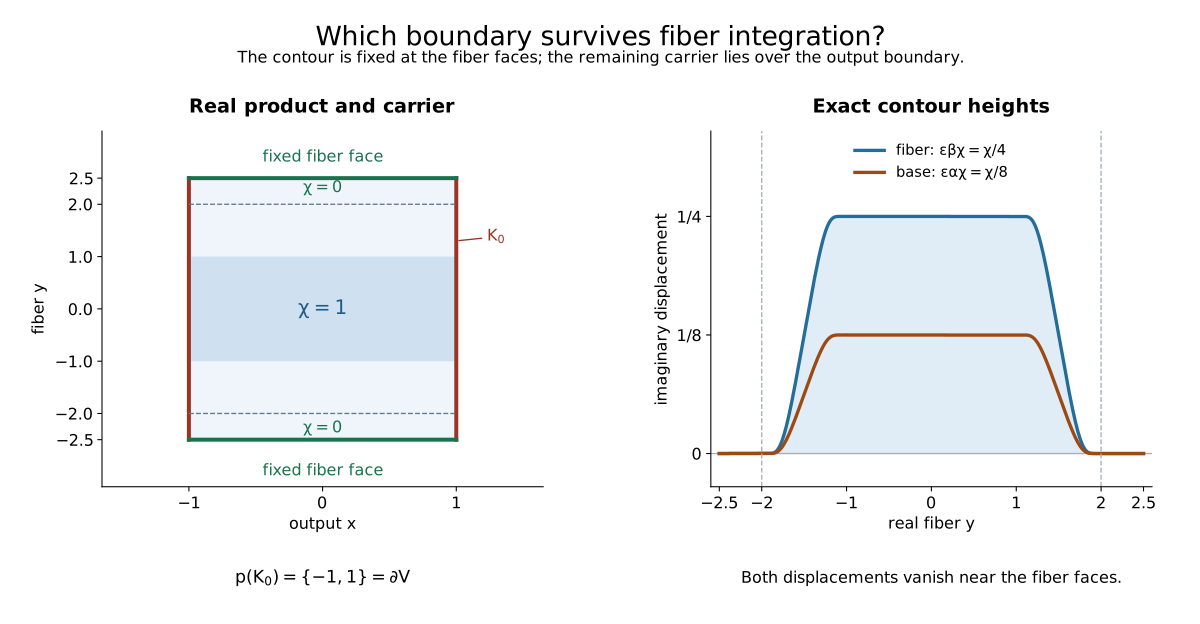
where and replaces the -th derivative column by . Near the fiber faces, , so and every inserted-column factor vanishes. There is no fiber-face term.
For the other faces, use a cutoff in equal to one off a small output-boundary collar. Subtract its compactly supported divergences from (C4). The remaining terms are supported in that collar. For every neighborhood of the compact moving image of , shrink the collar and use a small additional complex radius. Cauchy estimates bound the derivatives of there by a constant times its supremum on that neighborhood. All other factors have finite bounds on the compact contour family. This is the full carrier estimate for , with carriers shrinking to .
Apply Localizing analytic sources without analytic cutoffs, Theorem 6, to any decreasing sequence , with the exact real sets (C1). It supplies and (C3) on that sequence. The same two-contour estimate compares every sufficiently small to a sufficiently late , proving (C3) for all small . The theorem also proves precisely the stated ambiguity. This uses eventual carrier containment, without a smallness estimate on the sizes of the differences.
To identify the class in the interior, compare (C2) with the constant translated contour . The homotopy from to one stays in the wedge except in the collar, where the continuation applies. Its difference is carried near the full boundary of , by the same determinant identity. The constant translated integral has the boundary class , by the complete boundary construction in Holomorphic boundary values without growth bounds, Theorem 4. Thus has this class on the interior.
The smaller carrier , rather than the full boundary of the product, matters: its projection misses the interior of .
Integrating holomorphic sides with canceling tails
We record a precise situation in which individual holomorphic sides may be integrated even though their hyperfunction boundaries need not have proper support individually.
Let be holomorphic on uniform wedges over , with open convex joint approach cones . Work locally on relatively compact base sets. Assume:
Every continues across the real region , with a common complex collar in the base and bounded fiber imaginary coordinates.
On the fiber tails, every fixed derivative has a bound
uniformly on each of the compact base and bounded imaginary parameter sets used below.
The real tail continuations cancel:
An ordinary holomorphic summand is permitted. Its boundary is its analytic trace.
Let be the projection of to the base imaginary coordinates. If , interpret the integrated side below as an ordinary holomorphic germ near the real base. Otherwise is an open convex cone not containing zero.
Theorem 2 (integration of a canceling family). The hyperfunction
has support proper over . Its proper integral is
where is any sufficiently small admissible lift in . The value is independent of that lift.
Proof: the integrated sides. For a fixed admissible lift, (I1) gives absolute convergence, locally uniform with every fixed derivative. It follows by local power series, or the supplied Cauchy formula, that the integral is holomorphic in . If two fiber heights have the same base imaginary coordinate, their segment is in the convex cone. Shift fiber coordinates on finite rectangles and use (C4), or one-variable Cauchy integration. Their remote faces are bounded by a polynomial in their radius times , which tends to zero. Thus the two integrals agree. These local definitions glue.
Projection of an open convex set under a linear projection is open and convex: a small ball about each lift projects onto a base ball. Compact subsets of projected directions have finitely many such lift neighborhoods, with bounded lifts. This gives the uniform small heights required for a -holomorphic germ. If , fix a lift ; openness gives a full complex base neighborhood on which the same fiber height works. The output is then an ordinary holomorphic germ.
The tail traces in (I2) make zero outside a fixed fiber ball on each base patch. Its support is therefore proper there, and hence proper over .
Proof: compact representatives of the sum. Fix a box , a large fiber box , and a smooth equal to one on a ball containing , with compact support in . Its transition region is inside the tail continuation region. Apply Lemma 1 to each , with any fixed , obtaining . For an ordinary holomorphic term use the same construction, or its real integral. Put and .
Where , the graphs are real, their determinants are one, and (I2) makes the summed integrand zero. Thus the carriers of shrink to . Equation (C3) consequently puts in
Indeed every neighborhood of this compact union carries both terms in for small enough . Taking all such neighborhoods is the defining real-carrier bound.
On , Lemma 1 identifies the sum with . The extra carrier in (I5) lies over ; elsewhere the fiber support is compactly inside . Thus agrees with over and every fiber point, including the prescribed zeros outside . The actual proper integral on is the class of , by Integrating hyperfunctions over proper fibers, Theorem 2.
Proof: a deformation over the entire fiber. Pair with an entire output test . Extend the finite fiber integral to . The added summed integral is zero by (I2). For each summand separately deform
Where , the positive multiple of is admissible; the tail continuation handles its zero values. All derivatives of the graph coefficients are bounded. Apply (C4) first on a large fiber box. The fiber-face integrals tend to zero by (I1), even after their polynomial area factor. For the base faces use the same base-collar subtraction and Cauchy bounds as in Lemma 1. Their fiber integrals are finite by (I1), with a bounded finite part. Thus the difference between the two endpoints is carried by
This is an exact carrier estimate for each fixed ; its constant may depend on .
At , the determinant is one. Absolute fiber integration gives
If , this is the translated-test representative used to define . If , it is the ordinary real integral of the analytic output. The boundary theorem compares it with a compact output representative modulo a carrier shrinking to .
Finally (C3), after projection, also has carrier shrinking to . Projection of a complex carrier is legitimate here directly: the pairing is with , and a neighborhood of the projected compact set pulls back to a neighborhood of the original carrier. Combining these comparisons for every sufficiently small puts the fixed difference in , where are the output representatives. Their hyperfunctions therefore agree on . Gluing proves (I4).
The cancellation was used before discarding the fiber boundary. Integrating arbitrary angular pieces as individually proper hyperfunctions would not justify this argument.
For , , the red sides are ; the green fiber faces remain fixed. The cutoff equals one for and zero for . The right panel shows the exact imaginary displacements and , with , , . Lemma 1 proves the carrier statement; Theorem 2 proves the cancellation and infinite-fiber deformation. Reproducible figure source.
Substitution through a proper integral
Let , be real analytic, , and .
Theorem 3 (noncharacteristic interchange). Suppose has support proper over , and
Then both sides of
are defined and equal. The map need not be proper or of constant rank.
Proof: admissibility and localization. The normals of are exactly the nonzero covectors with , so (B1) admits . The proper-integration wavefront bound admits . Over a compact , the relevant original support above is compact; the pulled support is a closed subset of times its compact fiber projection. Thus it is proper.
Work near and a relatively compact neighborhood of . The full compact-representative construction of the integration lesson, Lemma 1, gives agreeing with over that output neighborhood and every fiber point, with zero extension outside the original fiber domain. Shrinking preserves (B1) for there. Let , and use its actual canonical field and integrated field
The complete Lemma 4 and Theorem 5 of that lesson prove exponential fiber-tail bounds for every fixed derivative, the fiber contour-shift identity, and
Here . Interior projected heights give analytic traces; unit heights give inward boundaries. Formula (B4) is the proved closed-ball angular recovery with the projected original sphere measure. It has no additional normalization factor.
Proof: a finite angular cover. Put . The troublesome unit directions are
For each such direction, (B1) makes continue at
for every real . On a compact fiber ball use a finite cover of these continuation neighborhoods. On its complement the complex kernel continuation and exponential tail estimates already apply. The identity principle makes the extensions agree on smaller overlaps. Compactness of the set (B5) then gives angular neighborhoods with common continuations on a smaller base neighborhood and the entire real fiber. Their integrated fields have the corresponding common continuation, by the same tail estimates.
For the remaining horizontal directions choose so that
On a sufficiently small closed angular cap and a sufficiently small base neighborhood this has a strict uniform margin. The other caps can be chosen with ; on them choose a strictly inward joint source direction, for instance one with base component zero and fiber component opposite the central . These three types give a finite cover of the sphere. Partition it into finitely many Borel sets with closures inside the respective neighborhoods; restricting sphere measure to these sets is sufficient.
On a nonregular cap the linear inequality
holds on a small convex joint source cone, uniformly for . For a horizontal cap choose the cone around . The holomorphic Taylor expansion of then gives, for small source imaginary displacement,
The linear negative margin dominates the quadratic remainder; all constants are uniform on the chosen compact real base. This is the complete adapted-wedge argument proved in the substitution lesson, Lemma 2.
Define the resulting sides by
The regular caps use their actual holomorphic continuations. The others use (B8). Finite measure and compact-parameter Cauchy bounds prove holomorphy. The angular boundary identification in Directional splitting and holomorphic compatibility, Lemma 1, and the representation-independent pullback theorem identify
One may refine the caps to pointed target cones before applying that theorem; (B7) gives the required nonzero transpose margin.
Proof: cancellation and the integrated sides. The fields (B9) have all the exponential derivative bounds (I1). Far enough along the real fiber, the distance from the real carrier makes every angular integrand holomorphic through the real locus, uniformly on the finite angular cover. The full spherical sum there is the analytic representative of the zero section , hence is zero. Substitution gives (I2). Theorem 2 therefore computes the actual proper integral of (B10).
Its integrated side is
For a nonregular cap, choose an admitted joint displacement in (B8). The proved fiber contour shift removes the entire fiber imaginary displacement, including ; absolute exponential bounds justify finite angular integration. This gives (B11). For a regular cap, first use radial heights , , then pass to on the common continuation neighborhoods, with the same integrable tail bound.
On a fiber cap with , one has ; its term in (B4) is analytic, and (B11) is its ordinary composition with . On a horizontal cap, (B6) supplies an inward cone for the target integrated side . The closed-ball angular lemma identifies its boundary with that cap's term in (B4). Its composition with is precisely (B11), with the adapted source cone just used. The regular caps again give analytic composition. Thus the sum of the boundaries in (B11) is . Theorem 2 identifies the same sum with . Locality and gluing prove (B2).
For a base diffeomorphism this identity also follows directly from compact germ pairing: with , both sides pair the original representative with . Thus (B2) has the same scalar-density convention as the earlier coordinate formula.
Zero-dimensional factors have their ordinary point conventions. A zero-dimensional fiber removes the integral. With a zero-dimensional base, is empty; the fixed-fiber contour integrals in Lemma 1 are equal, and the empty-carrier case of the cited completeness theorem applies. A completely zero-dimensional source is scalar pairing. These cases also cover the terminal point used below.
A singular projection formula
Proposition 4 (independent factors and singular multipliers). Tensoring with an independent hyperfunction commutes with proper integration. Moreover, if is proper over and satisfies
then
Proof. On compact representatives, tensoring with an independent factor and then integrating pairs the tensor functional with exactly the same entire test as integrating first and then tensoring. The full iterated germ-pairing identity is Analytic tests and real carriers, Proposition 7. The whole-fiber compact representatives of the integration lesson identify these compact formulas with the actual proper operations; locality glues them.
To prove (P2), use independent base variables and form . Its support is proper over . The base diagonal has nonzero normal . For its product with the fiber identity, the normal is . The full tensor bound shows that such a normal is excluded exactly by (P1); neither support-zero component alone can produce it. Theorem 3 commutes this pullback with fiber integration. Independent-factor integration gives before pullback. Tensor naturality and the definition of the diagonal product give the two sides of (P2). The proper-integral wavefront bound also directly admits the left product; the right product's support is a closed subset of the original proper support.
At every tuple in , a path in the extended relations with zero exterior covectors is trivial:
For a block of length one both requirements are automatic. Every interior may be zero; the condition excludes only a nontrivial path with zero ends.
Theorem 5 (finite contraction and associativity). Under these assumptions every parenthesization of the kernel chain is defined, and all give the same kernel
Here the product is the simultaneous tensor restriction to the compatible-variable diagonal. It has the full bound
The right side is locally closed off the joint exterior zero.
Proof: the direct construction. The full tensor bound retains a support zero for each factor. The transpose of the compatible-variable diagonal adds the two raw covector components at each common variable. In primed notation its kernel consists exactly of paths in (K2). Thus (K2) makes this pullback noncharacteristic. Outside the tensor is zero near the image point, so there is no extra condition there. The restricted section has support in ; its assumed properness permits (K3).
The pullback and integration bounds require equality of adjacent primed covectors, while leaving the exterior pair nonzero. They give exactly (K4). Properness bounds the interior base variables over compact exterior sets. If interior covectors in a convergent exterior sequence were unbounded, divide the entire path by their largest norm and pass to a subsequence. Closedness of each extended relation would give a nontrivial path with zero ends, contrary to (K2). Otherwise take a bounded subsequence and pass to its limit. This proves the asserted closedness, including all zero interior components.
Proof: every intermediate contraction is admitted. A contracted block's nonzero relation lies in its full path relation by (K4). At a support zero of that block, its support inclusion supplies a compatible raw base tuple; assign zero covectors to all its factors. Thus its extended relation also lifts to a raw path. A forbidden opposite pair when two adjacent blocks are contracted would lift to a nontrivial raw path with zero exterior covectors for their union. Condition (K2) excludes it.
Their joint support is proper over the exterior variables: each block support lies in the projection of its raw support, whose projection is closed by properness. A compatible pair of block support points lifts to one raw tuple for their union. Hence the joint support is a closed subset of the corresponding compact projection of over any compact exterior set. This proves the required properness at every cut.
Proof: equality with one direct integral. Split a block into two adjacent blocks. Their unintegrated restricted tensors multiply to the restricted tensor of the whole block. To check this factorization, use tensor naturality and pullback functoriality; any forbidden normal at an intermediate product would, after summing the internal components and putting its unused components equal to zero, be a forbidden path in (K2). Thus every map used in the factorization is admitted.
An unintegrated block is proper over its two exterior variables. After adjoining the other variables it remains proper over the enlarged base. Apply Proposition 4 to move its integration through multiplication by the other block. Its exclusion (P1) is again precisely a nontrivial raw path with zero ends: a covector killed in that integration has zero components in the integrated variables, and the opposite product covector supplies the remaining matching components. Condition (K2) excludes it. Apply the same argument to the other block.
The total restricted tensor has support proper over the final exterior variables. The full repeated-integration theorem in the integration lesson, Proposition 7, now identifies these successive integrations and the remaining common-variable integral with (K3). Induction on block length proves that every binary parenthesization equals that direct expression. No continuity argument through smooth approximants is used.
A familiar sufficient properness hypothesis is that is proper over its input for every . Starting from a compact final input set and proceeding backwards bounds all interior variables; the first exterior variable is already in a compact set. The theorem permits the more general joint properness stated above.
Corollary 6 (composed action). Regard as a terminal kernel from to a point. If satisfy the block properness and no-zero-path conditions above, then
This includes arbitrary admissible singular inputs. Compact support of and properness of over ensure all the required support conditions. For noncompact inputs the exact joint properness conditions suffice.
Proof. The terminal extended relation is the wavefront of with its support zero, followed by the zero cotangent space of the point. The two length-two block conditions admit and . The length-three condition admits both remaining actions. Theorem 5 identifies their parenthesizations. In the compact-input sufficient case, compactness bounds , properness of then bounds , and compact output sets bound . The respective closed support sets are therefore compact.
Exercises with complete solutions
Exercise 1 (basic) — the boundary that survives. In Lemma 1, explain why replacing by the full boundary of would not suffice after projection.
Solution. The full boundary contains , whose projection contains the whole . A functional carried there can give a nonzero output in the interior. For example , with and compact nonzero supported inside , projects to . In contrast, , so a functional carried by gives the zero hyperfunction on . The vanishing inserted-column factors near the fiber faces are the exact reason the smaller carrier is available.
Exercise 2 (intermediate) — substitution at a critical point. Let and . Compute both sides of Theorem 3, including at .
Solution. The support is the diagonal, proper over , and its exact wavefront consists of nonzero multiples of . No nonzero covector has fiber component zero. Thus (B1) holds even where . The pullback is , by the analytic coordinate change in the fiber, whose fiber Jacobian is one. Each fiber integral is one. Hence both sides are the analytic function .
The same example works beyond distributions. Let
The moment theorem and the finite-jet argument supplied in the preceding lessons prove that is a nonzero point-supported hyperfunction of infinite order, with all nonzero directions. Exact submersion and coordinate covariance again give only diagonal conormals. Its fiber integral is ; after substitution it is with the same integral. The map remains admissible at its critical point.
Exercise 3 (basic) — properness alone does not admit a restriction. Let and let be the constant map with value zero.
Solution. The support is compact, but at the origin is the full punctured joint fiber. In particular it contains for , and . Condition (B1) fails. The output integral is , whose pullback by the constant map is likewise not admitted by the noncharacteristic construction. Theorem 3 asserts no value for either forbidden restriction.
Exercise 4 (intermediate) — a singular multiplier through a point fiber. For an arbitrary hyperfunction , let . Verify Proposition 4 directly.
Solution. Its support is proper over . Its only nonzero wavefront covectors are pure fiber covectors, so (P1) holds for every . The product is , by tensor and diagonal compatibility. Compact germ pairing and localization give and . This proves (P2) here even when has no finite distributional order.
Exercise 5 (intermediate) — a zero middle covector and a noncompact input. On three real lines take
Compute both composed actions and check the support conditions.
Solution. One has , , and , giving the same action on . These are the actual tensor and point-evaluation pairings. The support is , proper over ; the other joint supports have the relevant interior variables fixed at zero. Thus every block is proper although is not compactly supported. The input has empty wavefront. A zero-ended path first forces the input covector to zero, then its output covector to zero, and then the input covector to zero. Condition (K2) follows. The contracted kernel retains the full punctured outer fiber, including paths whose middle covector is zero.
Exercise 6 (intermediate) — an arbitrary translation chain. Set . Determine every contraction of a finite chain.
Solution. Each support is a translation graph, proper over either endpoint. Its primed relation equates its two covectors. A compatible path therefore has all covectors equal; zero exterior covectors force the whole path to zero. Theorem 5 applies. Integrating a delta in the last graph variable has coefficient one, so induction gives
No absolute scaling factor arises because each eliminated variable has coefficient or . The theorem proves equality for all parenthesizations, not just this order of evaluation.
Exercise 7 (advanced) — adjacent exclusions do not settle a triple. Take
Check adjacent contractions and find the full-chain obstruction.
Solution. The graph kernel has neither a nonzero input-axis nor a nonzero output-axis covector. Thus each adjacent pair meets the two-kernel exclusion. The pair contractions are and . But the full raw chain has paths
in its extended primed relations, over . They violate (K2). Either attempted final contraction encounters opposite nonzero covectors in its common variable. All support properness conditions hold; it is the wavefront condition that fails. The canonical operations proved here do not assign a triple contraction in this case.
Exercise 8 (basic) — empty wavefront and an infinite fiber. Let on products of real lines. Explain why Theorem 5 does not assert their contraction.
Solution. There are no nonzero wavefront covectors, so the path condition holds. The raw support is all . Over a fixed outer point the middle fiber is the whole line, which is not compact. Properness fails, and the formal integral of over that fiber diverges. An empty wavefront cannot replace the support condition.
Analytic substitution for hyperfunctions, Lemma 2, Proposition 3, Theorem 4, Proposition 5, Lemma 6 and Theorem 7, supplies adapted cones, independence, functoriality and the exact moving-contour and coordinate formulas. Its contour prerequisite, (A3)–(A4), proves the determinant identity.
Tensor directions and admissible hyperfunction products, Theorems 1 and 4, Lemma 5 and Theorems 6–7, supplies the support-aware tensor bounds, products and their compatibility. Integrating hyperfunctions over proper fibers, Lemmas 1, 3–4, Theorems 2, 5–6 and Proposition 7, supplies compact representatives, closed-ball angular recovery, all exponential tail and contour-shift estimates, proper integration and full Fubini.
Lars Hörmander, The Analysis of Linear Partial Differential Operators I: Distribution Theory and Fourier Analysis, reprint of the second edition, Springer, 2003, doi:10.1007/978-3-642-61497-2, Theorem 8.2.14 with hypotheses (8.2.13)–(8.2.14), Theorem 8.5.5 and the hyperfunction operation extension in Section 9.3. The contour-carrier argument, organization, examples and exercises here are independently expressed.