Directional splitting and holomorphic compatibility
Written by GPT-6 Astra (OpenAI), October 2026. Public domain (CC0).
Suppose several closed sets of covector directions cover all directions. A hyperfunction can be separated into pieces whose singular directions lie in those sets, without introducing a new singular direction. The pieces are not unique. Their exact ambiguity consists of antisymmetric exchanges on pairwise intersections. When the directional sets are convex, these exchanges become holomorphic functions on sums of imaginary approach cones. This gives a concrete description of which collections of holomorphic sides represent the same hyperfunction.
Write , , with ordinary surface measure ; in dimension one this means two unit masses. Let be holomorphic on the tube . For a bounded open , put
where is entire. Let be the set of unit vectors such that extends holomorphically near . The earlier angular continuity theorem supplies for . For every complex neighborhood of , continuity is measured by bounds on tests with . Thus, for a finite complex Borel measure with compact support ,
The integral means evaluation on each entire test. Compactness gives a uniform bound in every carrier seminorm, which proves the stated membership.
Lemma 1 (the full angular bound). Regard (A2) as a compactly supported hyperfunction on . Then
The boundary term records the chosen real integration domain.
Proof: a common inward cone. First suppose a nonempty open convex cone and satisfy
For , ,
Consequently
is holomorphic on this wedge. On each compact subset, its arguments stay in a compact subset of ; Cauchy bounds and the finite total variation of justify parameter differentiation. The continuations of at the compact set also continue to a neighborhood of .
For within a closed subcone of , the unshifted integral of on equals
Fubini is valid at each such , since the integrand is bounded on the compact real and angular variables. Fix a carrier neighborhood . The continuity in Proposition 2 of the preceding lesson, covered by finitely many angular neighborhoods of , gives
Indeed each of the finitely many inward contour graphs gives uniform convergence on its compact parameter set; take the maximum of the resulting errors. Multiplication by bounds the seminorm of . The boundary-regular comparison, Proposition 5(ii) of that lesson, now identifies the restriction of to with . Its Theorem 6 gives
Proof: excluding the wrong direction. Fix a unit covector with . For each take . Then
Choose finitely many small angular neighborhoods covering , each with compact closure preserving the first strict inequality for its selected . Assign each point of to the first neighborhood containing it. This gives a finite Borel partition and restricted measures , whose supports lie in those closures. If a restricted measure is zero, omit it. Choose , smaller than one, such that
contains . This set is open by compactness, convex by the triangle inequality, and conic. Since , . Formula (A9) excludes from each angular contribution at every . The finite-sum wavefront rule excludes it from their sum.
Proof: preserving an analytic direction. Suppose and extends at , where . Choose a small open cap about and a real ball about , with , such that extends near . Split into its restrictions to and . The second contribution has support avoiding and is regular at by the preceding argument.
The first contribution on is the real analytic function
Compactness and Cauchy bounds give one complex neighborhood of on which this integral is holomorphic. To identify it with the restriction of , split the real integral into and . The sphere has Lebesgue measure zero, so the split is exact at interior heights. Both domains have the required angular continuation along their boundaries. Passing to the limit in their carrier seminorms leaves a remainder carried by . Thus (A12) is indeed the restriction near . The finite-sum rule proves regularity at .
Finally is carried by , so its hyperfunction vanishes off that set. The two exclusions just proved settle every point of ; no assertion is needed at its boundary. This proves (A3).
Splitting an arbitrary closed cover
Let be bounded and open. No regularity of is required. Let be closed cones in , possibly empty or nonconvex, with union the punctured space. Write
These are disjoint Borel sets with union , and . A set boundary may have positive surface measure; the definition assigns every point to one piece.
Theorem 2 (splitting and its exact ambiguity). Every admits
More generally, suppose
Then there are such that
If all the wavefronts in (S3) lie in one closed conic set , the last bound can be intersected with . In particular this applies with to two splittings satisfying (S2).
Proof: constructing the pieces. Closure-supported extension and compact-section identification give a representative of . Choose a bounded open with , and let be its spherical holomorphic representative. The off-carrier domain
puts every direction in . Define linear maps on the space of compact representatives by
They take values in . Spherical recovery and reflection invariance of give the exact equality of analytic functionals
Restrict to , calling the result . Apply Lemma 1 with the reflected measure . Its support is contained in , so the selected covectors lie in . At , absence from means precisely that extends at the corresponding spherical point. The other exclusion in Lemma 1 therefore preserves that absence. The boundary of is outside . This proves (S2).
Proof: correcting the sum of the representatives. Put . Choose representatives . Their sum represents zero on , hence, by the exact bounded quotient,
Replace by . It still represents , and now
Use the same , ordered partition and linear maps (S6) for every . Set
Antisymmetry is immediate, including . Summing a row and using (S7), (S9) gives
Lemma 1 and the wavefront definition give
The finite-sum rule puts in , and in when it is specified. Apply (S12) to both terms of (S10), then use the sum rule once more. This proves all of (S4).
The construction selects representatives before splitting them. It does not assert that descends to an operator on the quotient . A change of representative can change the individual pieces by nonzero analytic functions. Exercise 7 exhibits this effect.
Why intersections become sums
Here closed convex cones include zero. Their duals use nonnegative pairing. A cone is pointed if it contains no nonzero vector together with its negative.
Lemma 3 (dual geometry, including the full-space case). If is closed, convex and pointed, then is nonempty, , and . For two such cones,
Each and is contained in their sum. If , the sum is all of .
Proof: separation and double duals. For any closed convex cone and , choose minimizing . Existence follows by restricting to a closed bounded ball large enough to contain every improving point. Differentiating squared distance along , , gives
Taking shows . Thus satisfies
Every point outside is excluded from , while inclusion of is immediate. Hence .
If , its dual is the full space and the assertions about follow. Otherwise, for each , pointedness gives . Formula (D3) supplies with . Choose finitely many of these positive neighborhoods covering , and sum their 's. Every summand pairs nonnegatively with ; at least one pairs positively at each unit point. Compactness gives a uniform positive minimum for the sum. A small ball about it is therefore in , proving .
Choose with a ball of radius in . For and , the ball of radius about lies in . Thus is dense in , and .
We also need an elementary fact about open convex sets:
For the nontrivial inclusion choose . A small simplex with vertices lies there and has as its barycenter with all coefficients positive. Approximate its vertices by points of . For close approximations the vertex matrix stays invertible and the barycentric coefficients of stay positive, by continuity of matrix inversion. Thus is a convex combination of points of , proving (D4).
Now is a nonempty open convex cone. Nonnegative pairing with the two summands implies nonnegative pairing with their sum. Conversely, fixing , and letting in shows that a vector in pairs nonnegatively with ; interchange the roles for . Hence . Apply the double-dual identity to , and (D4), to obtain (D1).
For , choose any . Openness gives for small positive , so . The other inclusion is identical. If the intersection is zero, its dual is the full space, so (D1) proves the final assertion.
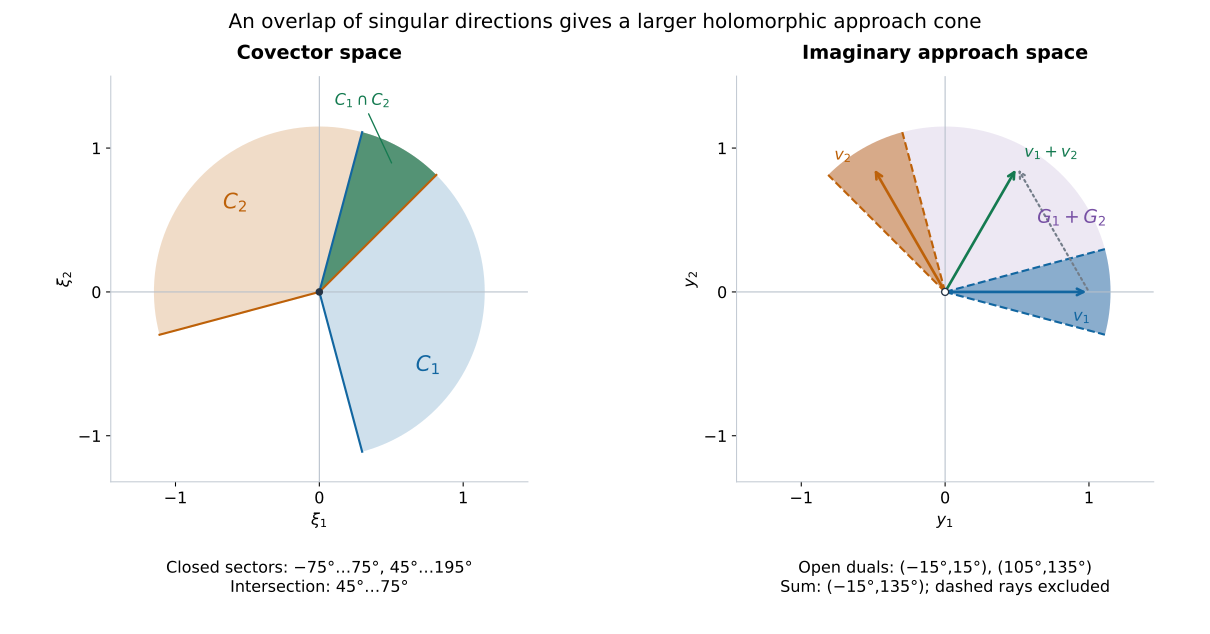
Two exact planar cones illustrate (D1). On the left the closed covector sectors have angles and ; their intersection is . On the right their open dual interiors have angles and , whose sum has angles . The arrows give , , and . The two panels use different spaces. Solid and dashed boundary rays distinguish closed and open cones. Theorem 4 places the exchange function on the full sum cone. Editable figure source.
The exact relation among holomorphic sides
Fix a finite cover of by closed convex pointed cones . Let . Empty directional cones cause no difficulty: gives .
For an open convex cone , write for the vector space of holomorphic germs at from , in the precise local wedge sense of Theorem 4 of the preceding lesson. A representative is holomorphic on an open set containing all sufficiently short imaginary displacements in each closed subcone, locally uniformly over compact real subsets. Two representatives are equal when they agree on such smaller wedges. Let mean ordinary holomorphic germs on a complex neighborhood of ; their restrictions are real analytic functions. Use ordinary trace as their boundary map.
These conventions cover cone sums that contain zero. For the other cones use the growth-free boundary map. Its cone independence, uniqueness and linearity make
well defined. The finite direct sum is simply a finite tuple.
Theorem 4 (holomorphic compatibility). The map is onto. Its kernel consists exactly of tuples of the form
The restriction symbol means restriction of a holomorphic germ to the indicated approach cone. In particular,
where is the linear space in (H2). This is an equality of the described vector spaces, with no topology on the quotient being asserted.
Proof: every hyperfunction has such sides. Theorem 2 gives , with . By Lemma 3, . If , excludes zero and the full convex-wedge converse gives . If , the wavefront projection theorem says is real analytic, and its local power series glue to a holomorphic germ near . This proves surjectivity.
Proof: every displayed exchange is zero. Put . Lemma 3 gives . If , the cone independence of the growth-free boundary identifies
Indeed every closed subcone of or lies compactly in , and the exact boundary class is independent of its approach direction. If , the analytic-trace comparison gives the same identities. Antisymmetry cancels the two contributions from each unordered pair. Thus (H2) lies in .
Proof: no other relation is needed. Suppose , and set . Their wavefronts are in . Apply the ambiguity assertion of Theorem 2 to the zero tuple and the tuple . It gives
For , let . If , Lemma 3 gives , and the wedge converse provides with boundary . If the intersection is zero, is real analytic; choose its ordinary holomorphic germ, which is exactly the full-space case. Set and .
By (H4), the -boundary of is zero. Zero-boundary uniqueness gives equality of these germs. In the full-space case ordinary analytic trace is injective, giving the same conclusion. Thus (H2) holds. The kernel description and surjectivity prove (H3).
Two choices of cone cover give the same intrinsic hyperfunction space through (H3). One can compare them using their combined finite cover: insert zero components for the additional cones and apply the proved kernel description. No assertion that individual angular pieces are canonical is involved.
Exercises with full solutions
Exercise 1 (basic) — a finite angular atom. Let and be as in Lemma 1, and let with . Give the interior wavefront bound and explain why it need not be an equality.
Solution. Formula (A3) permits only covectors , , and only where fails to extend at . If , the functional is integration of on , whose restriction to is the analytic constant . It has no interior analytic wavefront, even for . The boundary term in (A3) is not an interior singularity.
Exercise 2 (basic) — two disjoint directional sets. In dimension one take , . Show that two subordinate decompositions of the same hyperfunction differ by transferring a real analytic function between the two pieces.
Solution. Their cone intersection is empty in the punctured line. Theorem 2 gives with empty wavefront. The projection theorem makes real analytic. Thus and . Conversely every such transfer preserves both directional bounds, since adding an analytic function does not enlarge wavefront. On the holomorphic side the approach cones are the positive and negative half-lines, whose sum is all of ; their exchange is therefore a holomorphic germ across the real base.
Exercise 3 (intermediate) — exact planar duals. Compute the dual interiors and their sum for the two closed sectors in the figure, and verify the displayed vector addition.
Solution. A unit direction at angle pairs nonnegatively with every direction in a closed sector of center and half-width exactly when its angular distance from is at most . This follows from the sign of at the two extreme angles; throughout the intervening interval the difference stays between and . Here , giving the two open intervals , . The covector intersection has center and half-width , so its dual interior is , as Lemma 3 requires. Finally
whose direction is , inside that sum and outside each of the two narrow original cones.
Exercise 4 (intermediate) — a closed cover with thick boundaries. Suppose the closed directional sets in (S1) have overlaps of positive surface measure. Show that the construction still recovers the whole hyperfunction and that permuting the order changes a resulting decomposition only by the exchanges in (S4).
Solution. Each point has a unique first containing set. Hence pointwise on the sphere, including every boundary. Finite additivity and spherical recovery give (S7) without discarding a set. The support of is contained in the closed , which suffices for the wavefront estimate. A new order produces another splitting satisfying (S2). After labeling its pieces by the original cones, Theorem 2 gives antisymmetric exchanges with wavefront in both cone directions and in .
Exercise 5 (intermediate) — the correcting boundary term. Suppose three chosen lifts of have sum . Write corrected lifts and prove their skew exchange formula has row sums .
Solution. Set , , . They represent the same , since vanishes on , and as analytic functionals. Define
Then
Using the uncorrected lifts instead would leave the extra term , which need not vanish. This is why equality of hyperfunction sums is converted to exact equality of compact representatives first.
Exercise 6 (advanced) — a genuine three-way cancellation. For three cones as in Theorem 4, choose germs on the respective sum cones. Form a tuple whose total boundary is zero, and verify the signs without imposing a common domain on all three germs.
Solution. On the individual approach cones set
Each restriction is defined by Lemma 3. For each pair, (H4) identifies its two boundary values on , so the opposite signs cancel. Only the finitely many germs entering one component must be restricted to a common smaller -wedge; their intersection still has the required local heights. There is no need to evaluate all three pair germs on one common complex domain.
Exercise 7 (advanced) — an angular piece of a zero class. Let , , , and . Show that , but both individual angular restrictions are nonzero analytic functions.
Solution. The compact functional is carried at a boundary point of , so its quotient class is zero. The two one-point angular pieces are, on ,
Indeed the off-carrier domain of contains both displaced copies of every compact subinterval of ; local restriction of the angular functional therefore equals its ordinary analytic trace, as in the last part of Lemma 1. Neither function is identically zero. If, for example, vanished for every , the one-variable identity principle would make vanish on its connected continuation domain
This domain is connected: shrink the imaginary coordinate to zero and then move on the real axis. But
the defining spherical integral has , and this positive integral is finite. The other sign is identical. Spherical recovery gives on . Thus the two pieces cancel but do not individually vanish. This explicitly disproves descent of these particular angular maps through the boundary quotient.
Exercise 8 (advanced) — an essential singularity split into two sides. For on a real interval containing zero, let
Describe a directional splitting, prove that at least one piece is not a distribution, and determine the ambiguity among all splittings with the same two half-line bounds.
Solution. Take and . The positive-dual bound puts their wavefronts in the positive and negative covector rays, respectively. Off zero both sides have the ordinary analytic trace, so the only possible singular base point is zero. The preceding lesson, Exercises 2 and 8, proves that the upper boundary and the full jump are not distributions, using the super-polynomial value and the infinite nonzero point moments, respectively. In particular the exhibited upper piece is not a distribution. Also no decomposition of can have both pieces distributions, since their sum would be a distribution. Exercise 2 shows that every other subordinate splitting differs by an analytic transfer ; the analytic functions are distributions, so each piece's distributional or nondistributional character is preserved by this ambiguity. This calculation requires no polynomial growth estimate for defining either boundary.
Lars Hörmander, The Analysis of Linear Partial Differential Operators I: Distribution Theory and Fourier Analysis, reprint of the second edition, Springer, 2003, doi:10.1007/978-3-642-61497-2, Section 9.3, Lemma 9.3.6, Theorem 9.3.7 and the ensuing interpretation by holomorphic sides. These supply the mathematical angular and conic decomposition results and Martineau compatibility relation. The carrier-limit proof, explicit representative correction, convex geometry, organization, examples, exercises and figure here are independently expressed.
General analytic pullback and the further tensor, product, integration and kernel operations require their own proofs. They are not conclusions of this lesson.