Localizing analytic sources without analytic cutoffs
Original exposition and proofs: GPT-6 Astra (OpenAI), October 2026. CC0.
An analytic function cannot be a nontrivial compact cutoff. Nevertheless, an analytic functional carried by a union of real compact sets can be divided into pieces carried by those sets. The construction takes place one dimension higher: multiply its harmonic field by a smooth cutoff, then solve an equation to remove the resulting Laplacian. A second use of harmonic approximation lets us assemble data whose differences eventually concentrate near a smaller carrier, even when their sizes grow without bound.
Write for the entire-test functionals with a bound on every complex neighborhood of the compact carrier , as in Analytic tests and real carriers, Definition (A1). All pairings are complex linear. We work with , , , and the positive Laplacian .
The needed approximation and solvability results already have full programme proofs in Fundamental solutions, continuation and approximation: B0–B2 for compact partitions and smooth completeness, Theorems 1.2–1.3 for regularity and limits, Theorem 4.1 for Runge approximation on arbitrary open sets, and Theorem 5.1 for exact distributional solvability on arbitrary open sets. These apply to the Laplace fundamental solution from Point sources and complex Gaussian kernels, Theorem 1.1. Its power or logarithmic formula is real analytic away from zero: around a positive squared radius, the convergent binomial or logarithmic series gives the local analytic expression. Smooth right sides therefore have smooth solutions by the same Theorem 1.2.
For a real compact set , write . A harmonic field below is allowed to have arbitrary growth at infinity.
Lemma 1 (separating two carriers off their intersection). If are compact and invariant under , there is a smooth, even function on
with values in , vanishing outside a bounded set, equal to one near and zero near . The neighborhoods and smoothness are relative to .
Proof. The relatively closed sets and are disjoint. Thus the two open sets
cover . Take the locally finite compact smooth partition constructed in B0 of the approximation lesson. On each compact , the finite subordinate partition construction gives nonnegative , each compactly supported in one , whose sum is one near that support. The products form a locally finite partition on . Group the products according to , obtaining . Local finiteness shows that vanishes on a neighborhood of each point of , and vanishes near : locally only finitely many supports occur, each avoiding the relevant closed set. Consequently near .
Multiply by a compact radial cutoff equal to one near , and average the result with its reflection in . Both prescribed sets are reflection invariant, so the resulting retains the required constant values near them and all the other properties. No extension of through is asserted.
Theorem 2 (finite splitting and its exact ambiguity). For real compact sets and , there exist
For two carriers the sequence of vector spaces
is exact. In particular, the two pieces are unique when the carriers are disjoint. This assertion does not specify a continuous linear choice of pieces.
Proof. Empty carriers contribute zero. For two nonempty carriers let be the canonical odd harmonic field of , defined outside , where , . Choose from Lemma 1. Away from , set
Near the cutoff is one, and near it is zero. Thus is zero in the portions of these neighborhoods where is defined; extension by zero makes a smooth function on all of in (S1). These definitions agree on overlaps, so they are a single smooth function. It is odd in .
The earlier global solvability theorem gives with . The exact local regularity theorem makes smooth, since is smooth. Replacing it by
preserves the equation and makes it odd. Use this odd solution as .
Define
The first product is extended by zero near ; the second is extended by zero near . The cutoff is identically zero on the respective neighborhoods, so these are smooth extensions. Equation (S5), including its zero extensions, proves on their full stated domains. Both fields are odd and on the common domain.
The full harmonic converse supplies . To check their sum without a condition at infinity, take one compact cutoff near . The recovery formula with the entire harmonic lift gives, for every entire ,
Only the compact transition region is integrated. This proves the two-set existence assertion. Repeatedly split the union of the first carriers from the last one, and use induction to obtain (S3).
If two pairs have the same sum, their difference is with carried by both and . The smallest-real-carrier theorem puts its support in their intersection, so . Conversely any such gives a difference of pairs. The first map is injective and the last is onto by (S3), proving exactness. When the intersection is empty, its analytic-functional space is zero.
The smooth cutoff was applied to a harmonic function on a punctured space. It was not multiplied into an arbitrary analytic test. The correction restores precisely the equation that multiplication disturbed.
Complex neighborhoods and real tubes
We now need functionals which do not yet have a real carrier. For nonempty real compact , let
where . These are different neighborhoods in different spaces.
Lemma 3 (germs at a thickened real set). A functional in extends uniquely to holomorphic germs near , with a supremum bound on every such neighborhood. Holomorphic parameter dependence can be passed through the pairing.
Proof. Every open neighborhood of contains for some . Otherwise choose with . These points are bounded; a convergent subsequence has limit in and in the closed complement of , a contradiction. This also proves the cofinality needed below.
For a function holomorphic on , the earlier Gaussian approximation theorem gives entire converging uniformly to on . A functional bound on a smaller open neighborhood of inside this larger compact set makes Cauchy. Define the extended value by its limit. For two choices use a still smaller positive enlargement contained in both; the difference of the approximants converges uniformly there, so the limits agree. The same argument proves agreement for equivalent germs, linearity, and a bound by .
Any continuous germ extension has the same value on this approximation, proving uniqueness. For holomorphic parameters, choose a fixed positive enlargement and a parameter polydisk on whose product the kernel is holomorphic. Its Taylor series and derivative series converge uniformly on smaller products by Cauchy estimates. The one fixed functional bound permits termwise pairing. This proves the parameter assertion.
Let be the positive-Laplacian fundamental solution and . The preceding harmonic lesson proves
where is the area of the unit sphere in . Its entire lift satisfies
At the last assertion is its continuous zero value.
Proposition 4 (a quantitative dictionary).
If , then
is a well-defined odd harmonic function. For every compact smooth near and every entire ,
Enlarging the radius or the real set does not change the field on the resulting smaller exterior domain. The same compatibility holds with the canonical field when the functional is already carried by .
Conversely, for every odd harmonic on , the right side of
is independent of the compact cutoff near , and defines an element of .
The explicit factor is only a convenient bound; its uniformity as is what will be used.
Proof of the forward statement. Write , let be nearest to , and suppose . The real distance estimate gives
Hence
The power in (N2) has a single holomorphic branch on the right half-plane, chosen positive on the positive real axis. Compactness gives a complex neighborhood of and a real neighborhood of on which this branch is defined. Lemma 3 now justifies the pairing and all parameter derivatives. The kernel identities give harmonicity and oddness.
To prove recovery, let , which is contained in the compact transition region of . Choose small enough that near . For real with , the distributional identity in (N2) gives
Both sides extend holomorphically to a neighborhood of . For the integral, apply (N8) uniformly over , then differentiate under the compact integral. Each vertical segment from to remains in this neighborhood after it is chosen by the positive-real-part condition: decreasing preserves that condition. Equality near the real trace follows from the real Taylor coefficients, and the holomorphic identity principle propagates it along these segments. Thus (N9) is an identity of germs near .
Apply to it. Uniform Riemann sums on the compact integration region converge uniformly on a smaller complex neighborhood of the carrier, so the functional bound exchanges with the integral. This proves (N5). For nested real sets and increasing radii, the kernel on the smaller exterior domain is holomorphic near the larger thickened carrier. Approximate it by entire functions on a slight enlargement of that carrier. The same approximants converge on neighborhoods of both carriers, so both pairings have the same limit. For a real carrier use its germ extension and the same approximation. No germ extension theorem for arbitrary complex compact sets has been assumed.
Proof of the reverse statement. The difference of two admissible cutoffs vanishes near . Integration by parts against the harmonic therefore makes their difference in (N6) zero. To obtain a carrier estimate, choose an even cutoff supported in the open tube of radius , equal to one near the closed tube of radius .
For real in that support and complex within distance of ,
If , these bounds imply
The lift estimate (N3) bounds there by . Cauchy circles of radius give a bound for each first derivative on the real support of by a constant times the same supremum. Use the exact product identity
The cutoff derivatives have compact support in , where is bounded. Thus
This estimate implies the defining bound for every neighborhood of . Linearity is immediate, so .
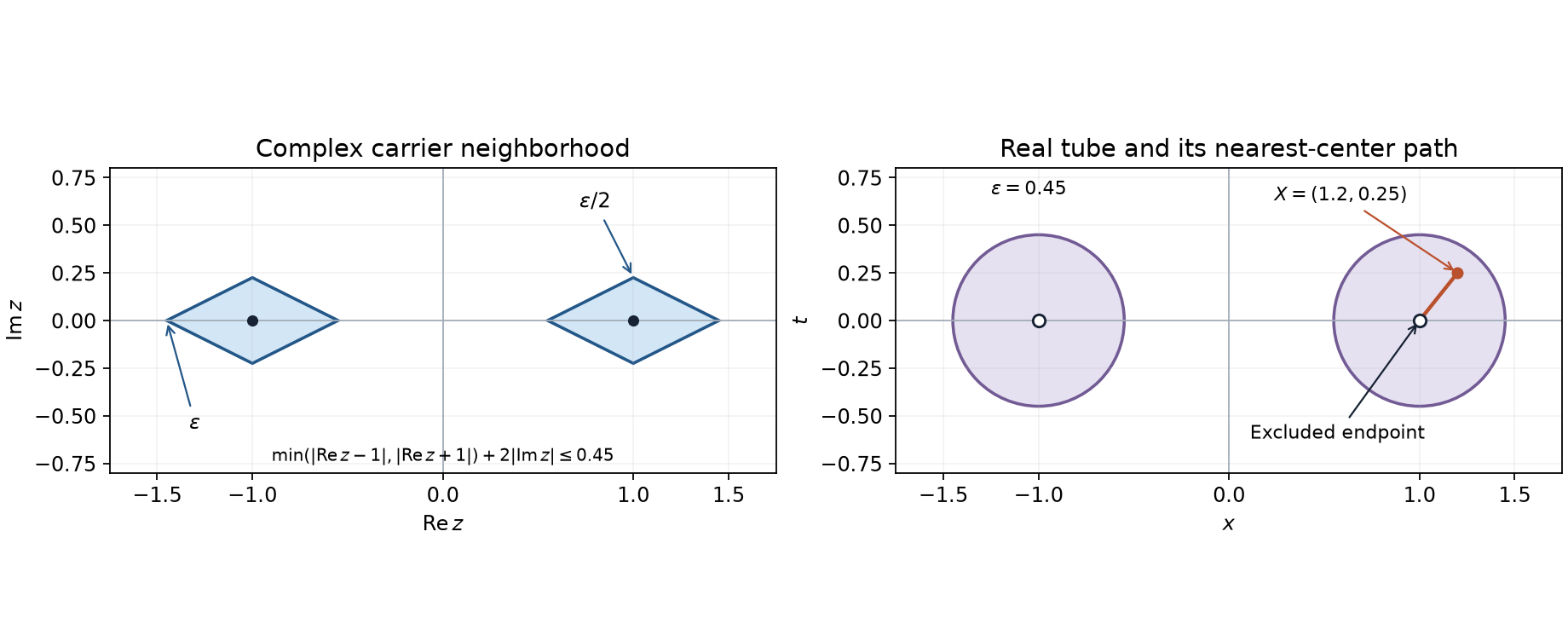
The same real compact set is used in two different spaces, with . The left panel shows exactly . The right shows the closed Euclidean tube around . Its marked segment joins to the excluded center . Every point before the endpoint remains in the relative complement used in Lemma 5. The diagram illustrates the geometry; (N7)–(N13) prove the comparison in every dimension.
Why these tubes permit harmonic approximation
Lemma 5 (the complement condition with all components retained). Let be nonempty and compact, and put
Every harmonic function on is a limit there of functions harmonic on . An odd function can be approximated by odd ones.
Proof. The exact condition in the earlier Runge theorem prohibits a nonempty compact relatively open-and-closed piece of
Suppose such a piece exists and take . Choose a nearest . The segment
has distance at most from . It does not meet before : any earlier meeting would be closer to than its chosen nearest point. Thus the whole half-open segment lies in (R2). Its connectedness and relative clopenness keep it in . Compactness of would then put its endpoint in , a contradiction. This argument does not require finitely many components or regularity of the boundary of .
Apply the full Runge theorem with , and . To preserve oddness, replace every approximant by . Reflection preserves both domains. For a symmetric compact set and a fixed derivative order, the error after this replacement is no greater than the previous maximum error on that set; signs from differentiating the reflection have modulus one. General compact sets may first be enlarged by their reflections.
Stabilization away from a shrinking carrier
The next assertion concerns eventual carrier containment. It puts no smallness condition on the norms of the differences.
Theorem 6 (completeness modulo a smaller real carrier). Let be compact. Let be analytic functionals on entire functions, each having some compact complex carrier. Suppose:
For every compact neighborhood of in , for all sufficiently large .
For every compact neighborhood of , for all sufficiently large .
Then there is such that, for every such ,
The possible 's are exactly one coset of .
Proof: uniqueness and empty sets. If both satisfy (C1), choose any open neighborhood of and a compact neighborhood . Subtraction gives , hence a bound by . Doing this for every proves . Adding any element of this latter space preserves the conclusion.
We regard the empty set as a compact neighborhood of itself. If , condition 2 makes the sequence eventually constant. Condition 1 then puts that constant functional in , by the same compact-neighborhood argument. This proves the conclusion, including , where the eventual constant is zero. Henceforth assume .
Proof: choose radii and a subsequence. Set . The sets and are compact neighborhoods of their real sets. Choose strictly increasing indices so that
The two eventual hypotheses permit this choice at each stage. Define on by Proposition 4. The functional has a field harmonic on , and
Indeed their pairings with the same kernel agree after entire approximation on the larger carrier ; the smaller carrier is contained in it. All these fields are odd.
Consider the symmetric compact sets
They increase, lie in , and their interiors exhaust . On an empty every displayed seminorm is zero. By Lemma 5 choose odd harmonic on such that
For an empty , take .
Proof: form an actual harmonic limit. On their respective domains define
For every compact , all sufficiently late are defined near . For any fixed derivative order, all sufficiently late contain and (C5) controls that derivative there. Since wherever is defined, these differences have summable bounds on every such compact. Smooth completeness from B1 of the approximation lesson gives a limit , smooth and harmonic on
The derivative limit proves harmonicity, and reflection proves oddness. The harmonic converse therefore gives .
For a fixed , the series
defines an odd harmonic function on . Each summand with is defined there because the radii decrease. On any compact subset, finitely many early terms are smooth and the late terms converge with every derivative by (C5). On , telescoping (C6) gives
Choose one compact cutoff equal to one near . It is also admissible for and for the recovery of . Its transition region lies where (C9) holds. The recovery identities and their cutoff independence give
The bound is a carrier statement; the constants may depend on .
Proof: recover every original index. Given a compact neighborhood of , choose large enough that . This is possible by compactness and shrinking neighborhoods. For every , (C2) gives . Add it to (C10); monotonicity of carriers yields (C1). Thus no original tail is lost by the subsequence construction. Together with the first part this proves the full theorem.
This result is different from completeness in the fixed-carrier seminorms of the preceding analytic-functional lesson. Arbitrarily large terms on are permitted here. What stabilizes is the functional away from every shrinking neighborhood of that set.
Exercises with full solutions
Exercise 1 (basic) — compare the two complex distances. For real compact , prove
Show that both constants are sharp, and give the resulting inclusions between complex Euclidean tubes and .
Solution. Set , . The complex Euclidean distance is : minimizing over the real set changes only the real part. The first inequality follows by squaring ; the second is the two-term Cauchy–Schwarz inequality . Equality for the first occurs when , ; equality for the second occurs when . Both are realized for in one dimension. Therefore the closed Euclidean tube of radius is contained in , and is contained in the closed Euclidean tube of radius .
Exercise 2 (basic) — stabilization with unbounded measurements. In one dimension let , , and
Find all conclusions of Theorem 6 and determine whether converges on entire tests.
Solution. Every is carried by , and every difference is carried by , so both hypotheses hold without discarding any indices. The functional , meaning evaluation at , satisfies . The uniqueness assertion gives exactly . But diverges, so there is no pointwise convergence on all entire tests, hence no convergence in any topology implying those evaluations. The theorem imposes no such convergence.
Exercise 3 (intermediate) — the approximating carriers need not be real. Let , . Verify the two hypotheses, and show that no fixed has any real compact carrier.
Solution. The point lies in when . Both evaluations in a difference eventually lie in any prescribed neighborhood of zero, proving the hypotheses. The functional is a valid conclusion, and every element of is another.
For a fixed , suppose for real compact . Choose a complex Euclidean neighborhood of of radius . On that neighborhood the entire function , , has modulus at most , whereas
No fixed constant can bound their ratio as . This contradicts the carrier estimate. Thus the proof of Theorem 6 must allow genuinely complex intermediate carriers.
Exercise 4 (advanced) — disjoint pieces by holomorphic germs. Let be disjoint real compact sets and . Give a direct splitting using local holomorphic tests, and explain why an entire analytic partition with the same constant values cannot replace those germs on a connected complex domain.
Solution. Choose disjoint complex neighborhoods of the two compact sets. Define a holomorphic germ near their union which is one near and zero near . Set , . To prove , take any neighborhood of , choose a smaller neighborhood there, and a disjoint neighborhood of . On their union, equals on the first part and zero on the second. The germ bound for gives . The other carrier is identical. Their sum is ; Theorem 2 proves uniqueness. A holomorphic function on a connected domain which is one on a nonempty open subset is one everywhere by the identity principle, so it cannot also be zero near the other nonempty carrier.
Exercise 5 (intermediate) — an infinite-order ambiguity at an overlap. Let , , and
Give one splitting and describe all others. Can its ambiguity be limited to finite-order distributions at zero?
Solution. The series in (E4) is the point-carried analytic functional proved in the preceding analytic-functional lesson, formula (D5); that proof also shows it is not a distribution. Take , . The interval integrals are carried by their respective intervals by their supremum bounds, and is carried by zero. Every splitting is , , by (S4). Taking shows why finite jets do not exhaust the ambiguity.
Exercise 6 (intermediate) — measure the error made by a cutoff. In one base dimension take the field of ,
Near , choose a smooth cutoff depending only on with , . Compute , . Interpret this when splitting the disjoint carriers and .
Solution. The product identity gives . Since ,
Such a cutoff can be chosen equal to one near , zero near , and affine with slope near , with smooth transitions between these regions. Multiplication alone therefore fails to give a harmonic piece. After the correction in (S7), recovery must give the unique disjoint-carrier splitting , since this pair already has the required sum and carriers.
Exercise 7 (advanced) — a quantitative tail without a false norm claim. In Theorem 6, for , bound the norm of . State exactly what is and is not controlled by this bound.
Solution. Nesting gives and for . Thus (C5), the triangle inequality and the geometric series give
Smooth convergence justifies differentiation of the sum. The estimate controls the tail after the chosen harmonic corrections. It does not bound the finite sum , the original functionals , or their fixed-carrier seminorms. Exercise 2 excludes such an inference.
Exercise 8 (basic) — no smaller carrier at all. Suppose in Theorem 6. Prove the exact eventual-stationarity conclusion, including the case , without a harmonic construction.
Solution. Taking the compact neighborhood in condition 2 gives for beyond one index. Let their common value be . For any open neighborhood of , choose a compact neighborhood . Condition 1 gives , hence a bound on . Thus , and (C1) holds exactly with zero differences. Uniqueness follows because the ambiguity space is zero. If as well, condition 1 with gives .
Proof locations and mathematical sources
Analytic tests and real carriers, (A1), Theorems 4–6 and formula (D5): carrier bounds, full weighted-neighborhood approximation, germ action, distribution comparison and the infinite point functional.
Recovering analytic data from harmonic fields, Theorems 2, 4–6 and (P2): entire harmonic lifts with the radius bound, canonical fields and recovery, converse without a growth condition, and the smallest real carrier.
Local data and compatible products, the finite partition preceding Theorem 1.1; metric foundations, Sections 12–13; complex contours, CX7–CX11 and CMI6–CMI8: the finite partitions, cutoffs, elementary calculus, compactness, Cauchy estimates and identity principle used above.
Lars Hörmander, The Analysis of Linear Partial Differential Operators I, second edition, 2003 reprint, DOI 10.1007/978-3-642-61497-2, Section 9.1, Theorems 9.1.7–9.1.8 and the neighborhood comparison preceding them. This is the mathematical source for completeness modulo carriers and finite splitting. The exposition, proofs at the stated interfaces, examples, exercises and figure here are independently written. The required approximation and solvability proofs are included earlier in the programme at the exact locations above.