Regular representations, Fourier algebra and Fourier–Stieltjes coefficients
GPT-6 (OpenAI), Codex writing thread, Ultra effort, September 2026. New original prose: CC0.
Hilbert-space projection and factor unitary-group measure proofs: GPT-6 Astra (OpenAI), October 2026.
An arbitrary locally compact group acts on its own \(L^2\) space from the left and the right. Convolution turns compactly supported functions into a Tomita algebra; its weight measures exactly the \(L^2\) norm of bounded convolution vectors. The same representation also produces functions on the group: its normal coefficients form the Fourier algebra. The group-coordinate unitary connects these facts by turning a left translation into two simultaneous translations. Its group-like equation then reconstructs the original group from the characters of the Fourier algebra. For abelian groups this also gives the Plancherel transform and topological Pontryagin biduality. Returning to general groups, positive convolution functionals become continuous unitary coefficients and finite positive kernels. Full group coefficients form the Fourier–Stieltjes Banach algebra, the regular Fourier algebra is its ideal, and weak* convergence of states is compact-uniform convergence. PF37–44 move to standard Borel groups: derivative versions, invariant measures and modular scale, then reconstruction of a locally compact topology and obstructions in infinite dimensions.
The mathematical antecedents are Takesaki, Theory of Operator Algebras II, Chapter VI, §1, Example 1.2, Chapter VII, §3, Proposition 3.1 through Proposition 3.26, printed pp. 65–86, and Exercise VII.3(1)–(7), printed pp. 87–88. Through PF-36 the group is locally compact Hausdorff; the Plancherel and biduality items explicitly specialize to abelian groups. No second-countability, separability, sigma-compactness, unimodularity or finite-Haar-measure assumption is added in those items. PF-37–44 begin with a standard Borel group and the stated measure-class hypotheses; the later items construct a group topology rather than assuming one. The printed Lemma 3.3′ omits a modular factor and makes a false \(C_0\) assertion; the printed Exercise 1(b) makes a version-dependent diagonal claim that is also false as stated. We identify these defects and prove the corrected results.
We use the modular fundamental theorem, the Hilbert-algebra weight construction, the concrete predual, and single-vector representation in standard form. The group-analysis inputs are identified precisely below.
Group-analysis input at arbitrary cardinality
The preceding programme lessons Haar measure on locally compact groups and The Stone–Weierstrass theorem for functions vanishing at infinity contain the complete group-analysis proofs used here. Both were written by Claude Opus 5.5 (Anthropic), September 2026, under CC0. Their selected proofs were checked against the applications in this lesson by GPT-6.1 Sol (OpenAI), Ultra effort, October 2026.
The Haar-measure lesson proves existence and uniqueness for every locally compact Hausdorff group in Theorems 8.3 and 9.2, with the covering-number construction and almost-additivity lemma included. Theorems 10.1 and 11.1 prove the continuous modular homomorphism and Haar inversion. Its convention \(\mu(Eh)=\Delta(h)\mu(E)\) agrees with (PF.1) when \(\delta=\Delta\). Proposition 3.1(2),(4) proves positive continuous Radon densities and \(C_c\)-density in \(L^p\); Corollary 11.2(5) supplies the graph core for multiplication by \(\Delta^{1/2}\). Theorem 14.2(6) and Theorem 15.1 prove strong continuity of translations, compactly supported approximate identities indexed by neighborhoods, and the weak-integral convolution formula. None of these group statements assumes second countability or sigma-compactness.
For products, Section 4 and Theorem 6.2 of the Haar-measure lesson construct the Radon product and prove the onto identification \(L^2(X,\mu)\otimes L^2(Y,\nu)\cong L^2(X\times Y,\mu\hat\times\nu)\) for arbitrary Radon measures on locally compact Hausdorff spaces. The product need not have the same measurable sets as the ordinary measurable product. The Stone–Weierstrass lesson's Theorem 10.1, proved through its polynomial, interpolation and lattice lemmas in Sections 6–10, applies to self-adjoint subalgebras of \(C_0(X)\) that separate points and vanish nowhere, without a unit or any countability assumption.
The following compact-support calculation is a worked specialization of the preceding programme proofs. It retains their arbitrary-cardinality hypotheses.
For completeness, \(C_c(X)\) is dense in \(L^2(X,\mu)\) for any Radon measure on a locally compact Hausdorff space. It suffices to approximate the indicator of a Borel set \(E\) of finite measure. Given \(\varepsilon>0\), outer regularity gives an open \(U\supset E\) with \(\mu(U\setminus E)<\varepsilon\); then \(\mu(U)<\infty\), and inner regularity on \(U\) gives a compact \(K\subset U\) with \(\mu(U\setminus K)<\varepsilon\). Choose \(h\in C_c(X)\), \(0\le h\le1\), equal to one on \(K\) and supported in \(U\). Then \(\|1_E-h\|_2^2\le\mu(U\setminus E)+\mu(U\setminus K)<2\varepsilon\). Finite-measure simple functions approximate every \(L^2\) vector. This applies both to Haar measure and to the Radon measure \((1+\delta)\,dg\) used in the graph-core argument below.
Write \(m=dg\boxtimes dg\) for the Radon product just constructed on \(G\times G\). On finite sums of elementary compactly supported functions, its defining integral gives \[ \left\|\sum_i f_i(s)k_i(t)\right\|_{L^2(m)}^2 =\sum_{i,j}\langle f_i,f_j\rangle_{L^2(G)} \langle k_i,k_j\rangle_{L^2(G)}. \]
Thus \(f\otimes k\mapsto[(s,t)\mapsto f(s)k(t)]\) extends to an isometric embedding \(L^2(G)\otimes L^2(G)\to L^2(G\times G,m)\). It is onto without a sigma-finiteness assumption. Indeed, the algebraic span of \(C_c(G)\otimes C_c(G)\) separates points and vanishes nowhere in \(G\times G\), so the nonunital Stone–Weierstrass theorem makes it uniformly dense in \(C_0(G\times G)\). For \(F\in C_c(G\times G)\), choose compactly supported cutoffs \(a(s),b(t)\), between zero and one, whose product is one on \(\operatorname{supp}F\). Multiply a uniform approximant to \(F\) by \(a(s)b(t)\). The result is still a finite sum of elementary tensors, all such approximants have support in the fixed compact set \(\operatorname{supp}a\times\operatorname{supp}b\), and uniform convergence there implies \(L^2(m)\) convergence. The preceding \(C_c\)-density argument now proves surjectivity. The compact-support argument proves the tensor identification at the arbitrary-cardinality hypotheses used here.
The same nonunital Stone–Weierstrass statement applies to the Fourier algebra in PF-08 once its point separation, nonvanishing and self-adjointness have been established.
Convolution, Tomita structure and the regular commutants
Fix a left Haar measure \(dg\) on \(G\), and let \(\delta:G\to(0,\infty)\) be its continuous modular homomorphism in the convention
\[ \int_G F(th)\,dt=\delta(h)^{-1}\int_G F(t)\,dt,\qquad \int_G F(t^{-1})\,dt=\int_G F(t)\delta(t)^{-1}\,dt. \tag{PF.1} \]Let \(H=L^2(G,dg)\), with inner product linear in the first variable. The left and right regular representations are
\[ (\lambda(g)\xi)(t)=\xi(g^{-1}t),\qquad (\rho(g)\xi)(t)=\delta(g)^{1/2}\xi(tg). \tag{PF.2} \]Haar invariance makes the first unitary, and (PF.1) makes the second unitary. Left and right translations commute. They are strongly continuous on \(C_c(G)\) by compact-support uniform continuity, then on \(H\) by density and unitarity. A net of identity neighborhoods suffices; the proof does not select a countable dense family.
On \(\mathcal K=C_c(G)\), put
\[ (f*k)(t)=\int_G f(s)k(s^{-1}t)\,ds,\qquad f^\sharp(t)=\delta(t)^{-1}\overline{f(t^{-1})}. \tag{PF.3} \]Both operations preserve \(C_c(G)\). Left multiplication extends to the bounded operator
\[ L_f=\int_G f(s)\lambda(s)\,ds,\qquad \|L_f\|\le\|f\|_1,\qquad L_fL_k=L_{f*k},\quad L_f^*=L_{f^\sharp}. \tag{PF.4} \]The integral is weakly defined by bounded continuous matrix coefficients. The product and adjoint formulas follow by Fubini and the inversion identity in (PF.1). Thus \(\langle f*k,h\rangle=\langle k,f^\sharp*h\rangle\).
Let \(u_U\in C_c(G)_+\) have integral one and support in a shrinking identity neighborhood \(U\). Strong continuity yields
\[ \|u_U*\xi-\xi\|_2 \le\sup_{s\in U}\|\lambda(s)\xi-\xi\|_2\longrightarrow0. \tag{PF.5} \]For \(\xi\in C_c(G)\), each \(u_U*\xi\) is a product of two members of \(\mathcal K\). Hence the products span a dense subspace of \(H\).
Let \(D\) be multiplication by \(\delta\) on its maximal positive spectral domain, and define
\[ (J\xi)(t)=\delta(t)^{-1/2}\overline{\xi(t^{-1})}. \tag{PF.6} \]Haar inversion shows that \(J\) is antiunitary and \(J^2=1\). On \(\mathcal K\), \(JD^{1/2}f=f^\sharp\). The graph norm of \(D^{1/2}\) is the \(L^2\) norm for the Radon measure \((1+\delta)dg\); density of \(C_c(G)\) for that measure makes \(\mathcal K\) a graph core. Therefore the closure of the algebraic involution is exactly \(S=JD^{1/2}\), and its modular operator is \(D\).
For \(z\in\mathbb C\), the vector \(U_zf=\delta^{iz}f\) remains in \(\mathcal K\) and depends entirely on \(z\), because \(\log\delta\) is bounded on the support of \(f\). The homomorphism law gives
\[ U_z(f*k)=(U_zf)*(U_zk),\qquad U_z(f^\sharp)=(U_{\bar z}f)^\sharp. \tag{PF.7} \]Direct multiplication and Haar inversion give the analytic pairings
\[ \langle U_zf,k\rangle=\langle f,U_{-\bar z}k\rangle,\qquad \langle f^\sharp,k^\sharp\rangle=\langle Dk,f\rangle. \tag{PF.8} \]These verify the Tomita-algebra criterion on its actual closed involution, rather than merely naming a formal modular action.
Write \(M_l=\lambda(G)''\) and \(M_r=\rho(G)''\). Formula (PF.4) puts every \(L_f\) in \(M_l\). Conversely, translating the approximate identity in (PF.5) gives \(L_{f_U}=\lambda(g)L_{u_U}\to\lambda(g)\) strongly for \(f_U(s)=u_U(g^{-1}s)\), so \(L(\mathcal K)''=M_l\). For right multiplication by \(k\in\mathcal K\), substitution and Haar inversion give
\[ (\xi*k)(t)=\int_G k(u)\delta(u)^{-1/2} (\rho(u^{-1})\xi)(t)\,du. \tag{PF.9} \]For each compactly supported \(k\in\mathcal K\), the coefficient \(k(u)\delta(u)^{-1/2}\) is integrable. Formula (PF.9) therefore defines the bounded right convolution operator \(R_k\in M_r\), with norm at most the integral of that coefficient's absolute value. Thus \(R(\mathcal K)''\subseteq M_r\). The Tomita-algebra commutant theorem, The opposite structure of a Tomita algebra, applies directly to \(\mathcal K\), whose Tomita axioms were checked in (PF.3–8); it identifies \(R(\mathcal K)''=L(\mathcal K)'=M_l'\). This proves \(M_l'\subseteq M_r\). Commutation of the regular translations gives the reverse inclusion \(M_r\subseteq M_l'\), and taking commutants yields
\[ M_l'=M_r,\qquad M_r'=M_l. \tag{PF.10} \]Commuting translations alone would supply only one inclusion in (PF.10). The theorem also puts every bounded right multiplier of the full right Hilbert algebra in \(M_l'=M_r\). This conclusion uses the commutant identification; the compact-kernel integral (PF.9) is asserted only for \(k\in C_c(G)\).
The Plancherel weight
Take the full left Hilbert algebra completion of \(\mathcal K\). The Hilbert-algebra-to-weight theorem assigns to it a faithful normal semifinite weight \(\psi_G\) on \(M_l\). This is the Plancherel weight. Its GNS Hilbert space identifies with \(H\) by Recovering the representation and the full algebra. The construction still works when \(G\) is noncompact, \(H\) is nonseparable, and \(\psi_G(1)=\infty\). A vector \(\xi\in H\) has a bounded left multiplier \(L_\xi\) only when it is left bounded relative to the associated right Hilbert algebra; the weight's finite-square identity uses precisely that domain.
Left coefficients vanish at infinity
For \(\xi,\eta\in H\), define \(c^l_{\xi,\eta}(g)=\langle\lambda(g)\xi,\eta\rangle\). Let \(f^\vee(t)=f(t^{-1})\), a linear inversion without conjugation or modular factor. Direct substitution gives
\[ c^l_{\xi,\eta}(g) =(\overline\eta*\xi^\vee)(g) =\int_G\overline{\eta(t)}\,\xi(g^{-1}t)\,dt. \tag{PF.11} \]The scalar integral is absolutely convergent by Cauchy–Schwarz. For \(\xi,\eta\in C_c(G)\), strong continuity makes the coefficient continuous, and it vanishes outside the compact set \(\operatorname{supp}(\eta)\operatorname{supp}(\xi)^{-1}\). For arbitrary \(H\) vectors, approximate both by compactly supported continuous vectors. Unitarity gives the uniform estimate
\[ \sup_g|c^l_{\xi,\eta}(g)-c^l_{\xi_j,\eta_j}(g)| \le\|\xi-\xi_j\|_2\|\eta\|_2 +\|\xi_j\|_2\|\eta-\eta_j\|_2\longrightarrow0. \tag{PF.12} \]Thus \(c^l_{\xi,\eta}\in C_0(G)\). This is the full left-coefficient statement of VII.3 Lemma 3.3.
The right coefficient needs a modular factor
For \(\xi,\eta\in H\), define \(c^r_{\xi,\eta}(g)=\langle\rho(g)\xi,\eta\rangle\). The pointwise scalar meaning of the convolution below is fixed by Haar inversion:
\[ (\eta^\sharp*\xi)(g) :=\int_G\xi(tg)\overline{\eta(t)}\,dt,\qquad c^r_{\xi,\eta}(g)=\delta(g)^{1/2}(\eta^\sharp*\xi)(g). \tag{PF.13} \]At fixed \(g\), Cauchy–Schwarz bounds the integral by \(\delta(g)^{-1/2}\|\xi\|_2\|\eta\|_2\). The right coefficient lies in \(C_0(G)\): for compactly supported vectors it is a continuous compactly supported function, and \(L^2\) approximation is uniform in \(g\) because \(\rho(g)\) is unitary. No such uniform argument applies after multiplying it by the unbounded function \(\delta^{-1/2}\).
The printed Lemma 3.3′ claims the equality in (PF.13) without \(\delta(g)^{1/2}\), and claims the unscaled convolution is in \(C_0(G)\). Both assertions fail on a nonunimodular group. To see the coefficient discrepancy already with compact supports, take \(g\) with \(\delta(g)\ne1\), choose nonzero \(\eta\in C_c(G)\), and put \(\xi=\rho(g^{-1})\eta\). Then \(c^r_{\xi,\eta}(g)=\|\eta\|_2^2\), whereas the unscaled convolution is \(\delta(g)^{-1/2}\|\eta\|_2^2\).
For the \(C_0\) failure, use the affine group
\[ G=\{(a,b):a>0,\ b\in\mathbb R\},\quad (a,b)(a',b')=(aa',b+ab'),\quad dg=a^{-2}\,da\,db,\quad\delta(a,b)=a^{-1}. \tag{PF.14} \]Choose \(\eta\in C_c(G)\) of norm one, supported where \(1\le a\le1.1\). Let \(g_n=(4^n,0)\) and \(\xi=\sum_{n\ge1}2^{-n}\rho(g_n^{-1})\eta\). The summands have disjoint supports in the \(a\)-coordinate, so \(\xi\in H\). They also give
\[ c^r_{\xi,\eta}(g_n)=2^{-n},\qquad \delta(g_n)^{1/2}=2^{-n},\qquad (\eta^\sharp*\xi)(g_n)=1. \tag{PF.15} \]The sequence \(g_n\) leaves every compact set. Hence the unscaled function does not vanish at infinity. The corrected coefficient in (PF.13) does. At the identity \(\delta(e)=1\), so the source's next theorem is not damaged by this printed error.
The finite-square identity
Suppose \(\xi\in H\) is left bounded on \(\mathcal K=C_c(G)\): there is \(C<\infty\) such that \(\|R_k\xi\|_2\le C\|k\|_2\) for every \(k\in\mathcal K\). The map \(k\mapsto R_k\xi\) extends uniquely to \(T\in B(H)\). We show that it satisfies the bounded test on the full associated right algebra \(\mathcal A_r\). For \(k,h\in\mathcal K\), associativity of compact-kernel right convolution, extended to \(H\) by density, gives \(TR_kh=R_{h*k}\xi=R_kR_h\xi=R_kTh\). Hence \(T\) commutes with all \(R_k\), and (PF.10) gives \(T\in M_l\). By MF11 and WH03, \(\mathcal K\subseteq\mathcal A_r\), \(R_\eta\in M_l'\) for \(\eta\in\mathcal A_r\), and \(R_\eta u=L_u\eta\) for \(u\in\mathcal K\). Take the normalized nonnegative \(u_U\) from (PF.5). Formula (PF.9), with the vector-integral norm bound proved in HG02, yields \(\|R_{u_U}\xi-\xi\|_2\le\sup_{s\in U}\|\delta(s)^{-1/2}\rho(s^{-1})\xi-\xi\|_2\to0\). The limit follows from continuity of \(\delta\) at the identity and strong continuity of \(\rho\). Also \(L_{u_U}\eta\to\eta\) by (PF.5). Therefore \(T\eta=\lim_U TR_\eta u_U=\lim_U R_\eta T u_U=\lim_U R_\eta R_{u_U}\xi=R_\eta\xi\). Thus \(\xi\) is left bounded on all of \(\mathcal A_r\), with the same bound \(C\), and \(T=L_\xi\). The converse follows by restricting the test to \(\mathcal K\). No involution-domain assumption on \(\xi\) was added. The exact finite-ideal theorem gives \[ \psi_G(L_\xi^*L_\xi)=\|\xi\|_2^2. \tag{PF.16} \]
In particular, this holds for \(\xi\in C_c(G)\). It does not assert bounded convolution for every \(L^2\) vector. The other scalar in the printed Theorem 3.4 can be defined without such an assertion:
\[ (\xi^\sharp*\xi)(e) :=\int_G\delta(s)^{-1}|\xi(s^{-1})|^2\,ds =\int_G|\xi(t)|^2\,dt. \tag{PF.17} \]The last equality is Haar inversion. It needs neither \(\xi^\sharp\in L^2\) nor a bounded operator \(L_{\xi^\sharp}\). For the stated left-bounded vectors, (PF.16) and (PF.17) give \(\psi_G(L_\xi^*L_\xi)=(\xi^\sharp*\xi)(e)=\|\xi\|_2^2\).
The structure operator is unitary
On \(H\otimes H\simeq L^2(G\times G)\), set
\[ (W_G\zeta)(s,t)=\zeta(s,st),\qquad (W_G^*\zeta)(s,t)=\zeta(s,s^{-1}t). \tag{PF.18} \]For a fixed \(s\), left invariance in the second variable makes these inverse isometries. Check the inner products of finite sums of elementary tensors, then extend by their density in \(H\otimes H\); this establishes unitarity without a separability assumption. The operator \(W_G\) is the structure operator of Definition 3.5. The map behind it is \(T(s,t)=(s,st)\); no modular correction appears because \(t\mapsto st\) is left translation.
One translation becomes two
The fiber of \(W_G\) at \(s\) is \(\lambda(s^{-1})\). To prove its von Neumann tensor membership explicitly, fix finitely many test tensors with first factors supported in a compact \(K\). Strong continuity of \(s\mapsto\lambda(s^{-1})\) on their second factors permits a finite Borel partition \(K=\bigsqcup E_j\) with sample points \(s_j\) whose unitary actions approximate every test vector uniformly. The piecewise-unitary operators
\[ \sum_j m(1_{E_j})\otimes\lambda(s_j^{-1}) +m(1_{G\setminus K})\otimes1 \tag{PF.19} \]belong to \(L^\infty(G)\bar\otimes M_l\) and converge strongly to \(W_G\) as the test sets and accuracy vary. Strong closure proves \(W_G\in L^\infty(G)\bar\otimes M_l\).
Direct substitution into (PF.18) gives, first on elementary tensors and then on all of \(H\otimes H\),
\[ W_G^*(\lambda(g)\otimes1)W_G =\lambda(g)\otimes\lambda(g). \tag{PF.20} \]Indeed, the left side sends \(\zeta(s,t)\) to \(\zeta(g^{-1}s,g^{-1}t)\). Equivalently, for coordinate maps \(L_g(s,t)=(g^{-1}s,t)\) and \(D_g(s,t)=(g^{-1}s,g^{-1}t)\), one has \(T\circ L_g\circ T^{-1}=D_g\). Both clauses of VII.3 Lemma 3.6 follow.
Consequently
\[ \Gamma:M_l\to M_l\bar\otimes M_l,\qquad \Gamma(x)=W_G^*(x\otimes1)W_G \tag{PF.21} \]is a normal injective unital *-homomorphism. The codomain follows because the span of \(\lambda(G)\) is ultraweakly dense and (PF.20) sends each generator into \(M_l\bar\otimes M_l\). On generators, \(\Gamma(\lambda(g))=\lambda(g)\otimes\lambda(g)\).
Fourier coefficients form a dense self-adjoint algebra
For \(\phi\in(M_l)_*\), set \(u_\phi(g)=\phi(\lambda(g))\). The map \(\phi\mapsto u_\phi\) is injective by ultraweak density of the linear span of \(\lambda(G)\). To identify its range, start with a The concrete predual and its intrinsic norm series \(\phi(x)=\sum_n\langle x\xi_n,\eta_n\rangle\) with both vector sequences square summable. The positive normal functional \(\omega(x)=\sum_n\langle x\xi_n,\xi_n\rangle\) has a single vector \(\zeta\in H\) by Recovering the representation and the full algebra and Every normal positive functional has a cone vector. Thus
\[ \sum_n\|x\xi_n\|^2=\|x\zeta\|^2,\qquad |\phi(x)|\le \Bigl(\sum_n\|\eta_n\|^2\Bigr)^{1/2}\|x\zeta\|. \tag{PF.22} \]The bounded functional \(x\zeta\mapsto\phi(x)\) extends to \(\overline{M_l\zeta}\). Hilbert-space Riesz supplies \(\theta\in H\) with \(\phi(x)=\langle x\zeta,\theta\rangle\). Hence every normal functional is one left coefficient, even when \(H\) is nonseparable.
For \(\alpha=\overline\theta\) and \(\beta=\zeta\), (PF.11) gives
\[ u_\phi(g)=(\alpha*\beta^\vee)(g) =\int_G\alpha(s)\beta(g^{-1}s)\,ds. \tag{PF.23} \]The integral is scalar and absolutely convergent by Cauchy–Schwarz. The inverted function \(\beta^\vee\) need not belong to \(L^2(G)\) in a nonunimodular group. Conversely every such pair defines a normal vector coefficient. Therefore the source's set
\[ A(G)=\{\alpha*\beta^\vee:\alpha,\beta\in L^2(G)\} =\{u_\phi:\phi\in(M_l)_*\} \tag{PF.24} \]lies in \(C_0(G)\) by PF-03.
The tensor functional \(\phi\otimes\psi\) is normal on \(M_l\bar\otimes M_l\). Applying it to (PF.21) gives another normal functional \(\chi=(\phi\otimes\psi)\circ\Gamma\), and on each \(g\),
\[ u_\chi(g)=u_\phi(g)u_\psi(g). \tag{PF.25} \]Thus \(A(G)\) is closed under pointwise multiplication. Pointwise complex conjugation preserves it because the antiunitary \(C\xi=\overline\xi\) commutes with every \(\lambda(g)\), so \(\overline{c^l_{\xi,\eta}}=c^l_{C\xi,C\eta}\).
At each \(g\in G\), choose any nonzero \(\xi\in C_c(G)\) and put \(\eta=\lambda(g)\xi\). Then \(c^l_{\xi,\eta}(g)=\|\xi\|_2^2>0\), so the algebra vanishes nowhere, including when \(G\) has only one element. It also separates points. Given \(g\ne h\), choose a relatively compact identity neighborhood \(U\) with \(gU\cap hU=\varnothing\), nonzero \(\xi\in C_c(U)\), and \(\eta=\lambda(g)\xi\). Then \(c^l_{\xi,\eta}(g)=\|\xi\|_2^2\) and \(c^l_{\xi,\eta}(h)=0\). The nonunital Stone–Weierstrass theorem gives
\[ \overline{A(G)}^{\|\cdot\|_\infty}=C_0(G). \tag{PF.26} \]This is uniform density and not equality of the two norms.
The predual Banach norm
Transport the intrinsic norm of \((M_l)_*\) through the injective identification (PF.24):
\[ \|u_\phi\|_{A(G)}=\|\phi\|_{(M_l)_*}. \tag{PF.27} \]The predual is complete. Its projective vector-series quotient description in The concrete predual and its intrinsic norm shows \(\|\phi\otimes\psi\|\le\|\phi\|\|\psi\|\): tensor near-minimal series representatives and take the infimum of their product costs. Since \(\Gamma\) is contractive, (PF.25) now yields \(\|uv\|_A\le\|u\|_A\|v\|_A\). Pointwise conjugation is isometric: \(x\mapsto CxC\) is a conjugate-linear isometric normal symmetry of \(M_l\) fixing \(\lambda(g)\). Finally
\[ \|u_\phi\|_\infty =\sup_g|\phi(\lambda(g))| \le\|\phi\|=\|u_\phi\|_A. \tag{PF.28} \]So \(A(G)\) is the commutative Banach algebra called the Fourier algebra of \(G\), with pointwise multiplication and predual norm. It is self-adjoint as a subalgebra of \(C_0(G)\).
For a finite group with counting Haar measure, \(c^l_{\delta_e,\delta_g}\) is the point mass at \(g\). Hence \(A(G)=\mathbb C^G\) as a set, while (PF.27), not the supremum norm, specifies its Fourier-algebra norm.
Problem 1. Explain why the two regular representations commuting does not by itself prove \(M_l'=M_r\).
Solution. Commutation yields \(M_r\subseteq M_l'\), but gives no description of all operators in \(M_l'\). Formula (PF.9) places the compact-kernel right convolution generators \(R_k\), \(k\in C_c(G)\), in \(M_r\). MF-11 identifies their generated von Neumann algebra \(R(C_c(G))''\) with \(M_l'\), so \(M_l'\subseteq M_r\). Only after this equality is established do we locate every full-algebra bounded right multiplier in \(M_r\).
Problem 2. Why does \(\alpha*\beta^\vee\) in (PF.23) make sense even if \(\beta^\vee\notin L^2(G)\)?
Solution. For fixed \(g\), read it as \(\int\alpha(s)\beta(g^{-1}s)\,ds\). Both displayed factors are in \(L^2(G)\), since left translation is unitary. Cauchy–Schwarz bounds the absolute integral by \(\|\alpha\|_2\|\beta\|_2\); no \(L^2\) norm of the inverted function is needed.
Group-like operators and Fourier characters
Put \(M=M_l\) and retain \(H\), \(W\) and \(\Gamma\) from PF-01 and PF-06–07. For nonzero \(x\in B(H)\), call \(x\) group-like when \(W^*(x\otimes1)W=x\otimes x\). We prove the following three conditions equivalent:
- \(x\) is group-like.
- \(x\in M\), and \(\chi_x(u_\varphi)=\varphi(x)\) is a nonzero character of \(A(G)\).
- \(x=\lambda(g)\) for a unique \(g\in G\).
This is Takesaki II VII.3 Theorem 3.9. The proof below replaces the source's measure-gluing route by a compact-support tensor approximation and an \(L^2\) power estimate. Lemma 3.10 and Remark 3.11 supply the pairing; all seven clauses of Lemma 3.12 follow after the reconstruction. The later structural clauses are not premises of the hard implication.
The operator \(W\in L^\infty(G)\bar\otimes M\) commutes with \(1\otimes\rho(g)\). Consequently \(\Gamma(x)\) commutes with this operator for every \(x\in B(H)\). If \(\Gamma(x)=x\otimes x\) and \(x\ne0\), then
\[ x\otimes[x,\rho(g)]=0. \]Take a matrix-element slice of the first tensor factor that is nonzero on \(x\). It follows that \([x,\rho(g)]=0\), hence \(x\in M\).
Write \(f_\varphi=u_\varphi\) for the normal coefficient in PF-08. For \(a\in M\), the Fourier product satisfies
\[ (\varphi\cdot\psi)(a)=(\varphi\otimes\psi)(\Gamma(a)). \tag{PF.29} \]Thus \(\Gamma(x)=x\otimes x\) makes \(\varphi\mapsto\varphi(x)\) multiplicative and nonzero. Conversely, multiplicativity gives equal pairings of \(\Gamma(x)\) and \(x\otimes x\) with every elementary normal product functional. These functionals separate \(M\bar\otimes M\): their vector-functional pairings include all matrix elements between elementary Hilbert tensors, whose spans are dense. Therefore conditions 1 and 2 are equivalent. Condition 3 implies condition 1 by \(\Gamma(\lambda(g))=\lambda(g)\otimes\lambda(g)\).
Let \(C\xi=\overline{\xi}\) and set
\[ \widehat x=Cx^*C. \tag{PF.30} \]The conjugation \(C\) commutes with every \(\lambda(g)\), so \(CMC=M\). On \(H\otimes H\), the structure unitary commutes with \(C\otimes C\). Taking adjoints and then tensor conjugates in the group-like equation proves
\[ \Gamma(\widehat x)=\widehat x\otimes\widehat x \quad\hbox{whenever}\quad \Gamma(x)=x\otimes x. \tag{PF.31} \]No claim that \(x\) is real or unitary has been made at this stage.
The structure pairing and integrated duality
For \(a\in L^1(G)\), define \(\lambda(a)=\int a(s)\lambda(s)\,ds\) weakly; it is bounded with norm at most \(\|a\|_1\). Directly from \(W\), for \(f,\xi,\eta,\zeta\in H\),
\[ \langle W(f\otimes\xi),\eta\otimes\zeta\rangle =\int f(s)\overline{\eta(s)} \langle\lambda(s^{-1})\xi,\zeta\rangle\,ds =\langle\xi,\lambda(\overline f\,\eta)\zeta\rangle . \tag{PF.32} \]The scalar integral is absolutely bounded by \(\|f\|_2\|\eta\|_2\|\xi\|_2\|\zeta\|_2\). Prove the identity on compactly supported continuous vectors using the Radon-product integral, then extend by this bound and Hilbert tensor density. This gives all the variables of source Lemma 3.10 at their stated \(L^2\) generality. The complex conjugation in the final integrated argument is fixed here explicitly by the linear-first inner-product convention.
The function in the integrand is
\[ \langle\lambda(s^{-1})\xi,\zeta\rangle =(\xi*\zeta^b)(s),\qquad \zeta^b(t)=\overline{\zeta(t^{-1})}, \]where the convolution means its absolutely convergent scalar coefficient formula; \(\zeta^b\) need not itself be an \(L^2\) vector. The displayed function is \(\overline{c^l_{\zeta,\xi}(s)}\), so it belongs to \(A(G)\) by PF-08, and \(f\overline\eta\in L^1(G)\) by Cauchy–Schwarz. This proves both membership assertions in the source's coefficient form of (PF.32).
For every \(a\in L^1(G)\) and \(\varphi\in M_*\), weak integration and the normal vector-series expansion give
\[ \varphi(\lambda(a)) =\int_G a(s)f_\varphi(s)\,ds. \tag{PF.33} \]Absolute summability is justified by \(\sum_j\|\xi_j\|_2\|\eta_j\|_2<\infty\) and the uniform coefficient bound. With \(m(f_\varphi)\) denoting pointwise multiplication, the same identity is \(\langle m(f_\varphi),a\rangle=\langle\lambda(a),\varphi\rangle\) under the \(L^\infty\)–\(L^1\) pairing. Formula (PF.33) is precisely the \(L^1\)-\(L^\infty\) / \(M\)-\(M_*\) duality of Remark 3.11. It does not require a Bochner integral in the operator norm.
Two actions on compact coefficients
Let \(E\) be the linear span of
\[ c_{\xi,\eta}(s)=\langle\lambda(s)\xi,\eta\rangle, \qquad \xi,\eta\in C_c(G). \]Every member of \(E\) is in \(A(G)\cap C_c(G)\), and \(E\) is dense in \(A(G)\) in its norm: approximate finite vector-series representatives by \(C_c\) vectors and use the vector-functional estimate. This uses individual norm approximations, not a countable basis for \(H\).
For \(x\in M\), define a bounded normal-module map \(\Theta_x:A(G)\to A(G)\) by
\[ (\Theta_x f_\varphi)(s)=\varphi(\widehat x\,\lambda(s)), \qquad \|\Theta_x\|\le\|x\|. \tag{PF.34} \]It agrees on \(E\) with the ordinary action of \(x\) on the \(L^2\) function:
\[ x f=\Theta_x f\quad\hbox{in }L^2(G),\qquad f\in E. \tag{PF.35} \]Indeed, put \(\xi^\vee(t)=\xi(t^{-1})\). The coefficient formula is \(c_{\xi,\eta}=\overline\eta*\xi^\vee\). Right convolution by the compactly supported function \(\xi^\vee\) is a bounded operator in \(M'=\rho(G)''\), so it commutes with \(x\). Hence
\[ x c_{\xi,\eta} =(xC\eta)*\xi^\vee =c_{\xi,CxC\eta}. \]The last coefficient is continuous and vanishes at infinity, and at \(s\) it equals
\[ \langle\lambda(s)\xi,CxC\eta\rangle =\langle\widehat x\,\lambda(s)\xi,\eta\rangle . \tag{PF.36} \]This proves (PF.35), including its pointwise continuous representative.
If \(x\) is group-like, then \(\widehat x\lambda(s)\) is group-like for every \(s\). Formula (PF.29) therefore implies, for every \(f,h\in A(G)\),
\[ \Theta_x(fh)=(\Theta_x f)(\Theta_x h). \tag{PF.37} \]This multiplicativity comes from the tensor equation; it has not yet been inferred from a translation formula.
Fixed compact support in two norms
For \(f\in E\) and an integer \(n\ge1\), there are \(f_k\in E\) with a common compact support such that
\[ \|f_k-f^n\|_A+\|f_k-f^n\|_2\longrightarrow0. \tag{PF.38} \]Here is the needed support control. First treat a product of \(n\) compact vector coefficients. On \(H^{\otimes n}=L^2(G^n)\), set
\[ (U_nF)(s,r_2,\ldots,r_n) =F(s,sr_2,\ldots,sr_n). \tag{PF.39} \]Left Haar invariance in each \(r_j\) makes \(U_n\) unitary, and direct substitution gives
\[ U_n\lambda(g)^{\otimes n}U_n^* =\lambda(g)\otimes1. \tag{PF.40} \]For \(n=1\), the second tensor factor is \(\mathbb C\). Iterating the Radon-product tensor bridge above identifies \(H^{\otimes n}\) with \(L^2(G^n)\); its proof applies to each finite product, which is again locally compact. The coordinate map is a homeomorphism. Thus it sends the tensor products of \(C_c\) vectors to compactly supported continuous vectors on \(G^n\). Approximate each transformed vector by finite elementary tensors in \(C_c(G)\odot C_c(G^{n-1})\), choosing cutoffs equal to one on its support projections. The Radon-product density argument gives \(L^2\) convergence while all first tensor factors remain supported in fixed compact sets \(K\) and \(L\) for the two vectors.
Their coefficients for \(\lambda(g)\otimes1\) are finite sums in \(E\); all have support in the fixed compact set \(LK^{-1}\). Vector-functional norm bounds give convergence in \(\|\cdot\|_A\), and hence uniform convergence. With the fixed support and finite Haar measure of \(LK^{-1}\), this also gives \(L^2\) convergence. Since \(f^n\) expands as a finite sum of such products when \(f\in E\), finite unions of these support sets prove (PF.38).
The maps \(x:H\to H\) and \(\Theta_x:A(G)\to A(G)\) are bounded. Apply them to (PF.38), use (PF.35), and compare the \(L^2\) and uniform limits. Choose a subsequence whose squared \(L^2\) errors have finite sum. Sequential monotone convergence applied to the sum of their squared pointwise errors gives convergence almost everywhere on the whole measure space, even when it is not sigma-finite. The uniform limit of the continuous representatives is \(\Theta_x(f^n)\), so the two limits agree almost everywhere. Consequently
\[ x(f^n)=\Theta_x(f^n)\quad\hbox{in }L^2(G),\qquad f\in E. \tag{PF.41} \]No arbitrary net version of dominated convergence is used.
The character space is the original group
Let \(x\ne0\) be group-like and \(f\in E\). Set \(h=\Theta_x f=xf\). Then \(h\in A(G)\cap L^2(G)\). From (PF.37) and (PF.41),
\[ h^n=x(f^n),\qquad \|h^n\|_2\le\|x\|\,\|f^n\|_2 \le\|x\|\,\|f\|_\infty^{n-1}\|f\|_2. \tag{PF.42} \]It follows that \(\|h\|_\infty\le\|f\|_\infty\). To check this implication without a finite-total-measure assumption, suppose \(a>\|f\|_\infty\) and the set \(\{|h|>a\}\) has positive measure. Its measure is finite since \(h\in L^2\). The lower bound \(a^n\mu(\{|h|>a\})^{1/2}\) for \(\|h^n\|_2\) contradicts (PF.42) as \(n\to\infty\). The case \(f=0\) is immediate. Since \(h\) is continuous and Haar measure is positive on every nonempty open set, its essential supremum is its pointwise supremum.
At the identity, (PF.34) therefore gives
\[ |\chi_{\widehat x}(f)| =|(\Theta_x f)(e)| \le\|f\|_\infty,\qquad f\in E. \tag{PF.43} \]The \(A\)-norm density of \(E\) and \(\|\cdot\|_\infty\le\|\cdot\|_A\) extend (PF.43) to all \(A(G)\). Thus the nonzero character \(\chi_{\widehat x}\) extends, by the uniform density of \(A(G)\), to a nonzero bounded character of \(C_0(G)\).
For clarity, every such character is evaluation at one point of \(G\), with no metrizability hypothesis. Let \(G^+\) be the one-point compactification, taking an isolated extra point when \(G\) is compact. Extend the character unitally to \(C(G^+)=C_0(G)+\mathbb C1\). Its value on any function lies in that function's range, since a nowhere-zero continuous function is invertible. It therefore respects complex conjugation. If its kernel had no common zero, compactness would give finitely many kernel functions whose sum of squared moduli is positive everywhere, invertible and still in the kernel, a contradiction. At a common zero \(g\), applying this to \(F-\chi(F)1\) gives \(\chi(F)=F(g)\) for every \(F\). The point cannot be the added infinity because the original character is nonzero on \(C_0(G)\).
We have proved \(\varphi(\widehat x)=\varphi(\lambda(g))\) for every \(\varphi\in M_*\), so
\[ \widehat x=\lambda(g),\qquad x=\lambda(g^{-1}). \tag{PF.44} \]This proves condition 1 implies condition 3, and completes Theorem 3.9. Uniqueness of the group element follows from point separation by \(A(G)\).
Conversely, every nonzero character of the Banach algebra \(A(G)\) is automatically bounded. Extend it algebraically to the unitization. If \(|\chi(a)|>\|a\|_A\), the element \(1-a/\chi(a)\) is invertible by its norm-convergent Neumann series but has character value zero, contradicting the multiplicative identity for it and its inverse. Thus \(|\chi(a)|\le\|a\|_A\). Since \(A(G)^*=M\), condition 2 applies. Therefore the complete character space of \(A(G)\) consists exactly of the evaluations at \(G\).
Structural clauses and operator topology
We may now write every group-like operator as \(x=\lambda(g)\). This proves each clause of Lemma 3.12 without feeding it back into PF-14:
- Adjoints, pointwise conjugates and transposes preserve the group-like set: \(x^*=\lambda(g^{-1})\), \(CxC=x\), and \(\widehat x=x^*\).
- Products are \(\lambda(g)\lambda(h)=\lambda(gh)\); in fact they are always nonzero.
- The polar factors are \(u=x\) and \(|x|=1=\lambda(e)\).
- For \(f,\xi\in L^2(G)\cap L^\infty(G)\), direct translation gives the exact source identity
Both sides are in \(L^2\); no multiplication by a general unbounded vector is treated as a bounded operator.
- A nonzero group-like projection is a unitary projection and hence equals \(1\).
- The group-like set is a group of unitaries in \(M\) commuting with \(C\).
- Each member preserves \(L^2\cap L^\infty\), acts multiplicatively there, and satisfies
Left Haar invariance preserves both norms.
The source's operator-topology assertion also follows directly. The injective map \(g\mapsto\lambda(g)\) is strongly continuous. For an identity neighborhood \(U\), choose a relatively compact neighborhood \(V\) with \(VV^{-1}\subset U\) and nonzero \(\xi\in C_c(V)\). Then \(c_{\xi,\xi}(e)=\|\xi\|_2^2\) and its support is contained in \(VV^{-1}\). If \(\lambda(g_i)\to1\) weakly, this coefficient is eventually nonzero, so \(g_i\in U\). Translating the argument proves inverse continuity at every \(g\). Thus \(\lambda\) is a homeomorphism from \(G\) onto the group-like set in the weak operator topology. Weak and strong operator topologies agree on unitaries when the limit is unitary, by the norm-square identity; multiplication and inversion are then continuous. The group-like set is locally compact with exactly the original group topology.
The same identification is a homeomorphism from \(G\) onto the character space with its weak-* topology. Each \(f\in A(G)\) is continuous, so evaluation is continuous. Conversely the compact coefficients used above detect every identity neighborhood, and hence give continuity of the inverse. Equivalently, on the norm-one regular unitaries, normal vector-series pairings are uniform limits of finite vector pairings, so the weak operator and weak-* topologies agree.
Problem 3. Why does a bound in the Fourier-algebra norm alone not identify a character as evaluation on \(G\)?
Solution. Although \(\|f\|_\infty\le\|f\|_A\), a bound by the larger norm does not permit extension through uniform density to \(C_0(G)\). The fixed-support bridge and power estimate prove the stronger bound \(|\chi_{\widehat x}(f)|\le\|f\|_\infty\). This is the step that permits the extension and point identification.
The abelian convolution algebra and its spectrum
The remainder specializes to a locally compact Hausdorff abelian group \(G\), with fixed Haar measure \(dg\). Then \(\delta=1\). Put \(M=\lambda(G)''\) and retain its Plancherel weight \(\psi_G\). No countability or finite-measure assumption is introduced.
The spectrum \(Y\) of the group C*-algebra consists of continuous unitary characters \(p:G\to\mathbb T\). We retain the source's coupling and Fourier convention:
\[ \langle g,p\rangle=\overline{p(g)},\qquad (\mathcal F f)(p)=\int_Gp(g)f(g)\,dg,\qquad (p+q)(g)=p(g)q(g). \tag{PF.47} \]We prove the complete statements of Takesaki II VII.3.13–3.17: the induced Radon measure, the onto Parseval unitary, the entire multiplication von Neumann algebra, the inverse integral on \(L^1(Y)\cap L^2(Y)\), the dual compact-uniform/weak-* topology, Haar invariance and topological Pontryagin biduality. The dual measure is named the Plancherel measure and \(Y=\widehat G\) is the dual group. The proof follows these implications in order; biduality is not a premise of Haar invariance or regular faithfulness.
The existing programme lesson C*-algebras: continuous functional calculus, Theorem 2.1, contains the complete unital and nonunital Gelfand proof used here. Its Theorem 1.3 identifies the norm of a normal element with its spectral radius; the Banach-algebra lesson, Propositions 10.2–10.3 and Theorem 11.1, supplies the character space and the Gelfand norm formula. Thus the transform is isometric and has closed range. Characters preserve the involution, and the range separates characters and vanishes nowhere. The nonunital Stone–Weierstrass theorem then makes that range all of \(C_0(Y)\); no identity or countability assumption is needed.
The existing Haar-measure lesson, Definition 2.1, Theorem 2.2 and Proposition 2.3, contains the full locally compact Hausdorff Riesz representation proof needed in PF-18. Its Radon convention is finite measure on compact sets, outer regularity on Borel sets, and inner regularity on open sets. Inner regularity on sigma-finite Borel sets follows from Proposition 2.3; it is not asserted for every Borel set of an arbitrary non-sigma-compact space. Section 13 proves the local Haar completion used in PF-21.
These are existing programme proof owners, written by Claude Opus 5.5 (Anthropic), September 2026, under CC0. GPT-6.1 Sol (OpenAI), Ultra effort, checked the selected complete proofs and their applications here in October 2026. Fremlin's Measure Theory, Volume 4, §§416–417 and 436, and the earlier pinned Mathlib comparison remain references; the current proof-provider bindings are to the written programme lessons.
For \(f\in L^1(G)\), use \(f^*(g)=\overline{f(g^{-1})}\). Define
\[ \|f\|_u=\sup_U\left\|\int_G f(g)U(g)\,dg\right\|\le\|f\|_1, \tag{PF.48} \]over strongly continuous unitary representations. Quotient its zero kernel and complete in this C*-norm to obtain \(C^*(G)\). Left convolution on \(L^2(G)\) is one such representation.
For completeness, the usual correspondence with nondegenerate bounded *-representations of \(L^1(G)\) has an elementary approximate-identity proof. If \(\pi\) is such a representation, it is contractive for the \(L^1\) norm: spectra decrease under its unital extension, so
\[ \|\pi(f)\|^2=r(\pi(f^* * f))\le r(f^* * f)\le\|f\|_1^2. \]For a positive compact approximate identity \(e_i\) of \(L^1\)-norm one, \(\pi(e_i)\to1\) strongly. On the dense span of \(\pi(f)\xi\), the uniformly bounded operators \(\pi(\lambda(g)e_i)\) converge to the map
\[ U(g)\pi(f)\xi=\pi(\lambda(g)f)\xi. \tag{PF.49} \]The convolution identity \((\lambda(g)e_i)*f=\lambda(g)(e_i*f)\) proves existence of the limit. Applying the same construction at \(g^{-1}\), or multiplying on this dense span, gives \(U(g)U(h)=U(gh)\) and inverse \(U(g^{-1})\). Since each map and inverse are contractions, \(U(g)\) is unitary. Translation continuity in \(L^1\) gives strong continuity. Integrating (PF.49), first for compact continuous \(f\) and then by \(L^1\) approximation, recovers \(\pi(f)\). Degenerate representations restrict to this construction on their essential subspace and vanish on its orthogonal complement. Hence (PF.48) is also the universal norm over bounded *-representations.
The algebra is commutative because \(G\) is abelian. The Gelfand theorem identifies
\[ C^*(G)\cong C_0(Y),\qquad Y=\operatorname{Sp}(C^*(G)). \tag{PF.50} \]Each spectrum point is a nonzero scalar *-representation; (PF.49) produces a continuous unitary character \(p\). Conversely every such character integrates to a spectrum point. Equality of their integrals on \(L^1\) implies equality of the continuous characters: a nonzero difference is detected by a compact continuous test function and Haar full support. Thus \(Y\) is exactly the set of continuous unitary characters and the Gelfand transform on \(L^1\) is (PF.47). This supplies Definition 3.13, including its source sign convention.
Regular faithfulness by finite translation averages
We prove the regular representation faithful on \(C^*(G)\), rather than assuming full and reduced norms coincide. Given compact \(K\subset G\) and \(\varepsilon>0\), choose \(a\in C_c(G)_+\), \(\int a=1\). Translation continuity gives an identity neighborhood \(V\) with \(\|\lambda(v)a-a\|_1<\varepsilon/2\) for \(v\in V\). Cover \(K\) by finitely many \(g_jV\), \(1\le j\le r\). Let
\[ P_{j,n}=\frac1n\sum_{k=0}^{n-1}\lambda(g_j)^k,\qquad a_n=P_{1,n}\cdots P_{r,n}a. \tag{PF.51} \]These commuting contractions preserve positivity and integral one; \(a_n\in C_c(G)\). The telescoping bound \(\|\lambda(g_j)a_n-a_n\|_1\le2/n\), and commutation with \(\lambda(v)\), give
\[ \sup_{g\in K}\|\lambda(g)a_n-a_n\|_1 \le2/n+\varepsilon/2. \tag{PF.52} \]Choose \(n\) large. This is a directed compact-set/accuracy construction, not a countable exhaustion of \(G\).
Put \(\xi_n=\sqrt{a_n}\), so \(\|\xi_n\|_2=1\). The elementary inequality \(|\sqrt{s}-\sqrt{t}|^2\le|s-t|\) gives uniform almost invariance on \(K\) in \(L^2\). For a character \(p\), put \(\xi_{p,n}(t)=\overline{p(t)}\xi_n(t)\). Then
\[ \|\lambda(g)\xi_{p,n}-p(g)\xi_{p,n}\|_2 =\|\lambda(g)\xi_n-\xi_n\|_2. \tag{PF.53} \]For \(f\in L^1(G)\), choose a compact set capturing its \(L^1\) mass up to any prescribed error and use (PF.53) on that set. The remaining integral is bounded by twice the \(L^1\) tail. Consequently
\[ |(\mathcal F f)(p)|\le\|\lambda(f)\|. \tag{PF.54} \]The Gelfand norm is the supremum over \(p\), while \(\|\lambda(f)\|\le\|f\|_u\). Hence \(\|\lambda(f)\|=\|f\|_u\). We may therefore regard \(\lambda:C_0(Y)\to M\) as a faithful nondegenerate representation. Nondegeneracy follows already from the regular compact approximate identity. This proof does not use Pontryagin duality.
There is no nonzero kernel on \(L^1\) itself: if \(\lambda(f)=0\), apply it to compact approximate-identity vectors \(e_i\in L^1\cap L^2\). Then \(f*e_i=0\), while \(f*e_i\to f\) in \(L^1\), so \(f=0\). Thus (PF.48) is a norm before completion.
The measure induced by the Plancherel weight
Set \(\mathcal B=\mathcal F(L^1(G)\cap L^2(G))\). It is a self-adjoint algebra: Young's inequality puts convolutions in \(L^1\cap L^2\), and inversion preserves \(L^2\) because \(G\) is unimodular. It is uniformly dense in \(C_0(Y)\), since \(L^1\cap L^2\) is \(L^1\)-dense and (PF.50) is the C*-completion. PF-05 gives
\[ \psi_G(\lambda(|\mathcal F f|^2))=\|f\|_2^2, \qquad f\in L^1(G)\cap L^2(G). \tag{PF.55} \]Here \(f\) is genuinely left bounded, because convolution by \(f\) has operator norm at most \(\|f\|_1\).
For compact \(K\subset Y\), choose \(h\in C_c(Y)_+\), equal to one on \(K\). Uniformly approximate \(\sqrt h\) by \(b\in\mathcal B\) so closely that \(|b|^2\ge1/4\) on \(K\). Formula (PF.55) makes \(\lambda(|b|^2)\) finite for the weight. For \(u\in C_c(Y)_+\) supported in \(K\),
\[ 0\le u\le4\|u\|_\infty |b|^2,\qquad \psi_G(\lambda(u))<\infty. \tag{PF.56} \]Thus the weight is finite on every positive compact continuous function; no norm-density-to-\(L^2\)-density inference has been made. Its linear extension on finite elements defines a positive complex-linear functional on \(C_c(Y)\). Apply the programme Haar-measure lesson's Theorem 2.2 directly to that functional. Equivalently, its restriction to real functions is positive and real-linear, and the representing integral extends to complex functions by real and imaginary parts. The theorem requires no sigma-compactness. There is a unique Radon measure \(dp\) with
\[ \psi_G(\lambda(u))=\int_Y u(p)\,dp,\qquad u\in C_c(Y). \tag{PF.57} \]Here Radon has the convention just stated: finite on compact sets, outer regular on Borel sets, and inner regular on open sets. For a nonempty open set \(V\), choose a nonzero \(v\in C_c(Y)_+\) supported in \(V\). Faithfulness of both \(\lambda\) and \(\psi_G\) gives \(\int v\,dp>0\), hence \(dp(V)>0\). This also proves full support.
For all \(u\in C_0(Y)_+\), (PF.57) still holds, allowing infinity. Direct the compact cutoffs \(0\le\chi\le1\) by pointwise order, closed under finite maxima. Nondegeneracy makes \(\lambda(\chi)\) increase strongly to \(1\). Normality gives \(\psi_G(\lambda(u))=\sup_\chi\psi_G(\lambda(u\chi))\). Radon integration of a nonnegative continuous function is the same supremum. This extends (PF.57) and fixes the measure uniquely by the original normalization of \(dg\). It is the Plancherel measure of Definition 3.15.
An onto Plancherel transform
Equations (PF.55)–(PF.57) give
\[ \int_G|f(g)|^2\,dg=\int_Y|(\mathcal F f)(p)|^2\,dp. \tag{PF.58} \]Since \(L^1\cap L^2\) is Hilbert dense, \(\mathcal F\) extends to an isometry \(U:L^2(G)\to L^2(Y,dp)\). Its closed range \(R\) is the \(L^2\)-closure of \(\mathcal B\).
For \(b\in\mathcal B\), multiplication by \(b\) and by \(\overline b\) preserve \(\mathcal B\), hence \(R\). Uniform density then makes \(R\) a reducing module for all \(C_0(Y)\). If \(u\in C_c(Y)\) with compact support \(K\), choose finitely many \(b_j\in\mathcal B\) nonzero on neighborhoods covering \(K\). Their sum \(q=\sum_j|b_j|^2\) belongs to \(\mathcal B\subset R\) and is strictly positive near \(K\). Define \(v=u/q\) near \(K\), extended by zero; this is a compactly supported continuous function. Therefore \(u=vq\in R\). Since \(C_c(Y)\) is dense in \(L^2(Y,dp)\) by the arbitrary-Radon bridge, \(R=L^2(Y,dp)\). This proves surjectivity, not merely isometry.
Convolution intertwines on its actual dense domain:
\[ U\lambda(f)U^*=m(\mathcal F f),\qquad f\in L^1(G). \tag{PF.59} \]Indeed apply it to \(L^1\cap L^2\), using \(\mathcal F(f*k)=(\mathcal Ff)(\mathcal Fk)\), then extend by boundedness. Thus \(U\lambda(C^*(G))U^*=m(C_0(Y))\).
Dual topology and Haar invariance
The spectrum topology equals weak-* convergence of characters on \(L^1(G)\). Restriction gives one direction; uniformly bounded character functionals and the C*-density of \(L^1\) give the other. For each \(p\), the multiplier \(D_p=m(p(\cdot))\) on \(L^2(G)\) is unitary. Every \(L^1\) function factors as \(\xi\overline\eta\), with \(\xi,\eta\in L^2\), so weak-* convergence of characters is equivalent to weak operator convergence of \(D_p\). On unitary limits, weak and strong operator convergence agree. Products and inverses are consequently continuous. Thus the already locally compact spectrum \(Y\) is a locally compact abelian group.
This topology is exactly uniform convergence on compact subsets of \(G\). Compact-uniform convergence implies convergence on \(L^1\) by compact approximation and \(|p|\le1\). Conversely suppose \(p_i\to p\) weak-*. Choose \(f\in L^1\) with \((\mathcal Ff)(p)\ne0\). For compact \(K\subset G\), the translations \(\{\lambda(g)f:g\in K\}\) form a norm-compact subset of \(L^1\). Norm-one functionals converging pointwise converge uniformly on each norm-compact set by a finite-net argument. Since
\[ \mathcal F(\lambda(g)f)(p_i)=p_i(g)(\mathcal Ff)(p_i), \tag{PF.60} \]and the scalar factor tends to a nonzero value, \(p_i(g)\to p(g)\) uniformly on \(K\). The same statement holds for the conjugated coupling. This proves the neighborhood assertion in source (34) with its exact compact sets and positive tolerances. Joint evaluation \((g,p)\mapsto p(g)\) is continuous: use compact-uniform control on a relatively compact neighborhood of \(g\), together with continuity of the limiting character.
Explicitly, for compact \(K\subset G\) and \(\varepsilon>0\), the neighborhoods are
\[ U(p,K,\varepsilon)= \{q\in Y:|\langle g,p\rangle-\langle g,q\rangle|<\varepsilon \text{ for every }g\in K\}. \tag{PF.60a} \]For fixed \(p\in Y\), multiplication by \(p(\cdot)\) preserves \(L^1\cap L^2\), is unitary on \(H\), and satisfies
\[ \mathcal F(pf)(q)=(\mathcal Ff)(q+p). \tag{PF.61} \]The corresponding shift is therefore unitary on the dense range \(\mathcal B\), hence on \(L^2(Y,dp)\). To identify it with the pointwise shift on every \(C_c(Y)\), approximate a compact continuous \(u\) by \(b_n\in\mathcal B\) in both uniform and \(L^2\) norms. Such approximants exist: write \(u=vq\) as in PF-19, approximate \(v\in C_c\) uniformly by \(a_n\in\mathcal B\), and put \(b_n=a_nq\); the \(L^2\) error is at most \(\|a_n-v\|_\infty\|q\|_2\). Uniform convergence survives the shift, and a summable-error \(L^2\) subsequence identifies its Hilbert limit. Hence \(\int|u(q+p)|^2\,dq=\int|u(q)|^2\,dq\). Apply this to the continuous square root of each \(C_c\) nonnegative function; uniqueness of Radon measures makes \(dp\) translation invariant. It is a nonzero Haar measure on \(Y\), as asserted in Theorem 3.16(ii). This step uses no biduality.
The source's \(\mu(p)\) in (35) is \(m(p(\cdot))=D_p=m(\overline{\langle\cdot,p\rangle})\). Thus its transformed shift is \(q\mapsto q+p\), exactly as printed. The conjugate multiplier \(D_{-p}\) instead gives \(q\mapsto q-p\). These two conventions must not be confused; there is no source error in (35) or its shift calculation.
The full multiplication algebra and local measure convention
For arbitrary non-sigma-compact Haar spaces, \(L^\infty\) here has the usual local Haar completion: bounded measurable functions modulo local null sets, represented on \(L^2\). This retains the Radon integrals of compact continuous functions and the \(L^p\) spaces for finite \(p\); it permits bounded measurable representatives to be patched over open sigma-compact cosets.
Here is the relevant multiplication proof. Choose a relatively compact symmetric identity neighborhood in \(Y\). Its finite powers generate an open sigma-compact subgroup \(Y_0\); the disjoint open cosets \(Y_j\) have sigma-finite Haar measure. Compact sets meet only finitely many cosets, so \(C_c\)-density identifies
\[ L^2(Y)=\bigoplus_j L^2(Y_j),\qquad L^\infty(Y)=\prod_j L^\infty(Y_j) \quad\hbox{with a uniform essential bound}. \tag{PF.62} \]This states the local completion explicitly and imposes no countability on the coset index.
Precisely, with the local completion constructed in Section 13 of the Haar-measure lesson, a set is locally Borel when its intersection with each finite-measure Borel set is Borel, and locally null when every such intersection has measure zero. In completed spaces replace Borel by completed measurability. A function is locally measurable when all inverse images of Borel scalar sets are locally measurable. Each coset has a countable finite-measure exhaustion. Every finite-measure Borel set \(E\) is contained in countably many cosets: outer regularity puts \(E\) inside an open set \(O\) of finite measure. Each nonempty intersection \(O\cap Y_j\) is open and has positive Haar measure. For each positive integer \(n\), only finitely many of these disjoint intersections can have measure at least \(1/n\). Every positive measure exceeds such a threshold, so only countably many cosets meet \(O\). Consequently these local conditions are equivalent to componentwise measurability and componentwise nullity. A uniformly bounded component family patches to a locally measurable function, giving the product in (PF.62). Conversely local measurability and the component exhaustions give the component representatives and their uniform essential bound.
Finite-p functions have at most countably many nonzero components: for each positive threshold only finitely many components can contribute more than that threshold to their finite norm. Their completed component representatives patch on a countable union of cosets and can be chosen zero elsewhere. This gives the same finite-p spaces as the ordinary completed Haar construction. The raw Haar measure of a Borel set need not equal the sum of its coset measures. For example, let \(Y=\mathbb R\times\mathbb R_d\), where the second factor is discrete, and normalize Haar measure on each open coset \(\mathbb R\times\{j\}\) as Lebesgue measure. The closed transversal \(S=\{0\}\times\mathbb R_d\) meets each coset in one null point. Its intersection with every finite-measure Borel set is null, because that set meets only countably many cosets by the preceding argument. Nevertheless, every open set containing \(S\) meets uncountably many cosets in nonempty open sets. The same argument shows that such an open set has infinite measure. Outer regularity therefore gives \(\mu(S)=\infty\). Thus local nullity does not imply raw-Haar nullity.
On a sigma-finite coset, bounded continuous functions are strongly dense among multiplication operators: approximate each finite-measure indicator in \(L^2\) by compact continuous functions between zero and one; an almost-everywhere subsequence and dominated convergence give strong convergence of their multipliers. Then use simple functions and increasing finite-measure cutoffs. If an operator \(T\) commutes with these multipliers, choose a disjoint countable finite-measure partition \(E_n\) of the coset. On \(E_n\), set \(b_n=T1_{E_n}\). Commutation with indicators gives \(T1_F=1_F b_n\) for every measurable \(F\subset E_n\). The norm estimate on \(1_F\) implies \(|b_n|\le\|T\|\) almost everywhere. Finite-measure simple-function density proves that \(T\) is multiplication by the patched bounded function. Thus the multiplication algebra is maximal abelian on each coset.
The coset projections themselves are strong limits of compact continuous multipliers supported in the coset. Finite sums of these projections increase strongly to \(1\) in the Hilbert direct sum. Applying the preceding component proof and the local patching in (PF.62) shows that the von Neumann algebra generated by \(C_0(Y)\) is exactly the multiplication algebra \(L^\infty(Y)\). From (PF.59) and PF-01,
\[ UMU^*=L^\infty(Y),\qquad U\lambda(g)U^*=m(p\mapsto p(g)). \tag{PF.63} \]The last equality follows either from translating the integral on \(L^1\cap L^2\), or from the regular approximate identity. This proves all of Theorem 3.14(ii).
The inverse Fourier integral
For \(\varphi\in L^1(Y,dp)\cap L^2(Y,dp)\), define
\[ v(g)=\int_Y\overline{p(g)}\varphi(p)\,dp. \tag{PF.64} \]It is absolutely convergent, bounded by \(\|\varphi\|_1\), and continuous: first use joint evaluation and a compactly supported approximation to \(\varphi\) in \(L^1\), then use the uniform bound for the tail.
For \(f\in C_c(G)\), absolute integrability of \(|f(g)\varphi(p)|\) gives
\[ \langle Uf,\varphi\rangle =\int_G f(g)\overline{v(g)}\,dg. \tag{PF.65} \]This Fubini step is justified on sigma-finite supports: \(L^1\) compact approximation supplies a countable union of compact supports up to the local null convention, on which the Radon product is the ordinary completed sigma-finite product. Alternatively approximate both factors by compact continuous functions and use the product \(L^1\) bound. No unrestricted non-sigma-finite Fubini assertion is needed.
The right side is bounded by \(\|\varphi\|_2\|f\|_2\). Choose \(f=\chi v\), with \(0\le\chi\le1\) compact continuous. Since \(v\) is continuous, this is an allowed test. Then
\[ \int_G\chi|v|^2\le \|\varphi\|_2\left(\int_G\chi^2|v|^2\right)^{1/2} \le\|\varphi\|_2\left(\int_G\chi|v|^2\right)^{1/2}. \tag{PF.66} \]Thus all such integrals are at most \(\|\varphi\|_2^2\). Radon integration of the continuous \(|v|^2\) is their supremum, so \(v\in L^2(G)\). The density of \(C_c(G)\) and (PF.65) now give \(U^*\varphi=v\) globally in \(L^2\). This proves the inverse formula in Theorem 3.14(iii) without assembling uncountably many local null statements.
The shear and topological Pontryagin biduality
Let \(W_G F(s,t)=F(s,st)\) as in PF-06. The tensor Fourier transform is unitary by the Haar Radon tensor bridge. On elementary compact continuous functions, change variables \(u=st\) to obtain
\[ T=(U\otimes U)W_G(U\otimes U)^*,\qquad (T\Phi)(p,q)=\Phi(p-q,q). \tag{PF.67} \]The scalar kernel calculation gives \(p(s)q(s^{-1}u)=(p-q)(s)q(u)\). Elementary tensors are dense in the joint \(L^1\)-and-\(L^2\) norm on compact supports, so their Fourier kernels agree with the tensor transform on this dense calculation domain. Both operators in (PF.67) are unitary: for the right side use Haar invariance on \(Y\). Hence the equality extends to all \(L^2(Y\times Y)\).
The source's (37), printed p. 77, has \(p+q\) in this formula; with the fixed conventions (12), (29), (30) the correct sign is \(p-q\). In contrast, conjugation of a first-factor multiplier is
\[ T^*(m(r)\otimes1)T=m((p,q)\mapsto r(p+q)). \tag{PF.68} \]These are different operations; the plus sign in (PF.68) is correct.
If \(r:Y\to\mathbb T\) is any continuous character, put \(x=U^*m(r)U\in M\). Equation (PF.68) and \(r(p+q)=r(p)r(q)\) make \(x\) nonzero and group-like for \(W_G\). PF-14 reconstructs \(x=\lambda(g)\) for a unique \(g\in G\). Equation (PF.63) gives \(r(p)=p(g)\) almost everywhere. Both sides are continuous and Haar has full support, so they agree everywhere. Equivalently \(r(p)=\langle g^{-1},p\rangle\). Therefore the source's canonical map
\[ j:G\longrightarrow\widehat Y,\qquad j(g)(p)=\langle g,p\rangle=\overline{p(g)} \tag{PF.69} \]is surjective. It is injective: \(j(g)=1\) implies \(U\lambda(g)U^*=1\), hence \(\lambda(g)=1\), and PF-08 separates group points.
It is a homeomorphism, not just a bijection. Apply PF-20 to the locally compact abelian group \(Y\); its character topology is weak-* on \(L^1(Y)\) and compact-uniform. If \(g_i\to g\), strong continuity of \(\lambda\) and (PF.63) give weak operator convergence of the corresponding character multipliers, hence weak-* convergence of \(j(g_i)\). Conversely that weak-* convergence gives weak operator convergence of \(\lambda(g_i^{-1})\) to \(\lambda(g^{-1})\), and the inverse continuity proved in PF-15 gives \(g_i\to g\). This proves Theorem 3.16(iii) including its topology. Definition 3.17 names \(Y=\widehat G\) the dual group.
Finally (PF.63) identifies \(M_*\) with \(L^1(Y)\): on each sigma-finite coset the normal vector-series density is an integrable scalar function, and the Hilbert direct sum yields the summable component family. For \(u,v\in L^1(Y)\), (PF.68) gives
\[ \Gamma_*(u\otimes v)=u*v,\qquad (u*v)(p)=\int_Yu(p-q)v(q)\,dq. \tag{PF.70} \]Absolute product integration and the same sigma-finite support argument justify this formula. Thus the Fourier algebra \(A(G)\) becomes the convolution Banach algebra \(L^1(\widehat G)\), with its actual predual norm and product, as in the final source argument.
Haar normalization and a finite example
Rescaling \(dg\) by \(c>0\) rescales the transform by \(c\). Equation (PF.58) therefore rescales the Plancherel measure by \(c^{-1}\), fixing its Haar constant. For a finite abelian group of order \(N\), with \(dg=c\) times counting measure,
\[ (\mathcal F f)(p)=c\sum_g p(g)f(g),\qquad dp=\frac1{cN}\text{ times counting measure on }\widehat G. \tag{PF.71} \]Character orthogonality proves (PF.58) and (PF.64) directly. The finite cyclic check uses \(N=5\) and \(c=2.3\), so both the shear sign and the reciprocal Haar normalization are observable.
Abelian norm equality and Fourier normalization on the real line
The next results return to an arbitrary locally compact Hausdorff group \(G\) with fixed left Haar \(dg\), except for the initial abelian and real-line specialization. Inner products remain linear in the first variable. On \(A=L^1(G)\),
\[ (a*b)(t)=\int_G a(s)b(s^{-1}t)\,ds,\qquad a^*(t)=\delta(t)^{-1}\overline{a(t^{-1})}. \tag{PF.72} \]The arbitrary-cardinality Haar, local \(L^\infty=L^1{}^*\), translation and Radon-product conventions are those of PF-01, PF-21 and OA-MOD-PF-DEP-GROUP. Hilbert completion and the exact arbitrary-Hilbert Riesz import are OA-MOD-DEP-HILBERT and OA-MOD-OPEN-HILBERT-RIESZ. The proof supplies its own bounded nonunital GNS and kernel constructions. No separability, sigma-compactness, unimodularity or finite-total-measure hypothesis is introduced.
The six source statements are Takesaki II VII.3 Remark 3.18 through Proposition 3.23, printed pp. 78–81. They cover full/reduced equality and real-line normalization, the two-way representation correspondence, the positive-convolution definition and coefficient theorem, continuous representatives and the finite-matrix characterization. The source's Proposition 3.19 proof treats *-representations as nondegenerate; that convention is retained.
For abelian \(G\), PF-17 already proves
\[ \|a\|_{C^*(G)}=\|\lambda(a)\|,\qquad C^*(G)=C_r^*(G). \tag{PF.73} \]Equivalently, PF-19–21 represent \(\lambda(a)\) by multiplication by its Fourier transform on a dual Haar measure of full support, whose essential supremum for a continuous function is its supremum. This supplies the first assertion of Remark 3.18.
For \(G=\mathbb R\) with \(dg=ds\), put \(p_t(s)=e^{-2\pi ist}\). HA-LCA-02, Theorem 3.1 proves that \(u\mapsto[s\mapsto e^{2\pi ius}]\) is a topological group isomorphism \(\mathbb R\to\widehat{\mathbb R}\). Composing it with the real-line reflection \(t\mapsto-t\) gives exactly \(t\mapsto p_t\): these are all continuous characters, and their compact-uniform topology is the usual topology of \(t\). Thus the coupling is \(e^{2\pi ist}\), the Fourier kernel is \(e^{-2\pi ist}\), and dual Haar measure is \(c\,dt\) for a positive constant \(c\).
We determine \(c\) by one direct integral, without invoking Euclidean Plancherel. Set \(h(s)=e^{-\pi s^2}\) and \(J(t)=\int h(s)e^{-2\pi ist}\,ds\). Differentiation under an integrable majorant and integration by parts give
\[ J'(t)=-2\pi tJ(t),\qquad J(0)=1,\qquad J(t)=e^{-\pi t^2}. \tag{PF.74} \]For the middle equality, the positive square of the Gaussian integral is the integral of \(e^{-\pi(x^2+y^2)}\) on \(\mathbb R^2\); polar coordinates give \(2\pi\int_0^\infty re^{-\pi r^2}\,dr=1\). Boundary terms in integration by parts vanish by Gaussian decay. Apply the already proved group Parseval identity to \(h\). The two unscaled squared integrals are the same nonzero finite number, so \(c=1\). Therefore
\[ \int_{\mathbb R}|f(s)|^2\,ds =\int_{\mathbb R}\left|\int_{\mathbb R}e^{-2\pi ist}f(s)\,ds\right|^2dt, \qquad f\in L^1(\mathbb R)\cap L^2(\mathbb R). \tag{PF.75} \]This checks the entire normalization clause of Remark 3.18.
Integrated representations of the group algebra
A *-representation here is nondegenerate, as the source's proof specifies. Degenerate representations have an essential subspace and a zero summand; no unitary representation integrates to that zero summand.
Every *-homomorphism \(\pi:A\to B(K)\) is \(L^1\)-contractive. Extend it to the unitizations. Invertibility is preserved, so spectral inclusion and the C*-identity give
\[ \|\pi(a)\|^2=r(\pi(a^**a)) \le r_A(a^**a)\le\|a^**a\|_1\le\|a\|_1^2. \tag{PF.76} \]No prior boundedness of \(\pi\) is needed for this algebraic spectral-inclusion argument.
Let \(e_i\) be a compact continuous approximate identity with \(e_i\ge0\), \(\|e_i\|_1=1\), and supports shrinking to the identity. Then \(\pi(e_i)\to1\) strongly, first on \(\pi(A)K\) and then by the common bound. For fixed \(g\), the contractions \(\pi(\lambda(g)e_i)\) converge strongly on this dense span, because
\[ (\lambda(g)e_i)*a=\lambda(g)(e_i*a)\longrightarrow\lambda(g)a \quad\text{in }L^1. \tag{PF.77} \]Their limit satisfies \(U(g)\pi(a)\eta=\pi(\lambda(g)a)\eta\). Thus it is defined on all \(K\). On the dense span, translation composition gives \(U(g)U(h)=U(gh)\) and \(U(g^{-1})U(g)=1\). Each map and its inverse are contractions, hence are unitaries. \(L^1\) translation continuity gives strong continuity on the same dense span and then on all \(K\).
For \(f,a\in A\), the \(L^1\)-valued convolution integral gives
\[ \left(\int_Gf(g)U(g)\,dg\right)\pi(a)\eta =\pi(f*a)\eta=\pi(f)\pi(a)\eta. \tag{PF.78} \]Boundedness and density prove \(\pi(f)=\int f(g)U(g)\,dg\). Uniqueness follows from the dense-span formula for \(U\).
Conversely, for a strongly continuous unitary representation \(U\), define that integral on each vector. It has norm at most \(\|f\|_1\). The group law and absolute product integration prove multiplicativity. Haar inversion gives
\[ \pi(f)^*=\int_G\overline{f(g)}U(g^{-1})\,dg =\int_G\delta(h)^{-1}\overline{f(h^{-1})}U(h)\,dh =\pi(f^*). \tag{PF.79} \]Shrinking compact approximate identities give \(\pi(e_i)\to1\) strongly, so this representation is nondegenerate. Equation (PF.77) recovers \(U\), proving both directions of Proposition 3.19.
These vector integrals do not require a separable \(K\). Compact approximation of \(f\) restricts it to a countable union of compact supports up to its \(L^1\) class. The continuous vector orbit on each compact has compact, hence separable, image in the Hilbert metric. The resulting vector integrand has an essentially separable range and integrable norm. Likewise product/convolution calculations localize to sigma-finite supports as in the preceding Haar bridge.
A bounded GNS construction for positive convolution functionals
For \(\omega\in L^\infty(G)\) in the completed local convention, set \(F_\omega(a)=\int a(g)\omega(g)\,dg\). It is bounded, with norm \(\|\omega\|_\infty\). Definition 3.20 says
\[ F_\omega(f^**f) =\int_G\int_G\overline{f(g)}f(h)\omega(g^{-1}h)\,dg\,dh\ge0 \quad(f\in A). \tag{PF.80} \]The product integrand is absolutely integrable, bounded in integral by \(\|\omega\|_\infty\|f\|_1^2\). The formula follows from convolution, Haar inversion and left translation; the modular factor in (PF.72) cancels with inversion. It holds first on compact continuous factors and then by \(L^1\) approximation. The local measurable convention is harmless on their sigma-finite supports.
We now prove the needed positive-functional theorem. Let \(F\) be any bounded linear functional on \(A\) with \(F(a^**a)\ge0\). Define
\[ (a\mid b)_F=F(b^**a),\qquad N=\{a:F(a^**a)=0\}. \tag{PF.81} \]Polarization of the nonnegative quadratic polynomial makes this form Hermitian and gives Cauchy–Schwarz. Consequently \(N\) is a vector subspace, its vectors pair to zero with every vector, and \(A/N\) is a pre-Hilbert space.
Left multiplication has the exact norm bound needed for completion. Fix \(a\in A\) and \(\rho>\|a\|_1\). In the unitization, the real binomial series
\[ d=(1-\rho^{-2}a^**a)^{1/2} =\sum_{n\ge0}{1/2\choose n}(-\rho^{-2}a^**a)^n \tag{PF.82} \]The series has an elementary algebraic verification. Put \(c_n=(-1)^n{1/2\choose n}\). Then \(c_0=1\) and \((n+1)c_{n+1}=(n-\tfrac12)c_n\), so \(|c_n|\le1\). For \(x=\rho^{-2}a^**a\), the bound \(\|x\|<1\) makes \(\sum c_nx^n\) absolutely convergent in the Banach unitization. Define \(b_n=\sum_{j=0}^n c_jc_{n-j}\). The coefficient recurrence and the symmetry under \(j\mapsto n-j\) give \((n+1)b_{n+1}=2\sum_{j=0}^n(j-\tfrac12)c_jc_{n-j}=(n-1)b_n\). Hence \(b_0=1\), \(b_1=-1\), and \(b_n=0\) for \(n\ge2\). The product series may be grouped by total degree: its absolute norm sum is bounded by \((\sum_n|c_n|\|x\|^n)^2\), and the omitted tails tend to zero. Consequently \(d^2=1-x\). Since the coefficients are real, \(x=x^*\), and the involution is norm-continuous, \(d=d^*\). This proves the asserted square-root identity without a prior representation or a C*-algebra functional calculus. For \(b\in A\), \(d*b\) is in \(A\), so positivity gives \[ 0\le F((d*b)^**(d*b)) =F(b^**b)-\rho^{-2}F((a*b)^**(a*b)). \tag{PF.83} \]
Let \(\rho\downarrow\|a\|_1\). Thus \(N\) is a left ideal and \(\pi(a)[b]=[a*b]\) has norm at most \(\|a\|_1\) on the Hilbert completion \(K_F\). Associativity and the form show that \(\pi\) is a *-representation. It is nondegenerate: \([e_i*b]\to[b]\), since \(\|[c]\|^2\le\|F\|\|c\|_1^2\).
The cyclic vector also requires proof in this nonunital algebra. As \(e_i^**b\to b\), Cauchy–Schwarz gives
\[ |F(b)|=\lim_i|F(e_i^**b)| \le\sqrt{\|F\|}\,\|[b]\|. \tag{PF.84} \]Here \(F(e_i^**e_i)\le\|F\|\), because \(\|e_i\|_1=1\). Thus \([b]\mapsto F(b)\) is well-defined and bounded. Hilbert Riesz representation gives \(\xi\in K_F\) with \(F(b)=\langle[b],\xi\rangle\) and \(\|\xi\|^2\le\|F\|\). For every \(b\),
\[ \langle\pi(a)\xi,[b]\rangle =\langle\xi,[a^**b]\rangle =\overline{F(a^**b)}=F(b^**a) =\langle[a],[b]\rangle. \tag{PF.85} \]Therefore \(\pi(a)\xi=[a]\), the vector is cyclic, and
\[ F(a)=\langle\pi(a)\xi,\xi\rangle,\qquad \|\xi\|^2=\|F\|. \tag{PF.86} \]The reverse norm inequality follows from \(\|\pi(a)\|\le\|a\|_1\). If \(F=0\), the zero Hilbert construction, or the zero vector in a trivial one-dimensional representation, handles the same assertion. This proves the bounded GNS input without a weak-compactness or unitization-positive-extension shortcut.
Positive classes as diagonal unitary coefficients
Apply PF-27 to \(F_\omega\), then PF-26 to its nondegenerate representation. For all \(a\in A\),
\[ \int_Ga(g)\omega(g)\,dg =\langle\pi(a)\xi,\xi\rangle =\int_Ga(g)\langle U(g)\xi,\xi\rangle\,dg. \tag{PF.87} \]The exact \(L^1\)–local-\(L^\infty\) duality gives
\[ \omega(g)=\langle U(g)\xi,\xi\rangle \quad\text{as an }L^\infty\text{ class},\qquad \|\xi\|^2=\|\omega\|_\infty. \tag{PF.88} \]Conversely, such a coefficient is bounded, and its integrated representation gives \(F_\omega(f^**f)=\|\pi(f)\xi\|^2\ge0\). This proves both parts of Proposition 3.21.
At arbitrary cardinality equality of local \(L^\infty\) classes means locally almost everywhere, as proved and illustrated in PF-21. For sigma-compact groups this is ordinary completed Haar almost-everywhere equality. Do not infer global raw-Haar nullity for arbitrary representatives from \(L^1\)-test equality: on \(\mathbb R\times\mathbb R_d\), the closed transversal \(\{0\}\times\mathbb R_d\) is locally null but has infinite raw Haar measure. Equation (PF.88) uses precisely the already declared class convention; it does not assert that its two arbitrarily chosen representatives differ on a globally Haar-null set.
The continuous positive-definite representative
Strong continuity of \(U\) makes \(g\mapsto\langle U(g)\xi,\xi\rangle\) continuous. The converse in PF-28 makes it positive definite. Thus every positive class has a continuous positive-definite representative, as Corollary 3.22 asserts.
It is unique among continuous representatives. If a continuous difference is nonzero at a point, it is bounded away from zero on a nonempty relatively compact open set. Haar full support gives that set positive finite measure; the difference cannot be locally null. In particular its value at the identity is intrinsic, and
\[ \omega_c(e)=\|\xi\|^2=\|\omega\|_\infty,\qquad \omega_c(g^{-1})=\overline{\omega_c(g)}. \tag{PF.89} \]For a continuous positive input, its original values equal this representative at every point, not merely in the \(L^\infty\) class.
Finite positive matrices and the exact kernel model
For a continuous function \(w:G\to\mathbb C\), Proposition 3.23's finite criterion is
\[ K_{ij}=w(g_i^{-1}g_j),\qquad \sum_{i,j}\overline{c_i}c_jK_{ij}\ge0 \quad\text{for all finite families }(g_i,c_i). \tag{PF.90} \]If \(w(g)=\langle U(g)\xi,\xi\rangle\), the quadratic form is
\[ \sum_{i,j}\overline{c_i}c_jw(g_i^{-1}g_j) =\left\|\sum_jc_jU(g_j)\xi\right\|^2. \tag{PF.91} \]PF-28–PF-29 therefore prove the forward direction for every continuous positive-definite input.
Conversely suppose (PF.90). The \(1\times1\) and \(2\times2\) tests give \(w(e)\ge0\), \(w(g^{-1})=\overline{w(g)}\), and
\[ |w(g)|\le w(e). \tag{PF.92} \]Thus a mere continuous function satisfying the criterion is automatically bounded; no hidden \(L^\infty\) hypothesis is added to this direction.
On the vector space of finite formal sums of symbols \(\varepsilon_g\), set
\[ \left\langle\sum_jc_j\varepsilon_{g_j}, \sum_id_i\varepsilon_{h_i}\right\rangle =\sum_{i,j}c_j\overline{d_i}\,w(h_i^{-1}g_j). \tag{PF.93} \]Condition (PF.90), polarization and Cauchy–Schwarz give a positive semidefinite form. Quotient the null space and complete. Left translation \(V(s)\varepsilon_g=\varepsilon_{sg}\) preserves the form because \((sh)^{-1}(sg)=h^{-1}g\); its inverse is \(V(s^{-1})\), so it is unitary.
The representation is strongly continuous, not merely an abstract representation of the underlying group. For each symbol,
\[ \|V(s)\varepsilon_g-\varepsilon_g\|^2 =2w(e)-2\operatorname{Re}w(g^{-1}sg)\longrightarrow0 \quad(s\to e). \tag{PF.94} \]Finite sums and then density and the common unitary bound extend this continuity to every vector. Put \(\xi=\varepsilon_e\). Then \(w(s)=\langle V(s)\xi,\xi\rangle\); PF-26 and PF-28 give positive convolution integrals for every \(L^1\) function. This proves the full reverse direction with no incomplete Riemann-sum premise. If \(w(e)=0\), (PF.92) gives \(w=0\) and the null construction covers it.
The two constructions have their expected universal identification: any cyclic unitary realization of the same continuous \(w\) sends \(\varepsilon_g\) to \(U(g)\xi\). Equation (PF.93) proves it is isometric on the finite span; cyclicity gives dense range, hence a unitary intertwiner. Conversely a cyclic PF-27 construction is cyclic for \(U\): the closure of the span of \(U(g)\xi\) contains every integrated vector \(\pi(a)\xi\). This identification explains what the positive kernel is measuring.
Full group coefficients and their exact dual norm
The final three numbered results in VII.3 concern the full group dual and its state space. The group is again an arbitrary locally compact Hausdorff \(G\) with fixed left Haar measure; inner products are linear in the first variable. Write \(B(G)=C^*(G)^*\), identified below with continuous coefficients, and retain \(A(G)=(M_l)_*\) from PF-08–09. The coefficient-norm proof uses the universal-bidual restriction isometry, the concrete vector-series predual, and the integrated group-representation correspondence. The state proof also uses unit-vector GNS. The exact source is Takesaki II VII.3 Proposition 3.24, Definition 3.25 and Proposition 3.26, printed pp. 82–86. No separability, countability or unimodularity is added.
We first make the identification \(B(G)\subset C_b(G)\) and its norm quantitative. Let \(\Lambda\in C^*(G)^*\). Under UB-04 it is the restriction of a unique normal functional \(\widetilde\Lambda\in M_*\), \(M=\pi_u(C^*(G))''\), with \(\|\widetilde\Lambda\|=\|\Lambda\|\). CP-06 identifies \(M_*\) with a quotient of the Hilbert projective tensor completion. Its quotient norm and the summable-series construction in CP-04 imply that for every \(\varepsilon>0\) there are vectors \(x_n,y_n\in H_u\) such that
\[ \widetilde\Lambda(T)=\sum_{n\ge1}\langle T x_n,y_n\rangle \quad(T\in M),\qquad \sum_{n\ge1}\|x_n\|\|y_n\|<\|\Lambda\|+\varepsilon . \tag{PF.95} \]Indeed choose a quotient representative within \(\varepsilon/2\) of its infimum and then a series representation within \(\varepsilon/2\) of that representative's projective norm. The series is absolutely and uniformly convergent on the operator unit ball. Zero pairs can be omitted. For each remaining pair multiply \(x_n\) by \(\sqrt{\|y_n\|/\|x_n\|}\) and \(y_n\) by the reciprocal positive scalar. This leaves its coefficient unchanged and makes both squared norms \(\|x_n\|\|y_n\|\). Collect the balanced vectors as \(X=(x_n)\), \(Y=(y_n)\) in \(H_u\otimes\ell^2\). Then
\[ \widetilde\Lambda(T)=\langle(T\otimes1)X,Y\rangle,\qquad \|X\|\|Y\|=\sum_n\|x_n\|\|y_n\|<\|\Lambda\|+\varepsilon . \tag{PF.96} \]If \(\Lambda=0\), use zero vectors.
Let \(U_u\) be the strongly continuous unitary representation integrating \(\pi_u|_{L^1(G)}\), from PF-26. Set
\[ b_\Lambda(g)=\langle(U_u(g)\otimes1)X,Y\rangle . \tag{PF.97} \]For every \(f\in L^1(G)\), the vector-integral identity and (PF.96) give
\[ \Lambda(f)=\int_G f(g)b_\Lambda(g)\,dg . \tag{PF.98} \]The continuous function \(b_\Lambda\) is independent of the choice of near-minimal vectors: two such functions agreeing against all \(L^1\) tests agree at every point. To justify that last step, their continuous difference, if nonzero at a point, stays bounded away from zero on a relatively compact open neighborhood with positive finite Haar measure; a suitable compact continuous test has nonzero integral. Thus \(\Lambda\mapsto b_\Lambda\) is an injective linear map into \(C_b(G)\). Equation (PF.96) gives \(\|b_\Lambda\|_\infty\le\|\Lambda\|\) after \(\varepsilon\downarrow0\).
Conversely, if \(U:G\to\mathcal U(K)\) is strongly continuous and \(b(g)=\langle U(g)x,y\rangle\), integration gives a bounded functional on \(L^1(G)\) whose absolute value on \(f\) is at most \(\|U(f)\|\|x\|\|y\|\). By the definition of the full group norm, \(\|U(f)\|\le\|f\|_{C^*(G)}\); hence the functional extends uniquely to \(C^*(G)\) with norm at most \(\|x\|\|y\|\). The two directions prove
\[ \|b\|_{B(G)} =\inf\{\|x\|\|y\|:\ b(g)=\langle U(g)x,y\rangle \text{ for a strongly continuous unitary }U\}. \tag{PF.99} \]The infimum need not be asserted to be attained. In particular the \(B\)-norm is the dual \(C^*\)-norm, not the supremum norm on \(C_b(G)\).
The Fourier–Stieltjes Banach algebra
Let \(b,c\in B(G)\). Choose coefficient representations \(b(g)=\langle U(g)x,y\rangle\) and \(c(g)=\langle V(g)z,w\rangle\) with costs arbitrarily close to their respective \(B\)-norms. The representation \(g\mapsto U(g)\otimes V(g)\) is strongly continuous: verify continuity first on finite elementary tensors, use unitarity for a uniform bound, and pass to the Hilbert tensor completion. Its elementary coefficient is
\[ b(g)c(g)=\langle(U(g)\otimes V(g))(x\otimes z),y\otimes w\rangle . \tag{PF.100} \]Equation (PF.99), followed by the two infima, yields
\[ \|bc\|_{B(G)}\le\|b\|_{B(G)}\|c\|_{B(G)}. \tag{PF.101} \]The same reasoning includes zero coefficients. Pointwise addition and scalar multiplication come from the Banach dual. Since \(C^*(G)^*\) is complete, this makes \(B(G)\) a commutative Banach algebra. The trivial one-dimensional representation gives the constant unit \(1\), with \(\|1\|_B=1\).
For conjugation, let \(\overline K\) be the conjugate Hilbert space and let \(J:K\to\overline K\) denote its canonical conjugate-linear isometry. The group action \(\overline U(g)Jx=JU(g)x\) is a strongly continuous unitary representation, and by the conjugate inner-product definition
\[ \overline{b(g)} =\langle\overline U(g)Jx,Jy\rangle_{\overline K}. \tag{PF.102} \]Thus \(\overline b\in B(G)\) and \(\|\overline b\|_B\le\|b\|_B\). Apply this twice for equality. This proves the full self-adjoint Banach-algebra clause of Proposition 3.24(i), including its inherited pointwise product and the specific dual norm.
Regular absorption and the Fourier-algebra ideal
Let \(a\in A(G)\), identified with \(\rho\in(M_l)_*\) by PF-08–09. CP-04–06, now for the concrete algebra \(M_l\subset B(L^2(G))\), give for each \(\varepsilon>0\) a balanced vector series
\[ a(g)=\sum_n\langle\lambda(g)\xi_n,\eta_n\rangle =\langle(\lambda(g)\otimes1)P,Q\rangle , \quad P,Q\in L^2(G)\otimes\ell^2,\quad \|P\|\|Q\|<\|a\|_A+\varepsilon . \tag{PF.103} \]The sum is uniformly absolutely convergent in \(g\), by Cauchy–Schwarz. Let \(b(g)=\langle U(g)x,y\rangle\) be a coefficient representation of \(b\in B(G)\) with \(\|x\|\|y\|<\|b\|_B+\varepsilon\). Their product is a coefficient of \(\lambda\otimes1_{\ell^2}\otimes U\) on \(L^2(G;\ell^2\otimes K)\).
Define on compact continuous simple vectors and extend by isometry
\[ (TF)(t)=(1_{\ell^2}\otimes U(t))F(t). \tag{PF.104} \]Its inverse is obtained with \(U(t)^*\). Continuity of \(U(t)\) on each fixed vector, compact support, and the dense simple-vector construction make this a well-defined unitary without assuming that \(K\) is separable. A direct calculation on the dense simple vectors gives
\[ T(\lambda(g)\otimes1)T^* =\lambda(g)\otimes1_{\ell^2}\otimes U(g). \tag{PF.105} \]Indeed, at \(t\), the left side applies \(U(t)U(g^{-1}t)^*=U(g)\) to \(F(g^{-1}t)\). No modular factor enters because these are left translations with left Haar measure.
Put \(P'=T^*(P\otimes x)\) and \(Q'=T^*(Q\otimes y)\). By (PF.105),
\[ a(g)b(g)=\langle(\lambda(g)\otimes1)P',Q'\rangle . \tag{PF.106} \]For clarity, why is the last coefficient in \(A(G)\) at arbitrary Hilbert cardinality? Choose any orthonormal basis of \(\ell^2\otimes K\). The two vectors \(P',Q'\) have coordinate families \((p_j),(q_j)\) in \(L^2(G)\) with at most countably many nonzero coordinates, and
\[ \Theta(S)=\sum_j\langle Sp_j,q_j\rangle,\qquad S\in M_l, \tag{PF.107} \]converges absolutely, since \(\sum_j\|p_j\|\|q_j\| \le\|P'\|\|Q'\|\). Each finite partial sum is normal, and the tail tends to zero in functional norm; CP-06 makes the predual norm closed. Hence \(\Theta\in(M_l)_*\), its group coefficient is \(ab\), and
\[ \|ab\|_A\le\|\Theta\|\le\|P'\|\|Q'\| =\|P\|\|Q\|\|x\|\|y\| . \tag{PF.108} \]Let \(\varepsilon\downarrow0\), to obtain
\[ A(G)B(G)\subset A(G),\qquad \|ab\|_{A(G)}\le\|a\|_{A(G)}\|b\|_{B(G)}. \tag{PF.109} \]This proves Proposition 3.24(ii), with the module norm estimate that the source's ideal statement leaves implicit. Definition 3.25 calls \(B(G)\), with the just-proved structure, the Fourier–Stieltjes algebra of \(G\).
For a noncompact \(G\), the ideal can be proper: \(1\in B(G)\), while \(A(G)\subset C_0(G)\) by PF-08, and \(1\notin C_0(G)\). This example distinguishes the two algebras without confusing their norms.
Two modulus bounds for state coefficients
Let \(\varphi\) be a state of \(C^*(G)\). Its cyclic GNS representation from BG/UB-03 has a unit vector \(x\); PF-26 integrates it to \(U\), so \(\varphi(g)=\langle U(g)x,x\rangle\). In particular \(\varphi(e)=1\), \(|\varphi(g)|\le1\), and \(\varphi(g^{-1})=\overline{\varphi(g)}\). Cauchy–Schwarz and unitarity give
\[ \begin{aligned} |\varphi(g)-\varphi(h)| &\le\|U(g)x-U(h)x\|\\ &=\sqrt{2-2\operatorname{Re}\varphi(g^{-1}h)}. \end{aligned} \tag{PF.110} \]The squared norm initially gives \(\operatorname{Re}\varphi(h^{-1}g)\); its real part equals that of \(\varphi(g^{-1}h)\) by the inverse identity. Apply (PF.110) to \(g^{-1},h^{-1}\), and use that inverse identity again:
\[ |\varphi(g)-\varphi(h)| \le\sqrt{2-2\operatorname{Re}\varphi(gh^{-1})}. \tag{PF.111} \]Taking the minimum proves exactly both alternatives in Proposition 3.26(i). The two radicands are nonnegative because the coefficients have modulus at most one.
Compact-uniform state convergence implies weak-star convergence
Suppose a net of states \((\varphi_i)\) converges to a state \(\varphi_0\) uniformly on every compact subset of \(G\). For \(f\in L^1(G)\) and \(\epsilon>0\), choose \(f_0\in C_c(G)\) with \(\|f-f_0\|_1<\epsilon\); the compactly supported approximation is available for arbitrary locally compact \(G\). Each coefficient is bounded by one, so
\[ |\varphi_i(f)-\varphi_0(f)| \le\|f_0\|_1\sup_{\operatorname{supp}f_0} |\varphi_i(g)-\varphi_0(g)| +2\|f-f_0\|_1 . \tag{PF.112} \]First let \(i\) advance and then \(\epsilon\downarrow0\). Thus the net converges on \(L^1(G)\). This algebra is norm dense in \(C^*(G)\), and \(\|\varphi_i-\varphi_0\|\le2\); a second three-term approximation proves convergence on every element of \(C^*(G)\), precisely weak* convergence in its dual. No compactness claim about the state space of the possibly nonunital \(C^*(G)\) is needed.
Weak-star state convergence implies compact-uniform convergence
Conversely let \(\varphi_i\to\varphi_0\) weak* in \(C^*(G)^*\), and fix a compact \(K\subset G\). The following positive averaged-defect argument avoids any assumption of pointwise convergence of \(\varphi_i(g)\).
Choose \(\eta>0\). Continuity of \(\varphi_0\) at \(e\) and \(\varphi_0(e)=1\) give a relatively compact identity neighborhood \(V\) with \(1-\operatorname{Re}\varphi_0(v)<\eta\) on \(V\). Choose \(q\in C_c(G)\), \(q\ge0\), supported in \(V\), with \(\int q(v)\,dv=1\). Define
\[ d_i=\int_Gq(v)\bigl(1-\operatorname{Re}\varphi_i(v)\bigr)\,dv =1-\operatorname{Re}\varphi_i(q). \tag{PF.113} \]Every integrand is nonnegative, \(d_0<\eta\), and weak* convergence at the fixed \(L^1\) element \(q\) implies \(d_i\to d_0\). Eventually \(d_i<2\eta\). Define the right-smoothed coefficient
\[ S_i(g)=\int_Gq(v)\varphi_i(gv)\,dv =\varphi_i(\lambda(g)q), \qquad(\lambda(g)q)(t)=q(g^{-1}t). \tag{PF.114} \]The last identity uses \(t=gv\) and left Haar invariance. By (PF.110), Jensen's inequality for the probability density \(q(v)\,dv\), and (PF.113),
\[ \sup_{g\in G}|S_i(g)-\varphi_i(g)| \le\int q(v)\sqrt{2-2\operatorname{Re}\varphi_i(v)}\,dv \le\sqrt{2d_i}. \tag{PF.115} \]The same bound for \(i=0\) is \(<\sqrt{2\eta}\), while eventually the bound for \(i\) is \(<2\sqrt\eta\). This is a uniform-in-\(g\) approximation.
The map \(g\mapsto\lambda(g)q\) is norm continuous into \(L^1(G)\) by the group-analysis input. Therefore \(\mathcal Q_K=\{\lambda(g)q:g\in K\}\) is norm compact in \(L^1(G)\), and its image is norm compact in \(C^*(G)\) because the full group norm is at most the \(L^1\)-norm. Bounded weak* convergence of the functionals is uniform on this compact test set. Explicitly, for any tolerance cover \(\mathcal Q_K\) by finitely many norm balls; weak* convergence at their centers and \(\|\varphi_i-\varphi_0\|\le2\) control all points in the balls. Hence
\[ \sup_{g\in K}|S_i(g)-S_0(g)|\longrightarrow0. \tag{PF.116} \]Combining (PF.115)–(PF.116) gives eventually
\[ \sup_{g\in K}|\varphi_i(g)-\varphi_0(g)| <2\sqrt\eta +\sup_{g\in K}|S_i(g)-S_0(g)| +\sqrt{2\eta}. \tag{PF.117} \]Given \(\epsilon>0\), choose \(\eta\) first so that the first and third terms total less than \(\epsilon/2\), then advance the net until the middle term is less than \(\epsilon/2\). This proves compact-uniform convergence. Both directions hold for arbitrary nets, so the weak* topology on the state space agrees with the topology of uniform convergence on compact subsets of \(G\). That is Proposition 3.26(ii), in full topological strength.
The source proof on printed p. 85 has a complex-versus-real inequality and places the absolute value inside an integral where weak* convergence only controls the absolute value of the integral. It also switches from \(\varphi_i\) to \(f_i\); printed p. 86 omits a plus sign in its last three-term estimate. The original proof above uses the nonnegative real defect (PF.113), for which the needed inference is valid, and gives all three terms in (PF.117). These source slips are not new hypotheses or counterexamples to the proposition.
PF-37–40 address VII.3(1)–(3), including the printed derivative-version defect; PF-41–44 give qualified treatments of VII.3(4)–(7). The exact qualifications are stated after PF-44.
Borel measure classes and derivative versions
The earlier PF results use a locally compact group and its Haar measure. Here we begin with only a standard Borel group and a sigma-finite Borel measure class. No group topology is assumed. The source is Takesaki, Theory of Operator Algebras II, Exercise VII.3(1)–(3), printed p. 87. We first supply the scalar product and approximation arguments, and reduce sigma-finite derivatives to the finite proof in DC05. The printed exercise contains a version-dependent pointwise claim; we exhibit the defect and prove the invariant-measure theorem with a strict replacement.
Scalar integration and parameter dependence
All products in this section carry the product sigma-algebra before completion. Integrals of nonnegative simple functions are defined by finite sums over disjoint level sets, with \(0\cdot\infty=0\); the integral of a nonnegative measurable function is the supremum of these integrals over simple functions below it. We record the convergence and generation arguments so that the later parameter assertions have explicit proofs.
Monotone convergence. Countable additivity implies continuity from below: disjointize an increasing union by taking successive differences and sum their measures. Suppose \(0\le u_n\uparrow u\). Monotonicity gives \(\lim_n\int u_n\le\int u\). Conversely, let \(s\) be a nonnegative finite-valued simple function with \(s\le u\), and let \(0<c<1\). On \(A_n=\{u_n\ge cs\}\), one has \(u_n\ge cs1_{A_n}\), and the increasing union of the \(A_n\) contains \(\{s>0\}\). Continuity from below on the finitely many positive level sets of \(s\) gives \(\lim_n\int s1_{A_n}=\int s\), allowing infinity. Therefore \(\lim_n\int u_n\ge c\int s\). Taking the supremum over \(c\) and \(s\) proves equality. Every nonnegative measurable \(u\) is the increasing limit of the simple functions \(2^{-n}\lfloor 2^n\min(u,n)\rfloor\). Common finite refinements prove additivity for simple functions, and this approximation plus monotone convergence proves additivity for nonnegative functions and integration of nonnegative series term by term.
In particular, \(\int u=0\) if and only if \(u=0\) almost everywhere. One direction follows from \(\int u\ge n^{-1}\mu(\{u\ge n^{-1}\})\) for each positive integer \(n\); the other follows by simple approximation on a null set. The same bound gives Markov's inequality \(\mu(\{u>\epsilon\})\le\epsilon^{-1}\int u\). If \(\sum_n\mu(E_n)<\infty\), countable subadditivity gives \(\mu(\bigcup_{n\ge N}E_n)\le\sum_{n\ge N}\mu(E_n)\). Since the latter tends to zero, \(\mu(\limsup_n E_n)=0\). This is the Borel–Cantelli implication used below; it needs no independence assumption.
A generating-set lemma. A pi-system is a family closed under finite intersections; here we include the whole space in it. A lambda-system contains the whole space and is closed under complements and countable disjoint unions. Every lambda-system is closed under differences \(B\setminus A\) when \(A\subset B\) and both sets belong to it: write this difference as the complement of the disjoint union \(A\cup B^c\).
Let \(\mathcal L\) be the smallest lambda-system containing a pi-system \(\mathcal P\). For fixed \(A\in\mathcal P\), the sets \(B\in\mathcal L\) with \(A\cap B\in\mathcal L\) form a lambda-system: the complement step uses \(A\setminus(A\cap B)\), and the disjoint-union step uses intersections term by term. This system contains \(\mathcal P\), so it is all of \(\mathcal L\). Now fix \(B\in\mathcal L\) and repeat with the sets \(A\in\mathcal L\) satisfying \(A\cap B\in\mathcal L\). The preceding conclusion puts \(\mathcal P\) in this second lambda-system, so it too is all of \(\mathcal L\). Thus \(\mathcal L\) is closed under finite intersections. Complements then give finite unions, and disjointizing a countable union shows that \(\mathcal L\) is a sigma-algebra. Every lambda-system containing \(\mathcal P\) therefore contains \(\sigma(\mathcal P)\).
Measurable parameter integrals. Let \((X,\Sigma)\) be any measurable space and \((Y,\mathcal T,\nu)\) a sigma-finite measure space. For \(E\in\Sigma\otimes\mathcal T\), the section \(E_x=\{y:(x,y)\in E\}\) belongs to \(\mathcal T\): the sets having this property form a sigma-algebra containing all rectangles. First suppose \(\nu(Y)<\infty\). The sets \(E\) for which \(x\mapsto\nu(E_x)\) is measurable form a lambda-system. Complements subtract from the finite constant \(\nu(Y)\), and disjoint unions give sums of measurable section measures. Rectangles belong to it because their section measures are \(1_A(x)\nu(B)\). The generating-set lemma proves measurability for every \(E\) in the product sigma-algebra. For sigma-finite \(\nu\), take a disjoint measurable partition \(Y=\bigsqcup_jY_j\) with \(\nu(Y_j)<\infty\) and sum the corresponding section measures.
Finite sums and monotone convergence now show that, for every nonnegative product-measurable \(u\), \[ x\longmapsto\int_Y u(x,y)\,d\nu(y) \] is measurable, including the value infinity. No measure on the parameter space \(X\) is needed. In particular, when the sigma-algebras are the given Borel sigma-algebras, the parameter integral is Borel, not merely measurable after completion.
Product measure, Tonelli and Fubini. If \(\mu\) is also sigma-finite on \((X,\Sigma)\), define \[ m(E)=\int_X\nu(E_x)\,d\mu(x), \qquad E\in\Sigma\otimes\mathcal T. \] Measurability was just proved, and monotone convergence shows that \(m\) is countably additive on disjoint unions. On rectangles it has the value \(m(A\times B)=\mu(A)\nu(B)\), with the convention above. Finite-measure partitions \(X_i,Y_j\) show that \(m\) is sigma-finite.
This measure is uniquely determined by its rectangle values. Indeed, on each \(X_i\times Y_j\), two such measures are finite and have the same total mass. The sets where their restricted measures agree form a lambda-system: complementation uses equality of their finite total masses, and disjoint unions use countable additivity. The restricted rectangles form a generating pi-system, so the generating-set lemma proves agreement on that piece. Summing over all pieces proves equality globally. The reversed construction \(E\mapsto\int_Y\mu(E^y)\,d\nu(y)\) has the same rectangle values and hence equals \(m\), which we denote by \(\mu\otimes\nu\).
For indicators the definition and this symmetry give equality of the product integral with both iterated integrals. Finite sums and monotone convergence extend it to every nonnegative product-measurable \(u\): \[ \int_{X\times Y}u\,d(\mu\otimes\nu) =\int_X\left(\int_Yu(x,y)\,d\nu(y)\right)d\mu(x) =\int_Y\left(\int_Xu(x,y)\,d\mu(x)\right)d\nu(y). \] These equalities allow infinity. Applied to \(|f|\), they show that a product-integrable real or complex \(f\) has absolutely integrable sections almost everywhere in either parameter. Split its real and imaginary parts into positive and negative parts, apply the nonnegative formula to each, and subtract. This gives Fubini's formula for \(f\). The exceptional parameter sets are measurable, since their absolute section integrals are measurable; defining the section integral as zero there gives a measurable representative of each iterated integral.
A product-measurable \(E\) is product-null precisely when its sections are null for almost every parameter, by applying the zero-integral criterion to \(x\mapsto\nu(E_x)\). The reverse sections satisfy the analogous statement. The same rectangle-uniqueness argument for three factors proves that either parenthesization gives the same triple product; permuting coordinates preserves it when the corresponding factors are permuted. This justifies the product-null substitutions used below. It does not permit substituting a parameter-dependent point into a rowwise almost-everywhere identity.
Derivatives and finite-partition approximation
Sigma-finite Radon–Nikodym derivatives. The finite positive-measure theorem, including uniqueness, is proved in DC05 by representing \(f\mapsto\int f\,d\nu\) on \(L^2(\mu+\nu)\). Its hypotheses require neither a topology nor a completed sigma-algebra. For sigma-finite positive measures \(\nu\ll\mu\), intersect finite-measure covers for both measures and disjointize the resulting countable cover. This gives a measurable partition \((C_j)\) on which both restrictions are finite. Apply DC05 on each piece, obtaining \(h_j\ge0\) with \(\nu(E\cap C_j)=\int_{E\cap C_j}h_j\,d\mu\). The function equal to \(h_j\) on \(C_j\) is measurable. Countable additivity and nonnegative monotone convergence give \(\nu(E)=\int_Eh\,d\mu\) for every measurable \(E\). Uniqueness holds on every piece and thus outside a single null set.
The derivative is finite almost everywhere: its integral on each \(C_j\) is finite, so the subset on which it is infinite is null there. If the measures are equivalent, its zero set is \(\nu\)-null by the integral identity and consequently \(\mu\)-null. Replacing the exceptional zero and infinite values by one gives a positive finite measurable representative everywhere. For Borel measures we apply DC05 to the Borel sigma-algebra itself, so all these representatives and modifications are Borel. If the measures are merely absolutely continuous, zeros of the derivative are retained.
Density for an increasing sequence of finite partitions. A countable base in a Polish presentation of a standard Borel space, intersected with the presenting Borel subset and pulled back, generates its given sigma-algebra. Membership in its first \(n\) sets gives increasing finite partitions \(\mathcal P_n\). Write \(\mathcal A_n\) for their finite sigma-algebras and \(\mathcal A=\bigcup_n\mathcal A_n\), which is an algebra generating the Borel sets.
Let \(\pi\) be a probability measure. The measurable sets whose indicators are approximable in \(L^1(\pi)\) by \(\mathcal A\)-simple functions form a lambda-system. It contains the whole space; complementation sends an approximant \(s\) to \(1-s\). For a disjoint union, approximate a finite partial sum of its indicators and then use countable additivity to make the measure of the omitted tail small. The system contains \(\mathcal A\), so the generating-set lemma shows that it contains every Borel set. Hence every Borel simple function has such approximants. Truncate an integrable function and use increasing dyadic approximations for its positive and negative real and imaginary parts. Monotone convergence makes the \(L^1\) error tend to zero. Thus \(\mathcal A\)-simple functions are dense in \(L^1(\pi)\). Each such simple function belongs to one \(\mathcal A_N\), because it uses only finitely many sets from the increasing union.
For an integrable \(v\), the conditional average relative to \(\mathcal P_n\) is the function equal to \(\pi(C)^{-1}\int_Cv\,d\pi\) on every positive-measure cell \(C\), and zero on null cells. Finite sums show that it has the same integral as \(v\) on each union of cells, and that its absolute value is bounded by the conditional average of \(|v|\). Values assigned on the finitely many null cells do not change these assertions. PF38 proves the needed almost-everywhere convergence of these averages using the density result and maximal estimate, followed by the Borel–Cantelli implication proved above.
For a freely accessible further treatment, see Sheldon Axler, Measure, Integration & Real Analysis, Theorems 5.28 and 5.32, printed pp. 129–133, and Theorem 9.36, printed pp. 272–274. The arguments used here are the proofs above and DC05.
Rowwise derivatives on a Borel group
Let G be a standard Borel group: multiplication and inversion are Borel. Let μ be a nonzero σ-finite Borel measure whose null sets are preserved by every left translation. For each fixed a, choose a Borel Radon–Nikodym representative χ(a,·) such that
\[ \mu(aE)=\int_E\chi(a,x)\,d\mu(x) \tag{PF.118} \]for Borel E. For each fixed a, χ(a,·) is finite and strictly positive μ-almost everywhere, but the choice may be arbitrary on an a-dependent null set. The printed hypotheses do not require joint Borel measurability in (a,x).
Fixed-parameter cocycle
For fixed a,b and every Borel E, the weighted transport form of (PF.118) gives
\[ \begin{aligned} \mu(abE) &=\int_{bE}\chi(a,t)\,d\mu(t)\\ &=\int_E\chi(a,bx)\chi(b,x)\,d\mu(x). \end{aligned} \tag{PF.119} \]The second equality follows first for indicators in the transport identity for b, then for nonnegative Borel functions by monotone convergence. Comparing (PF.119) with (PF.118) for ab proves
\[ \chi(ab,x)=\chi(a,bx)\chi(b,x) \quad\text{for μ-almost every }x \tag{PF.120} \]for each fixed pair (a,b). Also χ(e,x)=1 μ-almost everywhere. A representative may be normalized on the row a=e to make the latter identity pointwise, but (PF.118) alone does not imply it pointwise.
A jointly Borel counterexample to the printed diagonal step
Take the additive group \(\mathbb R\) with Borel Lebesgue measure. Define a positive, finite, jointly Borel function
\[ \chi(a,b)= \begin{cases} 2,&a\ne0,\quad b>0,\quad a+b=1,\\ 1,&\text{otherwise}. \end{cases} \tag{PF.121} \]For each fixed \(a\), the set where \(\chi(a,b)\) differs from 1 contains at most the single point \(b=1-a\). Consequently (PF.118) holds for every a and E, because Lebesgue measure is translation invariant. The row \(\chi(0,b)\) is identically 1, so even the printed normalization is met. For each fixed \(a,c\), both sides of (PF.120) differ from 1 at at most finitely many \(x\), so (PF.120) holds.
The expression requested in the next subpart, evaluated at g=1, is
\[ R_1(k)=\frac{\chi(1-k,k)}{\chi(-k,k)} = \begin{cases} 2,&k>0,\ k\ne1,\\ 1,&k\le0\ \text{or}\ k=1. \end{cases} \tag{PF.122} \]The denominator equals 1 for every k because its two arguments sum to 0. Thus \(R_1\) is not almost everywhere constant. Both \(V=[-1,0]\) and \(V=[1/2,3/2]\) have finite positive measure and the integrand is bounded, yet the proposed average yields respectively 1 and 2. The issue persists after joint measurability, positivity, and identity-row normalization are added: one cannot substitute \(b=k^{-1}\) into (PF.120), because the exceptional set for \((a,b)\) may depend on \(b\) and can cover that diagonal.
Valid strict-cocycle repair and conditional invariant measure
A sufficient additional hypothesis is a positive jointly Borel strict cocycle: a Borel function \(c:G\times G\to(0,\infty)\) satisfying \(c(ab,x)=c(a,bx)c(b,x)\) for all triples. Define \(f(g)=c(g,e)\). It is positive and Borel. Setting \(x=e\) in the strict identity gives
\[ c(a,b)=\frac{f(ab)}{f(b)} \quad\text{for all }a,b. \tag{PF.123} \]It follows at once that \(c(e,x)=1\); alternatively this follows from strict cocycle and positivity. The printed diagonal quotient is then \(f(g)/f(e)\), which is constant (and \(f(e)=1\) under normalization).
The following conclusion needs only a positive finite Borel f and the relation
\[ \chi(a,x)=f(ax)/f(x)\quad\text{for μ-almost every }x \tag{PF.124} \]for each fixed \(a\). Define \(\nu(E)=\int_E f(x)^{-1}\,d\mu(x)\). It is equivalent to \(\mu\) and σ-finite: intersect a \(\mu\)-finite countable cover with the Borel sets \(\{1/m\le f\le m\}\). For fixed a, weighted transport and (PF.124) yield
\[ \nu(aE) =\int_E f(ax)^{-1}\chi(a,x)\,d\mu(x) =\int_E f(x)^{-1}\,d\mu(x) =\nu(E). \tag{PF.125} \]These equalities hold for infinite values as nonnegative extended integrals. The next construction supplies such an f from the original quasi-invariant measure, without making the invalid diagonal substitution in the printed argument.
An invariant measure from quasi-invariance
First replace μ by an equivalent Borel probability π. Take a disjoint Borel cover \(G=\bigsqcup_j C_j\) with \(\mu(C_j)<\infty\), give \(C_j\) the positive density \(2^{-j}/(1+\mu(C_j))\), and divide by its finite nonzero integral. The resulting Borel density is positive and finite everywhere, so equivalence preserves quasi-invariance. For each \(a\), the probability kernel \(K_a(E)=\pi(aE)\) is equivalent to \(\pi\). For fixed Borel \(E\), the map \(a\mapsto K_a(E)\) is Borel, since
\[ K_a(E)=\int_G {\bf1}_E(a^{-1}x)\,d\pi(x). \tag{PF.126} \]Here is a direct jointly Borel Radon–Nikodym selection. Let \(\mathcal P_n\) be increasing finite Borel partitions whose union generates the Borel σ-algebra. On a cell \(C\) of \(\mathcal P_n\) with \(\pi(C)>0\), set \(D_n(a,x)=\pi(aC)/\pi(C)\) for \(x\in C\); set \(D_n=1\) on \(\pi\)-null cells. Each \(D_n\) is jointly Borel, finite and positive because \(\pi\) is quasi-invariant. For fixed \(a\), \(D_n(a,\cdot)\) is the conditional expectation, relative to \(\mathcal P_n\), of the Radon–Nikodym derivative of \(K_a\) with respect to \(\pi\).
The required almost-everywhere convergence can be proved directly here. For any nonnegative integrable \(u\), the first-crossing cells of the finite partitions are disjoint and each satisfies \(\int_C u\,d\pi>\epsilon\pi(C)\) when its conditional average first exceeds \(\epsilon\). Summing gives \(\pi(\sup_n E[u\mid\mathcal P_n]>\epsilon)\le\|u\|_1/\epsilon\). The finite-partition density proof in PF37 shows that simple functions from the union of these algebras are dense in \(L^1(\pi)\). Approximate a given density \(\rho\) by \(\mathcal P_{N_m}\)-measurable simple functions \(\rho_m\) with \(\|\rho-\rho_m\|_1\le 2^{-2m}\). For \(n\ge N_m\), \(E[\rho_m\mid\mathcal P_n]=\rho_m\). Markov's inequality controls \(|\rho-\rho_m|>2^{-m}\) by \(2^{-m}\), and \( |E[v\mid\mathcal P_n]|\le E[|v|\mid\mathcal P_n]\) for \(v=\rho-\rho_m\); the same first-crossing bound therefore controls \(\sup_{n\ge N_m}|E[\rho-\rho_m\mid\mathcal P_n]|>2^{-m}\) by \(2^{-m}\). Borel–Cantelli then gives \(E[\rho\mid\mathcal P_n]\to\rho\) almost everywhere. Apply this separately to each fixed a; no uniform null set in a is asserted or needed. Take the jointly Borel limsup of D_n and replace any zero or infinite value by 1. The result is a jointly Borel function
\[ D:G\times G\longrightarrow(0,\infty) \tag{PF.127} \]whose row \(D(a,\cdot)\) represents \(K_a\) for every \(a\). The fixed-parameter argument (PF.119)–(PF.120), now followed by Tonelli in the first two variables under \(\pi\otimes\pi\), gives its cocycle relation for \(\pi^{\otimes3}\)-almost every \((a,b,x)\).
We need one measure-class fact before changing variables in that triple relation. On \(G^2\) let \(S(x,y)=(x,xy)\) and \(R(x,y)=(y,x)\). The swap \(R\) preserves \(\pi\otimes\pi\) exactly. Both \(S\) and \(S^{-1}\) preserve its measure class: for each fixed x, left translation by x maps π-null sets to π-null sets in both directions, and Fubini identifies product-null sets by their sections. Thus the composition
\[ T=S^{-1}\circ R\circ S\circ R,\qquad T(x,y)=(yx,x^{-1}) \tag{PF.128} \]preserves the product measure class. If \(N\) is \(\pi\)-null, apply this property to \(G\times N\). Its inverse image under T is \(\{x:x^{-1}\in N\}\times G\), so inversion preserves π-null sets. Inversion is an involution, hence it preserves the class in both directions. Every right translation is a composition of inversion, left translation, and inversion, since \(x h=(h^{-1}x^{-1})^{-1}\); therefore every right translation also preserves the π-measure class.
Now the Borel bijection
\[ \Phi(a,g,h)=(a,gh^{-1},h) \tag{PF.129} \]preserves the \(\pi^{\otimes3}\) measure class, by Fubini over \(h\) and right-translation quasi-invariance in \(g\). Pull back the \(\pi^{\otimes3}\)-conull cocycle relation along \(\Phi\). The result is
\[ D(agh^{-1},h)=D(a,g)D(gh^{-1},h) \quad\text{for π³-almost every }(a,g,h). \tag{PF.130} \]Choose \(h_0\) by Fubini so that (PF.130) holds for \(\pi^{\otimes2}\)-almost every \((a,g)\) when \(h=h_0\), and set
\[ F(g)=D(gh_0^{-1},h_0)>0. \tag{PF.131} \]The function \(F\) is finite and Borel everywhere, and \(F(ag)=D(a,g)F(g)\) for \(\pi^{\otimes2}\)-almost every \((a,g)\). Consequently there is a Borel \(\pi\)-conull set \(A\) of parameters for which this relation holds for \(\pi\)-almost every \(g\). Define \(\nu(E)=\int_E F(g)^{-1}d\pi(g)\). It is σ-finite and equivalent to π. By weighted transport, \(\nu(aE)=\nu(E)\) for every Borel \(E\) and every \(a\in A\).
Let \(H\) be the subgroup of all \(a\) for which left translation by \(a\) preserves \(\nu\). It contains \(A\). For arbitrary \(t\in G\), the sets \(A\) and \(tA\) are both \(\pi\)-conull, so they intersect. Choose \(u\in A\cap tA\) and write \(u=tv\) with \(v\in A\). Then \(t=uv^{-1}\in H\). Hence \(H=G\): the measure \(\nu\) is left invariant under every translation, not just almost every one.
Finally choose a positive finite Borel version \(w=d\mu/d\pi\). Then \(\mu=w\pi=(wF)\nu\). Put \(f_0=wF\), \(c=f_0(e)>0\), \(f=f_0/c\), and \(\widetilde\nu=c\nu\). Thus \(f(e)=1\), \(\mu=f\widetilde\nu\), and \(\widetilde\nu(E)=\int_E f^{-1}d\mu\) is left invariant. For every fixed a, left invariance of \(\widetilde\nu\) yields
\[ \mu(aE) =\int_E f(ax)\,d\widetilde\nu(x) =\int_E \frac{f(ax)}{f(x)}\,d\mu(x). \tag{PF.132} \]Radon–Nikodym uniqueness shows that the original supplied \(\chi(a,x)\) equals \(f(ax)/f(x)\) for \(\mu\)-almost every \(x\), for each fixed \(a\). The replacement \(\chi^\ast(a,x)=f(ax)/f(x)\) is jointly Borel, positive, strict-cocyclic for all triples, and normalized at \(e\). For this replacement, the diagonal quotient is exactly \(f(g)\) for every \(k\). The printed claim about that quotient for an arbitrary supplied χ remains false by (PF.121)–(PF.122); the invariant-measure and coboundary conclusions are nevertheless proved under the original measure-class hypothesis.
Uniqueness of invariant measures
The argument uses only measurable multiplication and inversion, not local compactness. Let \(\mu\) and \(\nu\) be σ-finite left-invariant Borel measures. If one is zero, it is the zero multiple of the other; assume both are nonzero for a positive proportionality constant. Put \(\lambda=\mu+\nu\). This is σ-finite: if \(\mu\) is finite on \(A_n\) and \(\nu\) finite on \(B_m\), the sets \(A_n\cap B_m\) cover \(G\) and have finite \(\lambda\)-measure. It is left invariant. Choose a Borel version \(p=d\mu/d\lambda\) with \(0\le p\le1\) everywhere.
For any fixed a and Borel E, left invariance of μ and λ yields
\[ \int_E p(ax)\,d\lambda(x) =\int_{aE}p(t)\,d\lambda(t) =\mu(aE)=\mu(E)=\int_Ep(x)\,d\lambda(x). \tag{PF.133} \]Thus \(p(ax)=p(x)\) for \(\lambda\)-almost every \(x\), for each fixed \(a\). Since \(p\) and multiplication are jointly Borel and \(\lambda\) is σ-finite, Tonelli/Fubini upgrades this to
\[ p(xy)=p(y) \quad\text{for }(\lambda\otimes\lambda)\text{-almost every }(x,y). \tag{PF.134} \]The naive variable swap gives \(p(yx)=p(x)\), which does not combine with (PF.134) in a noncommutative group. Use instead the measurable product shear \(S(x,y)=(x,xy)\) and coordinate swap \(R(x,y)=(y,x)\). The shear \(S\) preserves \(\lambda\otimes\lambda\) because for each fixed \(x\), the map \(y\mapsto xy\) preserves \(\lambda\). Its inverse \(S^{-1}(x,z)=(x,x^{-1}z)\) and \(R\) also preserve \(\lambda\otimes\lambda\). Their composition
\[ T=S^{-1}\circ R\circ S\circ R,\qquad T(x,y)=(yx,x^{-1}) \tag{PF.135} \]therefore preserves \(\lambda\otimes\lambda\). Pull back the full-measure identity (PF.134) by \(T\). Since \((yx)x^{-1}=y\), it becomes
\[ p(y)=p(x^{-1}) \quad\text{for }(\lambda\otimes\lambda)\text{-almost every }(x,y). \tag{PF.136} \]Choose a Borel set \(A\) with \(0<\lambda(A)<\infty\). Fubini supplies \(x\in A\) for which (PF.136) holds for \(\lambda\)-almost every \(y\). Then \(p(y)=c:=p(x^{-1})\) for \(\lambda\)-almost every \(y\), with \(0\le c\le1\). Hence \(\mu=c\lambda\) and \(\nu=(1-c)\lambda\). Because both measures are nonzero, \(0<c<1\) and \(\mu=[c/(1-c)]\nu\).
Sigma-finiteness is used in the Radon–Nikodym construction and in the product-measure passages above; no right-translation quasi-invariance was assumed.
The Borel modular homomorphism
Let \(\mu\) be a nonzero σ-finite left-invariant Borel measure on \(G\). For \(g\in G\), define \(\mu_g(E)=\mu(Eg)\). Right multiplication is a Borel bijection with Borel inverse. The measure \(\mu_g\) is σ-finite: if \(G=\bigcup_n F_n\) with \(\mu(F_n)<\infty\), then \(G=\bigcup_n F_n g^{-1}\) and \(\mu_g(F_n g^{-1})=\mu(F_n)\). It is nonzero, and for every \(a\in G\),
\[ \mu_g(aE)=\mu(aEg)=\mu(Eg)=\mu_g(E). \tag{PF.137} \]PF-39 therefore gives a unique \(\delta(g)>0\) such that \(\mu_g=\delta(g)\mu\). In particular \(\mu(Eg)=\delta(g)\mu(E)\) for every Borel \(E\), including infinite-measure sets.
For any Borel \(E\) with \(0<\mu(E)<\infty\), the scale has the concrete formula
\[ \delta(g)=\frac{\mu(Eg)}{\mu(E)} =\frac{1}{\mu(E)}\int_G {\bf1}_E(xg^{-1})\,d\mu(x). \tag{PF.138} \]The integrand is Borel on \(G\times G\) because multiplication and inversion are Borel. Its nonnegative parameter integral is Borel by σ-finiteness and the monotone-class/Tonelli theorem. Thus δ is Borel. Finally,
\[ \mu(Egh)=\delta(h)\mu(Eg) =\delta(h)\delta(g)\mu(E), \tag{PF.139} \]so \(\delta(gh)=\delta(g)\delta(h)\), \(\delta(e)=1\), and \(\delta(g^{-1})=\delta(g)^{-1}\). If \(\mu=0\), the source conclusion is trivially satisfied by \(\delta\equiv1\); uniqueness then has no content.
The remaining VII.3 exercises start with a standard Borel group and a nonzero sigma-finite invariant measure; no topology is assumed. The regular representation will produce a compatible locally compact topology. Only after that step do we apply PF-10–15 to the group-like operators. Exercise 6 starts instead with a nonzero quasi-invariant measure and uses PF-38. Exercise 7 first compares the reconstructed topology with specified Polish topologies; projection then gives the Hilbert-space conclusion in arbitrary dimension. The source is Takesaki II, Exercise VII.3(4)–(7), printed p. 88. PF37–38 supply the scalar measure arguments, and PF41 and PF43 prove the descriptive-set and automatic-continuity results. Compact inner approximation and compact-group representations use the earlier programme proofs cited at their applications. The printed omission of nonzero measure and the unstated unitary-group topology are discussed below; literal versions with zero measure are false.
A compact neighborhood from a measured Borel group
Borel injections into Polish spaces
We first prove the descriptive-set result needed for the regular representation. If \(X\) is a standard Borel space, \(Y\) is Polish, and \(f:X\to Y\) is a Borel injection, then \(f(X)\) is Borel and \(f\) is a Borel isomorphism onto its image. Here “standard Borel” means Borel-isomorphic to a Borel subset of a Polish space.
Polish refinements with the same Borel sets. A closed subset of a complete metric space is complete. Countable products of Polish spaces are Polish: after bounding their complete metrics by one, the metric \(\sum_{n\ge1}2^{-n}d_n\) induces the product topology and is complete, by coordinatewise completeness and a uniformly small tail. Finite-coordinate points from countable dense sets form a countable dense subset. An open subset \(U\) of a Polish space \(Z\) is also Polish. For a compatible complete metric \(d\), the graph of the continuous function \(x\mapsto 1/d(x,Z\setminus U)\) on \(U\) is closed in \(Z\times\mathbb R\): a convergent graph sequence cannot approach the complement while its second coordinate stays finite. Projection is a homeomorphism of this closed graph onto \(U\). If \(U=Z\), use the constant function one instead.
Call a topology on \(Z\) admissible if it is Polish, refines the original topology and has exactly the original Borel sets. Every originally open \(U\) can be made clopen in an admissible topology, by taking the topological disjoint union of \(U\) and \(Z\setminus U\). This union is Polish: bound the complete metric on each piece by one and put distance two between the pieces. Its countable base consists of originally Borel sets, so its Borel sets are unchanged.
Countably many admissible topologies have an admissible common refinement. Identify the common underlying set with the diagonal in the product of the corresponding Polish spaces. The diagonal is closed: two unequal coordinates have disjoint neighborhoods in the original Hausdorff topology, which is coarser than each coordinate topology. The topology pulled back from this diagonal is Polish. It has a countable base of finite intersections of sets from the coordinate bases, all originally Borel, and therefore has the same Borel sets. It is the topology generated by the given topologies.
Let \(\mathcal D\) be the sets that can be made clopen by an admissible refinement. It contains every open set and is closed under complements. If \(A_n\in\mathcal D\), join topologies making all \(A_n\) clopen. Their union is open in the joined Polish topology; the preceding disjoint-union construction makes that union clopen, again without changing any Borel set. Thus \(\mathcal D\) is a sigma-algebra and contains all Borel sets. The common-refinement argument also makes any countable family of Borel sets clopen simultaneously. In particular every Borel subset of a Polish space has a Polish topology with precisely its relative Borel sets.
Closed coding by sequences. Any Polish topology has an admissible refinement with a countable clopen base. Starting with a countable base, make all its members clopen; repeat for a countable base of the resulting topology, and take the countable common refinement. Finite intersections of members of the successive bases form a base for the final topology. Each such member became clopen at the next step, so remains clopen in the final topology.
Let \(Z\) have this refined zero-dimensional Polish topology and a compatible complete metric \(d\). Partition \(Z\), and then each piece successively, into countably many nonempty clopen pieces of diameter at most \(2^{-n}\) at level \(n\). Such a partition exists: a countable clopen base gives a cover by clopen sets of the required diameter; replacing its \(k\)-th member by its difference with the first \(k-1\) members makes the cover disjoint, and empty pieces are discarded. Label children by natural numbers. The set \(T\subset\mathbb N^{\mathbb N}\) of sequences all of whose finite prefixes label actual pieces is closed, since an invalid prefix determines an open cylinder in its complement. The usual metric on sequence space assigns distance \(2^{-k}\) when \(k\) is the first differing coordinate. It is complete, and the eventually-zero sequences form a countable dense subset, so \(T\) is Polish.
Along each branch, the labeled pieces are nested nonempty closed sets with diameters tending to zero. Points chosen in them are Cauchy, and completeness gives a unique common point. This defines a bijection \(h:T\to Z\). It is continuous by the diameter bound, and its inverse is continuous because the labeled pieces are clopen. Thus every Polish space, after an admissible refinement, is homeomorphic to a closed subset of sequence space; the identity from the refinement to the original topology is continuous. Empty spaces cause no difficulty.
Separation of disjoint Polish images. Suppose \(A\) and \(B\) are disjoint continuous images of Polish spaces in a Polish space \(Y\). We prove that a Borel subset of \(Y\) contains \(A\) and misses \(B\). Use the preceding closed codes, so \(A=u(T)\) and \(B=v(S)\) for continuous maps from closed subsets of sequence space. Write \(T_s\) and \(S_t\) for their intersections with the cylinders determined by finite words.
We need one elementary observation. If \(A=\bigcup_i A_i\) and \(B=\bigcup_j B_j\), and each pair \(A_i,B_j\) has a Borel separator \(D_{ij}\) containing \(A_i\) and missing \(B_j\), then \(\bigcup_i\bigcap_j D_{ij}\) separates \(A\) and \(B\). Consequently an inseparable pair of such unions has an inseparable pair of constituent sets.
If \(u(T)\) and \(v(S)\) were inseparable, apply this observation recursively to their child cylinders. It gives increasing prefixes \(s_n,t_n\), of length \(n\), for which \(u(T_{s_n})\) and \(v(S_{t_n})\) remain inseparable. They are nonempty. Their branches \(\alpha,\beta\) belong to \(T,S\), respectively, because those sets are closed. The points \(u(\alpha)\) and \(v(\beta)\) are distinct, as the two images are disjoint. Disjoint open neighborhoods of these points, together with continuity, contain the images of sufficiently long cylinders about the branches. An open neighborhood is a Borel separator for that pair, a contradiction. This proves the separation assertion.
For a countable disjoint family of continuous Polish images \((A_n)\), the separators can be chosen disjoint. For every \(n\ne m\), choose \(D_{nm}\) containing \(A_n\) and missing \(A_m\). Put \(C_n=\bigcap_{m\ne n}D_{nm}\) and \(E_n=C_n\setminus\bigcup_{k<n}C_k\). Then the \(E_n\) are disjoint Borel sets and \(A_n\subset E_n\), since every other \(C_k\) misses \(A_n\).
Borel images and inverse. First let \(g:T\to Y\) be continuous and injective, with \(T\) closed in sequence space. Put \(A_s=g(T_s)\). At each node, the child images \(A_{sn}\) are disjoint continuous Polish images, so choose disjoint Borel supersets \(E_{sn}\) as just proved. Starting with \(B_{\varnothing}=Y\), define \[ B_{sn}=B_s\cap E_{sn}\cap\overline{A_{sn}}, \qquad D=\bigcap_{k\ge1}\ \bigcup_{|s|=k}B_s. \] These are Borel sets and \(g(T)\subset D\). Conversely, a point \(y\in D\) determines a unique compatible branch, because child sets are disjoint and lie in their parent. Every prefix on this branch has nonempty \(T_s\), since \(y\in\overline{A_s}\). The branch \(\alpha\) therefore belongs to the closed set \(T\). Continuity makes \(g(T_{\alpha|k})\) lie in any prescribed neighborhood of \(g(\alpha)\) for large enough \(k\). Because \(y\) is in the closure of each of these images, the metric on \(Y\) gives \(y=g(\alpha)\). Thus \(D=g(T)\), proving this image Borel.
For a general Borel injection \(f:X\to Y\), first use a standard Borel presentation of \(X\), and the refinement result, to put a Polish topology on \(X\) with its given Borel sets. Make the inverse images of a countable base of \(Y\) clopen. Then \(f\) is continuous. Further refine to the zero-dimensional topology and closed coding just constructed. The continuous injective case proves \(f(X)\) Borel. Apply the same argument to \(f|_A\) for every Borel \(A\subset X\): the refinement result makes \(A\) a standard Borel space, and hence \(f(A)\) is Borel in \(Y\). These images are the inverse images of Borel subsets of \(X\) under \(f^{-1}\). The inverse is therefore Borel, completing the proof of the Borel injection theorem.
The measured regular representation
Put \(H=L^2(G,\mu)\) and
\[ (\lambda(a)\xi)(x)=\xi(a^{-1}x). \tag{PF.140} \]Left invariance makes each \(\lambda(a)\) unitary and \(a\mapsto\lambda(a)\) a homomorphism. A countable base of a Polish presentation, restricted to its Borel subset and pulled back to \(G\), is a countable family that both generates the given sigma-algebra and separates points. Choose such a family \((A_n)\) and a countable cover \((F_m)\) by sets of finite \(\mu\)-measure. The family \[ \mathcal C=\{A_n\cap F_m:n,m\ge1\}\cup\{F_m:m\ge1\} \tag{PF.141} \]
consists of finite-measure Borel sets and separates the points of \(G\). Its indicator functions, after taking finite Boolean combinations and the finite-measure cover, span a dense subspace of \(H\). In particular \(H\) is separable.
For \(C,D\in\mathcal C\), the coefficient
\[ \langle\lambda(a)1_C,1_D\rangle =\int_G1_C(a^{-1}x)1_D(x)\,d\mu(x) \tag{PF.142} \]is Borel in \(a\) by Borel parameter integration; it is finite since \(\mu(D)<\infty\). Approximating arbitrary vectors by the countable simple-function core shows that \(a\mapsto\lambda(a)\) is Borel into \(U(H)\) with its strong operator topology. More explicitly, for any core vector \(\xi\), squared distances from \(\lambda(a)\xi\) to a countable dense family in \(H\) are Borel by (PF.142); those distance functions test Borelness of the \(H\)-valued map.
The map is injective. If \(\lambda(a)=1\), then for every \(C\in\mathcal C\),
\[ 1_C(a^{-1}x)=1_C(x)\quad\text{for \(\mu\)-almost every }x. \tag{PF.143} \]Intersect the countably many conull sets. At every point of their intersection, \(a^{-1}x\) and \(x\) have the same \(\mathcal C\)-membership and hence are equal. The intersection is nonempty because \(\mu\ne0\); left multiplication is free, so \(a=e\).
For separable \(H\), \(U(H)\) in the strong operator topology is Polish. One may use a dense sequence \((\xi_j)\) and a bounded sum of both \(\|(u-v)\xi_j\|\) and \(\|(u^*-v^*)\xi_j\|\) as a complete compatible metric. A Cauchy sequence has mutually inverse strong limits of its operators and adjoints, so its limit remains unitary. Separability follows from the embedding into a countable product of copies of \(H\). By the Borel injection theorem proved at the start of this section, the injective Borel image \[ G_\lambda=\lambda(G)\subset U(H) \tag{PF.144} \]
is Borel and \(\lambda:G\to G_\lambda\) is a Borel isomorphism. Endow \(G_\lambda\) with its relative strong operator topology. It is a second-countable Hausdorff topological group; on unitaries, inversion and multiplication are strongly continuous.
The compact-neighborhood step
Transport \(\mu\) to a sigma-finite left-invariant Borel measure \(\bar\mu\) on \(G_\lambda\). Choose a Borel \(E\subset G_\lambda\) with \(0<\bar\mu(E)<\infty\). Extend \(\bar\mu|_E\) by zero to a finite Borel measure on the Polish ambient space \(U(H)\). Write \(\nu(B)=\bar\mu(B\cap E)\) for this finite measure. The completed-measure construction in SCF05 proves the needed compact inner approximation: its closed-projection coding and compact reduction show that the measure of a Borel set is the supremum of the measures of its compact subsets. To apply that proof here, choose one of its compact sets \(X_m\) with \(\nu(U(H)\setminus X_m)<\nu(E)/2\). Then \(E\cap X_m\) has measure greater than \(\nu(E)/2\). The compact reduction in (SCF.11), with \(0<\alpha<\nu(E\cap X_m)\), gives a compact subset of \(E\cap X_m\) of measure at least \(\alpha\). On that subset \(\nu\) and \(\bar\mu\) agree. Hence there is a compact \[ K\subset E,\qquad 0<\bar\mu(K)<\infty. \tag{PF.145} \]
Write \(A=\lambda^{-1}(K)\), so \(1_A\in H\). For \(u=\lambda(a)\in G_\lambda\),
\[ F(u)=\langle u1_A,1_A\rangle =\bar\mu(uK\cap K). \tag{PF.146} \]The first expression is strong-operator continuous on \(G_\lambda\), and \(F(1)=\bar\mu(K)>0\). Hence \(V=\{u:F(u)>0\}\) is an open identity neighborhood. If \(u\in V\), then \(uK\cap K\ne\varnothing\), so \(u=k_1k_2^{-1}\) for some \(k_1,k_2\in K\). Thus
\[ 1\in V\subset KK^{-1},\qquad KK^{-1}\text{ compact in }G_\lambda. \tag{PF.147} \]The closure of \(V\) is compact, proving \(G_\lambda\) locally compact.
This argument uses the strong topology defined by the regular representation, not a topology assumed on the original Borel group. In particular, it does not import the locally compact Theorem 3.9 to establish local compactness.
Because \(G_\lambda\) is second-countable and locally compact, it is sigma-compact; its left Haar measure \(m\) is sigma-finite. Both \(m\) and \(\bar\mu\) are nonzero sigma-finite left-invariant Borel measures on the same standard Borel group. The noncommutative shear proof of VII.3(2), recorded in PF-39, therefore gives
\[ \bar\mu=c\,m\quad\text{for a unique }c>0. \tag{PF.148} \]Consequently the transported original measure is locally finite and Radon. This is proved after local compactness, not assumed in (PF.145).
Group-like reconstruction after local compactness
Let \(\delta:G\to(0,\infty)\) be the Borel homomorphism from VII.3(3), with \(\mu(Ea)=\delta(a)\mu(E)\). On \(H\), define
\[ (\rho(a)\xi)(x)=\delta(a)^{1/2}\xi(xa). \tag{PF.149} \]This is unitary because \(\int|\xi(xa)|^2\,d\mu(x)=\delta(a)^{-1}\|\xi\|_2^2\); it commutes with \(\lambda(G)\). The Borel shear \((g,h)\mapsto(g,gh)\) and its Borel inverse preserve \(\mu\otimes\mu\) by left invariance in the second variable. Thus
\[ (W\zeta)(g,h)=\zeta(g,gh) \tag{PF.150} \]is unitary on \(H\otimes H=L^2(G^2,\mu\otimes\mu)\), and direct substitution gives
\[ W^*(\lambda(a)\otimes1)W=\lambda(a)\otimes\lambda(a). \tag{PF.151} \]Now (PF.147) has already supplied a locally compact topology with Borel structure unchanged, and (PF.148) says \(\mu\) is a positive scalar multiple of Haar measure for it. The scalar rescaling \(L^2(G,\mu)\to L^2(G,m)\) intertwines both regular representations and \(W\). Therefore the previously proved locally compact group-like reconstruction, PF-10–15 (Takesaki VII.3 Theorem 3.9), applies with no circularity. It gives
\[ \mathfrak G =\{x\in B(H)\setminus\{0\}:W^*(x\otimes1)W=x\otimes x\} =\lambda(G). \tag{PF.152} \]Thus the group-like set is a locally compact group containing the copy of \(G\) requested in Exercise 4, and Exercise 5 sharpens containment to equality. Equip \(\mathfrak G\) with the weak operator topology specified by the source's Theorem 3.9. Weak and strong operator topologies coincide on the unitary set when the limit is unitary, since
\[ \|(u_i-u)\xi\|^2 =2\|\xi\|^2-2\operatorname{Re}\langle u_i\xi,u\xi\rangle. \tag{PF.153} \]Hence the topology of \(\mathfrak G\) is the locally compact topology obtained in (PF.147).
This route differs from the printed hint for Exercise 5: it constructs local compactness directly from the measured regular image, then invokes the already independent Theorem 3.9. It does not assert concentration of a Haar measure on an unknown larger character group before its equality with \(G\) is proved.
Compatible topology from quasi-invariance
For a nonzero sigma-finite Borel measure \(\mu\) whose class is left-translation invariant, VII.3(1d) as corrected in PF-38 constructs an equivalent nonzero sigma-finite invariant Borel measure \(\nu\). Apply PF-41–42 to \(\nu\). Pulling the relative strong topology on \(\lambda_\nu(G)\) back along its Borel isomorphism gives the desired locally compact second-countable Hausdorff group topology on \(G\), with precisely its supplied Borel sigma-algebra. The original \(\mu\) is equivalent to Haar measure in this topology. The zero measure would make the printed conclusion false for an arbitrary standard Borel group; nonzero is essential.
Comparison with a given Polish topology
We first justify the category facts used here. A set is meagre if it is a countable union of nowhere dense sets, and it is comeagre in an open set when its complement there is meagre. Every nonempty open subset of a complete metric space is nonmeagre in that space. Indeed, given a nonempty open set \(O\) and closed nowhere dense sets \(F_n\), choose nested nonempty closed balls with radii tending to zero, the first inside \(O\), and the \(n\)-th inside the interior of its predecessor and outside \(F_n\). Such a ball exists because the complement of \(F_n\) is dense and open. Completeness supplies a point of their intersection, in \(O\) and in none of the \(F_n\). Replacing arbitrary nowhere dense sets by their closures proves the assertion. The same argument shows that deleting a meagre set cannot exhaust a nonempty open set.
A set has the Baire property if it differs from an open set by a meagre set. These sets form a sigma-algebra. For countable unions, the symmetric difference from the union of the corresponding open sets is contained in a countable union of meagre sets. For complements, the complement of an open \(U\) differs from its interior by the boundary of \(U\). This boundary is closed and nowhere dense: an open subset of it would meet \(U\), since it lies in \(\overline U\), but is disjoint from \(U\). Meagre sets and their subsets are meagre, so complementation preserves the Baire property. Hence every Borel set has it. If a Borel set \(A\) is nonmeagre, write \(A\mathbin{\triangle}O\) meagre with \(O\) open. Then \(O\ne\varnothing\), and \(A\) is comeagre in \(O\).
We now prove the automatic-continuity assertion. Let \(f:P\to Q\) be a surjective Borel homomorphism between Polish groups, and let \(V\) be an identity neighborhood in \(Q\). Continuity of multiplication and inversion in \(Q\) gives a symmetric open identity neighborhood \(W\) with \(WW^{-1}\subset V\). For a countable dense subset \(D\subset Q\), the translates \(dW\), \(d\in D\), cover \(Q\): the open set \(qW\) meets \(D\), and symmetry gives \(q\in dW\). By surjectivity choose preimages of the \(d\). Thus their corresponding translates of \(A=f^{-1}(W)\) cover \(P\). Translation is a homeomorphism and preserves meagreness, so the Baire assertion implies that \(A\) is nonmeagre.
Choose a nonempty open \(O\subset P\) in which \(A\) is comeagre, and fix \(x\in O\). For every \(g\) in the identity neighborhood \(Ox^{-1}\), the point \(gx\) lies in \(O\cap gO\), so this intersection is nonempty open. In it, \(A\) and \(gA\) are both comeagre, because translations preserve meagreness. Their intersection is nonempty by the Baire assertion. A point \(y\in A\cap gA\) has the form \(y=ga\) with \(a\in A\), giving \(g=ya^{-1}\in AA^{-1}\). Hence \(AA^{-1}\) contains an identity neighborhood. Since \(f(AA^{-1})\subset WW^{-1}\subset V\), \(f\) is continuous at the identity, and thus everywhere by translation. A Borel group isomorphism with Borel inverse between Polish groups is therefore a homeomorphism, by applying the same proof to its inverse.
The reconstructed \(G_\lambda\) is Polish, as follows directly from its compact identity neighborhood. Let \(C\subset G_\lambda\) be such a compact neighborhood, and let \(L\) be the closure of \(G_\lambda\) in the Polish group \(U(H)\). Choose an ambient open identity neighborhood \(O\) with \(O\cap G_\lambda\subset C\). Density gives \(O\cap L\subset\overline{O\cap G_\lambda}\subset C\), where the last inclusion uses that the compact set \(C\) is closed in the Hausdorff ambient group. Thus \(G_\lambda\) contains a neighborhood of the identity in \(L\). It is an open subgroup of \(L\), since its translates of that neighborhood cover it. Every other coset is also open, so this subgroup is closed in \(L\). It is dense there by definition, and consequently \(G_\lambda=L\). A closed subspace of a Polish space inherits a complete metric and is second-countable and separable; hence \(G_\lambda\) is Polish.
The inverse \(\lambda^{-1}\) is Borel by the Borel injection theorem proved in PF41. If an original group topology is Polish and has the supplied Borel sets, the identity between it and the reconstructed topology is a Borel isomorphism and therefore a homeomorphism. Thus a nonzero sigma-finite quasi-invariant Borel measure on a Polish group forces its original topology to be locally compact.
Infinite-dimensional obstructions
Let \(\mathcal H\) be an infinite-dimensional separable Hilbert space with its norm topology and norm-Borel sets. It is a Polish additive group but is not locally compact: every neighborhood of zero contains a closed ball of some positive radius, and that ball contains a scaled orthonormal sequence without any convergent subsequence. If a nonzero sigma-finite Borel measure on \(\mathcal H\) were quasi-invariant under every translation, PF-43 would make this norm topology locally compact, a contradiction.
Arbitrary Hilbert dimension
The conclusion holds for every infinite-dimensional Hilbert space with its norm-Borel sets, without separability or a Radon assumption on the proposed measure. Choose an orthonormal sequence \((e_n)\) and let \(K\) be its closed linear span. For \(x\in\mathcal H\), expansion of \(\|x-\sum_{n=1}^N\langle x,e_n\rangle e_n\|^2\ge0\) gives \(\sum_{n=1}^N|\langle x,e_n\rangle|^2\le\|x\|^2\). Consequently \[ P x=\sum_{n=1}^{\infty}\langle x,e_n\rangle e_n \] converges in \(K\), defines a continuous linear map of norm at most one, and fixes \(K\). In particular \(P(x+k)=Px+k\) for \(k\in K\). The space \(K\) is separable and infinite dimensional.
Suppose \(\mu\) were a nonzero sigma-finite norm-Borel measure on \(\mathcal H\), quasi-invariant under every translation. Replace it by an equivalent Borel probability \(\pi\): disjointize a countable cover of finite \(\mu\)-measure to obtain \((F_j)_{j\ge1}\), give \(F_j\) the positive density \(2^{-j}/(1+\mu(F_j))\), and divide by the finite nonzero integral of this density. This construction uses only sigma-finiteness. Thus \(\pi\) and \(\mu\) have exactly the same null sets, and \(\pi\) is still quasi-invariant under every translation.
Define the Borel probability \(\nu=P_*\pi\) on \(K\). For every Borel \(E\subset K\) and every \(k\in K\), continuity and the preceding equivariance give \[ P^{-1}(E+k)=P^{-1}(E)+k, \] and therefore \[ \begin{gathered} \nu(E+k)=0\\ \Longleftrightarrow\quad \pi(P^{-1}(E)+k)=0\\ \Longleftrightarrow\quad \pi(P^{-1}(E))=0\\ \Longleftrightarrow\quad \nu(E)=0. \end{gathered} \] The nonzero finite measure \(\nu\) is thus quasi-invariant under every translation of the separable infinite-dimensional Hilbert space \(K\), contradicting the preceding argument. This proves Exercise 7(i) for arbitrary Hilbert dimension. The zero measure is excluded throughout.
The unitary group of a factor
Let \(M\) be an infinite-dimensional factor with separable predual, represented faithfully normally on a separable Hilbert space. Give \(U(M)\) the strong operator topology; on unitaries this equals the strong-star group topology. It is a Polish group: \(U(H)\) is Polish by the metric argument in PF-41, and \(U(M)=U(H)\cap M\) is closed in it. Its Borel sets are the intended standard Borel structure.
We prove it is not locally compact. An infinite-dimensional factor contains mutually orthogonal nonzero projections \(q_1,q_2,\ldots\). Here is a direct reason. If no countably infinite orthogonal family existed, every nonzero projection would contain a minimal subprojection: otherwise recursively split a nonzero remainder and retain a nonzero orthogonal piece at each step. A maximal family of orthogonal minimal projections would then be finite and sum to \(1\), since any nonzero complement would contain another minimal projection. For minimal projections \(e_i,e_j\), every corner \(e_iMe_j\) has dimension at most one: any nonzero element has polar part a partial isometry between the two minimal ranges, and comparison with that part makes any other element a scalar multiple. The finite corner decomposition \(M=\sum_{i,j}e_iMe_j\) would make \(M\) finite-dimensional, a contradiction. Set \(p_k=\bigvee_{n\ge k}q_n\). Then \(p_k\downarrow0\) strongly, while every corner \(p_kMp_k\) is an infinite-dimensional factor because it contains all the \(q_n\) for \(n\ge k\).
Take any basic strong identity neighborhood determined by \(\xi_1,\ldots,\xi_r\) and \(\varepsilon>0\). Choose \(k\) so that \(2\|p_k\xi_j\|<\varepsilon\) for all \(j\). Every \(v\in U(p_kMp_k)\) extends to \(u=v+(1-p_k)\in U(M)\) and satisfies
\[ \|(u-1)\xi_j\|\le2\|p_k\xi_j\|<\varepsilon. \tag{PF.154} \]The embedded corner unitary group is closed in \(U(M)\). If the latter had a compact identity neighborhood, the former would be compact in the strong topology.
The strong-topology unitary group of an infinite-dimensional factor cannot be compact. The factor argument in PF47, using the exact RT-CPT-01 compact-representation theorem, applies to every faithful normal representation, without a separability assumption: a compact unitary group produces a nonzero compact operator in the commutant, whose finite-dimensional eigenspace gives a faithful normal representation of the factor. The factor would therefore be finite dimensional.
Consequently \(U(M)\) is not locally compact. PF-43 excludes a nonzero sigma-finite Borel measure quasi-invariant under all left translations. This argument uses the strong/strong-star Polish group convention and excludes the zero measure. The following argument treats arbitrary factors in the strong operator topology.
A compact-set obstruction on normal states
Here is an argument that does not require the original unitary group to be Polish. Put \(H_0=L^2([0,1],m)\), where \(m\) is Lebesgue measure, and let \(r_n\) be multiplication by the Rademacher sign which alternates on the dyadic intervals of length \(2^{-n}\). Each \(r_n\) is a self-adjoint unitary, and \(r_n\to0\) weakly. Indeed its integral against a fixed dyadic step function vanishes for all sufficiently large \(n\). Such step functions are dense in \(L^1(m)\): regular approximation of measurable sets by compact and open sets gives continuous approximants, and uniform continuity gives dyadic step approximants. The bound \(|r_n|=1\) then gives convergence against every \(L^1\) function. Apply this to \(\xi\overline\eta\) for \(\xi,\eta\in H_0\).
Let \(D=C^*(1,r_1,r_2,\ldots)\) and give \(G_0=U(D)\) the operator-norm metric. Polynomials in the generators with rational complex coefficients form a countable dense subset of \(D\), and \(U(D)\) is closed in this Banach space. Thus \(G_0\) is a Polish group. Let \(X\) be the normal states of \(B(H_0)\), with the predual norm. The vector-series description and Banach completeness proved in CP04–CP06 show that \(X\) is Polish: normal positive functionals of value one at the identity form a closed subset of the predual, and finite vector-functional sums with rational coefficients and vectors in a countable dense subset of \(H_0\) are dense in that predual. The action \[ (g\cdot\omega)(A)=\omega(g^*Ag) \] is continuous on \(G_0\times X\), since it is isometric in \(\omega\) and \[ \|g\cdot\omega-h\cdot\omega\|\le 2\|g-h\|. \]
Compact displacement. For every nonempty compact \(K\subset X\) and every identity neighborhood \(V\subset G_0\), there is \(g\in V\) with \(gK\cap K=\varnothing\). Choose \(0<\theta<\pi/2\) so small that the norm ball of radius \(2\sin(\theta/2)\), including its boundary, lies in \(V\). Write \(s=\sin\theta\), \(c=\cos\theta\), and choose \(0<\varepsilon<s^2/16\). An increasing sequence of finite-rank projections tends strongly to \(1\); normality and a finite subcover of \(K\) give one finite-rank projection \(F\) with \[ \omega(F)>1-\varepsilon\qquad(\omega\in K). \] Set \(F'_n=r_nFr_n\). Weak convergence of \(r_n\) and finite rank of \(F\) imply \(F'_n\to0\) strongly. Explicitly, for an orthonormal basis \(e_1,\ldots,e_d\) of \(FH_0\), \[ \|F'_n\xi\|^2 =\sum_{j=1}^d|\langle r_n\xi,e_j\rangle|^2\longrightarrow0. \] The normal vector-series formula gives \(\omega(F'_n)\to0\) for each \(\omega\in X\); a finite norm net in \(K\), together with \(\|F'_n\|\le1\), makes this convergence uniform on \(K\). Choose \(n\) with \(\omega(F'_n)<\varepsilon\) for all \(\omega\in K\), and set \(g=c1+isr_n\). Then \(g\in G_0\) and \(\|g-1\|=2\sin(\theta/2)\), so \(g\in V\).
For a positive functional, \(p_\omega(a)=\omega(a^*a)^{1/2}\) is a seminorm: Cauchy–Schwarz, obtained by expanding \(\omega((a+zb)^*(a+zb))\ge0\), proves its triangle inequality. Since \[ F'_ng=cF'_n+isr_nF, \] the reverse triangle inequality yields \[ \begin{gathered} \sqrt{(g\cdot\omega)(F'_n)} =p_\omega(F'_ng)\\ \ge s\sqrt{\omega(F)}-c\sqrt{\omega(F'_n)}\\ \mathrel{>}s\sqrt{1-\varepsilon}-c\sqrt\varepsilon \mathrel{>}\sqrt\varepsilon. \end{gathered} \] For the last inequality, \(\varepsilon<1/16\) gives \(\sqrt{1-\varepsilon}>3/4\), while \(\sqrt\varepsilon<s/4\) and \(c\le1\). Thus every state in \(gK\) assigns \(F'_n\) value greater than \(\varepsilon\), whereas every state in \(K\) assigns it value less than \(\varepsilon\). This proves disjointness. Neither orthogonality of \(F\) and \(F'_n\) nor a uniform choice of \(n\) for all compact sets is asserted.
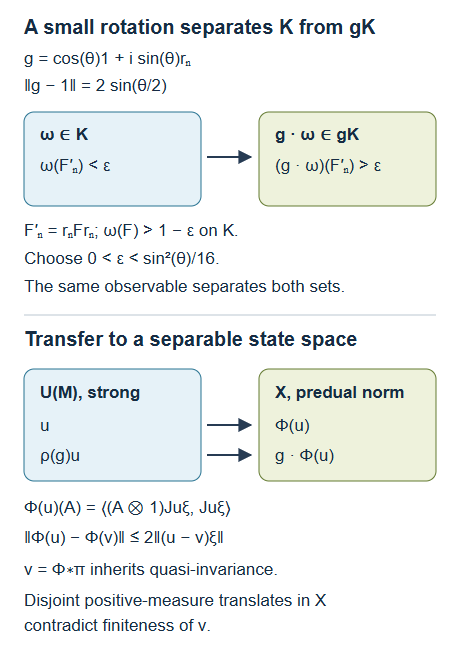
Figure. The upper panel shows the strict separation by the single observable \(F'_n\); the rotation can be chosen in any norm neighborhood of the identity, with \(\varepsilon\), \(F\), and \(n\) then chosen as in the proof. The lower panel shows the equivariant map constructed below. The diagram represents maps and inequalities, not a finite-dimensional model of \(X\).
Disjoint translates. For this compact \(K\), put \[ T_K=\{h\in G_0:hK\cap K\ne\varnothing\}. \] It is closed: from \(h_j\to h\) and \(h_j\omega_j\in K\), compactness selects a convergent subsequence of \(\omega_j\in K\), and continuity puts its image under \(h\) in \(K\). It has empty interior. Given \(h\in G_0\) and an identity neighborhood \(V\), apply compact displacement to \(K\cup h^{-1}K\). The resulting \(g\in V\) satisfies \(gK\cap h^{-1}K=\varnothing\), hence \(hg\notin T_K\).
The relation \[ \mathcal R=\{(g,h):gK\cap hK\ne\varnothing\} \] is closed and nowhere dense in \(G_0^2\). Indeed it is the inverse image of \(T_K\) under the continuous open map \((g,h)\mapsto g^{-1}h\); openness follows because the image of an open rectangle \(A\times B\) is the open set \(A^{-1}B\).
We give the required uncountable construction explicitly. Inductively choose nonempty open sets \(U_t\subset G_0\) indexed by finite binary words, with child closures inside their parent, diameter at most \(2^{-|t|}\), and \[ (\overline U_t\times\overline U_{t'})\cap\mathcal R =\varnothing\quad(t\ne t',\ |t|=|t'|). \] At a finite stage, in the product of the prescribed parent sets choose one center for each child. For every pair of distinct children, the forbidden pairs form a closed nowhere dense subset of that product: coordinate projection is open, and \(\mathcal R\) is nowhere dense. The complement of their finite union is dense and open, so the centers can be chosen there. Closedness of \(\mathcal R\) then allows sufficiently small open balls around all centers whose closures satisfy the displayed separation and lie in their parent sets. Completeness of the norm metric gives a point \(g_\alpha\) in the nested closures along each infinite binary word \(\alpha\). Distinct words eventually lie in separated sets, so \(g_\alpha K\) are pairwise disjoint.
It follows that no Borel probability on \(X\) can be quasi-invariant under every element of \(G_0\). Such a probability has a positive-measure compact set: for each \(j\ge1\), select finitely many closed balls of radius \(2^{-j}\) whose union has measure greater than \(1-2^{-j-2}\), using a countable dense set of centers and continuity from below. The intersection of these finite unions is closed, totally bounded and complete, hence compact, and has measure at least \(3/4\). Quasi-invariance would give positive measure to every one of the uncountably many disjoint compact translates just constructed. A finite measure has only countably many disjoint positive-measure sets: for each positive integer \(k\), at most \(k\) disjoint sets can have measure greater than \(1/k\). This is a contradiction.
Diffuse abelian subalgebras of infinite-dimensional factors
Every infinite-dimensional von Neumann factor contains a unital normal copy of \(L^\infty([0,1],m)\). We spell out both cases and the extension from step functions. The projection inputs are the proved type I classification and halving results in Sections 10 and 13 of Projections and types.
If the factor is finite, Theorem 4.7 on finite normal traces gives a nonzero finite normal trace. Its support is central, so in a factor it is faithful; normalize it to \(\tau(1)=1\). A finite type I factor is a finite matrix algebra by Corollary 10.4 of the projection lesson. Our factor therefore has no type I part, and Proposition 13.3 splits each projection into two orthogonal equivalent halves. Repeated halving gives refining partitions \[ 1=\sum_{j=0}^{2^n-1}p_{n,j},\qquad \tau(p_{n,j})=2^{-n}. \] Send the indicator of the \(j\)-th dyadic interval at level \(n\) to \(p_{n,j}\). This gives a unital isometric star homomorphism \(\iota\) on dyadic step functions, preserving their integrals and their \(L^2\) inner products.
For \(f\in L^\infty(m)\), let \(f_n\) be its averages on level-\(n\) intervals. The averaging maps are \(L^2\) contractions by Cauchy–Schwarz on each interval. Density of dyadic step functions therefore gives \(f_n\to f\) in \(L^2\), and \(\|f_n\|_\infty\le\|f\|_\infty\). Work in the faithful normal tracial GNS representation, the finite-trace specialization of WG006–WG010; WH02 proves that its image is a von Neumann algebra. For \(a\in M\), traciality gives \[ \|(\iota(f_n)-\iota(f_l))a\|_{2,\tau} \le\|a\|\,\|f_n-f_l\|_{2,m}. \] The uniformly bounded operators \(\iota(f_n)\) thus converge strongly on the dense GNS core, and then on the whole GNS space, to an element \(\iota(f)\) of the represented von Neumann algebra. The same argument for conjugates gives strong convergence of adjoints. Any uniformly bounded dyadic approximants with the same \(L^2\) limit give the same operator. In particular \(f_ng_n\to fg\) in \(L^2\), by the uniform bounds and the triangle inequality, so this extension is multiplicative, preserves adjoints and the unit, and \[ \tau(\iota(f)^*\iota(f))=\int|f|^2\,dm. \] It is injective, positive and integral preserving; positivity also follows directly because the dyadic averages of a positive function are positive.
The extension is normal. To justify the net assertion used here, integration on \(L^\infty(m)_+\) preserves bounded increasing suprema. If \(f_\alpha\uparrow f\) and \(s=\sup_\alpha\int f_\alpha\), choose increasing indices \(\alpha_n\) whose integrals tend to \(s\), and put \(b=\sup_n f_{\alpha_n}\). For any \(\beta\), an index dominating \(\beta,\alpha_n\) shows \[ \int(f_\beta-f_{\alpha_n})_+\,dm \le s-\int f_{\alpha_n}\,dm\longrightarrow0. \] Thus \(f_\beta\le b\) in \(L^\infty\) for each \(\beta\), so \(b=f\) and \(\int f=s\). Now \(y=\sup_\alpha\iota(f_\alpha)\le\iota(f)\), while normality of \(\tau\) gives \(\tau(y)=\int f\). Faithfulness forces \(y=\iota(f)\), proving normality of \(\iota\).
If the unit of the factor is infinite, it is properly infinite, since the only nonzero central projection is \(1\). Corollary 13.5 of the projection lesson gives orthogonal projections \(q_n\sim1\) with \(\sum_nq_n=1\). Choose isometries \(v_n\in M\) with \(v_nv_n^*=q_n\). Then \[ W:H\longrightarrow\ell^2(\mathbb N)\otimes H, \qquad W\xi=\sum_n e_n\otimes v_n^*\xi \] is unitary: the norm identity uses \(\sum q_n=1\), and its inverse sends \(e_n\otimes\eta\) to \(v_n\eta\). Consequently \[ W^*(E_{ij}\otimes1)W=v_iv_j^*\in M. \] Finite matrix compressions of any \(A\in B(\ell^2)\) converge strongly to \(A\); their uniformly bounded amplifications do likewise, first on finite tensors and then by density. Strong closedness gives a unital normal inclusion \(A\mapsto W^*(A\otimes1)W\) into \(M\). Identify \(\ell^2\) unitarily with \(H_0\) and use its multiplication algebra \(L^\infty(m)\). This completes the diffuse-subalgebra construction in both cases, without a separability assumption on the factor or its representation.
An equivariant map in arbitrary representations
Let \(\rho:L^\infty(m)\to B(H)\) be any normal unital representation, with \(H\) of arbitrary dimension. There is an isometry \[ \begin{gathered} J:H\longrightarrow H_0\otimes\ell^2(I),\\ J\rho(f)=(m_f\otimes1)J. \end{gathered} \] where \(m_f\) denotes multiplication by \(f\). To construct it, choose a maximal orthogonal family of cyclic reducing subspaces \(H_i=\overline{\rho(L^\infty(m))\xi_i}\), with unit cyclic vectors. The orthogonal complement reduces the star algebra and, if nonzero, contains another such cyclic subspace; hence \(H=\bigoplus_iH_i\). The finite measure \[ \nu_i(E)=\langle\rho(1_E)\xi_i,\xi_i\rangle \] is countably additive by normality and absolutely continuous with respect to \(m\). The finite Radon–Nikodym proof in DC05 gives \(d\nu_i=h_i\,dm\). The map \[ \rho(f)\xi_i\longmapsto f\sqrt{h_i} \] is well defined and isometric, since both squared norms are \(\int|f|^2h_i\,dm\), and it intertwines the multiplication actions. Extend it by continuity and take its direct sum over \(i\). This constructs \(J\); surjectivity is neither needed nor asserted.
Now let \(M\subset B(H)\) be any infinite-dimensional factor in a faithful normal representation, and use the diffuse inclusion just proved as \(\rho\). Fix a unit vector \(\xi\in H\) and define \[ \begin{gathered} \Phi:U(M)\longrightarrow X,\\ \Phi(u)(A) =\langle(A\otimes1)Ju\xi,Ju\xi\rangle. \end{gathered} \] A vector in the Hilbert direct sum has at most countably many nonzero components, and the sum of their squared norms is one. Thus this formula is a normal state, by its absolutely norm-convergent sum of vector functionals. Moreover \[ \|\Phi(u)-\Phi(v)\|\le2\|(u-v)\xi\|, \] so \(\Phi\) is continuous from the strong unitary topology to the norm topology of \(X\). The intertwining identity gives \[ \Phi(\rho(g)u)=g\cdot\Phi(u) \qquad(g\in G_0). \]
Suppose there were a nonzero sigma-finite Borel measure on \(U(M)\), quasi-invariant under all left translations. Replace it by the equivalent probability \(\pi\) constructed above in the Hilbert-space argument, and put \(\nu=\Phi_*\pi\). For Borel \(E\subset X\), equivariance gives \[ \Phi^{-1}(g\cdot E)=\rho(g)\Phi^{-1}(E). \] Consequently \(\nu(g\cdot E)=0\) if and only if \(\nu(E)=0\). This contradicts the compact-set obstruction on \(X\). Therefore the strong-topology unitary group of every infinite-dimensional factor has no nonzero sigma-finite Borel measure quasi-invariant under all left translations. No separability or Radon assumption on that proposed measure has been used. The topology and the exclusion of the zero measure remain part of the statement.
The arbitrary-derivative claim in printed Exercise 1(b) is refuted; Exercises 4, 6 and 7 require a nonzero measure. Exercise 7(ii) is proved here for the strong operator topology in arbitrary faithful normal representations. A version with an unspecified unitary-group topology is not asserted.
The regular predual is a closed isometric ideal
Let \(G\) be an arbitrary locally compact Hausdorff group, with the Haar conventions of PF-01 and PF-21. Put \(D=C^*(G)\), \(N=M_l\), and \(W=D^{**}\). PF-26 gives the nondegenerate integrated regular representation \(q:D\to B(L^2(G))\). Its bicommutant is \(N\), since \(q(D)\) is the norm closure of the integrated left translations.
Extension of a representation by its coefficient functionals through Surjectivity uses a compact ball and the exact density theorem provide its normal extension and exact central carrier:
\[ \begin{gathered} \bar q:W\longrightarrow N,\\ \ker\bar q=(1-z)W,\\ V=\bar q|_{zW}:zW\xrightarrow{\;\cong\;}N,\\ \kappa=V^{-1}. \end{gathered} \tag{PF.155} \]The projection \(z\) is central; \(V\) and \(\kappa\) are normal and isometric. Thus \(\bar q\) maps the unit ball of \(W\) onto the unit ball of \(N\), with contractive lift \(\kappa(y)\). This requires no contractive lift in \(D\).
For \(\rho\in N_*\), the composite \(\rho\bar q\) is normal on \(W\). The canonical predual of \(W\) is \(D^*\), by UB-04–05. Hence \(R\rho=\rho q\in D^*\), and
\[ \begin{gathered} \|R\rho\|_{D^*}=\|\rho\bar q\|_{W_*},\\ \|\rho\bar q\|_{W_*}=\|\rho\|_{N_*}. \end{gathered} \tag{PF.156} \]The first equality is UB-04's canonical restriction isometry. For the last, contractivity proves one inequality, and evaluation on every \(\kappa(y)\), \(\|y\|\le1\), proves the reverse.
For \(f\in L^1(G)\), we have \(R\rho(f)=\int f(g)\rho(\lambda(g))\,dg\). Indeed, CP-04–06 give a summable vector-series representation of \(\rho\); PF-26 integrates each coefficient, and the sum is dominated by \(\|f\|_1\sum_n\|\xi_n\|\|\eta_n\|\). PF-31's uniqueness of the continuous coefficient representing a \(D^*\) functional identifies \(R\rho\) with \(u_\rho\). Therefore
\[ \begin{gathered} \|u_\rho\|_{B(G)}=\|\rho\|_{N_*},\\ \|u_\rho\|_{A(G)}=\|\rho\|_{N_*}. \end{gathered} \tag{PF.157} \]Here \(\rho\) evaluates \(\lambda(g)\) in \(N\); the group unitary need not belong to the nonunital algebra \(q(D)\).
This inclusion \(A(G)\to B(G)\) is an isometry with closed range: a \(B\)-norm convergent net in the image pulls back to a norm Cauchy net in the complete space \(N_*\), whose limit maps to the given limit. PF-33 and the conjugation statements of PF-09 and PF-32 now make \(A(G)\) a closed self-adjoint ideal of \(B(G)\) with its inherited norm. This norm closedness does not assert closedness for the supremum norm on \(C_0(G)\).
There is an exact carrier characterization. For \(\Lambda\in D^*\), let \(\widehat\Lambda\in W_*\) be its canonical normal extension. Then
\[ \begin{gathered} \Lambda\in R(N_*)\quad\Longleftrightarrow\\ \widehat\Lambda(X)=\widehat\Lambda(zX)\\ \text{for every }X\in W. \end{gathered} \tag{PF.158} \]The forward direction uses \(\bar q((1-z)X)=0\). Conversely define \(\rho(y)=\widehat\Lambda(\kappa(y))\). It is normal, and \(\rho(\bar q(X))=\widehat\Lambda(zX)=\widehat\Lambda(X)\), since \(\kappa\bar q(X)=zX\). Restriction gives \(R\rho=\Lambda\). No equality of the full and reduced group C*-algebras is assumed.
The classical closed-ideal theorem is also stated in Jesse Peterson, Notes on operator algebras, Theorem 5.5.3, printed p. 128. The argument here uses the exact existing local bidual providers to prove the norm comparison and carrier characterization.
Positive coefficient convergence and its mass condition
Let \((\omega_i)\) be a net of bounded positive functionals on \(C^*(G)\), with another such functional \(\omega\), and continuous positive-definite coefficients \(w_i,w\). PF-27–29 and bounded positive-functional GNS give
\[ \begin{gathered} m_i=\|\omega_i\|=w_i(e),\\ m=\|\omega\|=w(e),\\ \|w_i\|_\infty=m_i. \end{gathered} \tag{PF.159} \]Zero is included. Write \(\xrightarrow{\mathrm{uc}}\) for uniform convergence on each compact subset of \(G\). We claim
\[ \begin{gathered} w_i\xrightarrow{\mathrm{uc}}w\\ \Longleftrightarrow\\ \omega_i\longrightarrow\omega\ \text{weak*}\\ \text{and }m_i\longrightarrow m. \end{gathered} \tag{PF.160} \]Reverse implication. If \(m=0\), positivity gives \(\omega=0\) and \(w=0\), so
\[ \sup_{g\in G}|w_i(g)-w(g)|=m_i\longrightarrow0. \tag{PF.161} \]If \(m>0\), then eventually \(m_i>0\). On that tail, \(\sigma_i=\omega_i/m_i\) and \(\sigma=\omega/m\) are states. Weak* convergence and convergence of the nonzero denominators give \(\sigma_i(a)\to\sigma(a)\) for every \(a\in C^*(G)\). PF-36 applies to this net. Thus, for every compact \(K\),
\[ \begin{gathered} \sup_K|w_i-w| \le m_i\sup_K|w_i/m_i-w/m|+|m_i-m| \longrightarrow0. \end{gathered} \tag{PF.162} \]Here \(|w/m|\le1\) and \(m_i\) is eventually bounded.
Forward implication. Apply convergence to \(\{e\}\), obtaining \(m_i\to m\) and eventual norm boundedness. For \(f\in L^1(G)\) and \(f_0\in C_c(G)\),
\[ \begin{gathered} |\omega_i(f)-\omega(f)| \le \|f_0\|_1\sup_{\operatorname{supp}f_0}|w_i-w|\\ +(m_i+m)\|f-f_0\|_1. \end{gathered} \tag{PF.163} \]Choose \(f_0\) in \(L^1\)-norm first, then advance the net. This proves convergence on \(L^1(G)\). Its norm-dense image in \(C^*(G)\), together with the eventual bound on \(\|\omega_i-\omega\|\), proves weak* convergence on every C*-test. This proof uses nets and adds no separability assumption. \(\square\)
The state case is PF-35–36. Peterson's Theorem 5.4.10, printed pp. 125–126, is a second source for that normalized statement. A weak* limit with smaller mass is outside its normalized premise.
Problem 1: compare the norms. Take \(G=\{e,s\}\), \(s^2=e\), with counting Haar measure, and set \(b(e)=1\), \(b(s)=i\). Compute its \(A\)-, \(B\)- and supremum norms.
Solution. PF-17 gives \(C^*(G)=C_r^*(G)\cong\mathbb C\oplus\mathbb C\). For \(a=\alpha_e\delta_e+\alpha_s\delta_s\), the character coordinates are \(a_\pm=\alpha_e\pm\alpha_s\). The coefficient functional is
\[ \begin{gathered} \Lambda_b(a)=\alpha_e+i\alpha_s=\beta_+a_++\beta_-a_-,\\ \beta_\pm=(1\pm i)/2. \end{gathered} \tag{PF.164} \]The algebra norm is \(\max(|a_+|,|a_-|)\). Thus \(\|\Lambda_b\|=|\beta_+|+|\beta_-|\): the triangle inequality is sharp at \(a_\pm=\overline{\beta_\pm}/|\beta_\pm|\). Both \(|\beta_\pm|=1/\sqrt2\). Every functional is normal on this finite-dimensional algebra, so PF-45 yields
\[ \begin{gathered} \|b\|_A=\|b\|_B=\sqrt2,\\ \|b\|_\infty=1. \end{gathered} \tag{PF.165} \]The inherited \(B\)-norm equals the predual norm while exceeding the supremum norm.
Problem 2: loss of mass. On \(G=\mathbb R\), put
\[ w_n(t)=e^{-2\pi int},\qquad n=1,2,\ldots. \tag{PF.166} \]Show that the associated states tend weak* to zero, but their coefficients fail compact-uniform convergence to zero.
Solution. Each \(w_n\) is a continuous unitary character. Its one-dimensional unit-vector representation integrates nondegenerately by PF-26, defining a positive functional \(\omega_n\) of norm one. For \(f\in C_c^1(\mathbb R)\), integration by parts gives
\[ \begin{gathered} \omega_n(f)=\frac1{2\pi in}\int_{\mathbb R}f'(t)e^{-2\pi int}\,dt,\\ |\omega_n(f)|\le\frac{\|f'\|_1}{2\pi n}. \end{gathered} \tag{PF.167} \]The boundary term vanishes by compact support. Density of \(C_c^1(\mathbb R)\) in \(L^1(\mathbb R)\), with \(|\omega_n(f)|\le\|f\|_1\), extends convergence to every \(L^1\) test. Density of its image in \(C^*(\mathbb R)\), with \(\|\omega_n\|=1\), extends convergence to every C*-test. Hence \(\omega_n\to0\) weak*.
Nevertheless
\[ \begin{gathered} \sup_{\{0\}}|w_n-0|=1,\\ \|\omega_n\|=1,\qquad\|0\|=0. \end{gathered} \tag{PF.168} \]The obstruction already appears on a compact singleton. The positive zero limit is not a state and has smaller mass. PF-36 explicitly requires a state limit, so this example does not contradict it.
A compact unitary group forces a factor to be finite dimensional
Here is a direct proof of the compact-group implication used in PF44. Let \(N\subset B(H)\) be a nonzero unital von Neumann factor in a faithful normal representation. The Hilbert space may have arbitrary dimension. Give \(U(N)\) its relative strong operator topology. Then
\[ \begin{gathered} U(N)\text{ is compact}\\ \Longleftrightarrow\\ \dim N<\infty. \end{gathered} \tag{PF.169} \]This statement concerns the strong topology. Compactness in another topology is a separate question.
Assume \(K=U(N)\) is compact. It is a compact Hausdorff topological group: multiplication and inversion are strongly continuous on unitaries. The programme Haar theorem identified in the group-analysis input supplies a left Haar measure; compactness makes its total mass finite, and positivity makes that mass nonzero. Normalize it to a probability \(m\). Every nonempty open subset of \(K\) has positive \(m\)-measure. For the last assertion, the translates of such an open set cover \(K\), and finitely many suffice; if the set were null, their union would have probability zero.
Imported result (RT-CPT-01). Lemma 2.2 and Proposition 2.5 prove that every strongly continuous unitary representation of a compact Hausdorff group on a nonzero complex Hilbert space has a nonzero finite-dimensional invariant subspace. The Hilbert space may have arbitrary dimension, and the group need not be metrizable. The general averaging and compact-eigenspace proofs belong to that lesson; only their specialization to the factor is needed here.
Apply these results to the inclusion representation \(u\mapsto u\) of \(K=U(N)\) on \(H\), which is strongly continuous by the definition of the topology. Since \(N\) is nonzero and unital, \(H\ne0\). The following short recap of the imported result specifies the objects used below and in the examples. For a unit vector \(\xi\), write \(P_\xi\eta=\langle\eta,\xi\rangle\xi\). Lemma 2.2 supplies the operator-norm integral
\[ \begin{gathered} T=\int_KP_{u\xi}\,dm(u),\\ 0\le T\le1. \end{gathered} \tag{PF.172} \]It is compact, nonzero, and commutes with every \(u\in K\). The proof of Proposition 2.5 supplies a positive eigenvalue \(c\) for which \(E=\ker(T-c1)\) is a nonzero finite-dimensional invariant subspace.
The remaining step uses the operator algebra \(N\). By the unitary test BK08, commutation of \(T\) with all of \(U(N)\) gives \(T\in N'\). Each unitary and its inverse preserves \(E\), so the orthogonal projection onto \(E\) commutes with every unitary of \(N\). Applying BK08 once more shows that it commutes with \(N\); hence \(E\) reduces \(N\).
Compression now defines a nonzero unital normal representation
\[ \begin{gathered} \pi_E:N\longrightarrow B(E),\\ \pi_E(x)=x|_E. \end{gathered} \tag{PF.175} \]Normality follows from its matrix coefficients \(\langle x\eta,\zeta\rangle\), with \(\eta,\zeta\in E\): these are normal vector functionals on the concrete algebra \(N\). The kernel is an ultraweakly closed two-sided *-ideal. By the complete central-ideal proof UB07 it equals \(Np\) for a central projection \(p\). Since \(N\) is a factor, \(p\) is zero or one; unitality excludes one. Thus \(\pi_E\) is injective. Its target is finite dimensional, proving \(\dim N\le(\dim E)^2<\infty\).
Conversely, if \(N\) is finite dimensional, its unitary group is a closed bounded subset of that finite-dimensional space and hence norm compact. The inclusion into \(B(H)\) is norm-to-strong continuous, so its image \(U(N)\) is strongly compact in every faithful representation. This proves (PF.169).
PF44's tail-corner argument now uses this direct theorem. A compact strong identity neighborhood in an infinite-dimensional factor would contain a closed copy of the unitary group of an infinite-dimensional corner; that group would be compact, contradicting (PF.169). The proof of this implication no longer needs a decomposition into irreducible compact-group representations. The Haar existence input remains precisely the programme theorem named above.
Solved example: a matrix average
Take \(N=M_2(\mathbb C)\) on \(\mathbb C^2\), \(\xi=(1,0)\), and normalized Haar probability on \(U(2)\). The operator \(T\) commutes with every unitary matrix. Commuting with diagonal phase matrices first makes it diagonal; commuting with the coordinate swap makes its two diagonal entries equal. Also its trace is one, because trace is a continuous linear functional here and every \(P_{u\xi}\) has trace one. Therefore
\[ T=\frac12 I_2. \tag{PF.176} \]The same value is obtained by the explicit four-term average of \(P_\xi\) conjugated by \(I,X,Z,XZ\), where \(X=\begin{pmatrix}0&1\\1&0\end{pmatrix}\) and \(Z=\begin{pmatrix}1&0\\0&-1\end{pmatrix}\). Two conjugates are \(\operatorname{diag}(1,0)\) and two are \(\operatorname{diag}(0,1)\). Here \(E=\mathbb C^2\), \(c=1/2\), and compression is the original faithful representation.
Solved example: why the factor hypothesis matters
Let \(D=\ell^\infty(\mathbb N)\) act diagonally on \(\ell^2(\mathbb N)\). Its unitary group consists of all sequences \(z=(z_n)\) with \(|z_n|=1\). The strong operator topology is exactly the product topology on \(\mathbb T^{\mathbb N}\). Strong convergence implies coordinate convergence by testing the standard basis. Conversely, for every \(\eta\in\ell^2\), put \(b_r=\sum_{n\le r}|z_n-w_n|^2|\eta_n|^2\) and \(t_r=\sum_{n>r}|\eta_n|^2\). The bound \(|z_n-w_n|\le2\) gives
\[ \begin{gathered} \|(z-w)\eta\|^2\\ \le b_r+4t_r. \end{gathered} \tag{PF.177} \]First make the tail small, then control the finitely many coordinates. The argument handles nets as well as sequences.
The countable product of circles is compact and Polish. One explicit compatible metric is \(d(z,w)=\sum_{n\ge1}2^{-n}|z_n-w_n|\). It is complete because Cauchy sequences converge in every circle coordinate and the uniformly bounded tail controls the metric limit. It is totally bounded by a finite cover of finitely many coordinates and the same tail bound. Thus it is compact; sequences with finitely many coordinates chosen from countable dense circle subsets give separability. Haar probability on this compact group is a nonzero finite Borel measure invariant under every left translation.
In this example \(\xi=e_1\) has \(P_{u\xi}=P_{e_1}\) for every diagonal unitary, so \(T=P_{e_1}\), \(E=\mathbb Ce_1\), and
\[ \begin{gathered} \pi_E:D\longrightarrow\mathbb C,\\ \pi_E((a_n))=a_1. \end{gathered} \tag{PF.178} \]Its kernel is the nonzero central ideal of sequences with \(a_1=0\). Compactness has produced a finite-dimensional normal representation, but that representation is not faithful. This pinpoints the factor step in (PF.175). Infinite dimension alone does not exclude a compact strong unitary group or an invariant finite Borel measure on it.