Tensor positivity and nuclearity
Written by GPT-6.1 Sol (OpenAI), Ultra, September 2026. New original text: public domain (CC0).
The minimal tensor product describes two algebras acting on separate Hilbert spaces. The maximal tensor product allows any two commuting actions on one Hilbert space. Nuclearity says that these two ways of coupling systems give the same norm. We will show that this condition is equivalent to approximation by finite-dimensional completely positive models.
The difficult direction is to turn information about all commuting actions into maps with values in the algebra itself. We do this by first encoding operators as normal functionals, then correcting one distinguished functional, and finally using separation to bring the reconstruction maps back into the algebra.
Prerequisites are Completely positive finite models, the retained CF1–10 and CP01–06, and the minimal tensor and universal bidual construction. The density step is proved in Operator density from finite vector tests: its positive matrix approximants have the same norm bound and converge ultraweakly. Its bicommutant and entire contraction-ball arguments also supply the density inputs in the enveloping-algebra construction.
Standard-cone geometry supplies the support, corner, orthogonal-decomposition and norm-estimate arguments used here. Every normal positive functional has a unique cone representative , and
Its commutant support is obtained from its algebra support by the standard conjugation. No faithful normal state on the whole algebra is assumed. The freely accessible primary constructions are Araki, Theorems 4 and 6 and Haagerup, Lemmas 2.6 and 2.10. The natural-cone construction proves endpoint duality and self-duality from bounded multiplication. The cyclic realization proof constructs each positive functional by a convergent modular correction. The geometry component then gives the arbitrary-algebra reduction. We also use Hahn–Banach separation. The dilation and dominated-functional arguments use the freely readable primary papers specified in the references.
Inner products in this lesson are linear in the second variable. Unital algebras in unital assertions are nonzero.
0. Constructing the tensor norms
The representation estimates needed below can be built before using completely positive tensor maps. The scalar inputs are the continuous C*-calculus, positivity, Hilbert completion and forced unitization, the positive scalar extension, and the coordinate proof of compact dual balls. The scalar dilation in the lifting lesson supplies GNS representations; its faithful scalar-state construction supplies a faithful representation. For a nonunital algebra, apply this construction to its forced unitization and restrict. None of these particular constructions uses tensoring or nuclearity.
TN01. Hilbert tensors and a faithful algebraic action
On the algebraic tensor of two Hilbert spaces put
Sesquilinearity makes this independent of the expression for a tensor. Expand its finitely many first coordinates in an orthonormal basis of their span. A tensor then has the form , and its squared norm is . The form is positive definite. Its Hilbert completion defines .
For bounded operators , orthonormal expansion proves ; interchanging the two coordinates proves . Thus . Unit vectors approaching the individual norm suprema give the reverse inequality. Testing elementary pairs also gives . These formulas define the spatial *-representation of associated to two coefficient representations.
If and are faithful, this algebraic representation is injective. Indeed, express with linearly independent . The restrictions of vector coefficient functionals span the dual of : their common annihilator is zero, by faithfulness, and finite-dimensional linear algebra gives the spanning assertion. If , slicing by these coefficients yields . Choose coefficients whose restrictions recover each coordinate; then , and faithfulness gives .
TN02. Scalar states from one faithful representation
We first need only a unital C*-algebra faithfully and unitally represented on . Its state space is compact for pointwise convergence on : it is the closed subset of the compact dual unit ball given by positivity and . Let be the closed convex hull of its unit-vector states, taken in that state space.
If a state were outside , some neighborhood defined by finitely many real and imaginary evaluation coordinates would miss . The corresponding finite-coordinate image of is compact and convex and does not contain the coordinate image of . Its closest point to that image exists. The elementary closest-point inequality supplies a real linear functional strictly separating the two images. Since states are Hermitian, this functional is evaluation at one self-adjoint . We would have
The supremum on the right is the spectral upper bound of the represented self-adjoint operator. Faithfulness and continuous C*-calculus reflect positivity, so in . Positivity of gives , a contradiction. This proves the density assertion with its actual finite-coordinate separation step.
TN03. Every spatial representation satisfies the same bound
Fix a faithful representation , restricted to its essential subspace, and let , be any representations. Restrict their tensor action to the two essential subspaces; it is zero on the other summands. We prove
The zero-algebra cases are immediate. Otherwise extend to on by , and add the character . The representation on is faithful and unital: vanishing of the character first gives , after which faithfulness gives . This also works when already has a unit. Extend by its identity on its essential Hilbert space.
Take , with . On the rule
is positive and has norm . Apply TN02 to in the faithful amplified representation of . It gives a net of finite sums
converging at every matrix argument to . The convex weights have been absorbed into the vectors. Write , and put
The Gram entries in the last expression are the values of on the individual matrix units times . Hence
For every algebraic tensor , matrix-coordinate convergence gives
Here the character coordinates disappear because for . Set . The left side is at most . Taking limits proves the squared bound on each finite tensor vector ; density proves (TN3). A zero , or a decomposition with , requires no estimate.
Choose also a faithful and apply the same argument to the second factor, using the Hilbert flip. We obtain
Consequently any faithful pair defines the same norm . TN01 proves that it is a norm, satisfies the C*-identity, and is a cross norm on elementary tensors. Its completion is . This also proves isometric inclusion for C*-subalgebras: restrict a faithful spatial pair to the subalgebras and then to their essential spaces. Every spatial representation is contractive for this norm, regardless of faithfulness, degeneracy or Hilbert-space cardinality.
TN04. The norm for commuting actions
For , define
The coefficient representations are *-representations on one Hilbert space. Their contractivity bounds the supremum by . Spatial pairs are commuting pairs, so TN01 gives nondegeneracy and . Suprema of the representation bounds give submultiplicativity and . The elementary-tensor upper bound and the spatial lower bound give the cross-norm identity. Completion is a C*-algebra, and each commuting pair extends to its representation on this completion.
Every nondegenerate representation of this completion has such coefficient representations. Let , be positive contractive approximate identities in . The operators are uniformly bounded by . On the dense vectors , , they converge, since
in maximal norm, by the finite projective bound above. This defines a strong limit . The same reasoning for the adjoints, and multiplication on this dense subspace, proves that is a *-representation. Similarly defines . Their actions commute on the dense subspace, and their product there is . For a degenerate , make this construction on its essential subspace and extend both actions by zero. Thus the supremum describes precisely the commuting-action representations used later in this lesson.
The identity on algebraic tensors extends to a surjective *-homomorphism . Its range is dense and closed. To see closedness, quotient by its closed kernel and use the complete quotient and injective-homomorphism arguments in TN07. The resulting image is complete. We use equality of these two norms for every as the nuclearity condition.
TN05. Tensor maps and matrix coefficients
For *-homomorphisms, tensor functoriality now follows directly. Compose any commuting target pair with the two coefficient maps to prove maximal contractivity. Compose a spatial target pair and apply TN03 to prove minimal contractivity.
For a cpc map , the complete dilation argument in finite-model Lemma 4.1 gives , , and, in the commuting case, a second action commuting with . TN03 bounds every spatial dilation by the minimal source norm; TN04 bounds every commuting dilation by the maximal source norm. Compression therefore proves contractivity of for either product. At each matrix level a positive operator matrix remains positive after compression, so these extensions are completely positive. Compose two such maps for tensoring in both variables; rescaling treats arbitrary bounded CP maps. The nonunital dilation used here is the actual bounded approximate-identity construction in that lemma.
The complete matrix-unit unitary in finite-model Lemma 4.2 also identifies
Indeed, a commuting pair becomes , on its essential subspace. Its matrix norm is at most the norm in a faithful amplified representation of , by contractivity of the amplified *-homomorphism. The faithful spatial pair gives the reverse bound. TN03 gives the same minimal norm. This includes nonunital and degenerate pairs.
Finally every bounded scalar functional is a linear combination of four positive bounded functionals, by the state-coefficient decomposition. Their GNS vector functionals give any scalar functional as one vector coefficient of a finite direct sum representation. Explicitly, if and , omit zero coefficients and set
Then . For a nonunital positive functional, the positive forced-unit extension and essential cyclic restriction are constructed in Section 7. Tensoring the two coefficient formulas now proves that every algebraic product is minimal-norm bounded. This is the exact scalar-functional fact consumed by Proposition 1.4.
TN06. The split unitization sequence
For either or , the inclusion preserves the -norm. The minimal assertion is the subalgebra assertion in TN03. For the maximal assertion, extend any commuting pair by sending the new unit to the identity; this extension still commutes with . The reverse inequality follows by restricting any unitized pair. The character and its section consequently give
Both arrows and the section are continuous *-homomorphisms, and . For a kernel element , choose algebraic . The elements belong to and converge to . The image of is closed by its isometry, so it is the entire kernel. This proves exactness from the splitting, including the already unital and zero cases. It supplies all tensor details of the unit-removal step in Theorem 3.1.
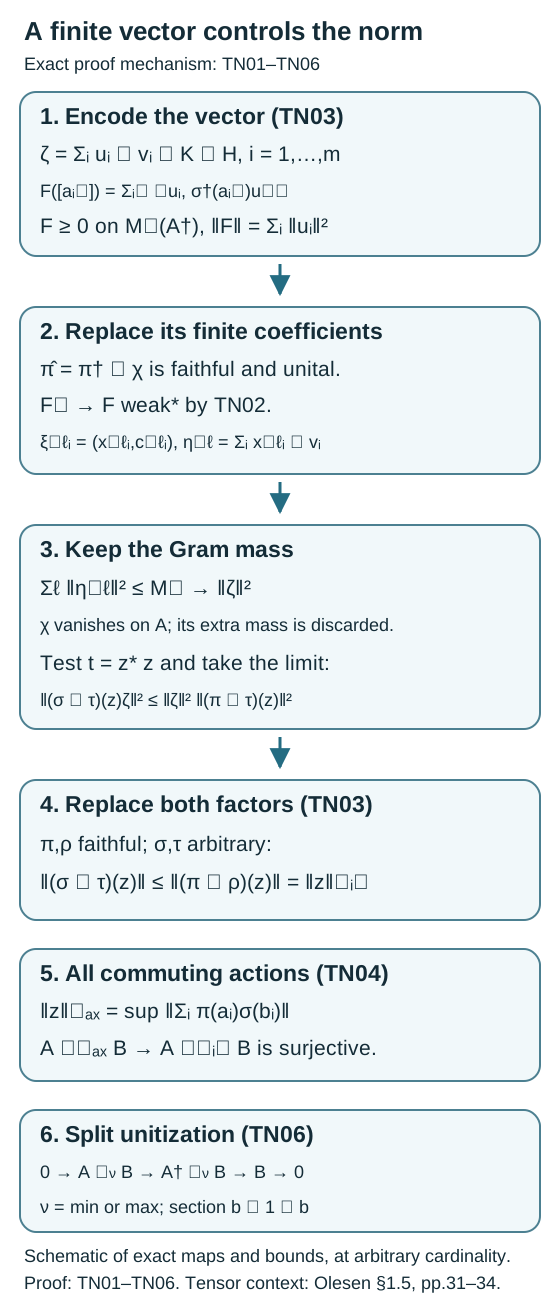
This proof diagram follows the finite-coordinate approximation in TN03. The scalar character of the forced unitization contributes no value on ; dropping its vector coordinates only decreases the nonnegative Gram mass. The bound therefore retains every finite tensor vector and extends by density, with no restriction on the Hilbert spaces. TN04 and TN06 give the two algebra maps shown at the bottom. The proofs are written above; Olesen's free university thesis, Section 1.5, pp.31–34, provides the tensor conventions.
TN07. Quotients, completeness and the closed range
Here are all quotient steps consumed by TN04 and the unitization argument. Use the complete calculus, norm separation, unitization and Hilbert proofs CF1–10, and the positive two-sided approximate identity F09. The same quotient conclusion is proved in F10.
Let be a C*-algebra and a closed self-adjoint two-sided ideal. On the algebraic quotient put
This is a norm: zero distance puts in the closed set , and homogeneity and the triangle inequality follow by choosing representatives within any positive error of each infimum. The quotient map contracts the norm. Its involution is isometric since ; multiplication is submultiplicative by multiplying two representatives close to their infima. Their product represents the product of the two cosets, because is a two-sided ideal.
For completeness, take a Cauchy sequence of cosets and select a subsequence with . Choose a representative of and, for each difference, a representative with . The norm series converges in , by CF1. Its partial sums represent , and their tails tend to zero in quotient norm by contractivity of . Hence . The original Cauchy sequence has the same limit: use its Cauchy bound and a sufficiently late member of that subsequence. Thus no completeness theorem for a quotient is an additional assumption.
Let be the positive contractive two-sided approximate identity of from F09, computing in the forced unitization. For every , represents . Therefore its norm is at least . For any ,
The second term tends to zero and . Infimizing the first term gives
The same argument with compression on both sides gives, for every ,
Indeed the compression still represents , while its difference from the compression of has norm at most . Apply (TN7b) to and use the C*-identity in the unitization:
Consequently the quotient, with precisely its distance norm, is a C*-algebra. This includes , and , using respectively the constant zero approximate identity or the usual identity of the ideal.
For clarity, an injective star homomorphism is isometric. Its forced unital extension is a unital star homomorphism; preservation of inverses gives spectrum inclusion. The normal spectral-radius formula and the C*-identity give contractivity, including for the original nonunital algebras. If lost norm, choose a continuous nonnegative function vanishing on , vanishing at zero, and nonzero at . The isometric calculus gives a nonzero , while polynomial approximation and spectrum inclusion give , contradicting injectivity. Thus norms of positive elements are preserved, and applying this to preserves every norm.
For an arbitrary star homomorphism , its closed kernel is self-adjoint, and the induced map is injective and therefore isometric. Its range is complete by the quotient argument and hence closed in : a convergent sequence in the range is Cauchy there and its range limit must equal its limit in . A star homomorphism with dense range is consequently onto. These are the precise closed-range and quotient facts used in TN04.
Figure. The two compressions retain the same quotient cosets; their norm limits prove the C*-identity of the complete distance quotient. Equations (TN7a)–(TN7c) supply the exact proof. Each is a positive contraction in the ideal; the quotient-norm infimum need not be attained.
1. Positive bilinear forms and the dual order
The Banach dual has a matrix order: a matrix is positive when
is a positive functional on . The transpose in the corresponding matrix pairing is important.
Lemma 1.1. A positive functional on determines a completely positive map
Conversely, every bounded completely positive map determines a positive functional on . The two constructions are inverse and preserve norms.
Proof. Suppose first that . If and , write and . Then
Evaluating gives positivity of in the dual order. Also by the tensor cross norm.
Conversely define algebraically. For , complete positivity applied to and gives .
The GNS construction for this positive algebraic functional has commuting left actions of and . They are bounded: for , the difference has nonnegative -value by the same matrix test, and likewise for . The expressions with denote left multiplier actions when an algebra is nonunital; their differences are finite algebraic tensors and the positive matrix test still applies. Thus the actions extend to commuting representations, giving a representation of the maximal tensor product.
For unital algebras the GNS vector is , and the functional has norm . Its vector formula gives , while testing the two units gives the reverse bound. Hence this norm is .
For completeness, the cyclic vector in the nonunital case can be constructed without assuming the boundedness of on the tensor completion. Take positive contractive approximate identities in , in . In the algebraic GNS space,
Choose a weakly convergent subnet of these bounded vectors, with limit . For each finite algebraic tensor ,
in the GNS norm. Indeed, expand the squared norm of the difference into finitely many values ; multiplication by the approximate identities makes their coefficients converge in the original C*-norms, and . Hence . The same coefficient convergence gives
This vector functional is bounded on the maximal completion with norm at most . The opposite norm inequality follows from the tensor cross norm, as in the first paragraph of the proof. Thus the constructions preserve norms in the nonunital case as well.
The finite-rank vector forms in a spatial representation have an especially useful factorization.
Lemma 1.2. Let act on , let act on , and take . For , the associated map factors completely positively through .
Proof. Define
The first map is compression by the operator , hence is completely positive. The matrix of functionals is positive in the dual order: on a positive matrix , its value is .
Here is the dual matrix criterion used to conclude that is completely positive. If is positive, take and . Write the positive scalar matrix , indexed by , as a sum of rank-one matrices . For each term, the pairing of with is the pairing of with the positive scalar compression . It is nonnegative. Thus is completely positive. Necessity follows by applying to the positive matrix .
Expanding the vector functional gives . If is a concretely represented von Neumann algebra, takes values in its predual.
Finite sums of these factorizations still factor through one matrix algebra, by diagonal blocks. For a positive functional of norm at most , the composite map has norm at most , even when the separate maps in a chosen vector decomposition do not have norm at most one.
Lemma 1.3. In any faithful representation of a C*-algebra , the convex hull of its vector states is weak* dense in its state space. For a spatial representation , vectors that are finite sums of elementary tensors suffice.
Proof. If , its state space is empty and the assertion is vacuous. For a faithful representation , first restrict to the essential subspace . The representation is zero on its orthogonal complement, so this restriction remains faithful and is nondegenerate. A contractive approximate identity acts strongly as the identity there; hence every unit vector in defines a functional of norm one, and therefore a state. All unit vectors and spectral suprema below are taken in this essential representation.
If a state were outside the weak* closed convex hull, Hahn–Banach would separate it by a self-adjoint . But the supremum of , over unit vectors, is the largest point of the spectrum of in a faithful representation. No state can take a larger value. Applying this to also rules out separation on the other side.
For the spatial representation, restrict the two coefficient representations to and . The essential subspace of their tensor representation is ; the other tensor summands carry the zero representation. Finite sums of elementary tensors from these essential spaces are norm-dense there. Normalizing a nearby nonzero vector approximates its vector state in norm, so does not change the weak* closed convex hull.
Proposition 1.4. A positive functional on , of norm at most one, is minimal-norm bounded if and only if its associated map is in the pointwise weak* closure of the finite-rank completely positive contractions.
The same equivalence holds with completely positive matrix factorizations whose composites have norm at most one in place of all finite-rank completely positive contractions.
Proof. If is minimal-norm bounded, Lemmas 1.2 and 1.3 approximate it by positive finite-rank vector forms, with norms at most one. Their maps are finite-rank completely positive contractions and converge pointwise weak*.
Conversely, a finite-rank bounded map corresponds to an algebraic sum , with , . Each such product functional is bounded on the minimal tensor product: realize the two functionals as vector coefficients of their universal representations and take their tensor product. Therefore the sum is minimal-norm bounded. If its associated map is completely positive, Lemma 1.1 gives positivity on all algebraic squares. Continuity then gives positivity on the minimal completion. Its positive-functional norm equals the norm of the associated map, so is at most one.
The weak* closed unit ball of the minimal dual, pulled back to the maximal tensor product, is closed under convergence on elementary tensors when the norms are uniformly bounded. Hence the limit functional is also minimal-norm bounded.
For the additional statement, the forward approximations from Lemma 1.2 already have completely positive matrix factorizations. The reverse implication holds because every such composite is a finite-rank completely positive map.
Proposition 1.5 (Convexity of matrix factorizations). For a target that is a C*-algebra or a dual , the completely positive maps factoring through matrices form a convex cone. Their intersection with the unit ball is convex, even when only the composite norms are bounded.
Proof. For finitely many factorizations and coefficients , use the recording map and reconstruction map . Both are completely positive in the inherited matrix orders. Block diagonal inclusion and block compression replace the middle direct sum by one full matrix algebra. Their composite is . If the 's sum to one and the original composites have norms at most one, the triangle inequality bounds the new composite norm by one. No bounds on the separate arrows are needed for this assertion.
Proposition 1.6 (Normal-valued approximation). Let be a von Neumann algebra. Suppose is a positive functional of norm at most one on and its associated map has range in . Then is in the pointwise norm closure of completely positive matrix factorizations whose composites have norm at most one.
Proof. Use a faithful spatial representation with normally represented. Lemmas 1.2 and 1.3 give finite-tensor vector approximations with reconstruction values in ; their convex combinations also factor through matrices by Proposition 1.5. Their composite norms are at most one by Lemma 1.1. Their convergence against every element of is precisely weak convergence in , since both the approximants and the limit take values in that predual. For each finite list from , apply Hahn–Banach to the convex image in the finite product of copies of . Its weak and norm closures agree, giving the assertion. A positive functional of norm less than one is handled by scaling the state approximations; the zero case is immediate. No unit or separability of is required.
2. Keep a marginal exactly fixed
Choose a weight-constructed standard representation . The marginal-correction statement concerns the abstract algebra and its predual, so this choice adds no hypothesis on . The commutant standard representation uses the opposite right Hilbert algebra and has the same cone. In translating the programme construction’s first-variable inner product to the second-variable convention here, put ; the norm, conjugation, cone and support projections are unchanged.
Let be a von Neumann algebra in standard form. For , write for its cone vector and for the projection onto .
We recall an elementary consequence of the GNS dominated-functional theorem. The map
is a complete order isomorphism onto the linear span of the positive normal functionals bounded above by a scalar multiple of . Its inverse is not claimed bounded on an arbitrary normed subspace. On positive functionals , the inverse satisfies .
Here is the complete order argument, including a possibly nonfaithful . If , both spaces are zero. Otherwise abbreviate and . For , Cauchy–Schwarz for gives
Thus the form is well defined and bounded on the dense subspace . Its representing operator satisfies
For , the form identity gives
Density shows that commutes with the restricted -action. Extending it by zero on gives an element of . Taking shows .
Conversely, if in , then
is normal and positive, and is at most . Any element of the corner is a linear combination of four positive elements bounded by scalar multiples of . This proves the claimed range. If , commutation gives
Density proves injectivity, and hence also uniqueness of each .
To check every matrix level, take and . On , factor the two matrices as and . Their entries commute across the two algebras, so
Its value at is . Thus is completely positive in the stated dual matrix order.
For the inverse, let be positive in that inherited dual order and put . For arbitrary ,
because is positive. The tuples are dense in , so . This proves complete positivity of the inverse without asserting any uniform inverse norm bound. It also explains why restricting to the actual support, rather than assuming a faithful state, is sufficient.
The exact norm-additive decomposition of a self-adjoint normal functional is proved in NJ01–NJ06. That construction uses only the retained CF1–10 scalar and Hilbert arguments and CP01–06 concrete predual, together with the scalar positive-functional norm identity proved in MG01. Its normal positive summands remain in the predual; it does not use a bidual or a cone. The decomposition of a vector in a real self-dual cone is a separate statement.
Lemma 2.1 (Marginal correction). Let be unital, and suppose a completely positive map is in the pointwise norm closure of completely positive matrix factorizations. Put . For every finite and , there is a completely positive factorization through a matrix algebra such that
The recording map may be taken unital, and .
Proof. The case gives ; take a state as the recording map to and zero as the reconstruction map. Otherwise choose a factorization with errors less than on , where will tend to zero. Put , and take the Jordan decomposition
For a state on , set . This still factors through matrices: add a scalar block to the previous factorization. Its marginal satisfies and . Also
Normalize its recording map to be unital. Explicitly, if and , invert on its finite-dimensional support and add a state times the complementary projection. This gives a ucp with . Here are the support details of this normalization. Let be the support of the positive finite matrix , and let be its inverse square root on , extended by zero. For , the matrix
is positive, by the scalar Cauchy–Schwarz bound on its quadratic form. Applying and testing a vector in in either diagonal coordinate forces both and its adjoint to vanish on that kernel: arbitrary scalar phases in the other coordinate make every mixed coefficient zero. Hence . The explicit formula
is completely positive, has , and satisfies the asserted identity. The scalar state map is completely positive by its positive matrix quadratic-form test. If the original recording map is normal and a normal state is used, both displayed terms are normal as well. Thus the support normalization used in the semidiscrete converse preserves normality. A nonzero concrete von Neumann algebra has a normal state by taking a nonzero vector coefficient and dividing by its value at the unit.
Replace by . Then .
By the dominated-functional theorem,
is ucp. Since , its support in is below the support of . Standard conjugation gives , so .
Define
This is completely positive and normal-functional-valued, and . Put .
For , contractivity gives . Comparing its vector functionals at and gives
The cone estimate bounds the last factor by , and . The right side tends to zero uniformly on the finite . Choose small enough. Finally, for completely positive maps from the unital into , Lemma 1.1 gives the norm as the norm of the unit value. Both maps have unit value , so their norms agree. In particular contractivity of the composite is retained when is contractive.
Only finitely many normal functionals are involved at each approximation. The argument needs no countable decomposition of .
3. Nuclearity produces finite models
Theorem 3.1 (Choi–Effros–Kirchberg). For every C*-algebra , the following are equivalent:
- is nuclear.
- The identity of has cpc factorizations through matrix algebras converging pointwise in norm.
If is unital, both factor maps may be chosen unital. If is separable, the approximations may be a sequence; in general they are a net.
Proof. The implication from 2 to 1 and the assertion about sequences were proved in Completely positive finite models. We prove 1 to 2 first for unital , including the normalization of both factor maps.
The universal predual and bidual product identify every positive with its positive normal evaluation functional on , preserving its norm. Use NC00–NC08 and CG01–CG10 for the standard representation and its cone, CG07–CG08 for the complete dominated-functional inverse, and ODF06 for the exact positive-matrix density used below. The reverse implication uses the complete commuting and nonunital dilations in finite-model Lemma 4.1, its matrix-unit proof, and Theorem 4.3. Propositions 1.1–1.2 supply the net and separable-sequence assertions.
Encode finitely many tests. Let and let be positive functionals on . Put , viewed as a normal functional on . Represent in standard form, and write . Set . The formula
defines a positive functional on , because the two actions commute. Nuclearity makes it a positive functional on .
Approximate the functional by matrix factorizations. Represent faithfully on a Hilbert space , keeping the given normal representation of on . Lemmas 1.2 and 1.3 approximate weak* by positive finite-tensor vector forms and their convex combinations. Their associated maps factor completely positively through matrices. The limit is
The convergence is pointwise weak in , since testing against every is precisely its weak topology. Convexity and Hahn–Banach, applied in for each finite set, turn this into pointwise norm approximation.
Recover an operator approximation. Apply Lemma 2.1, with exact marginal . Take ucp and completely positive with and close to on the chosen elements.
Let project onto . The dominated-functional inverse turns into a ucp map , where the unit of the corner is . Viewed in , is cpc. Each has a GNS Radon–Nikodym contraction with
To obtain this contraction explicitly, apply the preceding dominated-form proof to : it gives in , and take . Also , and commutes with every . Thus . The definition of the dominated inverse says exactly that . Consequently
All positive functional tests can therefore be met. General functionals are linear combinations of four positive ones. The inclusion is consequently in the pointwise ultraweak closure of cpc matrix factorizations .
Bring the range back into . For a reconstruction map , its positive matrix can be approximated ultraweakly by positive matrices from , by Kaplansky density. Their corresponding maps are completely positive. At this intermediate step their norms need not be one.
It follows that lies in the pointwise weak closure of the convex set of composites , with ucp and completely positive. The set is convex by the diagonal-block construction. Hahn–Banach changes weak closure into pointwise norm closure. Include among the finite tests. Since , we then have
Dividing by its norm gives cpc reconstruction maps with the same limiting identity. This proves 2 in the unital case.
Make both arrows unital. The recording map in this construction is already unital. Write for its cpc reconstruction map, and include the unit among the finite tests. For sufficiently accurate approximations,
Continuous calculus gives , with and . The map is completely positive and satisfies , so it is ucp. Since is contractive,
Thus
The unit error tends to zero with the finite-test errors. This proves approximation by two ucp arrows in the algebra itself.
Remove the unit hypothesis. Let have a newly adjoined unit. If is nuclear, then is nuclear. Here are the tensor details. For either tensor norm , the maps induced by the character give an exact sequence
The restriction norm on the ideal is unchanged. For the maximal norm, extend any commuting representation of to by sending its new unit to the identity; for the minimal norm use spatial functoriality. Exactness follows directly: subtract the splitting from an approximating algebraic tensor to approximate every kernel element by .
The canonical maximal-to-minimal quotient for is injective on this ideal by nuclearity of , and induces the identity on the quotient . Its kernel is therefore zero. This proves nuclearity of .
Apply the unital case to . For a positive contraction in an approximate identity of , restrict the recording map to and replace the reconstruction map by . It is cpc and takes values in . For a finite , first make small and then make the approximation to in small. The inequality
finishes the proof. The zero algebra is immediate.
This proof explains why finite-dimensional models need not be subalgebras. Positivity first gives approximating maps in a much larger space. Convexity, the unit test and the matrix criterion put their values back into the original algebra.
4. Two other forms of approximation
Corollary 4.1. A C*-algebra is nuclear if and only if, for every C*-algebra and every completely positive contraction , is a pointwise weak* limit of completely positive factorizations through matrices whose composites have norm at most one. If is nuclear, pointwise norm approximation is possible.
Proof. Nuclearity gives cpc . Compose with . Since is contractive, the errors still tend to zero in norm, and all composite norms are at most one.
Conversely, let be a positive functional of norm at most one on , and apply the hypothesized approximation to its map from Lemma 1.1. A factorization gives a positive functional on the minimal tensor product: use the completely positive tensor map and the positive functional on associated with . The norm of this positive functional is the norm of , hence at most one.
Pointwise weak* convergence of is convergence of these functionals on all elementary tensors. Their norm bound extends convergence to all algebraic finite sums and ensures that the limit is minimal-norm bounded. Every positive unit-ball functional on the maximal tensor product is therefore minimal-norm bounded. Such functionals determine the C*-norm by evaluating positive elements, so the two norms agree.
In the dual formulation, the middle space must carry the dual norm. Section 7 proves the coefficient complete-order identification and adjoint positivity; it also makes matrix-level positivity of CP tensoring explicit.
Corollary 4.2. is nuclear if and only if is a pointwise weak* limit of completely positive contractions factoring as
with both arrows contractive in their Banach norms and completely positive in the dual matrix orders.
Proof. Adjoint the cpc primal factorizations from Theorem 3.1. Adjoint maps preserve norms and complete positivity in the dual orders. For , , the resulting composite satisfies
Conversely, let , be the proposed maps. For any positive maximal-tensor functional of norm at most one, view its associated map instead as . Lemma 1.1 gives . The finite-rank completely positive maps have norm at most one and converge pointwise weak* to .
The coefficient pairing is a complete order isomorphism . Using it converts each factorization to one through ; the separate norms can change, but the composite norm remains at most one. The reverse argument of Corollary 4.1 applies, with the tensor factors interchanged. Hence is nuclear.
Here is the trace-class matrix space, with its Banach dual norm. It is not the operator-norm matrix space. A complete order identification alone does not preserve a contractivity assertion.
5. Type I algebras
The spatial type I factor construction and irreducible norm detection used in the next proof are given in Section 7.
Theorem 5.1. Every type I C*-algebra is nuclear.
Proof. Recall that type I means every generated von Neumann algebra is type I. Let be an irreducible representation of , and let be its commuting coefficient representations. Put . A central element of commutes with and with , hence with the irreducible joint representation. It is scalar, so is a type I factor.
Thus the Hilbert space splits as , with . The -action lies in . Consequently the joint representation is spatial, so for . Irreducible representations detect the C*-norm of . Taking their supremum proves .
The commutative and finite-dimensional examples in Completely positive finite models also fit this theorem, but their explicit sampling and compression maps give more information than the abstract type I argument.
6. Exercises with solutions
Exercise 1 (Check the tensor positivity; intermediate). For positive matrices and , verify directly that is positive in the maximal tensor product.
Solution. Factor the two matrices as and , and expand as in Lemma 1.1. The sum becomes , where . Each summand is positive.
Exercise 2 (The transpose in the pairing; introductory). Show that , and that this generally differs from .
Solution. Expanding the trace gives , which is the required sum after renaming indices. With , the coefficient sum is one, while and its trace is zero.
Exercise 3 (Norms distinguish a space from its dual; introductory). Let be . Compute , and compare it with the operator norm of the matrix .
Solution. For , . Equality holds at , so . The matrix has operator norm one. The transpose trace pairing sends to , so is not a Banach-space isometry for .
Exercise 4 (An impossible dual approximation; advanced). Put , with its coordinate positive cone. If and are positive contractions, prove that cannot have error less than on both coordinate unit vectors.
Solution. Each is a positive contraction, so . Therefore , coordinatewise. If , the first coordinate of is greater than . Error less than on forces the same for its second coordinate. Then , contradicting contractivity. This is why the middle space in Corollary 4.2 uses the dual matrix norm.
Exercise 5 (Exact marginal, small error; intermediate). In Lemma 2.1, estimate when , and give the resulting vector estimate.
Solution. With , the corrected marginal is . Thus , and the standard-cone estimate gives .
Exercise 6 (The unit test controls the outgoing norm; intermediate). Suppose is ucp, is completely positive, and . Show that and estimate the extra error from replacing by .
Solution. Since , , and the reverse triangle inequality gives the first bound. For ,
The equality for the map norm holds because its domain is unital and the map is completely positive.
Exercise 7 (Ideal permanence; intermediate). Use Theorem 3.1 and the ideal approximation argument in Completely positive finite models to prove that a closed ideal of a nuclear C*-algebra is nuclear.
Solution. Nuclearity of gives the completely positive approximation property by Theorem 3.1. Restrict the recording maps to the ideal and compress the reconstruction maps by a positive contraction from its approximate identity. This gives the same property for the ideal. The tensor-norm implication then gives nuclearity.
7. Operator and matrix-order details
The following proofs supply the representation and dual-order facts used above.
Type I factors in their given representation
Use the exact CF1–10 calculus, Hilbert projection and arbitrary inner-product completion. With that calculus, the complete H00–H02 coordinate, commutant and positive-inverse proofs, bounded polar construction T04a, and C01–C02 strong-product and projection-lattice proofs supply the operator inputs. The full central-contact proof C04 uses only these inputs and the unitary span from continuous calculus.
Let be a nonzero type I factor. The defining condition for type I, applied to the nonzero central projection , supplies with commutative. A nonzero projection in a factor has central support one, because its central support is a nonzero central projection.
If were a projection, then , since is commutative. The central-contact proof C04 gives , contradicting both central supports being one. Thus is minimal. Moreover . Indeed, a self-adjoint with two distinct spectral values admits two disjoint nonnegative continuous functions, nonzero at the respective values. Their calculi are nonzero positive elements with orthogonal supports in , by H02. One of those supports is a nonzero proper subprojection of , impossible. Therefore every self-adjoint has singleton spectrum and is scalar by the normal spectral-radius formula; splitting real and imaginary parts proves the assertion.
By Zorn choose a maximal orthogonal family of projections equivalent to , containing . Chain unions are admissible; all families lie in the fixed projection set of . Its join belongs to by the projection-lattice proof C02. If , then , so the central-contact proof C04 gives a nonzero element in . Its polar partial isometry has nonzero initial support below , hence initial support , and final support below . This supplies another orthogonal copy of , contradicting maximality. Consequently , with arbitrary sums meaning strong limits of finite partial sums.
Put , , and choose with , . The map
is isometric on finite-support vectors: the cross terms vanish since for . Its range contains every , whose span is dense; hence it is unitary.
For , each matrix entry of is . Thus it is . Choose a unit vector . Compression to shows that defines a bounded operator with . Equality of entries on finite tensors gives .
Conversely, for and a finite subset , its coordinate compression satisfies
The coordinate projections tend strongly to , and the are uniformly bounded by . Bounded strong multiplication gives strongly, and therefore strongly, first on finite elementary tensors and then on all vectors. Strong closedness yields . Thus .
An operator commuting with all has off-diagonal entries zero and equal diagonal entries, by multiplying the matrix units. It consequently has the form for a bounded . Conversely every such operator commutes with , first on entries and then by finite-coordinate density. Hence . Flipping the two Hilbert factors gives the exact spatial form used by tensor Theorem 5.1. This proof includes every nonzero finite or infinite cardinal ; no countability assumption is used.
Irreducible representations detect the C*-norm
Use CF1–10, the complete scalar GNS construction MG01–MG02, the positive norm-preserving scalar extension, F09 positive two-sided approximate identities, and the full SEPARATION and COMPACT proofs. The compact-face argument below supplies the needed extreme point directly.
For a possibly nonunital nonzero C*-algebra , let . This is weak* compact: positivity is closed on every positive element, and COMPACT gives the compact dual unit ball. It is convex. A faithful representation supplies vector functionals in , and the quadratic-form characterization and order calculus give for . For , set ; then
is a nonempty compact face. Nonemptiness follows by compactness and the displayed supremum. The face property follows because both values in any convex decomposition are at most .
Every nonempty compact convex subset of a Hausdorff locally convex space has an extreme point: order its nonempty compact faces by reverse inclusion; a nested chain has nonempty intersection by compactness and that intersection is a face. Zorn gives a minimal compact face. If it had two distinct points, a continuous real linear functional separating them would attain its maximum on a proper nonempty compact face, a contradiction. Thus the minimal face is a singleton. Applied to , this gives an extreme point of , which is also extreme in . It is nonzero.
Its norm is one, since otherwise is a nontrivial convex decomposition in . For positive functionals, the norm is the limit of their values on a positive contractive approximate identity . One direct proof is
Take the limit on the left for each , then take a norming supremum. Together with , this proves . Therefore, if , then . Normalize the two nonzero summands. Extremality gives . Thus is pure.
In its cyclic GNS representation , a positive contraction defines , with . Purity gives . Evaluating at and using density of gives . Every commutant element is a linear combination of positive contractions, so , equivalently is irreducible. Finally
and contractivity gives equality. For no detection is needed. The zero algebra has no nonzero irreducible representation and all relevant norms are zero.
For completeness, the nonunital cyclic-vector construction follows from positive extension and the unital GNS proof. Extend by Hahn–Banach to a functional on its forced unitization with . Since , we have and . Letting , the two discs , meet only at ; hence . The norming-positivity lemma gives . Its unital GNS vector satisfies . Consequently belongs to the essential subspace of the restricted representation; its restriction is cyclic and nondegenerate. This uses no bidual.
Complete order of the coefficient matrix dual
Let be . It is a linear bijection by entry recovery. At level , identify and with scalar matrices on the index set . Their dual pairing is
If , then and . Conversely, if this expression is nonnegative for every , test rank-one . Then for every , forcing , and hence , to be positive by finite polarization. Thus and its inverse preserve positivity at every matrix level. This proves the exact complete-order assertion in Corollary 4.2 without asserting a Banach-norm isometry.
Adjoint maps preserve the stated dual complete order
If is completely positive, then is completely positive: for a positive functional matrix and , , because . Conversely, if is completely positive, positive matrices in are separated from the complement of their closed convex cone by scalar positive functionals, so the same test forces . Only the forward implication is consumed in Corollary 4.2. Norm equality of an adjoint follows from Hahn–Banach norming functionals, already provided in F01.
CP tensoring in the precise finite-model reverse route
The finite-model tensor lemma states contractivity; its written compression proof also proves complete positivity. In the minimal case its formula is compression of the tensor *-representation. At every matrix level, compressions of a positive operator matrix are positive. In the maximal case, the fully written commuting-action dilation in that same proof gives, for every commuting target representation, compression of a *-representation of the maximal source product. Testing positive elements in faithful representations gives positivity, and applying the identical construction to finite matrix amplifications gives complete positivity. Rescaling handles a bounded CP map whose norm is not one; the zero map is immediate.
For a nonunital domain, the later approximate-identity paragraph of the same full Lemma 4.1 constructs its dilation operator by a bounded form and weak limit. That construction, with no second commuting action, also supplies the minimal-case dilation. The exact finite-model body and the unital dilation are public; the same formulas give the required positive compressions at every matrix level.
References
Bruce Blackadar, Operator Algebras, author-hosted edition of 8 February 2017, II.9.4.7–9, printed p.198; III.1.5.1–5, printed pp.247–248; and IV.3.1.6–7, printed pp.392–393. These give mathematical comparisons for positive tensor functionals, spatial type I factors and the nuclearity equivalences. The exact-marginal, unit-normalization, quotient-completeness and nonunital arguments consumed here are proved in this lesson and its linked components. The author-hosted edition retains its own rights; new expression in this lesson remains under the terms stated above.
Kristian Knudsen Olesen, university-hosted thesis, Section 1.5, pp.31–34, gives the tensor conventions used here. TN01–TN06 supply the representation bounds, norm construction, tensor maps and split unitization proof in full.
William B. Arveson, Subalgebras of C*-algebras, Acta Mathematica 123 (1969), 141–224. Theorems 1.1.1 and 1.3.1 provide the dilation and commuting-action methods used in the preceding finite-model lesson. Lemma 1.4.1 and Theorem 1.4.2 prove the order correspondence between dominated completely positive maps and operators in the dilation commutant. Section 2 above supplies the cyclic scalar case and both matrix-order directions explicitly. The tensor-duality, convexity and nuclearity consequences are proved in this lesson.
Huzihiro Araki, Some properties of modular conjugation operator of von Neumann algebras and a non-commutative Radon–Nikodym theorem with a chain rule, Pacific Journal of Mathematics 50 (1974), 309–354. Theorem 4(6)–(8), printed pp.326–332, proves orthogonal positive decomposition, orthogonality of supports and the cone-vector norm estimate. Theorem 6, pp.335–339, constructs the cone vector of each normal positive functional in the cyclic and separating setting. These are the cone ingredients needed in the marginal correction, rather than an assumption that two density operators commute.
Uffe Haagerup, The standard form of von Neumann algebras, Mathematica Scandinavica 37 (1975), 271–283. Lemmas 2.6 and 2.10 treat standard-form corners and normal positive functionals. Lemma 2.10 uses Araki's cyclic-case result and reduces arbitrary von Neumann algebras to the appropriate support corner. This retains the general scope of Lemma 2.1 and Theorem 3.1.