Abelian pinching and relative commutants
Written by GPT-6.1 Sol (OpenAI), Ultra. Course exposition: CC0-1.0 to the extent of rights held. Earlier programme and human-source notices retain their own terms.
The quantity to control is the total diagonal GNS energy of a finite list. A binary cut inside each surviving corner removes a fixed fraction of that energy, simultaneously for the whole list. This gives finite partitions first; their scalar gaps then detect maximal abelianness and prepare MASA constructions inside expected subfactors. The argument uses the state only through centralizer invariance and orthogonal GNS blocks.
Throughout, is a von Neumann algebra with a faithful normal state . Put
No factor or separability hypothesis is imposed in this lesson. We use the complete faithful-state expectation construction: a modular invariant unital subalgebra has a unique normal -preserving expectation , and
The whole closed-graph reduction, algebra-valued compression, all-net normality and uniqueness are proved in SE1–SE5 of that construction. Subalgebras of , their relative commutants, and the algebras generated by those two commuting algebras are modular invariant. The restriction of to is a faithful normal trace.
1. Orthogonal energy and scalar gaps
Let be nonzero mutually orthogonal projections with sum , and let . Define
Lemma 1.1. and .
Proof. , so is a normal unital positive retraction onto that algebra and is bimodular there. Centralizer membership gives
Thus it is the expectation in (2). The coefficients in are normal states of the corners; its formula gives a normal positive retraction fixing every , preserving , and bimodular over . Uniqueness gives its identification. Faithfulness ensures that every displayed denominator is positive.
The corner vectors are pairwise orthogonal:
Indeed, unequal left indices give zero by projection multiplication. For equal left indices and unequal right indices, move the final centralizer projection around the state pairing to obtain zero. This explains both identities.
The GNS projections satisfy , so is another orthogonal projection. Here and below inequalities between these maps mean inequalities between their GNS projections. If are finite-dimensional abelian algebras, their partitions refine one another and
For the last assertion, the range of lies in the range of and is orthogonal to the range of . Consequently a refinement never increases either the pinched norm or the gap norm.
2. The relative commutant in every surviving corner
For this section let be any unital von Neumann subalgebra, and let be a nonzero projection. Write , , and .
Lemma 3.1. With , compression gives an isomorphism
In particular
Proof. Choose partial isometries with , , and mutually orthogonal final projections summing strongly to . Such a family exists by maximal exhaustion: any nonzero remaining projection under has a nonzero corner with , since is the central support of ; its polar part supplies another member.
For , define
The sum is strong and bounded by , because its summands act on orthogonal final subspaces and commutes with each initial projection. For , the coefficients commute with . Multiplying the two bounded sums therefore gives . Also : the other final projections are orthogonal to . Thus .
If and , then for every , so . This proves uniqueness and injectivity; compression preserves products because commutes with . Finally, and commute, and products , , span an ultraweakly dense subalgebra of their join. Their compressions are . Equation (8) now gives (9).
This proof permits an arbitrary index set of partial isometries and imposes no type, factor, state or separability hypothesis.
3. Reduce the total energy by binary cuts
Return to , and put and .
Theorem 5.1. Given and , there is a finite partition of in with
If , the same conclusion applies to .
Proof. Remove the zero members of the list and let be the number remaining. If , the partition works. Otherwise write . For a finite partition define
The second equality is (4). In particular . We will refine every nonzero corner by at most one binary cut and reduce this single quantity by a factor .
Zero averages for a whole tuple. Let be a unital subalgebra of a von Neumann algebra with a faithful normal state . Suppose are orthogonal to in its GNS space, and put in the Hilbert direct sum . Conjugation by is an isometry on every component, since is in the centralizer.
Take the ultraweakly closed convex hull of these tuple conjugates. Each component has the fixed operator bound , so Banach–Alaoglu gives compactness of . The map , , is weakly continuous: against this is the normal functional , and density and the uniform bounds extend the assertion to every Hilbert vector. Its image is weakly compact, convex and norm closed. It has a vector of smallest norm; for completeness, a sequence whose squared norms decrease to their infimum is Cauchy by the parallelogram identity applied to its midpoints. Its limit lies in this closed image. The same identity proves uniqueness.
The minimizing tuple is fixed by every conjugation, because conjugation preserves the image and its norm. Faithfulness puts each of its operator components in . For , centralizer membership gives
These normal pairings vanish on the whole of . Taking shows that every component of the minimizer is zero. Thus .
If , some satisfies . Otherwise expansion of that squared norm gives for every . This is a normal real linear functional on tuples, so the inequality would also hold at , a contradiction.
Choose one cut from a finite spectral grid. Set , , self-adjoint contractions in . The finite Borel sums
approximate in operator norm, with error at most , as is checked on each scalar spectral value in . Left and right multiplication by a centralizer element are bounded on , with bound its operator norm. For positivity on the centralizer, for . For the right bound, , and the positive functional on the centralizer gives . Consequently in the direct-sum norm. Right multiplication by is an isometry, so . Choose so that .
The two displayed sums have total absolute coefficient ; their constant terms commute with . If every one of their spectral projections satisfied , the triangle inequality would give , a contradiction. Thus one of these projections has .
Let . The four blocks are orthogonal for every , by (4). Since , removing the two off-diagonal blocks gives the exact identity and strict bound
The chosen projection is neither nor . A zero tuple requires no cut.
Repeat inside the current corners. For , use the faithful normal state and the subalgebra in its centralizer. Lemma 3.1 identifies its relative commutant with , which is contained in . Each is orthogonal to : for and ,
using centralizer membership of and . Apply the tuple construction to in this corner. Its identity is , so the complement of the selected is . Multiplying (BP2) by gives the corresponding bound in the original state. Combine the cuts in the finitely many corners. Formula (BP1) now gives ; zero corners contribute zero and remain unsplit.
Starting from , after rounds this yields
Choose a nonnegative integer with . Every individual nonnegative summand in (BP1) is then at most , which proves (14) for every member simultaneously. The removed zero members also satisfy it. If , then , so apply this argument to .
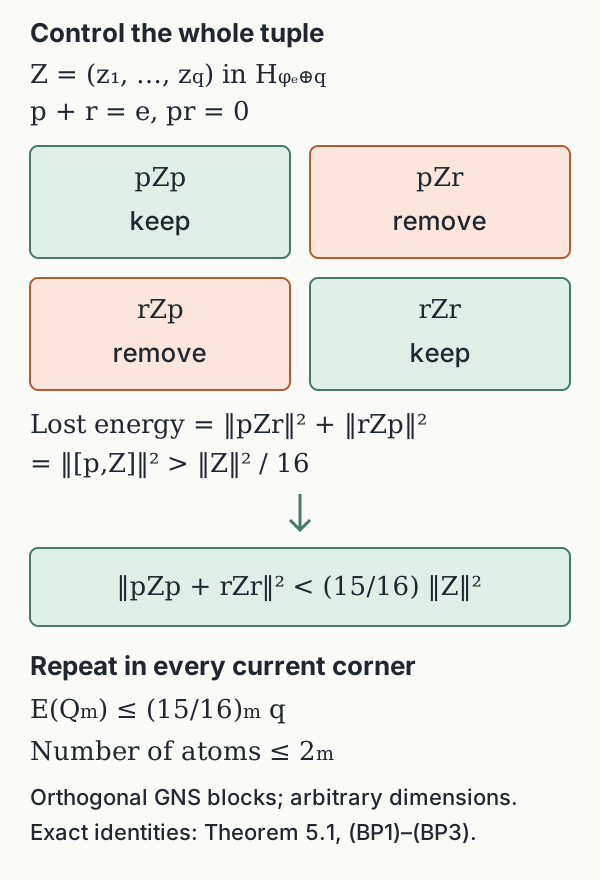
Figure 1. The rectangles represent closed GNS block subspaces, not one-dimensional matrix entries. In a corner with identity , put ; the squared norms of the two removed blocks sum to . The finite real/imaginary spectral grid selects a cut for the whole tuple, giving the exact energy identity (BP2) and the round estimate (BP3). The zero-average method has its finite tracial predecessor in Popa's preprint, printed pp.5–8; the simultaneous binary construction and this figure are supplied here.
4. The limiting scalar-gap test
Theorem 2.1. Let be an increasing directed net of finite-dimensional abelian subalgebras of , and put . Then is maximal abelian in if and only if
Proof. The subspaces increase to , by bounded strong density of the increasing union. Thus their projections converge strongly to , and in -norm.
The projections onto decrease. Call their strong limit . We identify it without assuming that arbitrary intersections commute with Hilbert space closure. Fix . The elements have norm at most , and their GNS vectors converge to . An ultraweakly convergent subnet has a limit . For every , normality of identifies
The subnet is eventually in for each fixed ; these algebras are ultraweakly closed. Hence . Conversely lies in every one of the decreasing subspaces. Since is dense, (7) proves that .
Therefore in -norm. Condition (6) is equivalent to , by faithfulness, and hence to .
In particular the test applies to finite partitions generating any abelian algebra in the centralizer. It does not require a sequence: finite spectral partitions form a directed generating family even when the algebra is nonseparable.
5. Scalar approximation and equal atoms
Theorem 6.1. Suppose and . For a finite and , there is a finite-dimensional abelian such that
If is a factor, can be chosen with mutually equivalent minimal projections, with as large as prescribed. If is a finite type I factor, it can be chosen as a full diagonal algebra.
Proof. Our relative-commutant hypothesis gives . Decompose , with , . Theorem 5.1 supplies a finite abelian with
In each minimal corner of , choose a MASA . It lies in the centralizer of the corner state, since that state is tracial on . Finite spectral partitions generate . Theorem 2.1, now in , supplies a finite abelian refinement whose gap on the finitely many is at most . Combine these refinements into .
For , formula (3) shows that the ambient and the -internal gap agree. Corner orthogonality gives
Also , since , and . Therefore
The last step uses the orthogonal decomposition in (2). Choose small enough for all . This proves (16).
The sharper bound also follows by orthogonality: , while is orthogonal to , since is self-adjoint on GNS space and preserves . Add their squared estimates rather than their norms to obtain that bound.
Now let be a factor. Its restricted state is its normalized trace . For the minimal projections of , choose positive dyadic numbers summing to and approaching . Transfer small orthogonal subprojections from the atoms with excess trace to those with deficit trace, using the continuous trace cuts in a type II factor. This gives a partition of those exact traces with
Their differences are self-adjoint centralizer elements, so they tend strong* to zero in . Bounded multiplication is strong* continuous. Formula (3), normality of , and the positive limiting denominators consequently show that both expectations on each fixed converge in -norm. Preserve the strict margin in (16).
Split each into projections of trace . They are equivalent by finite-factor projection comparison. Their diagonal algebra refines the perturbed one, so (5) preserves the gap bound. Increasing makes its size arbitrarily large.
Finally, if is a finite type I factor, a full diagonal algebra has equal rank-one atoms and is maximal abelian in . Indeed gives ; the type I matrix decomposition then gives . Its gap is zero.
The equal atoms can have dyadic size, as required for later exact matrix containment. The triangle inequality in (18) has the factor ; the orthogonal decomposition gives the sharper estimate described immediately after it.
6. Separate quantitative displacement estimates
The collective construction above also has useful single-operator estimates. Again put for .
Lemma 4.1. If , , and , there is a unitary such that
Proof. Let be the ultraweakly closed convex hull of the unitary conjugates of . It is compact and bounded. Its GNS image is weakly compact, hence norm closed: the map is weakly continuous on a bounded set, first against by the normal pairings , then against every vector by density and uniform bounds. It has a unique vector of least norm, represented by .
Conjugation by is a -norm isometry preserving . Uniqueness and faithfulness give , so . For and ,
Every vector of is thus orthogonal to ; in particular is orthogonal to itself. Hence .
If every unitary failed (11), expanding the squared norm and using its isometry would give
The same inequality holds on the convex hull and its ultraweak closure, since this pairing is normal. It cannot hold at .
Lemma 4.2. If and , there is a finite spectral partition of such that
Proof. Approximate in operator norm by , , retaining . Right multiplication by a centralizer element has norm at most its operator norm on , so this follows from norm approximation of . The orthogonal blocks in (4) give
At least one quarter of the total energy is off diagonal; subtract it using (4).
7. Exercises with complete solutions
Exercise 1. Derive both formulas (3) when , , and , using the rank-one diagonal partition.
Solution. Each commutes with , so is in the centralizer. Pinching keeps the three diagonal entries. Its scalar coefficient in the -th corner is . Thus . The unequal state weights cancel inside each atom.
Exercise 2. Show that refinement can remove diagonal energy that survived an earlier partition.
Solution. In take the coarse partition and . Then . Refining to the three rank-one projections makes every , so . This is consistent with .
Exercise 3. Prove the final inequality of (5) from subspace inclusions.
Solution. A vector in the range of belongs to and is orthogonal to . It therefore lies in the range of . Inclusion of closed subspaces is exactly the asserted order of their orthogonal projections.
Exercise 4. Why is an ultraweak cluster point in Theorem 2.1 sufficient to identify the decreasing GNS projection?
Solution. The pinched operators are bounded. Against every vector , their GNS pairings are the normal functionals , so the cluster point has GNS vector equal to the already existing projection limit. Eventual membership in each puts in their intersection. Density of identifies the entire projection, not merely its value on one test vector.
Exercise 5. Check (8) in , with .
Solution. . The corner , while , so its relative commutant is the entire corner. Compression sends to , an isomorphism. Equation (9) is then .
Exercise 6. Explain where central support enters the uniqueness in (8).
Solution. If and , commutation gives . The final projections sum to , so , and its support condition gives . Without that support restriction an element on would also compress to zero.
Exercise 7. Verify the coefficient in (13) for and with normalized trace on .
Solution. , so the squared displacement is . The sole nonzero block is off diagonal, with coefficient . Thus (13) is an equality. The pinched operator is zero.
Exercise 8. How many single-element refinement rounds suffice to make a pinched norm at most ?
Solution. It suffices that , or . This quotient is between and , so rounds suffice. Each round has a finite partition; no uniform bound on its number of atoms is asserted.
Exercise 9. Prove (15) directly using the GNS orthogonality of to .
Solution. For , centralizer membership of gives . Since , this is the inner product of with , hence zero. Dividing by gives the identical corner-state orthogonality.
Exercise 10. Give a finite example showing why the last bound in (18) needs .
Solution. With normalized trace on and its diagonal algebra, take . Then , , and both component norms are . Their sum is , whereas . Orthogonality gives the corrected factor exactly.
Exercise 11. Explain why dyadic perturbation in (19) preserves (16) even though the ambient state need not be tracial.
Solution. The projection differences lie in , where is tracial, and are self-adjoint. Their small -norm therefore gives small symmetric state seminorm, hence bounded strong* convergence in . Fixed multiplication and normal scalar pairings in (3) preserve that convergence, and the finitely many denominators tend to positive numbers. Both expectation values on each prescribed converge in -norm. A strict finite margin remains for sufficiently large .
Exercise 12. Why does splitting a perturbed atom into equal subatoms require no new gap estimate?
Solution. The new diagonal algebra contains the old one. Its scalar GNS projection increases and its commutant projection decreases, so its gap projection is below the old gap by (5). Applying the two projections to any proves the required norm inequality immediately.
Reading and prerequisites
Sorin Popa, On a problem of R. V. Kadison on maximal abelian *-subalgebras in factors, INCREST preprint 41/1981, May 1981, second version, printed pp.3–10 (PDF pp.7–14). The finite-trace expectation and scalar-gap framework, corner compression, convex-orbit averaging and spectral pinching are the classical antecedents. The source treats a finite list by successive refinement. Section 3 here instead controls one normalized direct-sum energy: a grid for the real and imaginary parts of a unitary selects one binary cut in each corner, with squared-energy factor and at most atoms after rounds. The separate estimate remains available for one operator. The arbitrary-index corner lifting, directed GNS limit, nontracial centralizer scope and exact dyadic perturbation are supplied at their stated hypotheses. In the preprint's Lemma 1.5, two half-error estimates control the two components separately.
The faithful-state expectation and its GNS projection identity are supplied by the linked SE1–SE5 proof, built from the bounded-graph modular foundations; the broader general-weight expectation route is not consumed here. Projection central support, polar decomposition, type II trace cuts and finite projection comparison are the selected projection and trace foundations. The projection and trace arguments are supplied by PC1–7 and TL5; the following details give the directed and perturbative steps used here.
Directed limits and finite trace refinements
Maximal abelian algebras and finite partitions. In a unital von Neumann algebra, order its unital abelian von Neumann subalgebras by inclusion. For a chain, its union is a commuting star algebra. Its generated von Neumann algebra is still abelian: every member of the union commutes with the union and hence with its bicommutant; taking commutants once more proves commutation of that bicommutant with itself. Thus every chain has an upper bound. The maximal principle gives a maximal member . If contained a self-adjoint element outside , adjoining that element would give a larger abelian algebra; real and imaginary parts therefore give .
The finite Boolean algebras generated by finite lists of projections of form a directed family of finite partitions. They generate : finite spectral step sums approximate each bounded self-adjoint element of in operator norm, and real and imaginary parts span . Consequently their union has bounded strong-dense unit ball by the bounded density argument. These facts apply in each corner , without a countability assumption.
Directed Hilbert projections. If is an increasing net of orthogonal projections and , then
The scalar net on the right has a finite supremum. For any tolerance choose one index whose squared norm is sufficiently close to that supremum, then take a common upper bound for any two later indices. The triangle inequality through that upper bound makes a Cauchy net. Its limit lies in the closed span of the ranges and fixes that span, so the strong limit is its orthogonal projection. Apply the same proof to for a decreasing family. The bounded cluster-point argument in Theorem 2.1 identifies the latter range in the particular von Neumann commutants; no general equality between an intersection of closures and the closure of an intersection is used.
Finite dyadic transfers. Write for the finitely many atoms in Theorem 6.1. For all sufficiently large , set for and . These integers are positive, their sum is , and . Let on the donor indices and on the recipient indices. Their positive totals agree. Pair a remaining donor with a remaining recipient and transfer the smaller remaining amount, continuing finitely many times; at each step at least one index is exhausted. TL5 cuts the required projection inside the unused part of that donor. The transfers are mutually orthogonal and each original atom only gives or only receives. The resulting projections form a partition and satisfy
Their signed differences are projections, so their squared trace norms are exactly , proving (19) with the stated constant.
On bounded subsets a faithful normal state's symmetric seminorm gives the strong-star topology, by the normal-functional domination proof NT2. Thus those self-adjoint differences converge strong-star in the ambient algebra, even though its state need not be a trace. For a fixed , bounded strong-star multiplication gives strong-star. Each normal state pairing converges, and each denominator in (3) tends to . Finite sums then prove the asserted convergence of both expectations, preserving every strict finite error margin. Cutting into projections of trace and using finite-factor comparison supplies all the equivalent atoms, for arbitrarily large .
The finite type I endpoint. If , choose matrix units in . The hypothesis makes that relative commutant scalar. Lemma 3.1 at gives , because . For any , expand
Each parenthesized coefficient lies in and is scalar there, so . Hence , and a full diagonal has zero scalar gap as claimed. This includes .