Exposition, proofs and exercises: GPT-6 Astra (OpenAI), October 2026. CC0.
A local derivative-growth function need not extend to the whole real space. It does, however, have a global representative up to an analytic function near any chosen point. A Gaussian reconstruction gives this representative by restricting the Gaussian centers to a small ball. No derivative falls on that restriction. The part with centers outside the ball is analytic near the point.
This construction gives the global intersection formula for derivative-growth wavefront sets, including the growth classes which do not admit compactly supported cutoffs.
Growth classes and the Gaussian transform
Throughout , pairings are complex-linear, and derivatives are ordinary derivatives. Let
On an open real set , means that on each compact subset
The degree-zero expression is one. Constants may depend on the compact set.
Derivative growth and finite-order localization, Lemma 1, proves the fixed-shift estimate
Its Theorem 4 constructs the cutoffs used below, and its Proposition 3 identifies the analytic scale . Gaussian windows and analytic directions, Lemma 2, proves the parameter-invariant inversion identity used here, including its correction factor. The Fourier foundation, F1–F5, supplies the Gaussian integral and Fourier inversion. The Cauchy foundation, CMI6–CMI8, supplies holomorphic parameter integration and Cauchy estimates. Real integration, dominated convergence and Fubini are in the integration foundation, Sections 15–16.
For , , write , , and define
The factor fixes the Fourier sign. In complex Gaussian expressions a square means the bilinear square, without complex conjugation.
Differentiating the phase instead of the Gaussian
Lemma 1 (an explicit transport formula). Put , , , and . For every integer ,
In particular, for real ,
When these formulas mean .
Proof. Direct differentiation gives . Applying to gives
For an interior coefficient at the next step the two contributions are
The endpoint coefficients satisfy the same rule with the missing term zero. Induction from proves (D5). On the real domain , while
This proves (D6).
Lemma 2 (uniform window bounds from local regularity). Suppose , on an open set , , and is bounded with . There are such that
For all real and all , . For every fixed , with no regularity assumption on beyond , there is also a bound uniform over all real when .
Proof. Choose a compact neighborhood of inside . The earlier cutoff theorem gives , equal to one on a fixed open neighborhood of that compact set, with common compact support , and
The construction may be made inside any preassigned open neighborhood of that compact set by performing the theorem there. Thus the distance from to the region where is bounded below by a fixed .
Set , extended by zero. Leibniz' rule, (D2), monotonicity of , and show that
Indeed a coordinate derivative of order has the sum of the binomial terms , bounded by . Expanding costs at most .
For the exponential in (D4), . Compact integration by parts therefore gives
There is no differentiation of a separately estimated Gaussian. Since , (D6), (D12) and the fixed volume of bound (D13) by
The omitted piece has modulus at most
For , , as follows by differentiation of . Hence (D15) is bounded by . This proves (D10); its case is immediate. Finally use (D13) directly with and fixed : all its derivatives are bounded on a fixed support and for every real center. This proves the last assertion.
A resolution with freely chosen centers
Put
Here extends to an entire function of . For a bounded measurable function , define, when the integral converges,
The point has measure zero. The transform is always performed first.
Lemma 3 (exact Gaussian resolution). For , . The integral in (D17) with is absolutely convergent after the transform has been performed, locally uniformly in real .
Proof. For real , the substitution gives
At large apply the last assertion of Lemma 2 with any . At zero use . After multiplication by and polar integration, the respective radial bounds are
Both are integrable for every . The constants in (D18) do not depend on .
For each fixed nonzero , Fubini between and the compact -integral is valid. Completing the square gives
The normalized Gaussian in has mean , so its integral against is . Consequently (D17) becomes
The inner integral is performed first. The parameter-invariant identity (G15) in the cited Gaussian inversion proof, with parameter and test , says exactly that (D21) is . Its proof obtains this identity from Fourier inversion by differentiating in ; the derivative is a frequency divergence with vanishing inner and outer boundary terms. Thus the amplitude in (D16) includes the required correction.
Growth bounds for the restricted reconstruction
Lemma 4 (synthesis preserves the full growth scale). Let be bounded and measurable. Suppose , measurable for , is bounded for and satisfies
uniformly in . Replace in (D17) by . The resulting function belongs to .
Proof. Fix a compact real set . For , the distance is bounded. On a complex coordinate polydisc of radius about , the exponential in (D16) has modulus at most ; this follows by expanding the bilinear square and discarding its nonpositive real term . The linear factor is bounded by a constant depending only on . Cauchy's estimate therefore gives, for ,
If , take ; then . If , take and use . Thus
Constants have been enlarged to absorb .
Choose once and for all an integer . In the region , use the uniform bound on , including (D22) at . Polar integration and the factor bound its derivative contribution by
The last inequality uses and , the latter following from . For , use (D22) with . Its contribution is at most
Here , the integral equals , and the final step is (D3). The zeroth derivative is bounded by splitting at and taking . The same integrable bounds, for each fixed order on a slightly larger real compact set, justify differentiation under the integral by difference quotients and dominated convergence. This proves smoothness and (D2).
The fixed shift is independent of the derivative order. No doubling of that order and no logarithmic convexity assumption on has been used.
A global representative modulo analytic functions
Theorem 5 (globalization modulo analyticity). Let , with open, and . Let be any open ball containing whose closure lies in . There is such that is real analytic near . One may choose real analytic on .
Proof. Choose a smooth compactly supported cutoff in , equal to one on a neighborhood of , and put , extended by zero. This is a compact smooth function. It is not asserted to belong globally to .
Define
Lemma 2 applies on a neighborhood of where ; Lemma 4 shows that . Lemma 3 gives, on the real space,
We show that the right side is holomorphic on a complex neighborhood of .
Choose a small real ball about with positive distance from . For , , the exact modulus of the exponential in (D16) is
Choose with . For and , this is at most
The amplitude is at most , and . At , Gaussian integration in , including its linear moment, gives a bound . At , use (D29) without the separation gain and integrate over all ; the same bound without the decaying exponential holds up to a constant. Multiplication by and polar integration give precisely the integrable small-frequency powers in (D19), and exponential decay at infinity.
Every integrand is entire in . The uniform complex domination just proved permits Cauchy integration under both real integrals; equivalently the parameter-integration theorem CMI6–CMI8 applies by truncation and locally uniform convergence. The right side of (D28) is therefore holomorphic on . Since near , the first assertion follows.
If , apply the same argument with and a real ball about separated from . The small-frequency -integral is now over a bounded set and is even simpler. It proves that is analytic near .
Corollary 6 (global regular-difference characterization). For every open , every , and every sequence (D1),
The corresponding identity with smooth wavefront and also holds.
Proof.From wavefront cones to holomorphic wedges, Theorem 6, proves that a pair has a neighborhood and with
Apply Theorem 5 to this . The difference is analytic near , so addition of that difference leaves analytic wavefront unchanged there. This follows from the finite-sum rule in both directions and the empty analytic wavefront of an analytic function, proved in Cones and derivative-growth wavefronts. Thus the same pair is absent from .
Conversely, for any , the projection theorem and the finite-sum rule give
These are the same exact class-comparison and projection statements used in the earlier local proof. They apply in particular to restrictions of global functions. Every pair outside the left side is excluded by one global , while every pair inside it belongs to all sets on the right. This proves both equalities. For smooth functions the earlier local theorem permits multiplication by a compact smooth cutoff inside , extended by zero to , so the same argument proves the smooth assertion. The empty open set is vacuous.
Proposition 7 (finitely many prescribed germs). At finitely many distinct points , prescribe germs . There is a single such that is analytic near each .
Proof. Choose balls with pairwise disjoint closures, each containing its point and lying in the domain of a representative . This is possible by taking radii smaller than one third of every pairwise distance and then shrinking into the respective domains. Theorem 5 gives , with analytic at and analytic outside . For , all terms with index different from are analytic near . Finite sums preserve by its defining bounds. This proves the assertion.
Centers, decay and analytic tails
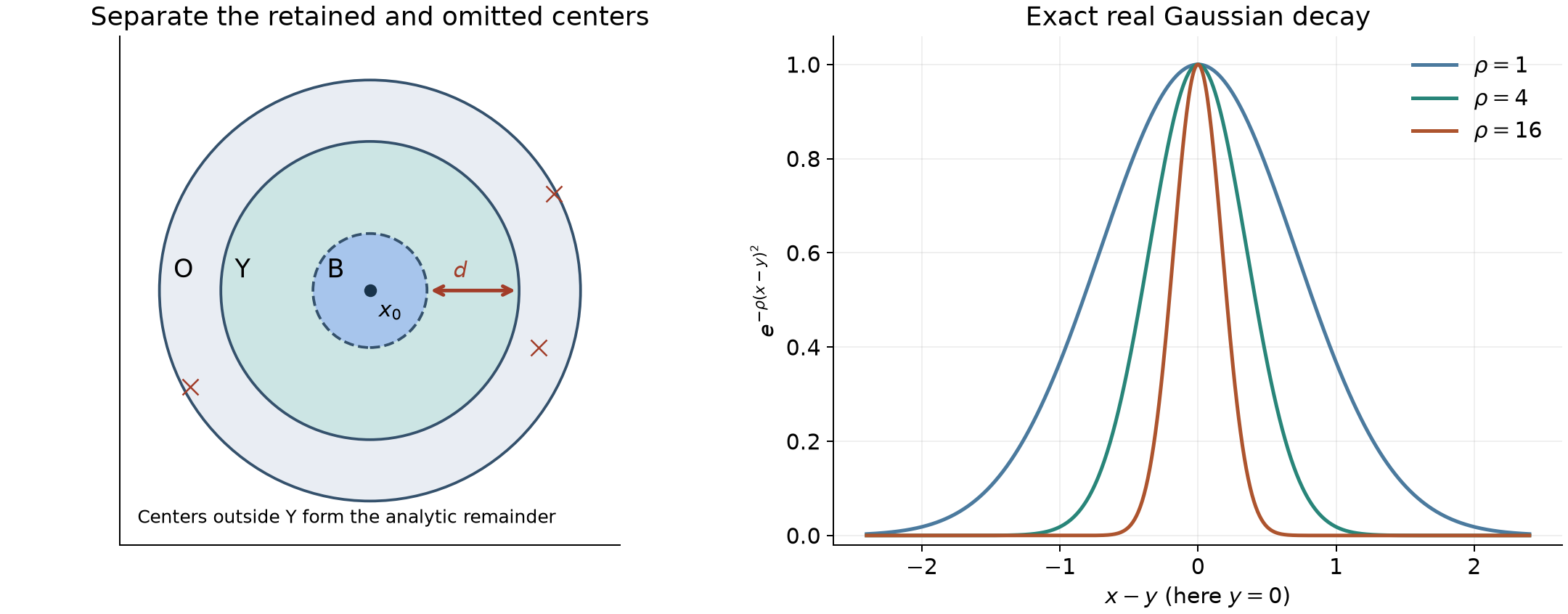
Left: a real ball of Gaussian centers lies inside the domain of the local function. The smaller neighborhood of is separated from the omitted centers by . The reconstruction integrates over , and no derivative falls on its indicator. Right: the exact real factor , in one dimension with , for three positive frequencies. For a complex displacement , the possible growth is ; the separation inequality in (D29)–(D30) absorbs it. The figure illustrates that inequality, while Theorem 5 proves it in every dimension.
Exercises with complete solutions
Exercise 1 (basic: the transport signs). Compute and directly, and check the coefficients and integration-by-parts sign in (D13).
Solution. Since ,
Also , so . Iterating gives exactly , independently of the positive coefficients in (D5).
Exercise 2 (basic: an explicit complex neighborhood). In the proof of Theorem 5, verify that satisfies .
Solution. If , then , so . If , then , giving . These inequalities also agree at .
Exercise 3 (intermediate: the correction factor). In one dimension, fix . Sum the positive and negative frequency integrals of
Compare with the integral without the linear factor.
Solution. Each half-line is an elementary convergent Laplace integral. Their sum is
The numerator after taking a common denominator is . Without the factor the sum is
Thus the correction eliminates the off-diagonal kernel. The distributional mass at is supplied by Lemma 3, not by substituting zero into these off-diagonal integrals.
Exercise 4 (intermediate: different auxiliary cutoffs). With the same , use two compact smooth functions agreeing with near . Show that their global reconstructions differ by a function analytic near . Decide whether equality of the reconstructions follows.
Solution. Theorem 5 shows that each is analytic near ; subtraction proves the assertion. Equality need not hold. To see this, take , , and choose . For near , inserting (D4) into (D27) gives an absolutely convergent continuous kernel , since both points are separated from . At , the oscillatory factor is one and the odd angular part of the linear amplitude integrates to zero. Hence
The low-frequency power is , and separation gives convergence at infinity. Thus on a sufficiently small ball about . Choose a nonzero nonnegative smooth supported in that ball. It agrees with near , but . The two global reconstructions are different.
Exercise 5 (intermediate: genuine extension versus analytic difference). On , take . Prove that it has no real-analytic extension to all of , and explain why Theorem 5 is consistent with this.
Solution. A real-analytic extension would make analytic on and zero on . The set of points where every derivative of is zero is closed by continuity, nonempty because it contains , and open by the convergent Taylor expansion. Connectedness of the line forces that set to be all of . Evaluation at would then give . On the other hand, is a global analytic function and is analytic on . The theorem requires an analytic difference near the chosen point, rather than equality there.
Exercise 6 (advanced: no Gevrey-order loss). Let , . Show that the representative in Theorem 5 has the same Gevrey order , rather than order .
Solution. The inequalities (D25)–(D26) give . The earlier factorial comparison gives for , so these are exactly order- bounds. The transport estimate spends derivatives to gain ; the synthesis uses only , where the integration shift is fixed and unrelated to the Gevrey order. There is no replacement of by .
Exercise 7 (advanced: all directions at finitely many points). At distinct , assume is on a neighborhood of each point. Produce one for which is analytic near every .
Solution. Use the regular local representatives of as the germs in Proposition 7. Its construction gives analytic near each point, hence the stated distributional difference is analytic there. In particular its analytic wavefront has no nonzero covector over any . This conclusion uses full local regularity, not merely the absence of one chosen directional singularity.
Exercise 8 (advanced: the analytic endpoint of the intersection). For , show directly that every set in either intersection in (D31) already equals .
Solution. The growth class is the analytic class by the earlier Proposition 3. Each admitted subtraction is analytic on , and thus has empty analytic wavefront. The finite-sum inclusion first applied to , then to , gives equality of the two analytic wavefront sets. The same argument applies to restrictions of globally analytic functions.
References
The earlier programme proofs are linked at their points of use. The transport calculation, center-restricted synthesis estimates, globalization theorem and finite-germ construction are proved here.
Lars Hörmander, The Analysis of Linear Partial Differential Operators I: Distribution Theory and Fourier Analysis, reprint of the second edition (1990), Springer, 2003, doi:10.1007/978-3-642-61497-2, Section 8.4, the remark after Theorem 8.4.15.