An equation can have a smooth right-hand side while its solution has one persistent singular covector along an entire line. We construct such a solution for a constant-coefficient operator of real principal type. The solution can have any prescribed finite number of continuous derivatives. Its ordinary wavefront is exactly one positive covector ray over the chosen characteristic line.
Write . Let
where is homogeneous of degree , is real on real covectors, and
Lower coefficients may be complex. Fix a nonzero real with , and put
Euler's identity follows by differentiating at . Thus and . Such data require . In one dimension a nonzero homogeneous principal polynomial has no nonzero characteristic covector.
1. Local Fourier tests and a global direction restriction
For a distribution , the pair is absent from its ordinary wavefront if a compact smooth cutoff equal to one near gives a Fourier transform decreasing faster than every inverse power on an open cone about . A fixed cutoff can replace that witness on a smaller cone when its support lies where the original cutoff is one. Indeed, for a compact distribution and compact smooth ,
On the original cone use rapid decay of ; outside it, a smaller output cone is separated from those directions, so . Rapid decay of then absorbs both the polynomial growth of and any required output weight. The complete integrable bounds and the finite-order justification of (4) are in U079 Lemma 2. This is an ordinary smooth cutoff assertion.
Choose , equal to one on a neighborhood of the ball . For , set
The supremum includes zero. The particular cutoffs are fixed once and for all; they need not have analytic derivative bounds.
Lemma 1 (countable directional tests). For , all quantities in (5) are finite if and only if
Moreover, is smooth near if and only if its wavefront has no covector over .
Proof. If (5) is finite, take and so large that a neighborhood of lies outside . Take . The one cutoff , with all , is the required witness at . Positive homogeneity proves (6).
Conversely suppose (6). Fix and a direction in the compact spherical complement of . For each , there is a regularity witness at . Choose finitely many such base neighborhoods covering that compact support, and intersect their angular neighborhoods, shrinking once more for (4). A smooth partition of subordinate to those base neighborhoods writes as a finite sum of cutoff multiples of those witnesses. To construct it, choose nonnegative compact bumps in the neighborhoods whose sum is positive near ; multiply each by and divide by that sum there, extending by zero away from its support. Formula (4) gives rapid decay for every summand on a common neighborhood of . Finitely many of these angular neighborhoods cover the spherical complement of . The maximum of the finitely many constants supplies (5), including bounded frequencies by continuity of the Fourier transform of a compact distribution.
For the last assertion, smoothness implies rapid decay after a compact cutoff by repeated integration by parts. In the reverse direction, cover the sphere by finitely many regular cones over , take one cutoff supported where all their base witnesses are one, and apply (4) on slightly smaller cones still covering the sphere. The resulting compact distribution has a globally rapidly decreasing Fourier transform. Its inverse Fourier integral and all differentiated integrals converge absolutely; on compact sets the tails converge uniformly. Fourier inversion for distributions identifies those integrals with a smooth representative of the cutoff distribution. It equals near . This also proves the usual projection of ordinary wavefront onto smooth singular support. The same local argument proves the finite-sum rule: localize both summands to one smaller cutoff and add their rapid bounds.
2. Receiving ordinary propagation from the signed parametrix
Lemma 2 (ordinary straight-line propagation). Let be open, satisfy (1)–(2), , and . Fix a characteristic . If a line interval in direction satisfies
then either every pair in belongs to , or none does.
Proof. Suppose is singular and is regular at . Work on the compact segment between them, enlarged slightly in and in the open set of forcing regularity. Replacing by if necessary, write , where for the chosen sign and . Compactly localize to a distribution equal to it near that segment, and put .
The wavefront is closed by its local definition. Compactness of the segment gives a small closed cone about on which is regular throughout a neighborhood of that segment. Shrink it so is also regular on near . Let be the complement of a smaller open cone about , with closure inside . The two closed cones cover all nonzero covectors and .
Apply the actual U079 projectors, which work for ordinary wavefront, and set , . U090 Lemma 4 proves their commutation with . Their wavefront inclusions and Lemma 1 imply
where contains the segment and contains . The pair remains in , because is regular there and the finite-sum rule applies.
Use coordinates , . Choose a compact cutoff , supported in , equal to one near the segment. Place its entire left transition in just before ; place its right transition beyond . Choose near zero, with support sufficiently narrow. These choices follow from the positive distance of the slightly extended compact segment to the complement of , and of to the complement of .
Put , . Along the backward ray , , each point has a neighborhood where either , , or is smooth in . In these cases is respectively zero, , or a derivative of a smooth product. Transition endpoints are inside the same smooth neighborhood. Consequently
The signed parametrix from U090 Theorem 3 satisfies
Since are compactly supported, the proved convolution derivative identities give
Here is smooth (in fact entire): all derivatives pass through the compact distributional pairing, whose finite-order seminorms are bounded on compact parameter sets. The ordinary convolution bound in U084 Corollary 7, together with , says that a singularity of at would require a pair in (9). The origin fiber in (10) corresponds to and is included. Thus (11) is regular at , contrary to near . Any pair of points in an unbounded interval lies in a compact subsegment, so the argument proves the full assertion.
3. A complete space that confines the possible singularities
Fix an integer . Let be the complex vector space of such that is smooth, is smooth on , and (6) holds. Distributional derivatives define even when . Set
Use the seminorms and
A supremum on an empty set is zero. Lemma 1 proves finiteness of the Fourier seminorms. These seminorms are countable and separate points because the 's do.
Lemma 3 (completeness). The space , with these exact seminorms, is a complete metrizable topological vector space.
Proof. Enumerate all the seminorms as . The functional foundation, formula BF2 and its proof, shows that
is a metric with the seminorm topology; a sequence is metric Cauchy exactly when it is Cauchy in every .
Let be such a sequence. The -estimates give uniform limits of every derivative with on each , consistent on overlaps and continuous. For , pass to the limit in
on small segments in a ball. Uniform convergence makes the error at most times the corresponding uniform derivative error. Dividing by and using continuity gives . Telescoping coordinate segments yields the full derivative, as in BF4 of the functional foundation. Induction proves a function , with . For , only the uniform continuous limit is needed.
The interiors of exhaust . Applying the same argument on small coordinate segments in one such interior, now with every derivative order, shows that the -limits give a smooth function there. Its zeroth limit is the already obtained . Thus is smooth off and .
The -Cauchy bounds similarly give a smooth limit of . For every compact test , local uniform convergence of lets us pass to the limit in its pairing with the fixed formal-transpose derivative of . Hence as distributions. It also converges to , so , with convergence in each .
Finally fix . The functions
, restricted to , are uniformly Cauchy by (5), so have a bounded uniform limit. For each fixed , the compactly supported functions converge in , since they converge uniformly on a common compact set. Their Fourier transforms converge pointwise to . This identifies the bounded uniform limit and proves both and . Lemma 1 now gives (6). Thus , with convergence in every original seminorm and in (14). The space is complete.
4. What Baire would force if the line were always smooth
Choose a coordinate index with , and define an extended seminorm
The value is allowed.
Lemma 4 (a forced finite estimate). If every member of is on some neighborhood of the origin, then there are finitely many defining seminorms and such that
Proof. Every global smooth function belongs to , by compact-cutoff integration by parts. Under the hypothesis, each has finite : near use the fundamental theorem and a bounded -st derivative on a small segment; for bounded away from zero use continuity of the -th derivative on the unit segment.
The sets , , are closed. They are intersections, over all , of closed inequalities involving continuous evaluations. They cover . Its complete metric and the proved closed-cover form of Baire therefore give a nonempty interior for some . Choose and a balanced neighborhood of zero with . For , subadditivity gives
.
There exist a finite maximum and such that implies ; an can be added if necessary. For , apply this bound to . It gives . If , every positive multiple of lies in ; arbitrary rescaling gives . For smooth , the difference quotient in (16) tends to . This proves (17), without an appeal to a closed-graph theorem.
5. Narrow packets defeat every such estimate
Use the linear coordinates
Then . The finite polynomial expansion in a parameter is
To check it, Taylor-expand each homogeneous polynomial exactly:
The coefficient of is zero. The coefficient of has precisely the two terms displayed; a term at has . This derives every order bound and allows complex .
Choose , supported in , with . The radius will be chosen after a proposed finite estimate. Define
Every is globally smooth and supported in the same transverse cylinder. Differentiation and integration in do not enlarge the transverse support. Direct differentiation verifies
In particular the sign in (20) corresponds to . Exponential growth as is permitted; all our estimates are on compact sets.
Lemma 5 (packet estimates). Fix finitely many seminorms from (5) and (13). One can choose and an integer so that the global smooth functions
satisfy every chosen seminorm bound , while
All constants may depend on the chosen finite list, , and the fixed amplitudes, but not on .
Proof. Each chosen is by the product rule on its compact ball. For the finitely many , choose for every involved . The cylinder supporting every amplitude is then disjoint from those , so these seminorms vanish exactly.
Conjugating by the exponential in (22) gives (19). The recurrence (20) cancels every combined index below , leaving
The 's are fixed smooth functions. When , the sum is empty and the equation is exactly homogeneous. Otherwise, on each fixed ball,
Choose , where is the largest order among the finitely many chosen , or zero if there are none. This makes all of them , even .
For a chosen , the exact Fourier shift is
There is a constant such that
For a proof, divide by . The normalized pair lies in a compact set with , , and outside the open cone. A zero of would have , in the forbidden positive direction; would also force , contrary to normalization. The continuous norm therefore has a positive minimum. Scaling proves (27).
Every is compact smooth. Integration by parts with gives
.
For any desired , choose . Equations (26)–(27) and
give . This argument applies to every member of the finite Fourier list, with its own constant, and in particular gives the required .
Finally, the amplitude in (22) equals one at the origin: , for . In the product-rule expansion of the derivative of order , the term with every derivative on the exponential is exactly the leading term of (23). Every other term has at most factors of , and all amplitude derivatives at zero are bounded uniformly for . This proves (23).
6. Exact realization on the whole line
Theorem 6 (one global characteristic ray). For every integer , every operator satisfying (1)–(2), every nonzero characteristic , and every , there is a complex function such that and
For , the function can be chosen not on any neighborhood of zero.
Proof. First take . If every were near zero, Lemma 4 would give a finite estimate (17). Choose the packets of Lemma 5 for exactly its finitely many seminorms. Its right-hand side is , whereas (23), with , has absolute value at least for large . This is impossible. Hence some is not on any neighborhood of zero.
Such a function is not smooth near zero. Lemma 1 supplies a wavefront covector over zero, and (6) forces it to be a positive multiple of . Positive conicity then gives . Its forcing is smooth on all of , so Lemma 2 propagates that covector over the whole line . Positive scaling gives every pair on the right of (29). The reverse inclusion follows from the defining smoothness off and (6). Translating this function by proves the general case: constant-coefficient differentiation commutes with translation, and translating a cutoff Fourier witness multiplies its transform by a phase of absolute value one. Thus wavefront base points translate exactly.
The theorem prescribes ordinary smooth wavefront. It does not assert that the analytic wavefront is the same set. It gives smooth forcing, without requiring that forcing to be zero. Both distinctions matter: finite differentiability allows ordinary singularities, and a separate solvability argument would be needed to subtract a smooth solution with that forcing.
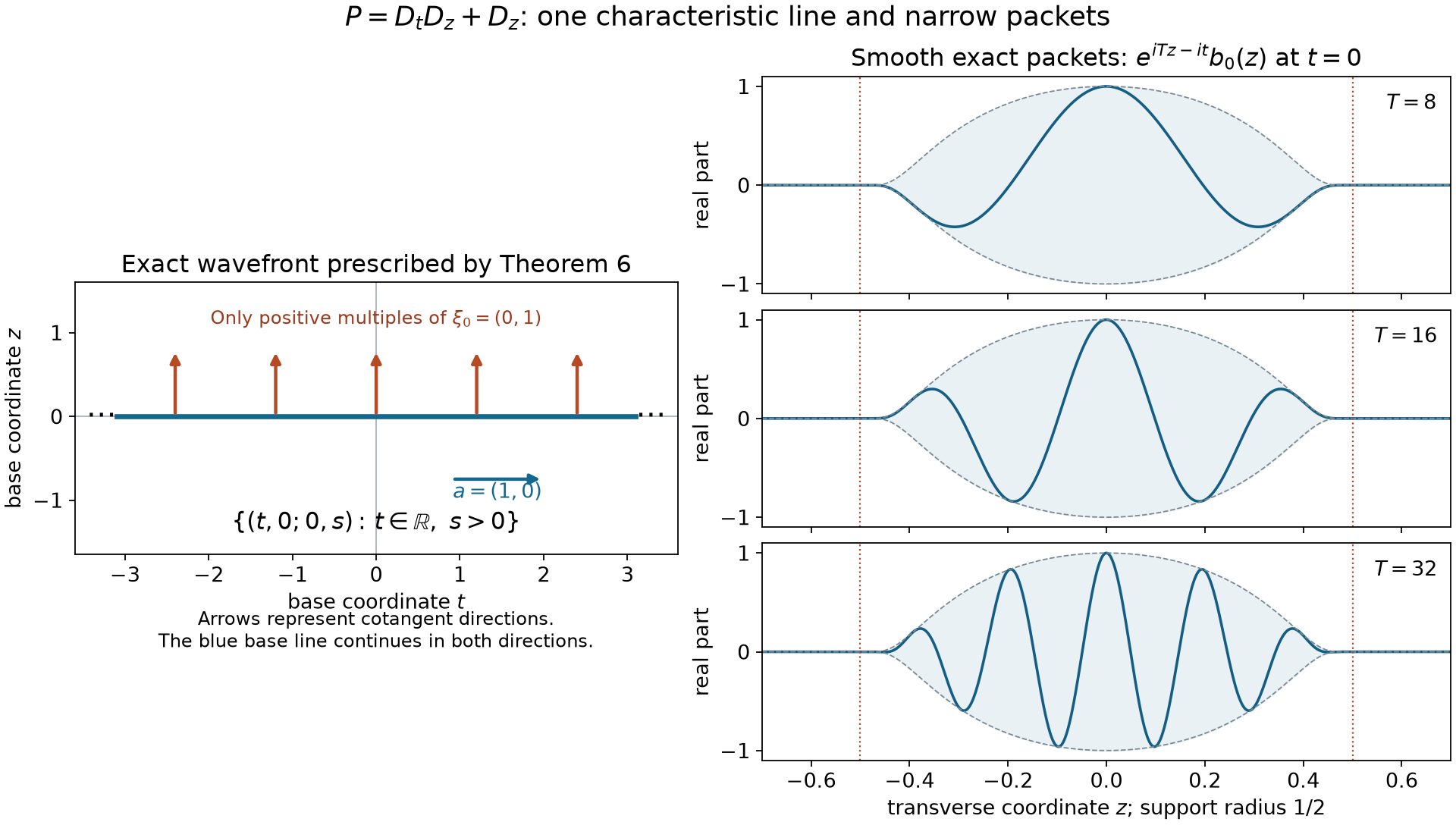
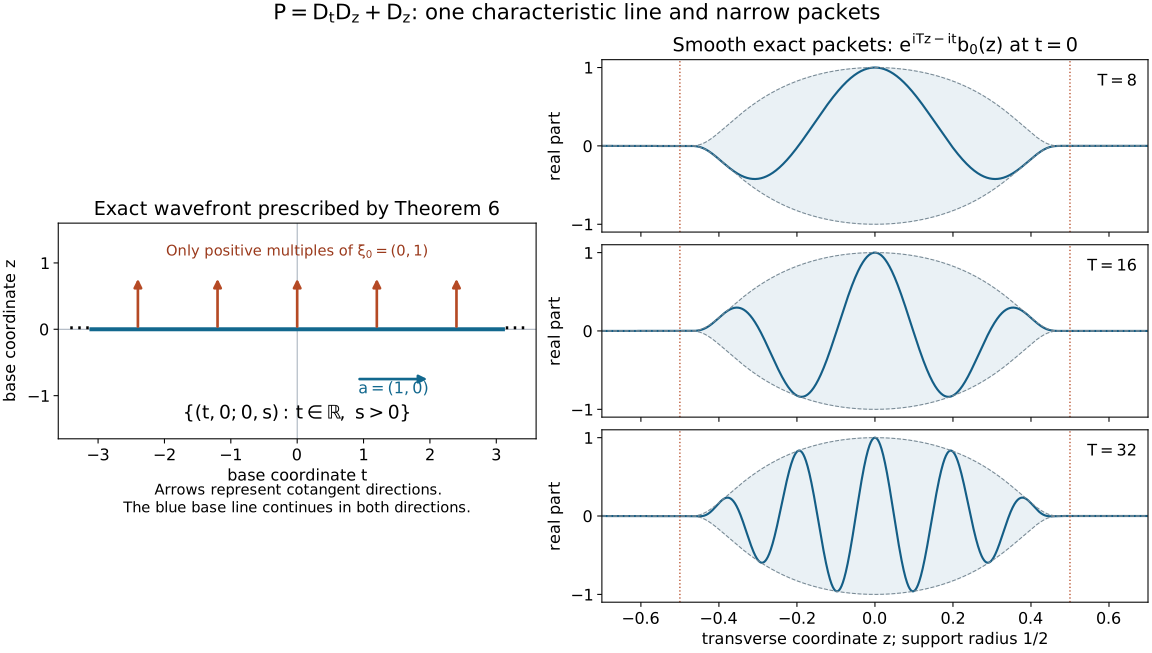
Left: for and , one has . The theorem prescribes the complete -axis and only positive multiples of over it. The arrows display covectors, not additional base directions. Right: the plotted real parts of the exact packets at , with , share a transverse support radius . These packets satisfy by Exercise 3. They are smooth for each finite ; the existence proof uses their derivative estimates and Baire. Vector figure · Plotting source.
7. Exercises with complete solutions
Exercise 1 (foundation: a real solution cannot select just one sign). Show that a real distribution cannot have exactly the nonempty wavefront in (29).
Solution. For a compact distribution ,
, by the Fourier pairing and complex conjugation. Conjugating a cutoff witness gives a witness in the opposite cone, and conjugating twice proves
For real , its wavefront is symmetric under . The nonempty positive ray in (29) is not symmetric. Thus complex-valued functions are essential for this exact one-sign prescription, even when has real coefficients.
Exercise 2 (intermediate: the first-order equation has no packet remainder). Take , real, , with . Check the packet construction and the forcing estimate directly.
Solution. Here , , and there are no with . Formula (20) gives for . Thus . Differentiation along leaves and the oscillatory factor constant, while . Hence exactly. Its fixed compact derivatives through order grow at most like , and its derivative of order in a direction with nonzero -component grows as in (23). Complex changes the amplitude on compact longitudinal intervals but none of these estimates.
Exercise 3 (intermediate: a second-order exact model). On coordinates , use and . Derive (19) and verify the packets in the figure.
Solution. The principal polynomial is , with gradient , nonzero at every nonzero point of . At it is . Direct expansion gives
Thus , , and . Since , every higher receiver in (20) is zero. The exact packet is annihilated by , since the two factors commute. For the figure,
It equals one at zero. It is smooth at the endpoints: each interior derivative is its exponential times a rational function whose growth is a fixed inverse power of ; exponential decay beats every such power, by the exponential series estimate. All one-sided derivatives therefore tend to zero. At , the plotted real part is , as stated.
Exercise 4 (advanced: why the full line is necessary). Under the hypotheses of Theorem 6, can smooth forcing coexist with a wavefront consisting exactly of a nonempty finite closed segment of the line in (29), with the same positive covector ray?
Solution. No. Select any point of that segment and the covector . Since the forcing is smooth globally, Lemma 2 puts the same covector over every point of the entire line, contradicting the asserted finite segment. A finite-ray construction with singular forcing at its endpoints has different hypotheses; those endpoints prevent applying (7) across the boundary of the segment. Smooth global forcing is the precise reason the current result prescribes the whole line.
Exercise 5 (intermediate: the finite neighborhood is used in two different ways). Explain why the radius of and the truncation length are chosen after the finite seminorm list in Lemma 4. Show that neither parameter needs to depend on .
Solution. Finitely many off-line seminorms involve finitely many positive distances . A fixed smaller than half their minimum makes every one vanish. Finitely many forcing seminorms involve a largest derivative order . A fixed makes (25) at most for all of them. Once these choices are made, all amplitudes are fixed, so their compact derivative and Fourier constants are independent of . Infinitely many off-line seminorms would have distances tending to zero, and infinitely many forcing seminorms would have no largest order. The Baire conclusion supplies exactly the finiteness that makes both choices possible.
Exercise 6 (advanced: no automatic homogeneous correction). Suppose a separately proved theorem supplies a smooth global solution of for the function in Theorem 6. What conclusion follows, and which step is conditional?
Solution. Then satisfies . A smooth summand has empty wavefront, so the finite-sum rule gives ; applying it to gives the reverse inclusion. Hence has exactly (29). If were near zero in the untranslated case, so would , contradicting the choice in Theorem 6. The existence of such a global smooth is the conditional step. It does not follow from the mere smoothness of the right-hand side or from the present Baire argument.
Exercise 7 (intermediate: both time directions of a wave). For , describe the set (29) at a nonzero characteristic .
Solution. The gradient is , and . The base line is
, . Its spatial speed relative to time is one, in the fixed direction . Over every point the covectors are positive multiples of ; these retain one time-covector sign even though the base parameter runs in both directions. Applying Theorem 6 to the opposite characteristic covector is a separate valid choice. One need not conjugate an equation with complex lower coefficients to obtain it.
The functional foundation, Sections 6, 14.1–14.2 and 19, supplies complete-metric Baire and its selected logical basis. Lemma 3 verifies completeness for the actual space used here; Lemma 4 derives its estimate directly.
Lars Hörmander, The Analysis of Linear Partial Differential Operators I, second edition, 2003 reprint, Theorem 8.3.8 and its proof, pp. 278–280, is the mathematical antecedent for global singular-ray realization. The finite-difference Baire argument, exposition, examples, exercises and figure here are independently expressed. The theorem is proved for every finite , including .