# The dual-center kernel through central overlap
A frequency survives every fixed corner precisely when the corresponding dual automorphism fixes the crossed-product center. We first prove a general overlap theorem for an integrable action with eigenunitaries. We then construct that setting by regular stabilization, check its full normal maps and bounded orbit domain, and transport the conclusion back. The direct absorption proof \(\Gamma(\alpha)+\operatorname{Sp}(\alpha)=\operatorname{Sp}(\alpha)\) and its closed-subgroup deduction give a second route to the subgroup property.
The group is arbitrary locally compact Hausdorff abelian and the von Neumann algebra and representation Hilbert spaces are arbitrary. There is no countability, separability, factor, finite-Haar or original-action integrability assumption.
*New expression is CC0-1.0 to the extent of rights held; original and prerequisite component terms retain their own terms.*
## Earlier proofs, definition and the reflected labels
The complete fixed-corner definition, restriction and local detection are [GCC SETTING/DEFINITION](OA-FLOW-GCC.md#gcc-setting); its [TOOLS](OA-FLOW-GCC.md#gcc-tools), [CENTRAL](OA-FLOW-GCC.md#gcc-central) and [INTERSECTION](OA-FLOW-GCC.md#gcc-intersection) give arbitrary support joins and the reduction to central fixed corners. The actual arbitrary-LCA cocycle-invariance proof is [L112's matrix and corner arguments](OA-FLOW-L112.md#cm-matrix), including [its completed corner conclusion](OA-FLOW-L112.md#cm-corners). The tensor action, full fixed-algebra realization and generator-preserving normal transport are [NCF1–3](OA-FLOW-NCF.md#ncf-1). None of these inputs is replaced by a real-action specialization.
The normal integrated maps and concrete predual tests are [AT1/3/5](OA-FLOW-AT.md#oa-flow.at.1) and [CP6](OA-FLOW-CP.md#oa-flow.cp.6). Local Fourier plateaus and hull/filter/product rules are [LF1](OA-FLOW-LF.md#lf-1), [GL1–3/6–7](OA-FLOW-GL.md#gl-1) and [SS3](OA-FLOW-SS.md#ss-3). The scalar and arbitrary-Hilbert integration conventions are [L24's Haar, translation and tensor proofs](OA-FLOW-L24.md#oa-flow.grp.haarconventions), [HR3/5/7–9](OA-FLOW-HR.md#hr-03), [H0 compact-neighborhood shrinking](OA-FLOW-TOPOLOGY.md#l138-h0), [H1 compact-open dual topology](OA-FLOW-HARMONIC.md#l138-h1), [BD4–5 normal generation and bounded strong limits](OA-FLOW-BD.md#oa-flow.bd.4) and [the normal multiplier algebra](OA-FLOW-ND.md#nd-multiplication). The full extended-positive values and normal positive vector tests are [EP1–3](OA-FLOW-EP.md#oa-flow.ep.1).
The full orbit operator-valued weight, exact bounded-domain/semifiniteness criterion and open eigenfrequency detection are the actual completed [L114 average and density proofs](OA-FLOW-L114.md#ip-average) and [L114 open localization](OA-FLOW-L114.md#ip-open). The continuous abelian part and local projection displacement are the complete [L113 continuous-part proof](OA-FLOW-L113.md#l113-continuous) and [L113 displacement proof](OA-FLOW-L113.md#l113-displacement). These earlier lessons give the density and local-displacement statements in the generality used below.
Throughout let \(G\) be LCH abelian, let \(M\ne0\) be a von Neumann algebra and let \(\alpha:G\to\operatorname{Aut}(M)\) be a point-ultraweakly continuous action by normal automorphisms. Put \(F=M^\alpha\). The reduced action on a fixed corner \(eMe\) is denoted \(\alpha^e\); \(\Gamma(\alpha)\) is the intersection of its action spectra over every nonzero \(e\in\operatorname{Proj}(F)\), at exactly the GCC definition. Put \(H=\widehat G\), write its group law additively, and use \(p(s)=(s,p)\). For this lesson the K-formulas have **positive eigenfrequency labels**: \(\alpha_s(x)=p(s)x\) has label \(p\). More precisely, with the same actual AT5 map \(T_bx=\int b(s)\alpha_s(x)\,ds\), put
\[
f_b^+(p)=\int_G b(s)p(s)\,ds,\qquad
F_b^-(p)=\int_G b(s)\overline{p(s)}\,ds,\qquad
f_b^+(p)=F_b^-(-p).
\tag{DK1}
\]
The positive-label annihilator is the reflection of the GL annihilator. The complete L114 reflection argument consequently gives
\[
\operatorname{Sp}_\alpha(x)=-\operatorname{sp}_{\mathrm{GL},\alpha}(x),
\qquad M_\alpha(E)=M_{\mathrm{GL},\alpha}(-E).
\tag{DK2}
\]
The Fourier algebra and its norm are unchanged by reflection. Thus every local plateau, filter law, closedness and spectral product theorem below is the reflected version of its exact earlier proof. Each corner action spectrum is symmetric by adjoint reflection, as already proved in GCC DEFINITION, so its positive-label action spectrum equals its negative-label action spectrum. Their intersections give the same \(\Gamma\). This explains why K1 and the current GCC definition agree; it does not assert symmetry of an individual vector spectrum.
For any nonzero action \(\beta\), local detection says that \(p\in\operatorname{Sp}(\beta)\) if and only if every neighborhood \(U\ni p\) contains the compact spectrum of a nonzero element. To see the stronger compact formulation, a positive-label plateau \(f\in A_c(H)\), supported inside \(U\) and nonzero at \(p\), has \(\beta_f\ne0\) by the hull definition. A nonzero \(\beta_f(y)\) has spectrum in \(\operatorname{supp}f\subset U\). Conversely a neighborhood disjoint from the closed action spectrum contains no nonzero vector spectrum, by GL2/7 and the empty-spectrum criterion. All neighborhoods are nets; no countable base is presumed.
## Fixed-corner compression retains integrability
Let \(\beta:G\to\operatorname{Aut}(P)\) be a normal continuous action, let \(e\in P^\beta\) be a projection, and put \(F_\beta=\mathcal P_\beta^+\) for L114's bounded positive orbit domain. For \(a\in F_\beta\) and every compact \(C\subset G\), normal compression of the actual compact integral gives
\[
T_{\beta^e,C}(eae)=eT_{\beta,C}(a)e,\qquad
\|T_{\beta^e,C}(eae)\|\le\|T_\beta(a)\|.
\tag{DK3}
\]
The equality is tested against every normal functional on \(ePe\): its extension \(z\mapsto\omega(eze)\) is normal, by CP6's vector-series substitution. Its scalar integral is exactly the defining corner integral. The bound follows from \(0\le T_{\beta,C}(a)\le T_\beta(a)\). Thus \(eae\in F_{\beta^e}\), and bounded monotone limits give \(T_{\beta^e}(eae)=eT_\beta(a)e\). No Bochner integrability of an operator orbit is being assumed.
If \(\beta\) is integrable, L114's full density theorem makes \(\mathfrak p_\beta=\operatorname{span}_{\mathbb C}F_\beta\) ultraweakly dense in \(P\). For any \(x\in ePe\), choose a net \(x_i\in\mathfrak p_\beta\) tending ultraweakly to \(x\). Normal compression gives \(ex_ie\to x\). Each compression is a finite complex linear combination of positive elements of \(F_{\beta^e}\), by (DK3). Hence \(\mathfrak p_{\beta^e}\) is ultraweakly dense in \(ePe\), and the same complete density criterion makes \(\beta^e\) integrable. The zero corner is harmless: its bounded domain and its whole algebra are both zero. The later Connes intersections concern nonzero corners only.
## An abstract integrable principal-eigenspace theorem
**Theorem.** Let \(\beta\) be an integrable normal point-ultraweakly continuous action of \(G\) on a nonzero von Neumann algebra \(P\). Let \(\mu:H\to\mathcal U(P)\) be a strongly continuous unitary representation satisfying
\[
\beta_s(\mu_p)=p(s)\mu_p\qquad(s\in G,\ p\in H).
\tag{DK4}
\]
Put \(B=P^\beta\) and \(\delta_p=\operatorname{Ad}(\mu_p)|_{Z(B)}\). Then
\[
\Gamma(\beta)=\{p\in H:\delta_p=\operatorname{id}_{Z(B)}\}.
\tag{DK5}
\]
The claim does not assume that the eigenunitaries belong to \(B\).
**Proof.** For \(b\in B\), the scalar factors in
\(\beta_s(\mu_p b\mu_p^*)\) cancel. Thus \(\mu_p\) normalizes \(B\), and also \(Z(B)\). Conjugation is normal by the vector-series test in CP6. The representation law gives an action \(\delta\) of \(H\). It is point-ultraweakly continuous: for a vector functional of \(\mu_p z\mu_p^*\), split the difference into the two changing vectors \(\mu_p^*\xi,\mu_p^*\eta\); strong continuity and the bound \(\|z\|\) control both terms. A summable normal vector series has a uniformly small tail, so the conclusion holds for every normal functional. The center is a von Neumann algebra, since commutation with each fixed bounded element is an ultraweakly closed condition. Consequently the complete L113 normal abelian-action theorem applies to this center and its actual norm-continuous part.
Write \(P_p=\{x:\beta_s(x)=p(s)x\text{ for all }s\}\). The product \(x\mu_p^*\) is fixed whenever \(x\in P_p\); conversely \(b\mu_p\in P_p\) for \(b\in B\). Fixed multiplication is ultraweakly continuous, with inverse multiplication by \(\mu_p^*\). Thus
\[
P_p=B\mu_p
\quad\hbox{as ultraweakly closed linear spaces}.
\tag{DK6}
\]
The reflected singleton theorem SS3 identifies this actual eigenoperator space with the positive-label singleton spectral space, including its zero element.
For a nonzero central projection \(e\in Z(B)\), the corner's \(p\)-eigenspace is precisely \(eP_pe=P_p\cap ePe\): fixed compression preserves the eigenphase, and an element already in the corner is its own compression. Since \(e\) and \(\delta_p(e)\) are central in \(B\),
\[
eP_pe=B e\delta_p(e)\mu_p,\qquad
eP_pe\ne\{0\}\ \Longleftrightarrow\ e\delta_p(e)\ne0.
\tag{DK7}
\]
Indeed \(\mu_pe=\delta_p(e)\mu_p\). If \(k=e\delta_p(e)=0\), the entire right-hand space is zero. If \(k\ne0\), then \(k\mu_p=e(k\mu_p)e\) is an actual \(p\)-eigenoperator; unitarity gives \(\|k\mu_p\|=\|k\|=1\). This proves both nonzero implications.
If \(\delta_p\) fixes the center, every nonzero central \(e\) has \(e\delta_p(e)=e\). Its corner therefore detects \(p\). GCC's complete central-corner intersection puts \(p\) in \(\Gamma(\beta)\).
If \(\delta_p\ne\operatorname{id}\), L113 displacement supplies \(0\ne e\in\operatorname{Proj}(Z(B))\) and an open neighborhood \(U\ni p\) such that \(e\delta_q(e)=0\) for all \(q\in U\). Formula (DK7) makes every such corner eigenspace zero. The compression proof above makes \(\beta^e\) integrable. The direct open-localization theorem of L114 then gives \((ePe)_0^{\beta^e}(U)=0\), where the subscript means the ultraweakly closed span of filters with positive Fourier support in \(U\). Choose a compactly supported plateau \(f\) with \(f(p)=1\) and support in \(U\). Every \((\beta^e)_f(y)\) belongs to that zero space, so \(f\) is in the action annihilator while \(f(p)=1\). Its hull therefore omits \(p\). Thus \(p\notin\operatorname{Sp}(\beta^e)\), hence \(p\notin\Gamma(\beta)\). This proves (DK5). \(\square\)
The open-localization step is essential: the absence of one eigenoperator alone would not exclude a limit frequency from an arbitrary action spectrum.
## Stabilization preserves the Connes spectrum
Let \(\mathcal K=L^2(G)\), and define the right regular representation and its conjugation action by
$$
(R_s\xi)(r)=\xi(r+s),\qquad
\rho_s=\operatorname{Ad}R_s. \tag{K15}
$$
On
$$
\overline M=M\ \overline\otimes\ B(\mathcal K) \tag{K16}
$$
consider
$$
\overline\alpha_s=\alpha_s\otimes\operatorname{id},
\qquad
\widetilde\alpha_s=\alpha_s\otimes\rho_s. \tag{K17}
$$
The normal tensor action exists on the entire spatial tensor product by NCF1/3. In a faithful standard representation, the implementation from NCF2 makes it point-ultraweakly continuous; NCF3 transports that property normally to every faithful representation. The original Hilbert space need not itself implement \(\alpha\). The fixed algebra of \(\overline\alpha\) is
$$
\overline M^{\overline\alpha}
=F\ \overline\otimes\ B(\mathcal K),\qquad
Z(\overline M^{\overline\alpha})=Z(F)\otimes1. \tag{K18}
$$
NCF1 proves the first identity in (K18) by all matrix entries, at arbitrary Hilbert dimension. Here is the center calculation. An element central in \(F\bar\otimes B(\mathcal K)\) commutes with every second-factor matrix unit. Commutation with each diagonal matrix unit makes all off-diagonal entries zero; commutation with \(|e_i\rangle\langle e_j|\) makes all diagonal entries equal to some \(z\in F\). Thus the element is \(z\otimes1\). Commutation with \(a\otimes1\), for \(a\in F\), makes \(z\in Z(F)\). Conversely every such tensor is central, proving the second identity. A basis exists by the earlier Hilbert proof used in NCF1; it is not presumed countable. Also \(\mathcal K\ne0\): a nonzero compact Haar bump has positive finite squared norm by HR3/6.
For every nonzero \(c\in\operatorname{Proj}(Z(F))\), the action on the corresponding central corner is
\(\alpha^c\otimes\operatorname{id}\). Its Fourier filter is
\((\alpha^c)_f\otimes\operatorname{id}\), so its action annihilator and spectrum equal those of \(\alpha^c\). For precision, the normal filter identity is checked entrywise against matrix vector tests: AT5 makes each entry the filtered entry, so all entries agree. A bounded matrix slice is normal by CP6; NCF1 constructs the normal tensor automorphisms, and AT5 constructs their normal integrated filter. No tensor extension of an arbitrary bounded map is presumed. If the base filter vanishes, every matrix entry of its amplification vanishes, so the amplified filter is zero. If it does not vanish, test a nonzero base output tensored with a rank-one projection. The two action annihilators are equal, hence their hull spectra are equal. Since central fixed corners suffice by the earlier GCC proof,
$$
\Gamma(\overline\alpha)=\Gamma(\alpha). \tag{K19}
$$
Equivalently, a rank-one projection on the second tensor factor is fixed, has central support one in (K18), and cuts the stabilized action back to \(\alpha\).
The unitaries
$$
u_s=1\otimes R_s \tag{K20}
$$
are strongly continuous and form an \(\overline\alpha\)-cocycle. In the abelian case the Haar modular function is one, and \(R_s=L_{-s}\); L24 gives strong continuity. The tensor unitaries are strongly continuous first on elementary vectors and then on all vectors by finite tensor approximation and their common norm one. Since \(\overline\alpha_s(1\otimes R_t)=1\otimes R_t\), their group law is exactly the cocycle identity. Moreover
$$
\operatorname{Ad}(u_s)\circ\overline\alpha_s
=\widetilde\alpha_s. \tag{K21}
$$
The cocycle-invariance theorem proved in [L112's complete matrix-corner theorem](OA-FLOW-L112.md#cm-corners) therefore gives
$$
\boxed{\Gamma(\widetilde\alpha)
=\Gamma(\overline\alpha)
=\Gamma(\alpha).} \tag{K22}
$$
Here is the transport used for cocycle conjugacy. If \(\Phi\) is an equivariant normal star isomorphism with normal inverse, scalar predual tests give \(\Phi(T_bx)=T_b\Phi(x)\) for every \(b\in L^1(G)\). The corresponding action filters vanish simultaneously, and element annihilators and hull spectra agree. Fixed projections correspond bijectively under \(\Phi\), and the same integral identity holds in each corner. Thus the intersections defining \(\Gamma\) agree. Applying this transport after the complete L112 cocycle theorem proves invariance under cocycle conjugacy, at exactly these normality and strong-cocycle hypotheses.
## The regular tensor action is integrable
Use the complete locally determined Haar convention of HR8–9 for \(L^\infty(G)\), and the canonical finite-exponent \(L^2(G)\) comparison with the outer regular Radon convention. The multiplier representation on \(\mathcal K\) is the actual ND multiplication-algebra proof. No global-null-set identification of the two raw measures is asserted. Formula (K15) gives
$$
\rho_s(M_h)=M_{h(s+\,\cdot\,)}. \tag{K23}
$$
If \(0\le h\in L^1(G)\cap L^\infty(G)\), then
$$
\int_G\rho_s(M_h)\,ds
=\left(\int_Gh(r)\,dr\right)1. \tag{K24}
$$
The integral in (K24) is an extended-positive orbit value, not an operator-norm Bochner integral. For a vector \(\xi\in L^2(G)\), choose Borel representatives of \(h\) and \(|\xi|^2\) on their sigma compact carriers, supplied by HR3/9. The nonnegative function \(h(r+s)|\xi(r)|^2\) has a sigma-finite Radon-product carrier: the shear \((s,r)\mapsto(r+s,r)\) sends it into the product of those two carriers. HR5 gives its two iterated integrals, and HR7 gives the exact measure-preserving shear and Haar change. Therefore
\[
\int_G\langle\rho_s(M_h)\xi,\xi\rangle\,ds
=\int_G\int_G h(r+s)|\xi(r)|^2\,dr\,ds
=\left(\int_Gh\right)\|\xi\|_2^2.
\tag{DK8}
\]
Changing representatives changes only null sections on this carrier. L114 constructs the full extended value; EP2–3 identifies it from all its vector quadratic forms. The displayed common bound makes that value precisely the bounded scalar operator in (K24). EP1's positive normal vector series gives the same equality on every normal positive functional. This verifies both the full-cone meaning and the asserted bounded domain.
Thus these positive multipliers belong to the bounded integrability domain. Write \(q_K=M_{1_K}\) for a compact subset \(K\Subset G\). For each \(\xi\in L^2(G)\) and error \(\epsilon>0\), HR3 gives \(g\in C_c(G)\) with \(\|\xi-g\|_2<\epsilon\). Whenever \(K\) contains \(\operatorname{supp}g\), \(\|(1-q_K)\xi\|_2\le\epsilon\). Thus \(q_K\to1\) strongly along the directed net of all compact subsets; finite unions give its upper bounds. This proof uses no compact exhaustion of the entire group, and (K24) gives \(T_\rho(q_K)=m(K)1\). For every \(a\in B(\mathcal K)_+\), heredity of the integrable positive cone gives
$$0\le q_Ka q_K\le\|a\|q_K,
\qquad T_\rho(q_Ka q_K)\le\|a\|m(K)1.
\tag{K24a}$$
These bounded positive compressions converge strongly to \(a\), so their span is ultraweakly dense and \(\rho\) is integrable.
The same projections in the invariant subalgebra
$$
1\otimes L^\infty(G)\subset\overline M \tag{K25}
$$
give an explicit density proof for \(\widetilde\alpha=\alpha\otimes\rho\). Put \(Q_K=1\otimes q_K\). The operators \(Q_K\) converge strongly to one: this is first the preceding \(L^2\) limit on elementary tensors and then finite tensor approximation with the norm bound one. The compact orbit averages of \(Q_K\) are \(1\otimes T_{\rho,C}(q_K)\), by the elementary tensor action and normal vector tests. Those averages are uniformly bounded by \(m(K)1\); their bounded increasing strong supremum is \(m(K)1\), by NCF1's normal matrix entries or by all elementary vector quadratic forms and polarization. Its orbit integral is \(m(K)1\), and for every \(a\in\overline M_+\),
$$\begin{aligned}
0\le Q_KaQ_K&\le\|a\|Q_K,\\
T_{\widetilde\alpha}(Q_KaQ_K)&\le\|a\|m(K)1,\\
Q_KaQ_K&\longrightarrow a\quad\text{strongly}.
\end{aligned}\tag{K25a}$$
Therefore positive integrable elements have ultraweakly dense linear span in \(\overline M\). [L114's completed full operator-valued-weight density criterion](OA-FLOW-L114.md#ip-density) yields integrability of \(\widetilde\alpha\), regardless of whether \(\alpha\) is integrable.
We also need integrability after taking a fixed corner. Let \(\beta\) be an integrable action on \(P\), let \(e\in P^\beta\), and let \(a\ge0\) have bounded positive orbit integral. Then
$$
\int_G\beta_s^e(eae)\,ds
=e\left(\int_G\beta_s(a)\,ds\right)e. \tag{K26}
$$
By the actual L114 density criterion, \(\mathfrak p_\beta=\operatorname{span}_{\mathbb C}\mathcal P_\beta^+\) is ultraweakly dense in \(P\). The normal map \(x\mapsto exe\) has range \(ePe\), so \(e\mathfrak p_\beta e\) is ultraweakly dense in that corner. Every positive generator \(eae\), with \(a\in\mathcal P_\beta^+\), has bounded orbit integral by (K26). Their linear span is precisely \(e\mathfrak p_\beta e\), proving integrability of the reduced action without selecting an unexplained approximate unit. Hence
$$
\boxed{\beta\text{ integrable and }e\in P^\beta
\quad\Longrightarrow\quad
\beta^e\text{ integrable on }ePe.} \tag{K27}
$$
All compact compressions in (K24a) and (K25a) are positive bounded-domain elements because L114's full orbit weight is positive and hereditary on its bounded-output cone. Their strong convergence has the common bound \(\|a\|\), hence is ultraweak convergence by CP6's vector-series tail estimate. This proves the two density claims with controlled approximants. Formula (K26) follows from the compact-average identity (DK3) and its bounded increasing supremum. That also verifies the corner continuity and normality before applying the criterion, including a zero corner. No finite Haar measure or conditional expectation is used.
## The crossed product is fixed and its eigenspaces are principal
Put
$$
B=\overline M^{\widetilde\alpha}. \tag{K28}
$$
The complete arbitrary-group fixed-algebra realization [NCF2–3](OA-FLOW-NCF.md#ncf-2) gives a normal identification
$$
B\cong N:=M\rtimes_\alpha G. \tag{K29}
$$
In a spatial standard model the identification is NCF2's concrete equality with the regular crossed product generated by
\[
(\pi(a)\zeta)(r)=\alpha_{-r}(a)\zeta(r),\qquad
(\lambda_s\zeta)(r)=\zeta(r-s).
\tag{DK9}
\]
For every faithful normal representation, NCF3 supplies the generator-preserving normal isomorphism and its normal inverse. Thus no narrower lcsc induction result or representation-independence slogan is being used.
Under this identification, the course's dual action
\(\theta:H\to\operatorname{Aut}(N)\) is spatial on \(B\). Let
$$
v_p=M_{\overline{(\,\cdot\,,p)}}\in1\otimes L^\infty(G),
\qquad
\mu_p=v_{-p}=M_{(\,\cdot\,,p)}. \tag{K30}
$$
Then
$$
\theta_p=\operatorname{Ad}(v_p)|_B,\qquad
\widetilde\alpha_s(\mu_p)=(s,p)\mu_p,\qquad
\operatorname{Ad}(\mu_p)|_B=\theta_{-p}. \tag{K31}
$$
For completeness all generator and continuity checks are as follows. Multiplication by \(v_p(r)=\overline{p(r)}\) commutes with \(\pi(a)\), and direct substitution gives
\[
v_p\lambda_sv_p^*=\overline{p(s)}\lambda_s.
\tag{DK10}
\]
Both coefficient and translation generators belong to \(B\) by NCF2. The scalar relation \(\widetilde\alpha_s(v_p)=\overline{p(s)}v_p\) makes conjugation by \(v_p\) preserve \(B\), with a normal inverse. Normality and normal generation identify this automorphism on the entire algebra from the two generator formulas; it is the course's dual action. Likewise \(\widetilde\alpha_s(\mu_p)=p(s)\mu_p\) follows from (K23). The map \(p\mapsto\mu_p\) is strongly continuous. On \(g\in C_c(G)\), its difference is bounded in \(L^2\) by \(\sup_{\operatorname{supp}g}|p-p_0|\|g\|_2\), tending to zero by the compact-uniform dual topology. L24 density and the unitary bound extend this to every \(L^2\) vector, and finite tensor approximation extends it to the whole representation space. This also proves point-ultraweak continuity of its conjugation on \(B\) and \(Z(B)\).
The inverse sign in the last formula comes from the convention
\(\theta_p(\lambda_s)=\overline{(s,p)}\lambda_s\).
Write \(\overline M_{\widetilde\alpha}(\{p\})\) for the \(p\)-eigenspace. If \(x\) lies in that space, then \(x\mu_p^*\) is fixed; conversely \(b\mu_p\) has frequency \(p\) for every \(b\in B\). Therefore
$$
\boxed{
\overline M_{\widetilde\alpha}(\{p\})
=B\mu_p.} \tag{K32}
$$
The preceding theorem's two inverse fixed-multiplication maps prove ultraweak closedness, and SS3 with the reflected labels identifies the eigenspace with the singleton spectral space. This is an equality of ultraweakly closed linear spaces. It is not a claim that \(\mu_p\) belongs to the fixed algebra.
## Central corners are measured by the dual action
Let \(0\ne e\in\operatorname{Proj}(Z(B))\). Since
$$
\mu_pe\mu_p^*=\theta_{-p}(e), \tag{K33}
$$
formula (K32) gives
$$
\begin{aligned}
e\,\overline M_{\widetilde\alpha}(\{p\})\,e
&=eB\mu_pe\\
&=B\,e\,\theta_{-p}(e)\,\mu_p.
\end{aligned} \tag{K34}
$$
The product \(e\theta_{-p}(e)\) is a central projection of \(B\). Hence
$$
\boxed{
\overline M_{\widetilde\alpha}(\{p\})\cap e\overline M e
\ne\{0\}
\quad\Longleftrightarrow\quad
e\theta_{-p}(e)\ne0.} \tag{K35}
$$
This formula converts a spectral question in the stabilized algebra into a projection-overlap question in the center of the crossed product.
The corner eigenspace is exactly its ambient eigenspace intersection, because \(e\) is fixed; normal compression commutes with every filter. Put \(k=e\theta_{-p}(e)\). Both factors are central projections in \(B\), hence their product is a central projection. If \(k\ne0\), \(k\mu_p\) is the explicit norm-one element of the left side in (K35); if \(k=0\), (K34) makes that entire space zero. This is the concrete instance of (DK7), with \(\delta_p=\theta_{-p}|_{Z(B)}\).
## The dual-center kernel is exactly the Connes spectrum
Define
$$
K_\theta
=\{p\in H:\theta_p(z)=z\text{ for every }z\in Z(B)\}. \tag{K36}
$$
Suppose \(p\in K_\theta\). Then \(\theta_{-p}\) also fixes \(Z(B)\), and every nonzero central projection \(e\) satisfies
$$
e\theta_{-p}(e)=e\ne0. \tag{K37}
$$
By (K35), the \(e\)-corner contains a nonzero \(p\)-eigenoperator. Thus
\(p\in\operatorname{Sp}(\widetilde\alpha^e)\) for every nonzero central fixed projection \(e\). Central corners suffice by the full GCC INTERSECTION proof, so
$$
p\in\Gamma(\widetilde\alpha). \tag{K38}
$$
Conversely, suppose \(p\notin K_\theta\). The inverse action
$$
\delta_q=\theta_{-q}|_{Z(B)} \tag{K39}
$$
is nontrivial at \(p\). Apply the local-displacement theorem from [L113's completed local-displacement proof](OA-FLOW-L113.md#l113-displacement) to this abelian von Neumann system and its norm-continuous C\*-part. It produces a nonzero projection \(e\in Z(B)\) and an open neighborhood \(U\ni p\) such that
$$
e\theta_{-q}(e)=0
\qquad(q\in U). \tag{K40}
$$
Equations (K35) and (K40) say that the reduced action on \(e\overline M e\) has no nonzero \(q\)-eigenoperator for any \(q\in U\). The action
\(\widetilde\alpha^e\) is integrable by (K27). The integrable spectral-detection theorem in [L114's completed open-localization proof](OA-FLOW-L114.md#ip-open) therefore gives
$$
(e\overline M e)_0^{\widetilde\alpha^e}(U)=\{0\}. \tag{K41}
$$
Local detection now excludes \(p\) from
\(\operatorname{Sp}(\widetilde\alpha^e)\), and hence from
\(\Gamma(\widetilde\alpha)\). Together with (K38),
$$
\Gamma(\widetilde\alpha)=K_\theta. \tag{K42}
$$
Finally use (K22) and the identification (K29):
$$
\boxed{
\Gamma(\alpha)
=\ker\!\left(
\widehat\alpha:H\longrightarrow
\operatorname{Aut}Z(M\rtimes_\alpha G)
\right).} \tag{K43}
$$
For the trivial action on \(M=\mathbb C\), the crossed product is the abelian group von Neumann algebra. Indeed, the regular unitaries \(\lambda_s\) commute because \(G\) is abelian, so their generated algebra \(VN(G)\) is abelian: the algebraic generators commute, and separate ultraweak continuity of multiplication extends commutation to the generated von Neumann algebra. If a character \(p\ne0\), then \(p(s)\ne1\) for some \(s\) by the definition of a nontrivial character. The unitary \(\lambda_s\ne0\) is multiplied by \(\overline{p(s)}\ne1\), so that dual automorphism is not the identity on this center. Thus its kernel is exactly \(\{0\}\), without an additional identification of \(VN(G)\) with a function algebra. The dual action on its center is faithful, so (K43) gives \(\Gamma(\alpha)=\{0\}\), as the fixed-corner definition does.
The intrinsically defined center is carried to \(Z(N)\) by the actual normal isomorphism (K29): a star isomorphism preserves exactly the elements commuting with every element, and its inverse gives the converse. The two signs in (K31) differ by \(p\mapsto-p\). For every group action the kernel is inverse invariant, since \(\theta_{-p}=\theta_p^{-1}\). Thus (DK5) applied to the verified regular system gives exactly (K42)–(K43), rather than a statement for a different-sign dual action. It also verifies the individual premises of the direct argument (K36)–(K41).
## Connes frequencies absorb the action spectrum
Let \(G\) be a locally compact abelian group, \(H=\widehat G\), and let
\(\alpha:G\to\operatorname{Aut}(M)\) be a point-ultraweakly continuous action on a nonzero von Neumann algebra. Put \(F=M^\alpha\). Recall from [GCC's complete definition](OA-FLOW-GCC.md#gcc-definition) that
$$
\Gamma(\alpha)
=\bigcap_{\substack{0\ne e\in\operatorname{Proj}(F)}}
\operatorname{Sp}(\alpha^e). \tag{K1}
$$
We prove
$$
\boxed{\Gamma(\alpha)+\operatorname{Sp}(\alpha)
=\operatorname{Sp}(\alpha).} \tag{K2}
$$
The inclusion from right to left follows from \(0\in\Gamma(\alpha)\). For the other inclusion, take
$$
p\in\Gamma(\alpha),\qquad q\in\operatorname{Sp}(\alpha), \tag{K3}
$$
and let \(U\) be any open neighborhood of \(p+q\). Continuity of addition first supplies neighborhoods \(V_0\ni p,W_0\ni q\) with \(V_0+W_0\subset U\). The actual LCH compact-neighborhood shrinking proved in H0 gives \(V\ni p\) and \(W\ni q\) with compact closures contained in those neighborhoods. Consequently
$$
\overline V+\overline W\subset U. \tag{K4}
$$
Local spectral detection supplies a nonzero \(x\in M\) satisfying
$$
\operatorname{Sp}_\alpha(x)\subset\overline W. \tag{K5}
$$
Let \(s_r(a)\) denote the right support of \(a\), and form
$$
e=\bigvee_{t\in G}s_r(\alpha_t(x)). \tag{K6}
$$
The join is nonzero, and translation merely reindexes its terms. Hence
$$
0\ne e\in F. \tag{K7}
$$
Because \(p\in\operatorname{Sp}(\alpha^e)\), local detection inside \(eMe\) gives
$$
0\ne y\in eMe,\qquad
\operatorname{Sp}_\alpha(y)\subset\overline V. \tag{K8}
$$
Some translate of \(x\) acts nontrivially on \(y\). Indeed, if
\(\alpha_t(x)y=0\) for every \(t\), then
\(s_r(\alpha_t(x))y=0\) for every \(t\). GCC TOOLS proves both support implications: \(ab=0\) if and only if \(s_r(a)b=0\), and the join projects onto the closed span of the support ranges. The range of \(y\) is perpendicular to each such range, hence to their closed span. Thus the join in (K6) gives
\(ey=0\), contrary to \(ey=y\ne0\). Choose \(t\) with
$$
z=\alpha_t(x)y\ne0. \tag{K9}
$$
The support join is fixed because automorphisms preserve the least right-support characterization and projection joins, and the group translation permutes the terms; these are precisely GCC TOOLS. The nonzero \(y\) is supplied by the compact local-detection formulation in the opening, inside the normal reduced action. Orbit invariance of vector spectra and the reflected GL6 product theorem yield
$$
\operatorname{Sp}_\alpha(z)
\subset\overline W+\overline V
\subset U. \tag{K10}
$$
The sum of the two compact closures in (K10) is compact, so GL6's general closure causes no extra term here. The spectrum of \(z\ne0\) is nonempty by GL2 essentiality and LF6's empty-hull theorem. Thus every neighborhood of \(p+q\) contains the spectrum of a nonzero vector. The local detection criterion gives \(p+q\in\operatorname{Sp}(\alpha)\), proving (K2).
## The Connes spectrum is a closed subgroup
The set \(\Gamma(\alpha)\) is closed because it is an intersection of closed action spectra. It contains \(0\): the unit of every nonzero fixed corner is a nonzero zero-frequency vector. It is symmetric because
$$
\operatorname{Sp}_\alpha(x^*)
=-\operatorname{Sp}_\alpha(x), \tag{K11}
$$
so every reduced action spectrum in (K1) is symmetric.
It remains to prove closure under addition. Fix \(p,r\in\Gamma(\alpha)\) and a nonzero \(e\in\operatorname{Proj}(F)\). Every nonzero projection fixed by \(\alpha^e\) is also fixed by \(\alpha\), so
$$
p\in\Gamma(\alpha^e),\qquad
r\in\operatorname{Sp}(\alpha^e). \tag{K12}
$$
Apply (K2) to the reduced action:
$$
p+r\in\operatorname{Sp}(\alpha^e). \tag{K13}
$$
Since \(e\) was arbitrary, (K1) puts \(p+r\) in \(\Gamma(\alpha)\). Therefore
$$
\boxed{\Gamma(\alpha)\text{ is a closed subgroup of }H.} \tag{K14}
$$
The same proof works without a countability or separability assumption. Neighborhoods and support joins are nets and arbitrary joins, respectively.
**Problem.** In the proof of (K14), why is it insufficient to use (K2) only for the original action?
**Solution.** From \(p,r\in\Gamma(\alpha)\subset\operatorname{Sp}(\alpha)\), the original absorption law gives only \(p+r\in\operatorname{Sp}(\alpha)\). Membership in \(\Gamma(\alpha)\) requires membership in every reduced action spectrum. Applying the same absorption law to each \(\alpha^e\), as in (K12)--(K13), supplies exactly those cornerwise conclusions. \(\square\)
## Antecedents and the bounded conclusion
The theorem corresponds to Takesaki, [*Theory of Operator Algebras II*, XI.2 Theorem 2.7, printed335–336](https://doi.org/10.1007/978-3-662-10451-4). The local proof first isolates an integrable principal-eigenspace/central-overlap theorem, then verifies all hypotheses in the regular stabilized system. The absorption and subgroup argument, scalar example and solved problem give complementary views of the spectrum. Full normality, arbitrary-Hilbert tensor slices, qualified Haar carriers, compact-projection nets and the explicit overlap witness are supplied here or in the exact earlier proof bodies.
The earlier free-source normal-action, scalar Fourier and spectral-space developments remain substantive premises and retain their complete alternative proofs. Arveson, [*On groups of automorphisms of operator algebras*](https://www.isibang.ac.in/~soumyashant/misc/collected-works-of-arveson/1970s/1974_On_groups_of_automorphisms_of_operator_algebras.pdf), J. Funct. Anal. 15 (1974), Section 1, is one primary antecedent to that framework; the actual programme inputs are AT, LF, GL and SS at their recorded full hypotheses. External citations identify mathematical antecedents and do not replace any internal proof.
The conclusions are spectral absorption, the closed subgroup property, amplification and strongly continuous cocycle-conjugacy invariance, regular tensor and fixed-corner integrability, and the full dual-center kernel formula for the given arbitrary-LCA normal action.
## Frequencies and central projection overlap
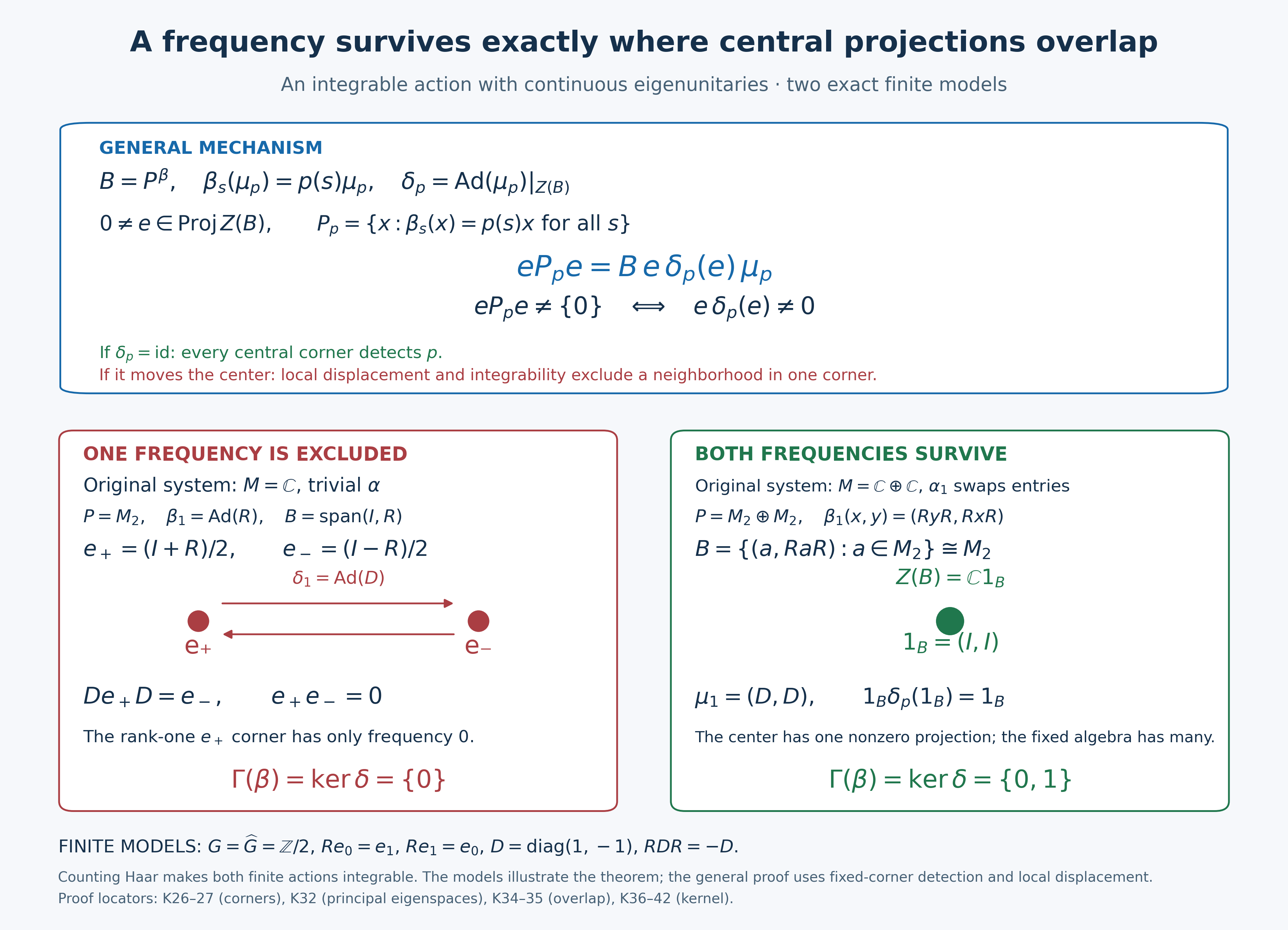
The upper panel concerns an arbitrary locally compact Hausdorff abelian group \(G\), its dual \(H\), and an integrable point-ultraweakly continuous action \(\beta\) on a nonzero von Neumann algebra \(P\). A strongly continuous unitary representation \(p\mapsto\mu_p\) of \(H\) satisfies \(\beta_s(\mu_p)=p(s)\mu_p\). Put \(B=P^\beta\) and \(\delta_p=\operatorname{Ad}(\mu_p)|_{Z(B)}\). For the positive eigenfrequency convention and a nonzero central projection \(e\) of \(B\), the complete local argument gives
\[
P_p=B\mu_p,\qquad eP_pe=B e\delta_p(e)\mu_p,\qquad
eP_pe\ne\{0\}\ \Longleftrightarrow\ e\delta_p(e)\ne0.
\tag{OKF1}
\]
If the overlap projection \(k=e\delta_p(e)\) is nonzero, \(k\mu_p\) is an explicit nonzero corner eigenoperator of norm one. If it is zero, the whole corner eigenspace vanishes. Thus a parameter fixing the center survives every central-corner test. For a parameter moving the center, the complete local-displacement proof supplies one \(e\) whose overlaps vanish throughout a neighborhood. Integrability of the reduced action and open spectral detection then exclude that neighborhood. These are the mechanisms behind \(\Gamma(\beta)=\ker\delta\), rather than a claim that point spectra are always closed. The full local proof is [fixed-corner integrability](OA-FLOW-L115.md#dk-corner-integrability) and [the principal-eigenspace/central-overlap theorem](OA-FLOW-L115.md#dk-overlap), especially (DK3)–(DK7). The verified regular model is [K26–27](OA-FLOW-L115.md#dk-regular-integrability) and [K32](OA-FLOW-L115.md#dk-principal), with [K34–35 and K36–42](OA-FLOW-L115.md#dk-concrete-overlap).
Both lower panels use \(G=H=\mathbb Z/2\), the character pairing \((-1)^{sp}\), counting Haar, and
\[
R=\begin{pmatrix}0&1\\1&0\end{pmatrix},\qquad
D=\begin{pmatrix}1&0\\0&-1\end{pmatrix},\qquad RDR=-D.
\tag{OKF2}
\]
Finite counting Haar makes every positive orbit average bounded: \(T_\beta(a)=a+\beta_1(a)\le2\|a\|1\). Thus these particular actions are integrable without an additional measure argument.
In the left model the original action on \(\mathbb C\) is trivial. Its stabilized algebra is \(P=M_2\), the action is \(\beta_1=\operatorname{Ad}R\), and \(B=\operatorname{span}(I,R)\). Solving \(RX=XR\) directly gives this two-dimensional fixed algebra. Its two minimal central projections are \(e_\pm=(I\pm R)/2\). The eigenunitary \(\mu_1=D\) interchanges them, so \(e_+\delta_1(e_+)=e_+e_-=0\). The rank-one \(e_+\) corner is scalar and fixed, hence its only frequency is zero. Every nonzero fixed corner contains its fixed unit, so zero survives all corners and \(\Gamma(\beta)=\{0\}\).
In the right model the original action on \(\mathbb C\oplus\mathbb C\) swaps the two entries. The stabilized action is \(\beta_1(x,y)=(RyR,RxR)\) on \(P=M_2\oplus M_2\). Its fixed algebra is exactly \(B=\{(a,RaR):a\in M_2\}\), a copy of \(M_2\). Commutation with the two diagonal matrix units and either off-diagonal matrix unit makes its center \(\mathbb C(I,I)\). The eigenunitary \(\mu_1=(D,D)\) therefore fixes this center. Its only nonzero central projection is \(1_B\), whose overlap is one at both frequencies. The general central-corner theorem gives \(\Gamma(\beta)=\{0,1\}\). Independently, the original system has only one nonzero fixed projection, and \((1,1)\) and \((1,-1)\) give both original eigenfrequencies; the complete stabilization theorem identifies the same Connes spectrum. The fixed algebra nevertheless has many noncentral projections: the single green point depicts its center only.
The source antecedent for the general kernel theorem is Takesaki, [*Theory of Operator Algebras II*, Theorem XI.2.7, printed335–336](https://doi.org/10.1007/978-3-662-10451-4). The preceding spectral lessons provide the prerequisites. The two matrix models and diagram illustrate the central-overlap test. A source citation does not replace any internal proof.
[Editable SVG](../assets/dual-center-kernel/assets/central-overlap.svg), [exact semantic data](../assets/dual-center-kernel/assets/central-overlap-data.json) and [reproduction source](../assets/dual-center-kernel/render_overlap.py) accompany the PNG. The source uses exact symbolic matrix checks, deterministic SVG identifiers and date-free output. DejaVu Sans is used locally; no font file is redistributed. Original figure, caption and source: GPT-6 Astra (OpenAI), Ultra, 5 October 2026. New expression is CC0-1.0 to the extent of rights held; applicable third-party font terms are retained separately.
## Orbit averages for an arbitrary locally compact group
The Fourier and Connes-spectrum arguments above concern LCA groups. Orbit averaging and inheritance of integrability also have a formulation for any locally compact Hausdorff group. Fix such a group \(G\), a point-ultraweakly continuous action \(\alpha\) on \(M\), and left Haar measure \(m\). Use the [Haar and modular conventions](OA-FLOW-L24.md#oa-flow.grp.translations)
\[
m(Et)=\Delta_G(t)m(E).
\tag{L115G1}
\]
No second countability, sigma compactness, separable predual or countably decomposable algebra is assumed. Let \(F=M^\alpha\).
**Theorem (whole positive cone and bounded finite domains).** For every compact \(K\subseteq G\), the compact orbit average \(A_K:M\to M\) is bounded and normal, positive, and satisfies \(A_K(1)=m(K)1\). There is a faithful normal operator-valued weight
\[
T_\alpha:M_+\longrightarrow\widehat F_+,
\qquad
\widehat{\omega|_F}(T_\alpha(x))
=\sup_K\omega(A_K(x))
=\int_G\omega(\alpha_s(x))\,dm(s)
\quad(\omega\in M_*^+).
\tag{L115G2}
\]
The supremum is over all compact subsets, ordered by inclusion. Infinite values and the infinite spectral projection of an extended-positive element are retained. The output is fixed under \(\alpha\), while the input obeys
\[
T_\alpha(\alpha_t(x))=\Delta_G(t)^{-1}T_\alpha(x).
\tag{L115G3}
\]
Define
\[
F_{T_\alpha}=\{x\in M_+:\sup_K\|A_K(x)\|<\infty\},\qquad
N_{T_\alpha}=\{a\in M:a^*a\in F_{T_\alpha}\},\qquad
m_{T_\alpha}=\operatorname{span}F_{T_\alpha}
=\operatorname{span}N_{T_\alpha}^*N_{T_\alpha}.
\tag{L115G4}
\]
Here \(F_{T_\alpha}\) is exactly the set where \(T_\alpha\) has a bounded value in \(F_+\). The following conditions are equivalent:
1. \(N_{T_\alpha}\) is weak-operator dense in \(M\), that is, \(T_\alpha\) is semifinite and \(\alpha\) is integrable.
2. \(m_{T_\alpha}\) is ultraweakly dense in \(M\).
3. There is an increasing net of positive contractions in \(F_{T_\alpha}\), converging strongly to \(1\).
**Proof of the whole-cone construction.** For each \(\omega\in M_*\), [AT-3](OA-FLOW-AT.md#oa-flow.at.3) makes \(s\mapsto\omega\alpha_s\) norm continuous. On a compact set its image is compact and therefore separable in the metric of \(M_*\). The compact integral in [AT-5](OA-FLOW-AT.md#oa-flow.at.5) exists in the predual, and its adjoint defines
\[
\omega(A_K(x))=\int_K\omega(\alpha_s(x))\,dm(s).
\]
Thus \(A_K\) is normal, \(\|A_K\|\leq m(K)\), and has the stated positivity and value at one. For \(x\geq0\) the operators \(A_K(x)\) increase with \(K\).
The nonnegative continuous function \(s\mapsto\omega(\alpha_s(x))\) has integral equal to the supremum of its compact integrals. This follows from the compact localization in [HR-2](OA-FLOW-HR.md#hr-02) and [HR-5](OA-FLOW-HR.md#hr-05): its integral is the supremum over compact continuous functions below it, each with compact support; conversely every compact restriction is bounded above by the whole integral. This statement works for an infinite integral and for either the outer regular Haar convention or its complete locally determined counterpart in [HR-9](OA-FLOW-HR.md#hr-09). It introduces no unrestricted product-measurability assertion.
Define \(m_x(\omega)=\sup_K\omega(A_K(x))\) on \(M_*^+\). Each compact term is continuous there. A common larger compact set handles any two compact indices, so this supremum is additive, positively homogeneous and norm lower semicontinuous, including infinite values. Hence \(m_x\in\widehat M_+\), by [EP-4](OA-FLOW-EP.md#oa-flow.ep.4). The complete spectral representation [EP-2](OA-FLOW-EP.md#oa-flow.ep.2)–[3](OA-FLOW-EP.md#oa-flow.ep.3) writes it as a positive affiliated operator on its finite-support subspace together with its complementary infinite projection.
For \(t\in G\), testing on every \(\omega\geq0\) gives
\[
\widehat{\omega\alpha_t}(m_x)
=\int_G\omega(\alpha_{ts}(x))\,dm(s)
=\widehat\omega(m_x).
\]
This is left translation of the integration variable. Thus \(\alpha_t\) fixes \(m_x\), including its full form domain. The unique spectral pair and its bounded truncations
\((H_x\wedge n)e_x+n(1-e_x)\)
are consequently fixed by every \(\alpha_t\), by [FF's spectral transport](OA-FLOW-FF.md#oa-flow.ff.6). The finite and infinite projections and all spectral projections lie in \(F\). The same pair therefore defines a unique element \(T_\alpha(x)\in\widehat F_+\) whose bounded truncations give (L115G2). Every positive normal functional on \(F\) has a positive normal extension to \(M\), by [EP-1's vector-series extension](OA-FLOW-EP.md#oa-flow.ep.1). Testing those extensions proves uniqueness as an element of \(\widehat F_+\).
Additivity and positive homogeneity in \(x\) follow at each compact average and then at the directed supremum. If \(x_i\uparrow x\) is a bounded increasing positive net, normality of \(A_K\) and interchange of two independent suprema give
\[
\sup_i\sup_K\omega(A_K(x_i))
=\sup_K\sup_i\omega(A_K(x_i))
=\sup_K\omega(A_K(x)).
\tag{L115G5}
\]
Positive normal extensions from \(F\) prove order normality in \(\widehat F_+\). For \(b\in F\), compact averages satisfy \(A_K(b^*xb)=b^*A_K(x)b\). The full bounded-conjugation and supremum rule of [EP-4](OA-FLOW-EP.md#oa-flow.ep.4) gives
\(T_\alpha(b^*xb)=b^*T_\alpha(x)b\), including singular \(b\) and all infinite values. Thus this is an operator-valued weight.
If \(T_\alpha(x)=0\), every nonnegative continuous function \(s\mapsto\omega(\alpha_s(x))\) has zero Haar integral. A positive value would give a positive lower bound on a nonempty open neighborhood, which has positive Haar measure by [HR-6](OA-FLOW-HR.md#hr-06). Its value at the identity is therefore zero for every \(\omega\in M_*^+\), so \(x=0\). This proves faithfulness without a countable family of states.
Right translation is different from the output calculation. For every compact \(K\), the convention (L115G1) gives
\[
A_K(\alpha_t(x))
=\Delta_G(t)^{-1}A_{Kt}(x).
\tag{L115G6}
\]
The sets \(Kt\) run through all compact sets. Taking their extended-positive supremum proves (L115G3). In the LCA case \(\Delta_G=1\), recovering the input invariance used above.
If the norms of \(A_K(x)\) have a finite common bound, [WF-2](OA-FLOW-WF.md#oa-flow.wf.2) gives their bounded strong supremum in \(M\). It represents \(m_x\) and is fixed, hence belongs to \(F_+\). Conversely a bounded value of \(T_\alpha(x)\) bounds every \(A_K(x)\), by [EP-3's bounded-element test](OA-FLOW-EP.md#oa-flow.ep.3). This proves the finite-cone identity in (L115G4); [EP-6](OA-FLOW-EP.md#oa-flow.ep.6) supplies its hereditary cone, left ideal and polarization identities. Semifiniteness is a further property, not a consequence of the whole-cone construction.
**Proof of the density equivalences.** The cutoff argument in [L114](OA-FLOW-L114.md#oa-flow.l114.density) uses only a hereditary finite cone and bounded spectral calculus; here are those steps for \(F_{T_\alpha}\). Let \(q\) be the join of all projections belonging to that cone, as constructed in [PC-1](OA-FLOW-PC.md#oa-flow.projection.pc1). For \(a\in F_{T_\alpha}\) and \(\epsilon>0\),
\[
p_\epsilon(a)=1_{[\epsilon,\infty)}(a)
\leq\epsilon^{-1}a,
\]
so \(p_\epsilon(a)\in F_{T_\alpha}\) and the support of \(a\) is at most \(q\). If \(z\in N_{T_\alpha}\), apply this to \(z^*z\) to obtain \(z(1-q)=0\). The set of operators satisfying that equation is weak-operator closed. Condition 1 therefore forces \(q=1\). Condition 2 also forces \(q=1\), because every member of \(m_{T_\alpha}=\operatorname{span}F_{T_\alpha}\) satisfies the same equation and the set is ultraweakly closed.
Index the entire cone \(F_{T_\alpha}\) by its operator order; it is directed since \(a+b\) is an upper bound. Put
\[
e_a=a(1+a)^{-1}=1-(1+a)^{-1}.
\tag{L115G7}
\]
These are positive contractions in \(F_{T_\alpha}\), since \(e_a\leq a\). They increase with \(a\): if \(0
## Integrability passes through invariant subalgebras, products and fixed corners
**Theorem.** For the general-group notion of integrability just proved, each of the following is sufficient for an action \(\alpha\) on \(M\) to be integrable:
1. A globally invariant unital von Neumann subalgebra \(B\subseteq M\) has integrable restricted action.
2. The action is normally conjugate to \(\alpha^{(1)}\overline\otimes\alpha^{(2)}\) on \(M_1\overline\otimes M_2\), and at least one factor action is integrable.
3. The action is normally conjugate to the restriction of an integrable action \(\beta\) on \(N\) to \(eNe\), for a fixed projection \(e\in N^\beta\).
Normal conjugacy means a unital normal coefficient isomorphism with normal inverse intertwining the actions. None of these statements imposes a countability condition. They do not assert that a cocycle perturbation of an integrable action is integrable.
**Proof of invariant-subalgebra inheritance.** The restriction is point ultraweakly continuous: a positive normal functional on \(B\) extends normally to \(M\), by [EP-1](OA-FLOW-EP.md#oa-flow.ep.1), and arbitrary normal functionals are linear combinations of such functionals. Compact averages in \(B\) agree with those in \(M\) on every element of \(B\), because these extensions test both predual integrals. By the preceding theorem choose positive contractions \(e_i\in F_{T_{\alpha|_B}}\) increasing strongly to one. Strong convergence is representation independent on this bounded increasing net, by normality and [WF-2](OA-FLOW-WF.md#oa-flow.wf.2). Each \(e_i\) has bounded ambient compact averages with the same norm bound.
For \(a\in M_+\),
\[
0\leq e_i a e_i\leq\|a\|e_i^2\leq\|a\|e_i,
\qquad
0\leq A_K(e_i a e_i)\leq\|a\|A_K(e_i).
\tag{L115I1}
\]
Hence \(e_i a e_i\in F_{T_\alpha}\); the bound is uniform in \(K\) for each fixed \(i\), as required. The nets converge strongly and ultraweakly to \(a\), with norm at most \(\|a\|\). Thus \(m_{T_\alpha}\) is ultraweakly dense. The proved density criterion gives integrability of \(\alpha\).
**Construction of the whole product action and its inheritance.** Take faithful standard-form representations of \(M_1,M_2\). Their canonical implementing unitary groups \(U_1(s),U_2(s)\) are strongly continuous on the whole Hilbert spaces by [NR-1](OA-FLOW-NR.md#oa-flow.nr.1). On simple Hilbert tensors \(U_1(s)\otimes U_2(s)\) is strongly continuous. Finite sums of such tensors are dense, and these operators have norm one, so the tensor unitary group is strongly continuous everywhere. Its conjugation gives the required normal continuous product action.
The normal tensor maps used here can also be verified without an abstract tensor-functor assumption. For a normal isomorphism \(\gamma:A\to C\) with normal inverse, [ND.TENSOR](OA-FLOW-ND.md#nd-tensor) extends \(\gamma\otimes\mathrm{id}_{B(K)}\) to a whole normal isomorphism
\(A\overline\otimes B(K)\to C\overline\otimes B(K)\), with its whole normal inverse. If \(B_0\subseteq B(K)\) is a von Neumann algebra, restrict that extension to \(A\overline\otimes B_0\). Normality sends its ultraweakly dense algebraic tensor product into \(C\overline\otimes B_0\); the inverse does the same in the reverse direction. This gives a normal isomorphism onto the latter whole algebra. Applying the Hilbert-space flip supplies the corresponding extension in the other factor. The two extensions commute, first on elementary tensors and then everywhere by normality. Their composition is the product automorphism. The arbitrary-basis matrix proof [NCF-1](OA-FLOW-NCF.md#ncf-1) likewise supplies the whole normality used in these restrictions. Thus the spatial unitary implementation and the normal tensor maps agree on the entire product.
If \(M_2\ne0\), the invariant unital subalgebra \(M_1\overline\otimes\mathbb C1\) is normally isomorphic to \(M_1\) by \(x\mapsto x\otimes1\), with normal inverse on its image. Compact averages satisfy
\[
A_K^{\alpha^{(1)}\otimes\alpha^{(2)}}(x\otimes1)
=A_K^{\alpha^{(1)}}(x)\otimes1.
\tag{L115I2}
\]
Testing normal functionals proves the equality; the inclusion has its whole normality from the preceding construction. If the first factor is integrable, part 1 therefore proves product integrability. Use the flip if the second factor is integrable. If either factor algebra is zero, the product is zero and is integrable.
**Proof of fixed-corner inheritance, with its full domains.** Let \(T_\beta:N_+\to\widehat{N^\beta}_+\), and put \(F=N^\beta\). For \(e\in F\), the corner fixed algebra is \(eFe\). Every compact average of the restricted action satisfies
\[
A_K^e(eae)=eA_K^\beta(a)e\qquad(a\in N_+).
\tag{L115I3}
\]
For a normal corner functional \(\omega\), its normal extension \(z\mapsto\omega(eze)\) tests the equality. Taking directed suprema in the full extended cone, with [EP-4](OA-FLOW-EP.md#oa-flow.ep.4), gives
\[
T_{\beta|_{eNe}}(eae)=eT_\beta(a)e
\quad\text{in }\widehat{eFe}_+.
\tag{L115I4}
\]
For a positive element of \(eNe\) its ambient average is supported in \(e\), so the ambient and corner bounded-element tests agree exactly. In particular
\[
\begin{aligned}
F_{T_{\beta|_{eNe}}}&=F_{T_\beta}\cap(eNe)_+,\\
N_{T_{\beta|_{eNe}}}&=N_{T_\beta}\cap eNe,\\
m_{T_{\beta|_{eNe}}}&=e\,m_{T_\beta}\,e
=m_{T_\beta}\cap eNe.
\end{aligned}
\tag{L115I5}
\]
For the last equality use [EP-6](OA-FLOW-EP.md#oa-flow.ep.6)'s \(F\)-bimodule property and its finite-positive polarization: compression of each ambient finite positive element is corner finite, and every corner finite positive is already ambient finite. The reverse intersection identity follows from \(x=exe\) for \(x\in eNe\).
If \(\beta\) is integrable, \(m_{T_\beta}\) is ultraweakly dense. Normal compression by \(e\) sends its approximating nets to \(e m_{T_\beta}e\), which is therefore ultraweakly dense in \(eNe\). The preceding density criterion proves corner integrability. For \(e=0\), these identities give precisely the zero domains and zero weight, so no nonzero-corner assumption is concealed. This extends the earlier [fixed-corner proof](OA-FLOW-L115.md#oa-flow.l115.corner-integrability) from LCA to arbitrary locally compact groups.
**Normal conjugacy.** If \(\psi:M\to N\) is a normal isomorphism with normal inverse and \(\psi\alpha_s=\beta_s\psi\), normal functional tests give
\[
A_K^\beta(\psi(x))=\psi(A_K^\alpha(x)),\qquad
T_\beta(\psi(x))=\widehat\psi(T_\alpha(x)).
\tag{L115I6}
\]
Here \(\widehat\psi\) is the whole extended-positive transport proved in [EP-4](OA-FLOW-EP.md#oa-flow.ep.4) and [FF](OA-FLOW-FF.md#oa-flow.ff.6), including the infinite projection and full form domain. Norms of bounded positive averages are unchanged by [CF-6](OA-FLOW-CF.md#oa-flow.cf.6), applied to the isomorphism and its inverse. Hence \(\psi\) carries each of the three domains in (L115G4) bijectively onto the corresponding domain for \(\beta\), and transports their density. Integrability is consequently invariant under normal conjugacy. This completes parts 2 and 3 as stated. \(\square\)
For LCA groups, [normal coefficient cocycle conjugacy](OA-FLOW-L29.md#l29-cocycle-conjugacy) intertwines the character dual actions. Applying the last paragraph to that normal map transports the dual orbit averages and their complete bounded finite domains. This application concerns the dual actions; it does not identify the original-action orbit averages of a cocycle perturbation.
The three inheritance statements in the LCA setting are Takesaki's *Theory of Operator Algebras II*, Chapter X, Lemma 2.7. The arbitrary-group formulation here uses the compact-average construction and the modular input factor \(\Delta_G(t)^{-1}\); the preceding Fourier and Connes-spectrum conclusions retain their LCA hypotheses.
## The exact multiplier domains of the regular action
The compact compressions used above prove that the regular action is integrable. Its bounded domain also has an exact intersection with the multiplication algebra, including complex functions. That equality requires a reverse argument: a decomposition of a multiplication operator into positive integrable operators need not remain inside the multiplication algebra.
Let \(G\) be an arbitrary LCH abelian group with its fixed Haar normalization, let \(\mathcal K=L^2(G)\), and let
\[
(R_s\xi)(r)=\xi(r+s),\qquad \rho_s=\operatorname{Ad}R_s.
\tag{RD1}
\]
Use the concrete multiplication representation \(h\mapsto M_h\) from the [regular-integrability proof](OA-FLOW-L115.md#dk-regular-integrability). Its \(L^\infty\) classes use the complete locally determined Haar measure of [HR9](OA-FLOW-HR.md#hr-09). Finite-exponent \(L^p\) classes have the isometric outer-regular representatives proved there. The group is not assumed sigma compact or first countable.
Write \(T_\rho\) for the full normal orbit weight constructed in [L114](OA-FLOW-L114.md#ip-average), and put
\[
\begin{aligned}
F_\rho&=\{a\in B(\mathcal K)_+:T_\rho(a)\text{ is bounded}\},\\
\mathfrak n_\rho&=\{x:T_\rho(x^*x)\text{ is bounded}\},\qquad
\mathfrak p_\rho=\operatorname{span}_{\mathbb C}F_\rho.
\end{aligned}
\tag{RD2}
\]
The weight takes values in the entire extended positive cone of the fixed algebra. In particular, a value \(+\infty\,1\) below denotes the extended positive element with infinite-part projection \(1\).
**Theorem.** For every \(h\in L^\infty(G)\),
\[
\begin{aligned}
M_h\in\mathfrak p_\rho
&\quad\Longleftrightarrow\quad h\in L^1(G),\\
M_h\in\mathfrak n_\rho
&\quad\Longleftrightarrow\quad h\in L^2(G).
\end{aligned}
\tag{RD3}
\]
For \(h\geq0\), including nonintegrable \(h\),
\[
T_\rho(M_h)=\left(\int_G h\,dm\right)1.
\tag{RD4}
\]
All intersections in (RD3) are inside the specified multiplication representation.
**Positive functions and the full extended value.** For a compact \(K\subset G\), the function \(h1_K\) is bounded and integrable. Formula (K24), proved with normal vector tests and qualified Haar product integration, gives
\[
T_\rho(M_{h1_K})=\left(\int_K h\,dm\right)1.
\tag{RD5}
\]
The projections \(q_K=M_{1_K}\), directed by inclusion of all compact sets, increase strongly to \(1\), as already proved before (K24a). Thus
\(M_{h1_K}=M_{h^{1/2}}q_KM_{h^{1/2}}\) increases strongly to \(M_h\).
Normality of the full extended weight gives (RD4) by taking these directed suprema.
Here the scalar identity
\(\int h=\sup_K\int_Kh\) holds even when the integral is infinite. To spell out the use of [HR9](OA-FLOW-HR.md#hr-09), compact inner regularity holds for each locally measurable level set. For a nonnegative simple function below \(h\), approximate the finitely many level sets by compact subsets and take their finite union. This makes its full integral the supremum of its compactly restricted integrals. Taking the supremum over simple functions proves the identity for \(h\). When one level set has infinite measure, choose compact subsets with arbitrarily large finite measure instead. This argument concerns the locally determined convention and does not assert global inner regularity of every Borel set for a different raw Haar measure.
It follows that \(F_\rho\) meets the positive multiplication operators exactly in \(L^1(G)_+\cap L^\infty(G)\). Decomposing the real and imaginary parts of an integrable complex \(h\) into positive and negative parts proves
\[
L^1(G)\cap L^\infty(G)
\ \subseteq\ \{h:M_h\in\mathfrak p_\rho\}.
\tag{RD6}
\]
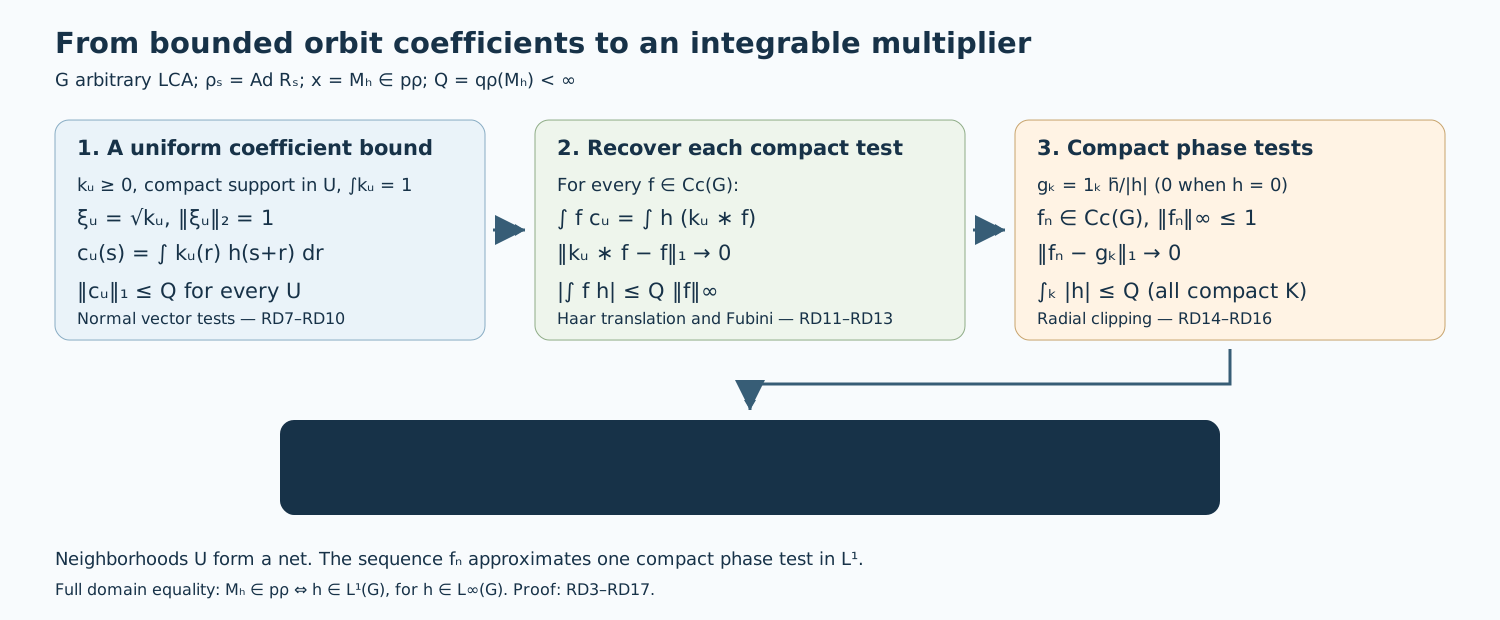
**A uniform coefficient bound for the reverse implication.** Suppose \(x=M_h\in\mathfrak p_\rho\). The gauge and constant-one estimate (IP6)–(IP8) in the [complete integrable-domain proof](OA-FLOW-L114.md#ip-coefficients) give a finite number
\[
Q=q_\rho(x)=
\inf_{x=\sum_j c_j a_j,\ a_j\in F_\rho}
\sum_j |c_j|\,\|T_\rho(a_j)\|,
\qquad
\int_G|\omega(\rho_s(x))|\,ds\leq Q\|\omega\|
\quad(\omega\in B(\mathcal K)_*).
\tag{RD7}
\]
The bound is uniform over normal functionals, not just a separate integrability assertion for each one. It holds for this possibly nonpositive \(x\).
Take the positive compact cutoffs \(k_U\) of [L113, (D24)](OA-FLOW-L113.md#l113-averages):
\[
k_U\in C_c(G),\quad k_U\geq0,\quad
\int k_U=1,\quad \operatorname{supp}k_U\subset U,
\qquad \xi_U=k_U^{1/2}\in L^2(G).
\tag{RD8}
\]
The index \(U\) runs through all relatively compact identity neighborhoods, ordered by reverse inclusion. The vector \(\xi_U\) has norm one. Its vector functional is normal by [CP6](OA-FLOW-CP.md#oa-flow.cp.6); Cauchy–Schwarz bounds its norm by one, and evaluation at the identity attains one. Since \(\rho_s(M_h)=M_{h(s+\,\cdot\,)}\), define the actual coefficient
\[
c_U(s)=\langle \rho_s(M_h)\xi_U,\xi_U\rangle
=\int_G k_U(r)h(s+r)\,dr .
\tag{RD9}
\]
It is continuous by the already established normal-action continuity. Equations (RD7)–(RD9) give
\[
c_U\in L^1(G),\qquad \|c_U\|_1\leq Q
\quad\text{for every }U.
\tag{RD10}
\]
The integral in (RD9) depends only on the multiplication class of \(h\): translations preserve compact-local null sets, and \(k_U\) has compact support.
**Recovering every compact test.** Fix \(f\in C_c(G)\). Haar substitution \(t=s+r\) and scalar Fubini give
\[
\begin{aligned}
\int_G f(s)c_U(s)\,ds
&=\int_G h(t)\,(k_U*f)(t)\,dt,\\
(k_U*f)(t)&=\int_G k_U(r)f(t-r)\,dr .
\end{aligned}
\tag{RD11}
\]
Only the product of the two compact supports is needed before the substitution; afterward \(t\) lies in their compact sum. On the finitely many open sigma compact cosets meeting those sets, \(h\) has a bounded measurable representative in the completed sigma-finite Haar restriction. [HR3/5/9](OA-FLOW-HR.md#hr-03) supply a Borel representative and the qualified Radon-product Fubini rule. Changing that representative on a compact-local null set changes none of these integrals. No global product-Borel identity or sigma compact exhaustion of \(G\) is used.
By [L24's translation theorem](OA-FLOW-L24.md#oa-flow.grp.translations),
\[
\begin{aligned}
\|k_U*f-f\|_1
&\leq \int_G k_U(r)\|L_r f-f\|_1\,dr\\
&\leq \sup_{r\in U}\|L_r f-f\|_1\longrightarrow0,
\qquad (L_rf)(t)=f(t-r).
\end{aligned}
\tag{RD12}
\]
The first inequality follows by the scalar triangle inequality and the same finite-carrier Tonelli rule; \(\int k_U=1\). Norm continuity at zero proves the last limit along the neighborhood net. Because \(h\) is bounded, (RD11)–(RD12) imply
\[
\int f c_U\longrightarrow\int f h.
\]
Combining this with (RD10) yields the compact-test inequality
\[
\left|\int_G f h\,dm\right|\leq Q\|f\|_\infty
\qquad(f\in C_c(G)).
\tag{RD13}
\]
This limit is a pairing identity. It assumes neither pointwise convergence of \(c_U\) nor an arbitrary-net version of Fatou's lemma.
**Compact phase tests give global integrability.** Fix a compact \(K\subset G\). Set
\[
g_K(r)=
\begin{cases}
\overline{h(r)}/|h(r)|,&r\in K,\ h(r)\ne0,\\
0,&\text{otherwise}.
\end{cases}
\qquad |g_K|\leq1 .
\tag{RD14}
\]
This is a compactly supported \(L^1\) class in the locally determined convention, and
\(\int h g_K=\int_K|h|\).
The finite-exponent identification in HR9 and [HR3's density proof](OA-FLOW-HR.md#hr-03) give \(a_n\in C_c(G)\) with
\(\|a_n-g_K\|_1\to0\). A sequence is legitimate here because only approximation in a normed function space is involved; it is not a countable neighborhood base of \(G\).
Clip the approximants radially:
\[
f_n=\frac{a_n}{\max(1,|a_n|)}\in C_c(G),\qquad
\|f_n\|_\infty\leq1,\qquad
\|f_n-g_K\|_1\leq2\|a_n-g_K\|_1\longrightarrow0.
\tag{RD15}
\]
Indeed, where \(|a_n|>1\), the displacement caused by clipping is
\(|a_n|-1\leq|a_n-g_K|\); elsewhere it is zero. The triangle inequality proves the displayed pointwise bound and its integral.
Apply (RD13) to \(f_n\). Boundedness of \(h\) permits the \(L^1\) limit in the pairing, giving
\[
\int_K|h|\,dm=\lim_n\int h f_n\,dm\leq Q .
\tag{RD16}
\]
The middle terms can be complex; the conclusion follows from their absolute-value bound \(Q\) and their real nonnegative limit. Taking the supremum over all compact \(K\), with the scalar compact-inner formula proved above, gives
\[
\|h\|_1\leq q_\rho(M_h)<\infty.
\tag{RD17}
\]
This proves the reverse inclusion in (RD3). For its square-integrable assertion, use
\(M_h^*M_h=M_{|h|^2}\) and (RD4). Its orbit value is bounded exactly when
\(\int |h|^2<\infty\). This completes both domain equalities. \(\square\)
The reverse inclusion uses a uniform estimate before taking a limit. The coefficients \(c_U\) in (RD9) have \(L^1\) norm at most \(Q=q_\rho(M_h)\). Equations (RD11)–(RD13) pass that bound to every compact continuous test. The clipped phase tests (RD14)–(RD16) bound each compact integral of \(|h|\); compact inner regularity gives (RD17). The boxes describe exact implications for an arbitrary LCA group, not a numerical approximation or a countable exhaustion. Open the diagram; the SVG is the editable figure source.
**Solved check.** Why is mere integrability of every \(c_U\) insufficient for the last argument?
**Solution.** The bound in (RD13) must be independent of \(U\) to survive the limit. That uniform bound comes from (RD7) and the unit norm of every vector functional. On \(G=\mathbb R\), for example, the functions \(1_{[-n,n]}\) are individually integrable and converge pointwise to \(1\), but their integrals are \(2n\), and \(1\notin L^1(\mathbb R)\). The proof uses the common bound \(Q\) and compact test pairings, rather than drawing an integrability conclusion from pointwise convergence.
The exact intersection \(\mathfrak p_\rho\cap L^\infty(G)=L^1(G)\cap L^\infty(G)\) occurs in Takesaki, *Theory of Operator Algebras II*, [XI.2, proof of Theorem 2.7(iv), printed 336](https://doi.org/10.1007/978-3-662-10451-4). The argument here proves its complex reverse implication through uniform normal coefficients and compact phase tests. The earlier Haar, normal-integration and bounded-domain lessons supply the complete local premises; the citation does not replace them.