# From a compact spectral profile to the continuous core
The compact-core profile theorem DP is a theorem about states. The continuous-core invariant requires two additional arguments: an exact comparison of the two cores, including the Haar scalar, and a proof for arbitrary positive normal functionals of possibly different masses. We supply both.
Earlier complete proofs: [DD.8](OA-FLOW-DD.md#oa-flow.dd.8), [DP.2](OA-FLOW-DP.md#oa-flow.dp.2), [CC.1](OA-FLOW-CC.md#oa-flow.cc.1), [CC.2](OA-FLOW-CC.md#oa-flow.cc.2), [CD.4](OA-FLOW-CD.md#oa-flow.cd.4), [NR.4](OA-FLOW-NR.md#oa-flow.nr.4), [CC.8](OA-FLOW-CC.md#oa-flow.cc.8), [CORE.2](OA-FLOW-CORE.md#core-2), [CORE.3](OA-FLOW-CORE.md#core-3), [DP.3](OA-FLOW-DP.md#oa-flow.dp.3), [DP.5](OA-FLOW-DP.md#oa-flow.dp.5), [DP6: full spectral construction](OA-FLOW-DP.md#oa-flow.dp.6), [CINV.COVARIANCE](OA-FLOW-CINV.md#cinv-covariance), [CINV.METRIC](OA-FLOW-CINV.md#cinv-metric), [CSAS.RANGE](OA-FLOW-CSAS.md#csas-range), [CINV.MASS](OA-FLOW-CINV.md#cinv-mass), [CINV.INVERSE](OA-FLOW-CINV.md#cinv-inverse), OA-MOD DC-04, OA-MOD MW-02, OA-MOD MW-04, OA-MOD MW-05.
## 1. The compact input and the spatial comparison
Let \(M\) be a type III\(_\lambda\) factor with separable predual, \(0<\lambda<1\). Put
\[
L=-\log\lambda,\qquad P=2\pi/L.
\]
The actual DD theorem, as applied in DP2, supplies a faithful normal semifinite periodic weight \(\omega\) with \(\sigma_P^\omega=\mathrm{id}\). It need not be finite. The compact regular crossed product
\[
B=M\rtimes_{\sigma^\omega}(\mathbb R/P\mathbb Z)
\]
is a type II∞ factor, with compact Haar measure \(dt/P\). Write its generators as \(\pi_0(x),\ell_t\). Its negative dual generator, counting average, clock and canonical trace satisfy
\[
\begin{gathered}
\beta(\pi_0(x))=\pi_0(x),\qquad\beta(\ell_t)=e^{-iLt}\ell_t,\\
E_B(b)=\sum_{n\in\mathbb Z}\beta^n(b),\quad
H_0^{it}=\ell_t,\quad\beta(H_0)=\lambda H_0,\quad
\tau_0\beta=\lambda\tau_0. \end{gathered}
\tag{PCO1}
\]
These are the full normal constructions and complete positive-weight identities of CC/CD/DP, not solely their generator relations. For \(\phi\in M_*^+\), DP2 gives
\(\phi E_B=(\tau_0)_{H_\phi}\), including support and full density domains.
Represent \(M\) faithfully on \(H\). On the dense subspace of \(L^2(\mathbb R,dt;H)\) supported in finitely many translates of \([0,P)\), define
\[
(S\xi)(t,q)=\sqrt{\frac PL}\sum_{n\in\mathbb Z}
e^{i(t+nP)q}\xi(t+nP),
\quad 0\le t
## 2. The wrapped action and the exact trace
For \(q\in[0,L)\), write
\(q-s=q'+nL\), where \(0\le q'
## 3. Extend the compact profile theorem to every mass
DP3 proves, by finite-domain pairings and nonnegative integration, the identities
\[
f_\phi(\lambda a)=\lambda^{-1}f_\phi(a),\quad
\phi(x)=\int_\lambda^1
\tau_0(\pi_0(x)1_{(a,\infty)}(H_\phi))\,da,\quad
\int_\lambda^1 f_\phi(a)\,da=\phi(1). \tag{PCO11}
\]
Its calculation uses boundedness of \(\phi\) and retains the factor \(\phi(1)\) in every estimate, so these identities have the displayed all-positive-functional scope. DP5's zero-distance theorem and DP6's realization theorem were stated for states; we now extend them explicitly.
DP6 supplies one fixed filling equivariant trace flag \(Q(t)\), \(t\ge0\), with
\[
\tau_0(Q(t))=t,\quad Q(t)\uparrow1,\quad
\beta(Q(t))=Q(\lambda t),\quad
\|Q(t)-Q(r)\|_1=|t-r|. \tag{PCO12}
\]
For every decreasing right-continuous finite-valued profile \(f\) with
\(f(\lambda a)=\lambda^{-1}f(a)\), define
\(m=\int_\lambda^1 f(a)\,da<\infty\).
If \(m=0\), right continuity and scaling force \(f=0\), realized by zero. If \(m>0\), every multiplicative window of ratio \(\lambda\) has the same integral:
\[
\int_{\lambda c}^{c}f(a)\,da=m\qquad(c>0). \tag{PCO13}
\]
Indeed \(r\mapsto e^rf(e^r)\) is \(L\)-periodic, and these integrals are its integrals over intervals of length \(L\).
Set \(g(a)=f(ma)\). Equation (PCO13) gives
\(\int_\lambda^1g(a)\,da=m^{-1}m=1\).
The state realization in DP6 gives a state \(\rho_g\) whose compact density has tails \(Q(g(a))\). Then \(\phi_f=m\rho_g\) has tails
\[
1_{(a,\infty)}(H_{\phi_f})
=Q(g(a/m))=Q(f(a)). \tag{PCO14}
\]
The full self-adjoint domain is the spectral domain constructed in DP(T6), scaled by \(m\); no new domain restriction is imposed.
For any original \(\phi\) with mass \(m>0\), \(\phi/m\) and \(\phi_{f_\phi}/m\) are states with the same profile \(f_\phi(ma)\). DP5, including its small-support unitary completion, gives zero orbit distance between them. Multiplying their norm estimates by \(m\) gives
\(\delta_M(\phi,\phi_{f_\phi})=0\).
Zero mass again causes no exception.
Given \(\phi,\psi\) of arbitrary masses, realize both profiles on the same flag \(Q\). For every contraction \(x\in M\), (PCO11), (PCO12) and finite trace pairings yield
\[
|(\phi_{f_\phi}-\phi_{f_\psi})(x)|
\le\int_\lambda^1
\|Q(f_\phi(a))-Q(f_\psi(a))\|_1\,da
=\int_\lambda^1|f_\phi(a)-f_\psi(a)|\,da.
\]
Replacement by equal closed orbits does not change the orbit distance. Combine this upper bound with (CI17) and (PCO10):
\[
\boxed{\ \delta_M(\phi,\psi)=\|\chi_\phi-\chi_\psi\|
\quad(\phi,\psi\in M_*^+).\ } \tag{PCO15}
\]
In particular unequal masses have been treated by a common-flag proof, not by applying a state theorem outside its hypotheses.
## 4. The entire circle subinvariant cone
Let \(\chi\in L^\infty([0,L))_*^+\) have density \(p(q)\) and satisfy
\(\chi\theta_s\ge e^{-s}\chi\) for all \(s\ge0\). Extend \(p\) periodically to \(\mathbb R\). The inequality becomes
\(p(q+s)\ge e^{-s}p(q)\) almost everywhere. As proved explicitly in [the semifinite range construction](OA-FLOW-CSAS.md#csas-range), (SA15), the function \(e^qp(q)\) has an increasing left-continuous representative \(g(q)\), finite everywhere. Periodicity and uniqueness of this representative give
\[
g(q+L)=e^Lg(q)\qquad(q\in\mathbb R).
\]
Thus \(f(a)=g(-\log a)\) is decreasing, right-continuous and finite, satisfies \(f(\lambda a)=\lambda^{-1}f(a)\), and has window mass
\(\int_\lambda^1f(a)\,da=\int_0^Lp(q)\,dq=\chi(1)\).
Section 3 realizes it by a positive normal functional. Equation (PCO10) identifies its \(\chi\) with the prescribed one. With (CI15), this proves
\[
\boxed{\ \{\chi_\phi:\phi\in M_*^+\}
=\{\chi\ge0:\chi\theta_s\ge e^{-s}\chi\ (s\ge0)\}.\ } \tag{PCO16}
\]
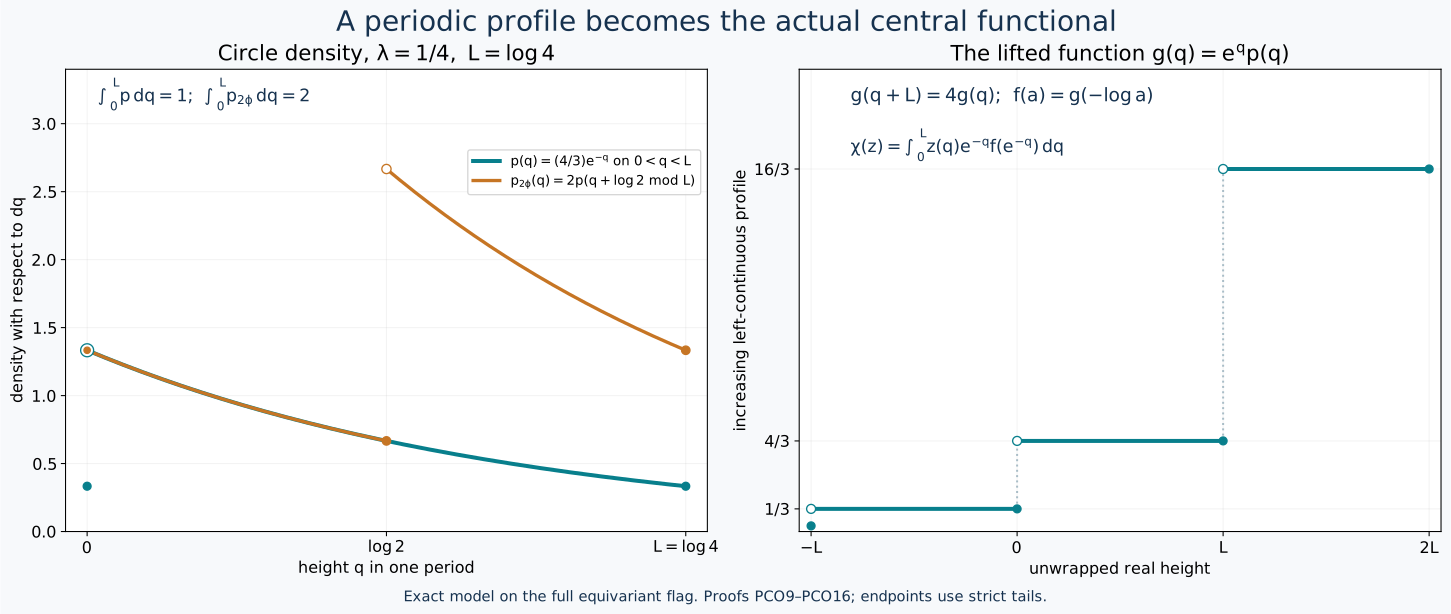
*Exact circle model for (PCO9)–(PCO16), with \(\lambda=1/4\), \(L=\log4\), and \(p(q)=(4/3)e^{-q}\) on \(0