Comparing weights through strips and spectral tails
A comparison between two weights can be transported to positive operators in one traced algebra. This identifies the exact power seen by a complex strip, and lets us recover the comparison on every positive element of the original algebra. A second construction relates all strip depths to the spectral support of a single matrix unit.
1. Conventions and the statements
Let \(M\) be a von Neumann algebra and let \(\mathcal W_0(M)\) denote its faithful normal semifinite weights. No separability, factoriality, proper infiniteness or finiteness of the weights is assumed. Ordinary order means comparison on the entire positive cone, with infinite values allowed.
Sections 1–7 concern faithful weights, whose real-time cocycles are unitary. Section 8 defines and proves the corresponding order for arbitrary normal semifinite weights by including support inclusion and a precise partial-cocycle convention.
For the zero algebra there is a single weight, all comparisons below hold, and its cocycle is the sole element of that algebra. This settles that case. In the rest of the proof and the scalar-rescaling diagnostics, assume \(M\ne0\).
For \(a>0\), put \[ \begin{aligned} S_a&=\{z:-a\leq\operatorname{Im}z\leq0\},\\ \varphi\preceq_a\psi &\Longleftrightarrow (D\varphi:D\psi)_t\\ &\qquad\text{has a contractive holomorphic extension to }S_a. \end{aligned} \tag{WO1} \] The extension is required to be jointly intrinsically sigma-strong continuous on the closed strip. Holomorphy initially means holomorphy of every normal scalar coefficient in the interior. The proof below also gives norm holomorphy inside and joint sigma-strong-star continuity on both edges. Write \(\varphi\preceq_\infty\psi\) when (WO1) holds for every \(a>0\).
The normalized cocycles, including the ordered chain rule and positive scalar normalization, are the ones constructed in BC4–5. These normalizations are part of the definitions: equal modular groups alone do not identify weights.
We will prove that every \(\preceq_a\), and also \(\preceq_\infty\), is a partial order. More precisely, if \(h_\varphi,h_\psi\) are the positive nonsingular densities in one common continuous core, then \[ \begin{aligned} \varphi\preceq_a\psi &\Longleftrightarrow D(h_\psi^a)\subseteq D(h_\varphi^a),\ \|h_\varphi^a\xi\|\leq\|h_\psi^a\xi\| \quad(\xi\in D(h_\psi^a))\\ &\Longleftrightarrow h_\varphi^{2a}\leq h_\psi^{2a} \quad\text{as complete closed forms},\\ \varphi\preceq_{1/2}\psi&\Longleftrightarrow\varphi\leq\psi. \end{aligned} \tag{WO2} \] Thus the exponent is \(2a\). No product of two unbounded operators is presumed to be everywhere defined.
We use L158's full power-strip theorem, including its endpoint domains, both boundary topologies, and all-powers converse. The continuous core, its normalized trace and its normal changes of chart are proved in CORE; the whole-cone density identity is SCW2. Sections 2–3 supply the additional weight-order bridge, rather than assuming that an operator inequality is already a weight inequality.
An earlier programme route proves the same faithful-weight statements directly. Contractive strips form an order proves reflexivity, transitivity and antisymmetry from the normalized cocycle. The half-strip recovers pointwise order supplies the joint sigma-strong boundary continuity for the full half-strip domination theorem. The proof below instead uses complete forms in a common core.
2. The averaging map reaches every positive coefficient
Choose a faithful reference weight and its core \(C=M\rtimes_\sigma\mathbb R\), writing \(\pi:M\to C\) for the normal coefficient embedding. Let \(T:C_+\to\widehat{\pi(M)}_+\) be the canonical operator-valued weight with the Haar normalization fixed in DA. For a normal weight \(\eta\), its dual is \[ \widetilde\eta(X)= \widehat{\eta\circ\pi^{-1}}\bigl(T(X)\bigr),\qquad X\in C_+. \tag{WO3} \] EP5 constructs the indicated extension to the complete extended positive cone. In particular, \(\eta\leq\nu\) implies \(\widehat\eta\leq\widehat\nu\): evaluate the original inequality on each canonical bounded spectral approximation and take the supremum. Hence dualization preserves order.
It also reflects order. Choose a nonzero continuous compactly supported scalar function \(f\) and divide it by its \(L^2(\mathbb R,dt)\) norm. The latter is positive and finite. The compact-square formula DA(A23), with coefficient function \(s\mapsto f(s)1\), gives \[ T\bigl(\lambda(f)^*\lambda(f)\bigr)=1. \tag{WO4} \] Here \(\lambda(f)=\int f(s)\lambda_s\,ds\) is bounded, with norm at most \(\|f\|_1\). In DA's right-sided convention this is exactly \(F(f1)\).
For arbitrary \(x\in M_+\), define the bounded positive element \[ X_x=\bigl(\lambda(f)\pi(x^{1/2})\bigr)^* \bigl(\lambda(f)\pi(x^{1/2})\bigr)\in C_+. \tag{WO5} \] The full bimodule identity DA(A21) yields \[ T(X_x)=\pi(x),\qquad \widetilde\eta(X_x)=\eta(x). \tag{WO6} \] Consequently \(\widetilde\eta\leq\widetilde\nu\) implies \(\eta\leq\nu\). The same test also proves injectivity of dualization. This argument includes infinite weight values; it neither subtracts them nor infers equality of weights from a small finite ideal.
For faithful normal semifinite \(\varphi,\psi\), place their densities in the same core with its fixed trace \(\tau\). CORE6 and SCW2 give \[ \widetilde\varphi=\tau_{h_\varphi},\qquad \widetilde\psi=\tau_{h_\psi},\qquad \pi((D\varphi:D\psi)_t)=h_\varphi^{it}h_\psi^{-it}. \tag{WO7} \] All the equalities of weights hold on \(C_+\). The exact complete-form order isomorphism TD5, followed by (WO6), proves \[ h_\varphi\leq h_\psi \Longleftrightarrow \widetilde\varphi\leq\widetilde\psi \Longleftrightarrow \varphi\leq\psi. \tag{WO8} \] This also shows why the reference trace and the dual-weight normalization must be fixed consistently.
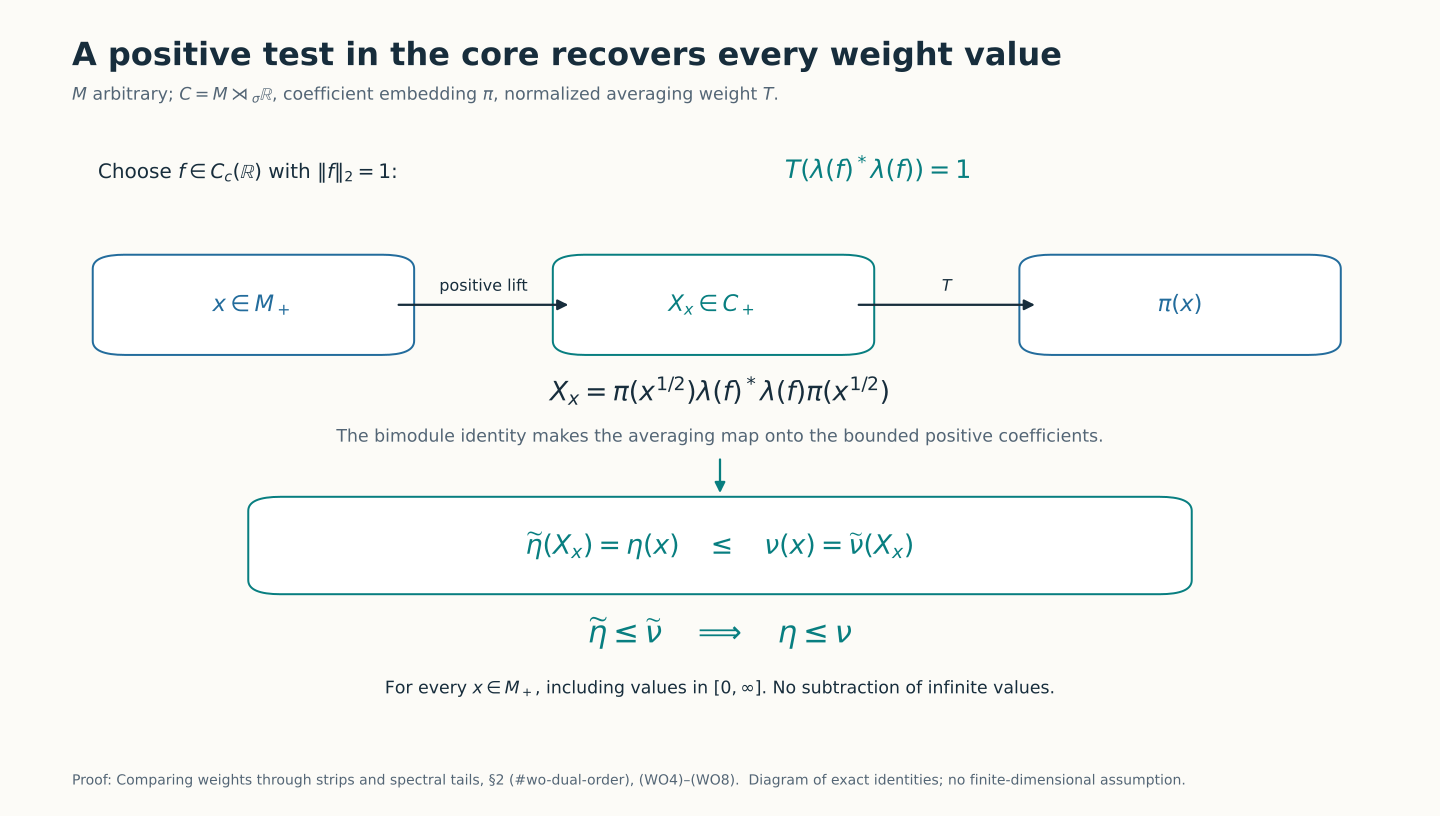
The arrows are the exact identities (WO4)–(WO8): the normalized compact square gives a positive lift for every positive coefficient, including infinite weight values. Reproduce the figure; source context.
3. Recover the strip in the coefficient algebra
An extension in \(M\) gives one in \(C\) by applying \(\pi\). A normal representation transports intrinsic strong-star limits because its normal vector functionals are normal functionals on the original algebra. L158 proves the corresponding spectral-domain transport.
Conversely suppose the complete form inequality in (WO2) holds. L158 constructs the unique contractive extension \(U(z)\in C\), including both boundary limits. Let \(\theta_s\) be the dual action. For each fixed \(s\), the function \(\theta_s(U(z))\) is another such extension with the same real boundary values, because the real cocycle in (WO7) belongs to \(\pi(M)\). L158's boundary-interval uniqueness therefore gives \[ \theta_s(U(z))=U(z)\qquad(s\in\mathbb R,\ z\in S_a). \tag{WO9} \] The full fixed-point result in DA identifies \(C^\theta=\pi(M)\). Thus every \(U(z)\) lies in that coefficient algebra. Applying the normal inverse of \(\pi\) gives the required extension in \(M\), with its asserted topologies. This proves the first two equivalences in (WO2), and (WO8) proves the depth-one-half assertion.
At the lower edge the extension is the bounded closure prescribed by L158: \[ \pi(U(t-ia))=h_\varphi^{it}B_a h_\psi^{-it},\qquad B_a=\overline{h_\varphi^a h_\psi^{-a}},\quad\|B_a\|\leq1. \tag{WO10} \] Before closure the product is taken on the entire natural domain \(D(h_\psi^{-a})\); the form comparison ensures that it maps there as stated. Formula (WO9) puts \(B_a\) in \(\pi(M)\) even though its two formal unbounded factors need not be affiliated with \(\pi(M)\).
Trace densities in the original algebra. If \(M\) is semifinite with a fixed faithful normal semifinite trace \(\tau\), take positive injective self-adjoint \(h,k\) affiliated with \(M\). The trace-weight normalization in L157 proves the required faithful density weights and normalized cocycle. The local whole-cone construction CZ2 agrees with TD's cutoff definition of these weights, and the balanced calculation CZ6(CZ32) gives \((D\tau_h:D\tau)_t=h^{it}\). The chain and reversal laws in BC4 therefore give \[ (D\tau_h:D\tau_k)_t=h^{it}k^{-it}. \tag{WO26} \] Apply L158 directly to these two operators. It gives \[ \begin{aligned} \tau_h\preceq_a\tau_k &\Longleftrightarrow D(k^a)\subseteq D(h^a),\\ &\qquad \|h^a\xi\|\leq\|k^a\xi\| \quad(\xi\in D(k^a))\\ &\Longleftrightarrow h^{2a}\leq k^{2a} \quad\text{as complete closed forms}. \end{aligned} \tag{WO10T} \] The lower edge is the bounded closure of \(h^ak^{-a}\) on all of \(D(k^{-a})\). L158 proves its contraction bound, algebra membership and joint intrinsic strong-star boundary limits. The exponent \(2a\) therefore applies to the original trace densities as well as to the common-core densities in (WO2).
Reflexivity follows from the constant extension \(1\). For transitivity, multiply the two extensions in the order of BC21: \[ (D\varphi:D\chi)_t =(D\varphi:D\psi)_t(D\psi:D\chi)_t. \tag{WO11} \] The product remains contractive. Bounded strong-star multiplication is jointly continuous, and the norm-holomorphic interior functions have a holomorphic product. Thus \(\varphi\preceq_a\psi\preceq_a\chi\) implies \(\varphi\preceq_a\chi\).
If both opposite comparisons hold, (WO2) gives equality of the two complete positive forms \(h_\varphi^{2a},h_\psi^{2a}\). The spectral correspondence for complete forms EP2–3 identifies their selfadjoint operators; taking the Borel power \(1/(2a)\) gives \(h_\varphi=h_\psi\). Equation (WO8) in both directions gives \(\varphi=\psi\). Hence these are partial orders. Restricting an extension shows \[ 0<b\leq a,\quad\varphi\preceq_a\psi \ \Longrightarrow\ \varphi\preceq_b\psi. \tag{WO12} \] Their intersection \(\preceq_\infty\) is again a partial order.
For \(c>0\), common scalar multiplication preserves and reflects every order. Indeed the dual density of \(c\varphi\) is \(c h_\varphi\), by (WO3) and TD's uniqueness; positive spectral powers multiply the forms by \(c^{2a}\). Normal isomorphisms preserve and reflect the orders as well, either through the normal chart maps or directly by the cocycle covariance BC25 and its inverse.
4. All depths compare every spectral tail
Applying L158, Section 7 to (WO7) gives \[ \begin{aligned} \varphi\preceq_\infty\psi &\Longleftrightarrow h_\varphi^p\leq h_\psi^p \text{ as complete forms for every }p>0\\ &\Longleftrightarrow E_{h_\psi}([0,r])\leq E_{h_\varphi}([0,r]) \quad(r\geq0). \end{aligned} \tag{WO13} \] For clarity, the direction from powers to projections tests a vector in a low \(h_\psi\)-spectral band against arbitrarily high powers: its high \(h_\varphi\)-tail at \(v>r\) has squared norm at most \((r/v)^{2n}\|\xi\|^2\), which tends to zero. The converse uses increasing finite positive sums of ordered tail projections, then monotone convergence on the complete spectral forms. Those two arguments, including the endpoints and the full domains, are written out in L158.
It suffices in (WO13) to test integer powers: the proof from powers to projections uses only \(p=2n\), and the projection condition then supplies every positive power. The strip extensions agree on overlaps by uniqueness. They therefore define one bounded holomorphic function on the lower half-plane, with joint strong-star boundary continuity and norm at most one. Conversely restriction of such a function gives every finite strip.
None of these statements requires \(h_\varphi\) and \(h_\psi\) to commute. Nor does ordinary order generally imply (WO13).
5. A half-plane criterion proved by normal filters
We prove the spectral fact needed to express all-depth order by a matrix unit. Let \(\alpha\) be a point-ultraweakly continuous automorphism group of a von Neumann algebra \(N\). Use exactly AL's convention: \[ T_f(x)=\int_{\mathbb R}f(t)\alpha_t(x)\,dt,\qquad \widehat f(p)=\int_{\mathbb R}f(t)e^{itp}\,dt. \tag{WO14} \] Thus an orbit \(e^{itp}x\) has frequency \(p\). We claim \[ \operatorname{Sp}_\alpha(x)\subseteq(-\infty,0] \Longleftrightarrow \alpha_t(x)\text{ extends boundedly and holomorphically to } \operatorname{Im}z<0. \tag{WO15} \] In the right-hand condition, extension includes continuous normal scalar boundary values equal to the given orbit. The extension then has joint intrinsic strong-star continuity on the closed half-plane; it is unique and has norm at most \(\|x\|\).
Here are details of the forward construction, including the spectral endpoint zero. For \(y>0\), let \[ P_y(s)=\frac{y}{\pi(s^2+y^2)},\qquad F(t-iy)=\int_{\mathbb R}P_y(s)\alpha_{t+s}(x)\,ds. \tag{WO16} \] These are normal integrals, as in AL1. The kernel is nonnegative and has integral one, so \(\|F\|\leq\|x\|\). Its Fourier transform is \(e^{-y|p|}\). To verify that scalar formula directly for \(p\geq0\), apply SF4's rectangle Cauchy formula to \(e^{izp}/(z^2+y^2)\) on the rectangle with vertices \(-R,R,R+iR,-R+iR\), where \(R>y\). Equivalently apply that formula to the holomorphic numerator \(e^{izp}/(z+iy)\) at \(iy\). The integral is \(\pi e^{-yp}/y\). On the other three sides, \(|e^{izp}|\leq1\) and \(|z^2+y^2|\geq R^2-y^2\), so their combined integral has modulus at most \(4R/(R^2-y^2)\), which tends to zero. A rectangle below the real axis for \(p<0\), with the corresponding reversed orientation, gives \(\pi e^{yp}/y\). Multiplication by \(y/\pi\) proves the claim, including \(p=0\).
Both first kernel derivatives are in \(L^1\), locally continuously in \(y>0\). Differentiation of translated kernels in \(L^1\) consequently makes \(F\) norm continuously differentiable there, with \[ (\partial_y+i\partial_t)F(t-iy) =\alpha_t(T_{q_y}x),\qquad q_y=\partial_yP_y-iP_y',\quad \widehat q_y(p)=-2p_+e^{-yp}, \tag{WO17} \] where \(p_+=\max(p,0)\). We show \(T_{q_y}x=0\), without assuming spectral synthesis at zero. Put \(q_{y,\varepsilon}(s)=e^{-i\varepsilon s}q_y(s)\). Its transform is supported in \([\varepsilon,\infty)\), and \(q_{y,\varepsilon}\to q_y\) in \(L^1\) by dominated convergence.
For each fixed \(\varepsilon>0\), approximate \(q_{y,\varepsilon}\) in \(L^1\) by Schwartz functions whose smooth compact Fourier supports lie in \((0,\infty)\), as follows. Choose a Schwartz \(g\) with \(g(0)=1\) and smooth Fourier support in \([-1,1]\), using RF1. The products \(q_{y,\varepsilon}(s)g(s/n)\) converge in \(L^1\) to \(q_{y,\varepsilon}\). They are Schwartz: the rational kernel \(q_y\) has polynomially decaying derivatives, and the modulation has bounded derivatives of every order. Fourier multiplication convolves the integrable transform \(\widehat q_{y,\varepsilon}\) with the compactly supported transform of \(g(s/n)\); hence their Fourier support lies in \([\varepsilon-1/n,\infty)\). For \(n>2/\varepsilon\), convolve these products with RF3's Schwartz approximate identity with smooth compact Fourier transform. This gives Schwartz functions with smooth compact Fourier support in \([\varepsilon/2,\infty)\), and converges in \(L^1\) to the product. Fourier multiplication/convolution here follows from ordinary absolutely convergent scalar integrals.
The hypothesis and AL7 kill each of these smooth compact filters. The bound \(\|T_f(x)\|\leq\|f\|_1\|x\|\) passes through the two approximations and then \(\varepsilon\downarrow0\). Thus (WO17) is zero. The Cauchy–Riemann equations prove holomorphy of every normal coefficient; local boundedness gives norm holomorphy by the Cauchy-coefficient argument of L158.
For the boundary, point-ultraweak continuity of automorphisms gives intrinsic strong-star continuity of each orbit. Indeed expand \(\omega((\alpha_t(x)-x)^*(\alpha_t(x)-x))\); each of its four terms tends to its value at zero, using normality of \(\omega\) and of multiplication by a fixed bounded element. Apply the same argument to \(x^*\). Formula (WO16), \(\int P_y=1\), and \[ \int_{|s|\geq\delta}P_y(s)\,ds \leq\frac{2y}{\pi\delta} \tag{WO18} \] now give joint strong-star convergence to \(\alpha_{t_0}(x)\) as \((t,y)\to(t_0,0)\): on small \(|s|\) use continuity of that vector orbit, and on the complement use \(2\|x\|\|\xi\|\) and (WO18). Repeat for adjoints. The uniform bound and SF2 give every intrinsic normal seminorm.
For the reverse implication, let \(F\) be a bounded extension. If \(\chi\in C_c^\infty((0,\infty))\), its inverse transform \[ k_\chi(z)=\frac1{2\pi}\int\chi(p)e^{-izp}\,dp \tag{WO19} \] is entire. Choose \(\varepsilon>0\) with \(\operatorname{supp}\chi\subseteq[\varepsilon,L]\). Integration by parts in \(p\), together with the direct bound near \(\operatorname{Re}z=0\), gives for each integer \(m\geq2\) \[ |k_\chi(t-iy)| \leq C_m(1+y)^m e^{-\varepsilon y}(1+|t|)^{-m}, \qquad y\geq0. \tag{WO20} \] Integrate the scalar coefficient of \(k_\chi(z)F(z)\) around a rectangle between the real line and \(\operatorname{Im}z=-y\). First let its vertical sides tend to infinity; (WO20) makes them vanish for each fixed \(y\). One may initially place the upper side below the real axis and then use bounded boundary convergence. The remaining bottom integral tends to zero as \(y\to\infty\), by (WO20) and boundedness of \(F\). Thus \(T_{k_\chi}(x)=0\), tested against every normal functional. AL7 proves the asserted spectral containment.
Finally two bounded extensions with the same boundary orbit are equal: their scalar difference extends by zero across a real interval, is holomorphic by the boundary-gluing proof in SF4, and vanishes by the identity theorem. The forward construction must therefore equal any proposed bounded extension, proving its optimal bound \(\|x\|\). This proves (WO15).
For modular flows, the earlier Fourier-algebra proof establishes the same half-plane criterion for the annihilator-hull definition of spectrum. It proves local inversion in the Fourier-algebra norm and the empty-spectrum criterion before applying the Poisson kernel. Thus this alternative spectral definition gives the same balanced-corner test below.
6. One balanced matrix unit detects the order
Form the faithful normal semifinite balanced weight \[ \Theta((x_{ij}))=\varphi(x_{11})+\psi(x_{22}) \quad\text{on }M_2(M), \qquad e_{ij}=1\otimes E_{ij}. \tag{WO21} \] The complete balanced-weight construction BC1–4 proves \[ \sigma_t^\Theta(e_{12})=(D\varphi:D\psi)_t e_{12}. \tag{WO22} \] Multiplication by \(e_{12}\) and its inverse corner identification preserve norms and all normal coefficient topologies. Equations (WO13), (WO15) and (WO22) give \[ \begin{aligned} \varphi\preceq_\infty\psi &\Longleftrightarrow \operatorname{Sp}_{\sigma^\Theta}(e_{12})\subseteq(-\infty,0]\\ &\Longleftrightarrow \operatorname{Sp}_{\sigma^\Theta}(e_{21})\subseteq[0,\infty). \end{aligned} \tag{WO23} \] The second equivalence follows by taking adjoints, or directly by reflecting the half-plane extension. These signs refer to (WO14). For scalar weights \(\varphi=c\psi\) with \(0<c<1\), the first orbit is \(c^{it}e_{12}\), of frequency \(\log c<0\); this fixes the orientation without ambiguity.
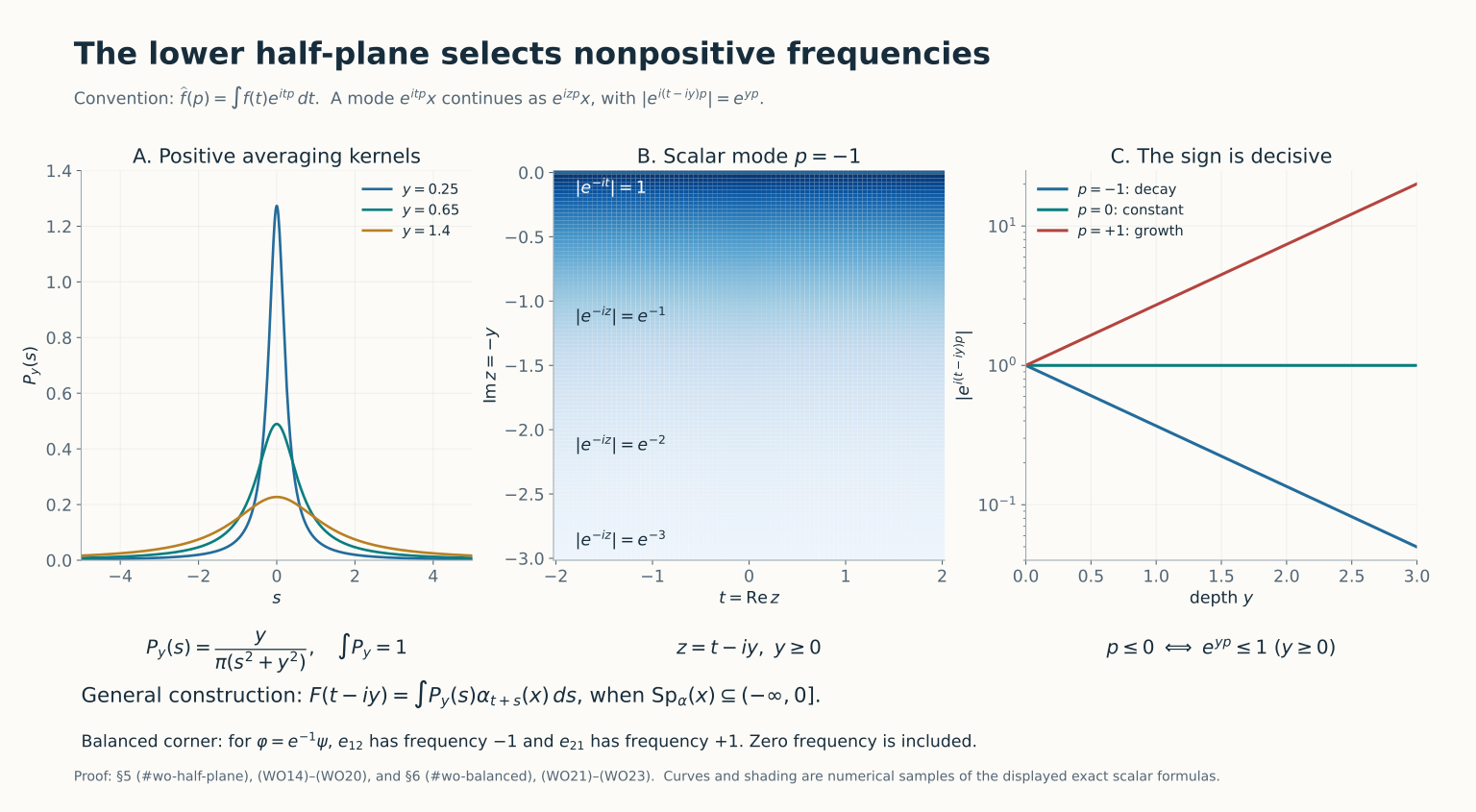
The curves sample the exact scalar formulas in (WO14)–(WO20); they illustrate the normal-filter proof in Section 5. For \(\varphi=e^{-1}\psi\), the two balanced off-diagonal frequencies are \(-1\) and \(+1\), as proved in (WO23). Figure source.
7. Exact models and solved diagnostics
Semifinite density chart. The examples use the faithful density weights and complete-domain criterion proved in the trace specialization. Here \(h,k\) are the original trace densities. The same calculation supplies the commuting-density and matrix-distance models in the next lesson.
1. The half-depth test can stop before depth one. On \(M_2(\mathbb C)\), with its usual trace, let \[ h=\begin{pmatrix}1&0\\0&2\end{pmatrix},\qquad k=\begin{pmatrix}2&1\\1&3\end{pmatrix},\qquad \varphi=\operatorname{Tr}(h\,\cdot),\quad \psi=\operatorname{Tr}(k\,\cdot). \tag{WO24} \] Both are faithful. Since \(k-h=\begin{pmatrix}1&1\\1&1\end{pmatrix}\geq0\), ordinary weight order and depth one-half hold. But \[ k^2-h^2=\begin{pmatrix}4&5\\5&6\end{pmatrix},\qquad \langle(k^2-h^2)(5,-4),(5,-4)\rangle=-4. \tag{WO25} \] Thus depth one fails. The forced lower endpoint sends \(k(5,-4)=(6,-7)\) to \(h(5,-4)=(5,-8)\); its squared norm increases from \(85\) to \(89\). This is an exact obstruction, not a numerical estimate of the largest possible strip.
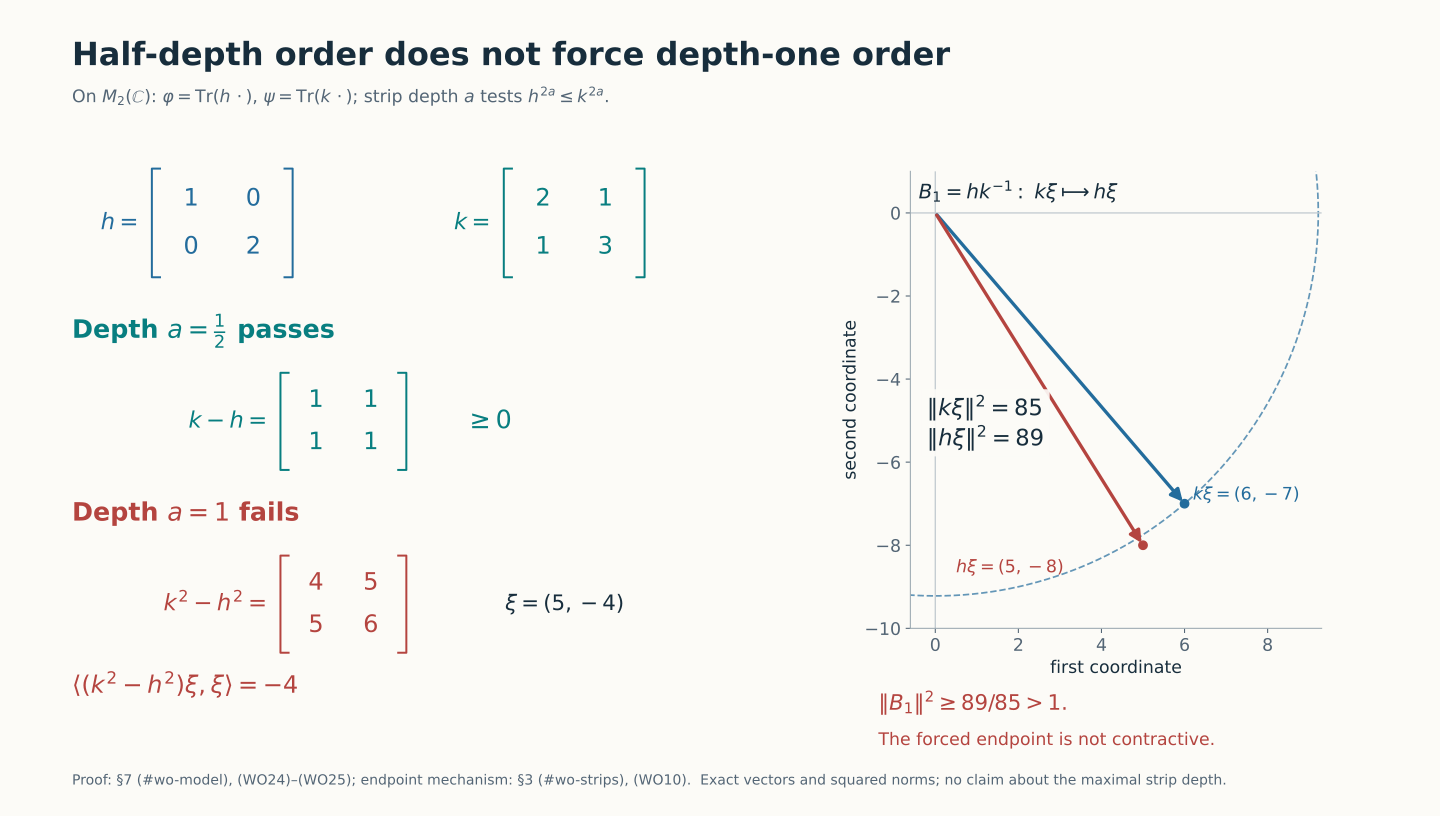
The real coordinate plane shows the exact obstruction in (WO24)–(WO25); the dashed circle has radius \(\sqrt{85}\). This proves failure at depth one, without claiming the largest possible strip. Numerical checks; the proof is the exact matrix computation above.
2. All-depth order does not imply commutation. Keep \(h=\operatorname{diag}(1,2)\), but take \(k=\begin{pmatrix}4&1\\1&4\end{pmatrix}\). Its eigenvalues are \(3,5\). Thus \(h^p\leq2^p1\leq3^p1\leq k^p\) for every \(p>0\), so \(\varphi\preceq_\infty\psi\). Nevertheless \(hk-kh=\begin{pmatrix}0&-1\\1&0\end{pmatrix}\ne0\).
3. The scalar ratio fixes both signs. If \(\varphi=c\psi\), then the unique extension is \(c^{iz}1\), of norm \(c^a\) at depth \(a\). Every positive depth works exactly when \(c\leq1\). The two off-diagonal frequencies in (WO23) are \(\log c\) and \(-\log c\).
4. Why faithful densities do not need bounded inverses. On \(\ell^2(\mathbb N)\), put \(ke_{2n-1}=ne_{2n-1}\), \(ke_{2n}=n^{-1}e_{2n}\), and \(h=ck\), \(0<c<1\). Both densities and both inverses are unbounded. Their trace weights are faithful normal semifinite by TD6. On the full inverse-power domain, \(h^ak^{-a}=c^a1\), whose closure is bounded. Thus the strip is \(c^{iz}1\) at every depth. None of the unbounded products is silently evaluated off its natural domain.
5. Infinite values are tested too. Let \(x\in M_+\) have \(\varphi(x)=\infty\). Formula (WO6) says \(\widetilde\varphi(X_x)=\infty\). If the dual inequality holds, it forces \(\widetilde\psi(X_x)=\psi(x)=\infty\). Thus the order-reflection argument has not discarded the part of the cone on which the weights are infinite.
6. Why zero frequency is included. A fixed nonzero \(x\) has constant extension \(F(z)=x\), and its spectral support is \(\{0\}\). The modulation-and-limit step after (WO17) is what permits this endpoint. Replacing either closed half-line in (WO23) by an open one would exclude equal weights.
8. An explicit comparison for nonfaithful weights
We now extend the definition to all normal semifinite weights, including zero. This extension specifies both the support condition and the derivative convention; it agrees with (WO1) on faithful weights.
Use the intrinsic densities from SCW1–2. For weights \(\varphi,\psi\), put \(p=s(\varphi)=s(h_\varphi)\), \(q=s(\psi)=s(h_\psi)\). All imaginary powers in this section are taken on the support and extended by zero. For \(p\leq q\), define \[ u_{\varphi,\psi}(t)=h_{\varphi,s}^{it}h_{\psi,s}^{-it}. \tag{WO27} \] This lies in \(M\): the two homogeneous powers acquire opposite scalar factors under \(\theta_s\), so their product is fixed; the full fixed-algebra theorem gives \(C^\theta=M\). SCW1 constructs the powers independently of faithful completions and charts, so (WO27) has the same independence. Its support identities are \[ u(t)u(t)^*=p,\qquad u(t)^*u(t)=\sigma_t^{\psi_q}(p),\qquad u(0)=p, \tag{WO28} \] where \(\psi_q\) is the faithful restriction to \(qMq\). Indeed SCW2 implements that modular action by \(h_{\psi,s}^{it}\) on \(qMq\), and \(p\leq q\) lets \(q\) be removed next to each supported power of \(h_\varphi\). The same multiplication proves \[ u(t+r)=u(t)\,\sigma_t^{\psi_q}(u(r)). \tag{WO29} \] Thus this is a partial cocycle in \(qMq\). When \(\psi\) is faithful it is the partial cocycle constructed in SCW1 with reference \(\psi\); when both weights are faithful it is exactly the normalized cocycle in (WO7). On a common support corner both weights are faithful there, and the SCW3 core identification gives that corner's normalized cocycle. No arbitrary logarithm at zero is chosen.
For \(a>0\), define \(\varphi\preceq_a^s\psi\) to mean \(p\leq q\) together with a contractive holomorphic extension of (WO27) to \(S_a\), jointly intrinsically sigma-strong continuous there. For incomparable supports the relation is false. The supported operator theorem L158, Section 9, applied in the common core, proves \[ \begin{aligned} \varphi\preceq_a^s\psi &\Longleftrightarrow D(h_\psi^a)\subseteq D(h_\varphi^a),\ \|h_\varphi^a\xi\|\leq\|h_\psi^a\xi\| \quad(\xi\in D(h_\psi^a))\\ &\Longleftrightarrow h_\varphi^{2a}\leq h_\psi^{2a} \quad\text{as complete closed forms}. \end{aligned}\tag{WO30} \] Here is the algebra-membership step, which a Hilbert-space strip theorem alone does not supply. Given the form inequality, that theorem constructs the unique contractive \(U(z)\in C\). Each \(\theta_s(U(z))\) has the same real boundary values (WO27). Boundary uniqueness therefore makes \(U\) fixed by \(\theta\), hence \(M\)-valued. The normal coefficient identification preserves all normal seminorms. The reverse implication follows by representing an \(M\)-valued extension in \(C\). The extension is unique, norm-holomorphic inside and jointly intrinsically sigma-strong-star continuous on the closed strip. Its lower edge is \[ U(t-ia)=h_{\varphi,s}^{it}\,T_a\,h_{\psi,s}^{-it},\qquad T_a=\overline{h_\varphi^a h_{\psi,s}^{-a}}\in pMq,\quad \|T_a\|\leq1. \tag{WO31} \] L158 proves that this product is taken on the full supported inverse-power domain before closure, including the kernel of \(h_\psi\).
The whole-cone density identity SCW2, the complete-form trace-density order isomorphism TD5, and the onto positive test (WO5)–(WO6) apply to nonfaithful weights as well. Consequently \[ \varphi\preceq_{1/2}^s\psi \Longleftrightarrow h_\varphi\leq h_\psi \Longleftrightarrow\widetilde\varphi\leq\widetilde\psi \Longleftrightarrow\varphi\leq\psi. \tag{WO32} \] All weight inequalities include infinite values on the entire positive cone.
These are partial orders. Reflexivity has constant extension \(p\). Transitivity follows either from (WO30) and transitivity of complete-form order, or by multiplying strip extensions: for \(p_1\leq p_2\leq p_3\), the intervening supported inverse and positive imaginary powers multiply to \(p_2\), and \(h_{\varphi_1,s}^{it}p_2=h_{\varphi_1,s}^{it}\). This is the exact ordered chain law needed at real times. Products of the bounded extensions are holomorphic and jointly sigma-strong-star continuous. For antisymmetry, the two form inequalities in (WO30) give identical complete closed forms. Their selfadjoint operators coincide; taking the Borel power \(1/(2a)\) gives \(h_\varphi=h_\psi\). Density uniqueness and (WO6) give equality of the original weights, including their supports. Zero is the least weight for every depth. If \(\psi=0\), the support condition forces \(\varphi=0\).
Define \(\preceq_\infty^s\) by requiring every finite depth. L158's supported spectral-order equivalence gives \[ \varphi\preceq_\infty^s\psi \Longleftrightarrow E_{h_\psi}([0,b])\leq E_{h_\varphi}([0,b]) \quad(b\geq0). \tag{WO33} \] The case \(b=0\) is the support inclusion. The extensions agree on overlaps and define one contractive lower-half-plane function. This is an order comparison of weights; it does not extend the later faithful-weight metric merely by dropping its hypotheses.
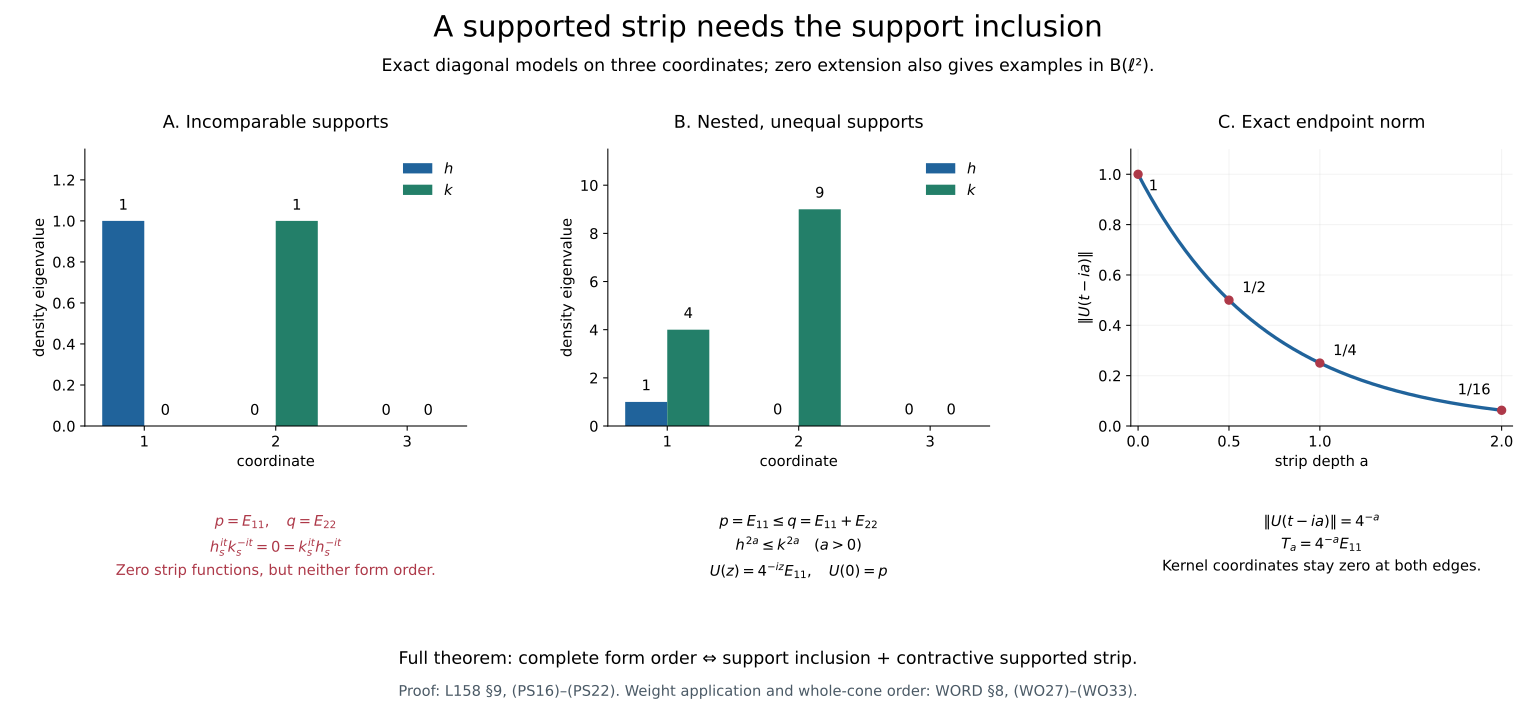
Why zero extension alone is insufficient, even on a properly infinite algebra. Let \(M=B(\ell^2(\mathbb N))\), let \(p=E_{11}\), \(q=E_{22}\), and take the finite normal weights \(\varphi(x)=\langle xe_1,e_1\rangle\), \(\psi(x)=\langle xe_2,e_2\rangle\). They are normal semifinite, with orthogonal supports. In the faithful trace chart, SCW1 gives \(h_\varphi=p h_{\operatorname{Tr}}\), \(h_\psi=q h_{\operatorname{Tr}}\); both projections commute with the trace generator. Their supported real-time products are therefore zero in both directions, and both zero functions extend to every strip. Yet \(\varphi(p)=1>\psi(p)=0\), with the reverse obstruction on \(q\). The explicit support clause in our definition excludes both comparisons.
The nested three-coordinate model in L158 gives a valid nonfaithful example: trace densities \(\operatorname{diag}(1,0,0)\) and \(\operatorname{diag}(4,9,0)\) satisfy every depth, with exact strip norm \(4^{-a}\). It can be read on \(M_3(\mathbb C)\), or extended by zero to the remaining coordinates of \(B(\ell^2)\). In the latter case the faithful trace chart gives the same supported products. The underlying weights are finite even though the ambient algebra is properly infinite.
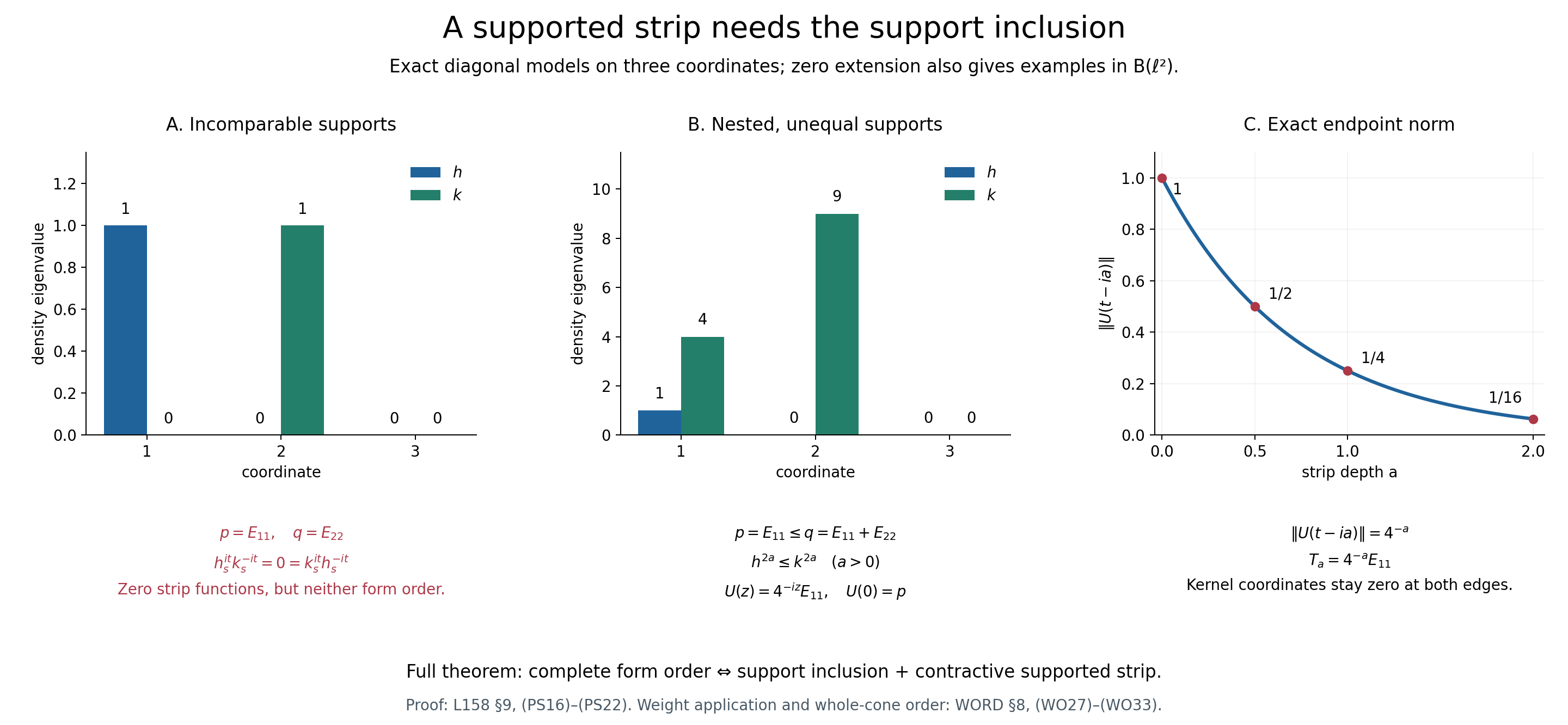
Exact models. In the left panel the two supported products are zero, although evaluating the forms on the first and second coordinate vectors disproves both orders. In the middle and right panels the supports are nested, the complete power inequality holds at every depth, and (WO31) and the diagonal calculation gives the exact norm values \(1,1/2,1/4,1/16\) at depths \(0,1/2,1,2\). The continuous curve samples that proved formula. Zero coordinates remain part of the full domains. Original renderer, exact data, editable SVG, and terms.
Further reading
M. Takesaki, Theory of Operator Algebras II, Chapter XII, Section 5, Definition 5.1, Lemmas 5.2 and 5.4, Remark 5.3 and Example 5.6(i), printed pp.421–423, treats these weight comparisons. The proof here first reflects order through an explicitly onto averaging map, then applies complete-form interpolation in one core. The half-plane criterion is proved by Poisson kernels, smooth normal filters and a contour estimate, with the Fourier sign fixed by (WO14). The earlier L158 proof supplies both the power-domain theorem and its noncommuting finite-dimensional diagnostics.
Section 8 supplies an explicit supported convention for the general-weight wording of Definition 5.1. The support condition is essential: its orthogonal-support example shows why contractivity of zero-extended products alone cannot recover ordinary weight order. The complete proof uses the local supported interpolation theorem and the earlier whole-cone density and averaging identities.