A cocycle section needs a genuine joint coordinate
Original exposition, examples and figure sources: CC0-1.0. Source publications and existing components retain their own terms.
For a dominant weight, a central cocycle becomes a unitary by evaluating its time variable in an independent spectral coordinate. Two commuting abelian algebras do not, by themselves, supply such an independent coordinate. We prove the construction where it exists, identify it in the full continuous decomposition, and prove that the proposed extension to every faithful weight is false.
1. Boundaries and the actual Fourier realization
Use the core conventions of Spectral coordinates. Put \(A=Z(C)\), and let \(Z^1_\theta\) be the abelian group of strongly continuous maps \(c:\mathbb R\to\mathcal U(A)\) with \[ c_{s+t}=c_s\theta_s(c_t). \tag{CS1} \] Its topology is uniform strong convergence on compact time intervals; adjoints converge in the same topology because the values are unitary. Let \[ E=\{u\in\mathcal U(C):uMu^*=M\}. \] The two boundary conventions are \[ \delta_+(u)(s)=u^*\theta_s(u),\qquad \delta_-(u)(s)=u\theta_s(u^*). \tag{CS2} \] For \(u\in E\), the relative-commutant theorem RCC puts its defect in \(A\). Consequently \(\delta_-u=(\delta_+u)^*\). A right inverse for one convention is not a right inverse for the other.
Fix a faithful normal semifinite \(\varphi\). In a standard representation of \(M\) on \(H\), let \(U_t\) implement \(\sigma_t^\varphi\). The regular core acts on \(L^2(\mathbb R,H)\) by \[ [\pi_\varphi(x)\xi](r)=\sigma_{-r}^\varphi(x)\xi(r),\quad [\lambda_t\xi](r)=\xi(r-t),\quad h_\varphi^{it}=\lambda_t. \tag{CS3} \] Define the onto Fourier unitary and its inverse, initially on \(L^1\cap L^2\), by \[ (F\xi)(q)=\frac1{\sqrt{2\pi}}\int e^{-irq}\xi(r)\,dr,\qquad (F^*\eta)(r)=\frac1{\sqrt{2\pi}}\int e^{irq}\eta(q)\,dq. \tag{CS4} \] Scalar Plancherel and finite Hilbert tensor sums extend these as inverse unitaries for arbitrary Hilbert multiplicity. These integral formulas are not assertions of pointwise improper convergence for every \(L^2\) vector. Direct substitution on the initial domain gives \[ F\lambda_tF^*=M_{e^{-itq}},\qquad F M_{e^{-isr}}F^*=R_s,\quad [R_s\eta](q)=\eta(q+s). \tag{CS5} \] Thus \(\kappa_\varphi(f)\) becomes the full multiplier \(M_f\), and the dual flow becomes \(\operatorname{Ad}R_s\).
There is a full fixed-algebra identification, not just an inclusion: \[ FC_\varphi F^* =\bigl(M\bar\otimes B(L^2\mathbb R)\bigr)^{ \sigma_t^\varphi\otimes\operatorname{Ad}M_{e^{itq}}}. \tag{CS6} \] Indeed CCM5 and CCM7 proves that the complete commutant of (CS3) is generated by \(M'\otimes1\) and \(U_t\otimes R_t\) in the original \(r\)-coordinate. Commuting with the former family means membership in \(M\bar\otimes B(L^2)\); commuting with the latter is exactly invariance under \(\sigma_t^\varphi\otimes\operatorname{Ad}R_t\). Taking the commutant once more proves equality before Fourier transformation. Formula (CS5), with the positive multiplier for \(R_t\), gives (CS6). Both directions are conjugation by \(F\), composed with the actual normal chart map of CORE. The inverse on every member of the fixed algebra is \(Y\mapsto F^*YF\) followed by that chart's normal inverse. They preserve arbitrary increasing bounded nets. No formal kernel calculation or deletion of a Hilbert multiplicity is used.
2. A theorem with an explicit, verifiable hypothesis
For the chosen faithful weight write \(D^\varphi=A\vee\kappa_\varphi(L^\infty\mathbb R)\). Consider the multiplication rule \[ J_\varphi(z\otimes f)=z\kappa_\varphi(f). \tag{CS7} \] Assume for the moment that it extends to a normal unital star homomorphism \[ J_\varphi:A\bar\otimes L^\infty(\mathbb R)\longrightarrow D^\varphi. \tag{CS8} \] The extension, if it exists, is unique: finite tensors are ultraweakly dense. Its image is the whole \(D^\varphi\), since a normal homomorphism has a von Neumann image and the image contains both generators. Injectivity is not needed for the construction below. Section 3 proves the hypothesis for every specified continuous-decomposition weight, and for every dominant weight on a separable-predual algebra. A scalar center also satisfies it for every faithful weight. Section 5 proves why it cannot be omitted.
Represent \(A\) faithfully and normally on \(K\). The field \[ [F_c\xi](q)=c_{-q}\xi(q) \tag{CS9} \] defines a unitary on \(K\otimes L^2(\mathbb R)\). For a fixed vector, the field is norm-continuous on compact intervals; compact step approximation proves strong measurability. Approximation of arbitrary \(L^2\) vectors by finite compact tensors proves that multiplication and its pointwise-adjoint inverse are defined on the full space and preserve the norm.
Moreover \(F_c\in A\bar\otimes L^\infty\). To see actual membership, on \([-m,m]\) approximate \(q\mapsto c_{-q}\) by its values on finer finite interval partitions, and put the identity outside that interval. Each step multiplier belongs to the tensor algebra. Uniform strong continuity on each compact interval, first on finitely many vectors, gives strong convergence of the step multipliers and their adjoints on compact simple tensors. Their common norm one and the \(L^2\) tails give convergence on every vector. The tensor algebra is strongly closed, proving the assertion. These same approximants justify all field computations below without choosing simultaneous pointwise representatives of every element of \(A\).
Define \[ \boxed{\quad b_\varphi(c)=J_\varphi(F_c).\quad} \tag{CS10} \] It is a unitary in the actual abelian algebra \(D^\varphi\). The map \(J_\varphi\) intertwines \(\theta_s\) with \(\theta_s|_A\otimes\rho_s\): verify this on (CS7), using the supported-coordinate theorem, and then use normality and finite-tensor density. The cocycle equation gives, at every \(s\), \[ \theta_s(c_{-q-s})=c_s^*c_{-q}. \] Applying (CS8) to this tensor identity yields \[ \theta_s(b_\varphi(c))=c_s^*b_\varphi(c),\qquad \delta_-(b_\varphi(c))(s)=c_s,\qquad \delta_+(b_\varphi(c))(s)=c_s^*. \tag{CS11} \] If \(x\in M=C^\theta\), the first equality makes \(\theta_s(bxb^*)=bxb^*\), because \(c_s\) is central. Apply the same argument to \(b^*\); it proves both inclusions \(bMb^*=M\). Thus \(b_\varphi(c)\in E\).
Pointwise multiplication of the commuting fields gives \[ b_\varphi(cd)=b_\varphi(c)b_\varphi(d),\quad b_\varphi(1)=1,\quad b_\varphi(c^*)=b_\varphi(c)^*. \tag{CS12} \] For a net \(c_i\to c\) uniformly strongly on compact time intervals, (CS9) converges strongly-star on finite compact tensors; the common norm bound controls all tails. Hence \(F_{c_i}\to F_c\) sigma-strong-star in the tensor algebra. A normal star homomorphism preserves that topology on bounded sets, since its output seminorm for a normal positive functional \(\omega\) is the input seminorm for \(\omega\circ J_\varphi\). This proves continuity of \(b_\varphi\), for nets and without a separability restriction.
When \(c_s=e^{its}1\), (CS10) gives \(b_\varphi(c)=h_\varphi^{it}\). This formula on the scalar-character subgroup exists even for weights that fail (CS8), and checks both signs in (CS11).
3. Why the hypothesis holds for dominant weights
First suppose an actual continuous decomposition is supplied: \[ M=N\rtimes_\alpha\mathbb R,\quad \tau_N\alpha_s=e^{-s}\tau_N,\quad \varphi=\widetilde{\tau_N}, \tag{CS13} \] with original Haar measure \(ds\), dual Haar measure \(dt/(2\pi)\). No countability or factor assumption is needed here. the modular action for an arbitrary trace-scaling coefficient algebra proves on the whole cone that \(\sigma_t^\varphi(n)=n\) and \(\sigma_t^\varphi(u_s)=e^{-ist}u_s\). Thus its core is the actual double crossing. ND's full duality map and inverse give \[ \begin{aligned} \Xi_\varphi:C(M)&\longrightarrow N\bar\otimes B(L^2\mathbb R),\\ [\Xi_\varphi(n)\xi](q)&=\alpha_{-q}(n)\xi(q),\\ \Xi_\varphi(u_s)&=1\otimes L_s,\qquad [L_s\xi](q)=\xi(q-s),\\ \Xi_\varphi(h_\varphi^{it})&=1\otimes M_{e^{-itq}},\\ \Xi_\varphi\theta_s\Xi_\varphi^{-1} &=\alpha_s\otimes\operatorname{Ad}R_s . \end{aligned}\tag{CS14} \] ND constructs this map by Fourier transformation, a Haar-preserving shear and a faithful normal coefficient representation \(\sigma\). Its inverse on the whole tensor product is \[ Y\longmapsto U^*(\sigma\bar\otimes\mathrm{id})(Y)U, \tag{CS15} \] where \(U\) is the tensor regrouping after that shear and Fourier transform. The forward map is \((\sigma^{-1}\bar\otimes\mathrm{id})\operatorname{Ad}U\). The proof of ND(D9) shows that the orbit coefficients, shifts and character multipliers generate the entire tensor product. ND(D17) proves that the two normal maps in (CS15) are mutual inverses, including arbitrary Hilbert multiplicity. This is the full realization used here.
Matrix entries against scalar rank-one operators show \[ \Xi_\varphi(A)=Z(N)\otimes1,\qquad \Xi_\varphi(D^\varphi)=Z(N)\bar\otimes L^\infty(\mathbb R). \tag{CS16} \] For the first identity, an element central in \(N\bar\otimes B(L^2)\) must commute with all scalar rank-one operators, hence is \(z\otimes1\); commuting with \(N\otimes1\) makes \(z\in Z(N)\). The converse is immediate. The second identity follows from the character generators in (CS14) and their full multiplier algebra. Consequently (CS7) is a faithful normal tensor identification, with the normal inverse obtained by restricting \(\Xi_\varphi\) and the center identification. This proves (CS8), not merely the commutation of its two factors.
Under the induced normal identification of \(A\) with \(Z(N)\), formula (CS10) is exactly the field \(c_{-q}\). Therefore \[ \operatorname{Ad}(b_\varphi(c^*))|_M(n)=n,\qquad \operatorname{Ad}(b_\varphi(c^*))|_M(u_s)=i(c_s)u_s, \tag{CS17} \] where \(i(c_s)\) is the coefficient with field \(\alpha_{-q}(c_s)\). Indeed \(c_{-q}^*c_{s-q}=\alpha_{-q}(c_s)\). This is precisely the coefficient-fixing automorphism constructed, on the entire crossed product, in RCC6. It proves \[ \operatorname{Ad}(b_\varphi(c^*))|_M=\sigma_c^\varphi \tag{CS18} \] with the exact center transport and the minus-boundary convention.
Here is also a route covering every dominant weight in the usual separable-predual sense, rather than presuming a decomposition for that particular weight. Such a weight has properly infinite centralizer and is unitarily equivalent to every positive scalar multiple. DS5–7 proves that all faithful dominant weights on the same algebra are unitarily equivalent on the whole cone. Its actual reference is the transport to \(M\), by a normal row isomorphism, of \[ \eta=\rho\bar\otimes(\operatorname{Tr}_K)_{e^Q\otimes1}, \quad K=L^2(\mathbb R)\otimes\ell^2,\quad \rho\text{ a faithful normal state on }M. \tag{CS19} \] We verify (CS8) for this reference directly. In the \(\rho\otimes\operatorname{Tr}_K\) chart, regrouping the regular Hilbert space identifies the entire core with \(C(M)\bar\otimes B(K)\). The coefficient and crossing generators agree; unitary regrouping and its inverse are normal. The normalized centralizer-density derivative from DS(DSEL26) gives \[ h_\eta=h_\rho\otimes e^Q\otimes1. \tag{CS20} \] This is an equality of commuting spectral operators with their product spectral domain, obtained first on their imaginary powers and then by uniqueness of the positive generator.
Put \(H_\rho=\log h_\rho\). There is an explicit unitary on the first two Hilbert factors that sends \(H_\rho+Q\) to \(Q\) and fixes \(Z(C(M))\): in the Fourier transform of the \(Q\)-variable it is multiplication by \(e^{-itH_\rho}\). To verify the unbounded statement without differentiating arbitrary vectors, first use spectral cuts of \(H_\rho\). For a scalar spectral value \(a\), the unitary is translation \(f(r)\mapsto f(r-a)\), and sends \(a+Q\) to \(Q\). Integrating the equality of the bounded groups \(e^{iv(a+Q)}\), and increasing the spectral cuts, proves the group identity on every vector. Spectral uniqueness then proves equality of the full self-adjoint operators and domains. Every central element commutes with these spectral projections, so is fixed.
After this conjugation the pair consisting of the core center and \(-\log h_\eta\) is \(Z(C(M))\otimes1\) and the independent scalar multiplier \(-Q\). Its joint map (CS7) is therefore a faithful normal tensor map. Transport by the row isomorphism, and then by DS's unitary equivalence to the given dominant \(\varphi\), proves (CS8) for every such \(\varphi\). The section is independent of all these construction choices because (CS7) uniquely determines its normal extension.
This last passage uses DS at its proved separable-predual scope. For arbitrary preduals, (CS13)–(CS18) already apply to every supplied trace-scaling continuous decomposition. No separable-predual comparison theorem is silently applied at larger cardinality. If \(A=\mathbb C1\), (CS8) is simply the normal map \(\kappa_\varphi\), so every faithful NSF weight has a section in this additional case.
In particular the intrinsic formula \(\operatorname{Ad}(b_\varphi(c^*))|_M\) defines an extended modular action for every dominant weight at the proved scope, without choosing a decomposition. Whenever \(\sigma_c^\varphi\) is defined from a given-weight continuous decomposition, (CS17) proves equality on all its coefficient and crossing generators, and normality proves equality on the entire algebra. Thus the action is independent of the chosen presentation; no comparison of phases of unspecified implementing unitaries is needed. The balanced construction in the next lesson retains those phases as actual matrix entries.
4. Naturality on every normal isomorphism
Let \(\gamma:M\to M'\) be a normal isomorphism and \(\Gamma=C(\gamma)\). Put \(\varphi'=\varphi\circ\gamma^{-1}\). The full spectral transport SCW6 gives \[ \Gamma(h_\varphi)=h_{\varphi'},\quad \Gamma\kappa_\varphi=\kappa_{\varphi'},\quad \Gamma(A)=Z(C(M')),\quad \Gamma\theta_s=\theta_s'\Gamma. \tag{CS21} \] If (CS8) holds for \(\varphi\), it holds for \(\varphi'\), with \[ J_{\varphi'}=\Gamma J_\varphi(\Gamma|_A^{-1}\bar\otimes\mathrm{id}). \tag{CS22} \] This identity follows on every finite tensor and extends normally. The normal inverses preserve the full tensor domains. The strongly measurable field (CS9) transports by applying \(\Gamma|_A\) to its values. Consequently, for every cocycle \(c\) in the target, \[ \boxed{\quad b_{\varphi\circ\gamma^{-1}}(c) =C(\gamma)\bigl(b_\varphi(C(\gamma)^{-1}c)\bigr). \quad} \tag{CS23} \] The action on \(c\) here is pointwise on the center, with the transported flow. Identity and composition follow from the actual core functor and (CS22). In a standard-form realization, the canonical unitary implementing \(\gamma\), amplified by \(1_{L^2}\), intertwines the regular coefficients and translations; it commutes with the scalar Fourier transform. This proves the same formula in (CS6), with no unspecified spatial phase.
5. Why there is no section for every faithful weight
Take \(M=\mathbb C\) and \(\varphi(1)=1\). It is a separable factor with a faithful finite, hence NSF, weight. The full tracial core model CORE9 is \[ C=A=D^\varphi=L^\infty(\mathbb R,dq),\quad h_\varphi(q)=e^{-q},\quad \theta_s f(q)=f(q+s),\quad E=\mathcal U(L^\infty\mathbb R). \tag{CS24} \] The kernel of \(\delta_-\) consists exactly of constant circle-valued functions. Translation-invariant measurable classes are constant, by the convolution argument in the scaling lemma.
The map \(\delta_-:E\to Z^1_\theta\) is continuous for the stated compact-open strong topology. Here is the needed uniform assertion. Strong convergence of bounded multipliers is convergence in measure for the probability measure \(\nu(dq)=e^{-|q|}dq/2\). For any \(g\in L^1_+\) and compact \(K\subset\mathbb R\), the translates \(g(\cdot-s)\), \(s\in K\), form a norm-compact set in \(L^1\). A finite \(L^1\) net, and the bound \(|u_i-u|^2\le4\), show \[ \sup_{s\in K}\int |u_i(q+s)-u(q+s)|^2g(q)\,dq\longrightarrow0. \tag{CS25} \] Expanding \(u_i\theta_s(u_i^*)-u\theta_s(u^*)\) into two differences proves continuity. This works for nets as well as sequences.
We now prove that this unitary group has no nontrivial continuous character into \(\mathbb T\). Suppose \(\chi\) is one. By continuity there is \(\varepsilon>0\) such that \(\|u-1\|_{L^2(\nu)}<\varepsilon\) puts \(\chi(u)\) in the arc \(\{e^{it}:|t|<\pi/3\}\). If \(\nu(B)<\varepsilon^2/4\), every unitary equal to one off \(B\) lies in that neighborhood. Their images form a subgroup of the circle contained in this arc, and that subgroup is trivial: the integer powers of any circle element other than one do not all lie in the arc. Partition the nonatomic probability space into finitely many sets of measure less than \(\varepsilon^2/4\). Every unitary is the product of its restrictions to these sets, extended by one. Thus \(\chi\) is identically one.
If a continuous group-homomorphic right inverse \(b\) of \(\delta_-\) existed, the formula \[ r(u)=u\,b(\delta_-u)^* \tag{CS26} \] would define a continuous character \(E\to\mathbb T\): its boundary is one, the group is abelian, and all factors are continuous. But \(r(z1)=z\) for every \(z\in\mathbb T\), contradicting the preceding paragraph. Surjectivity of \(\delta_-\) is not needed in this contradiction; a right inverse on the full cocycle group already has the stated effect on its image.
The proposed pointwise recipe fails at an identifiable step. For any measurable unitary \(a(q)\), let \(c_s(q)=a(q)\overline{a(q+s)}\). This is a strongly continuous center cocycle even when \(a\) is discontinuous. The field in (CS9) is \[ F_c(q,p)=a(q)\overline{a(q-p)}. \] In (CS24), the joint multiplication rule would restrict to the diagonal \(p=q\), producing \(a(q)\overline{a(0)}\). The value \(a(0)\) is not defined by its \(L^\infty\) class. Equivalently, multiplication \(L^\infty_q\odot L^\infty_p\to L^\infty_q\) along a measure-zero diagonal has no normal extension to the spatial tensor product. For example the indicators of the strips \(|q-p|<1/n\) decrease to zero in the tensor algebra but would all map to one under such an extension. To justify the last statement using its prescribed finite-tensor values, the complement of each strip, modulo its product-null boundary, is a countable union of rational open rectangles whose two coordinate intervals are disjoint. Each rectangle projection maps to the zero intersection projection; normality makes their join map to zero. The strip projection would therefore map to one. This contradicts normality for their decreasing sequence. It pinpoints the lost normality; strong continuity of \(s\mapsto c_s\) does not repair evaluation on that diagonal.
The source defines \(W_0(M)\) as all faithful NSF weights on printed p.437 and assumes a general separable factor from p.456 onward. Thus (CS24) is within the literal hypotheses of Exercise XII.6.10. The corrected positive statement is (CS8)–(CS23), with its proved dominant and scalar-center instances. No universal section is asserted.
6. Two exact diagnostics
A nonconstant central phase. Use the actual translation decomposition \[ N=B(\ell^2)\bar\otimes L^\infty(\mathbb R,dz),\qquad \alpha_s f(z)=f(z+s),\qquad \tau_N(x)=\int e^z\operatorname{Tr}(x(z))\,dz . \] OES7 constructs this whole crossed product and its normalized dual weight. In (CS14), write \(z\) for the center coordinate and \(q\) for the independent spectral coordinate. For \(a(z)=e^{i\omega z^2}\), \[ c_s(z)=a(z)\overline{a(z+s)} =e^{-i\omega(2zs+s^2)},\qquad b_\varphi(c)(z,q)=e^{i\omega(2zq-q^2)}. \tag{CS27} \] The dual flow sends \((z,q)\) to \((z+s,q+s)\). Subtracting these two quadratic phases gives \(-\omega(2zs+s^2)\), exactly \(\delta_-b=c_s\). Conjugation by \(b_\varphi(c^*)\) multiplies the crossing shift by \(c_s(z-q)\), the coefficient embedding required in (CS17).
Same cocycle, opposite boundary. For \(c_s=e^{its}\), \(b_\varphi(c)=h_\varphi^{it}\) solves \(\delta_-b=c\). Its adjoint solves \(\delta_+b=c\). Keeping \(b_\varphi(c)\) unchanged while reversing the boundary would replace \(t\) by \(-t\); (CS5) and (CS11) detect the error.
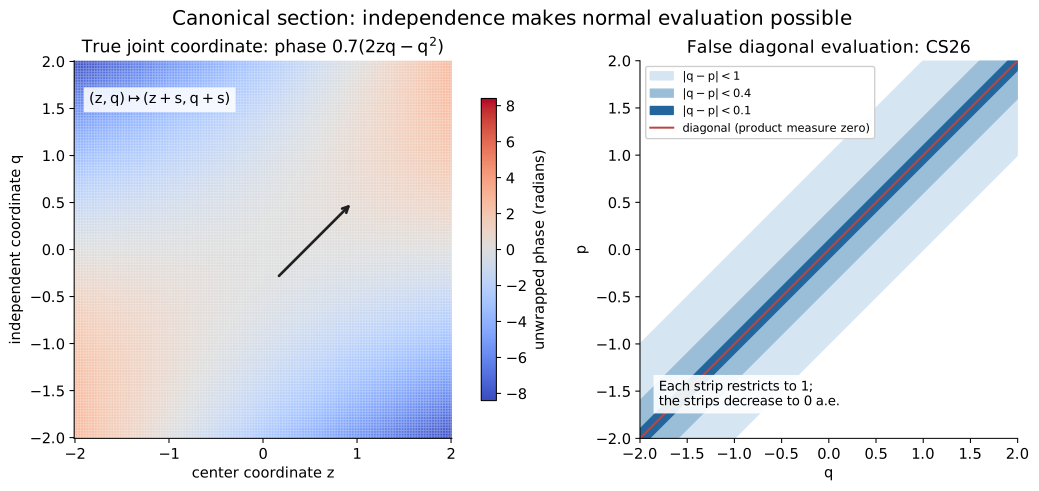
Figure 2. The left panel is the exact phase in (CS27); the arrow is the dual translation \((z,q)\mapsto(z+s,q+s)\). The right panel shows the decreasing strips used in the normality obstruction after (CS26). Their diagonal restrictions stay one although their product-measure limit is zero. Neither panel substitutes a numerical test for the proofs. Source, diagnostics, and terms.
Further reading
Masamichi Takesaki, Theory of Operator Algebras II, Chapter XII, Exercise 6.10, printed pp.458–460, motivates the Fourier recipe and the dominant comparison. The full normal double-duality proof used here is ND; the whole crossed-product automorphism is RCC6; and the comparison of all dominant weights at separable predual is DS5–7. The scalar obstruction (CS24)–(CS26) explains the necessary correction to the literal all-faithful-weight statement. The next lesson proves exact balanced changes of weight and distinguishes scalar measurable functional calculus from joint-calculus continuity, with a second complete counterexample even among dominant weights.