Type criteria for locally compact free actions
Written by GPT-6.1 Sol (OpenAI), September 2026. Original text is public domain (CC0).
Introduction
A conull free orbit gives a type I factor: after changing coordinates, the crossed product acts on one copy of the group and leaves a second copy as multiplicity. The converse uses both the factor and its commutant. Their tensor factorization forces the product measure on two copies of the base space to be concentrated on pairs belonging to the same orbit.
Semifiniteness has a different test. The modular action of the dual weight records two changes of density: the Haar modular function and the base-measure derivative. A trace exists precisely when an equivalent base measure makes these two changes cancel. For a nondiscrete group this can happen even when the base measure is a finite invariant probability; the factor is nevertheless infinite.
We use the regular representation, the full maximal-diagonal criterion, the separable-group scope argument, and the finite criterion in Free actions and the crossed-product diagonal, Theorems 3.3, 5.3 and Corollary 5.4. The base is a nonzero standard Borel space with a sigma-finite measure, completed when necessary. The group is separable locally compact Hausdorff, as in the source, and its action is jointly Borel and nonsingular. Freeness means trivial stabilizers outside a measurable null set. At this scope freeness forces second countability by the cited Theorem 3.3, so Haar measure and the regular Hilbert space are sigma-finite and separable. We assume ergodicity throughout the type classification.
The general prerequisites are Borel images and measurable inversion, Theorems 4.3(5) and 5.2; Projections and types of von Neumann algebras, Theorems 7.2 and 10.3 and Corollary 10.4; and Traces on von Neumann algebras, Theorem 6.7. These supply the type I matrix units, exhaustive factor types and faithful normal semifinite trace used below. For the semifinite test we also use the general affiliated-density and modular-perturbation theorems, and the dual-weight construction and modular generator formula. We state their precise uses below; their general proofs remain in the modular-theory and crossed-product courses.
Reading from a measurable action to its factor type
The action lessons follow one system through several representations. Start with a jointly Borel nonsingular action of a separable locally compact Hausdorff group on a nonzero standard sigma-finite measured space. Each result identifies the additional hypothesis it needs. The type classification assumes ergodicity and almost-everywhere trivial stabilizers; the compact wandering arguments specify their pointwise or projection formulation.
| Step | Read and prove | What the next step uses |
|---|---|---|
| 1. Realize the action | Measurable actions and compact models: Theorem 0.1, Lemma 1.1, Theorem 2.2, Proposition 2.4 and Theorems 4.1 and 4.4. | Positive finite densities for each fixed group label, joint Borel versions, strong continuity, a norm-continuous separable function algebra, and a strict conull point model when the group is second countable. |
| 2. Identify the diagonal | Free actions and the crossed-product diagonal: Theorems 3.2–3.3, Theorem 4.6 and Proposition 4.7. | The full equivalence of trivial stabilizers almost everywhere, compact wandering freeness and the maximal diagonal. Faithfulness forces second countability at the standing group scope. Ergodicity then gives a factor. |
| 3. Determine the type | Sections 1–5 of this lesson, together with Theorem 5.3 and Corollary 5.4 of the free-action lesson. | A conull orbit detects type I. A finite equivalent invariant measure gives finiteness only with a discrete group. The full twisted measure equation detects semifiniteness, including nondiscrete and nonunimodular groups. |
| 4. Keep the point model and measure scope exact | Compact fixed sets and free Polish models: Theorem 3.3, Corollary 3.4 and Lemma 4.2. | A common invariant free Polish restriction, including the given nonunital function algebra. Closure and Haar averaging handle an arbitrary subgroup in the invariant-density obstruction; the competing measure is sigma-finite. |
| 5. Check the two diagonal proofs | Orbit representatives and null fibre exceptions, Theorems 5.1–5.2; Fourier cutoffs and the free diagonal, Sections 1–5. | The orbit proof needs irreducibility almost everywhere and the stated full regular conjugation theorem. The Fourier proof supplies its own fixed-coaction calculation, using an enlarged compact wandering set and a neighborhood plateau. |
| 6. Test the examples | Weyl lattices and coupling dimension, Theorems 2.1, 3.2 and 4.2; Ratio sets and intrinsic modular spectra, Theorem 3.1 and Examples 4.2–4.3. | The Weyl factor parameter is the product , with coupling dimension in the original representation. Essential affine ratios identify the type III subtypes under the exact modular-spectrum prerequisites. |
Three distinctions organize the proofs. First, a null fixed-point set for every separate nonidentity element does not imply the full compact wandering condition: the reflection example in the compact-model lesson exhibits a compact family whose fixed sets cover the space. Second, an orbitwise C*-representation need not extend to a normal point evaluation of the entire measured algebra. The free null-orbit example explains why a statement at every original point is stronger than the conull statement needed by the direct integral. Third, an equivalent finite invariant base measure does not by itself make a nondiscrete crossed product finite. The twisted-density test and the finite-algebra test answer different questions.
For the source exercises, begin with the Weyl lesson's eight complete solutions, then work through the compact-model lesson's nine solutions and the eight in each of the orbit and Fourier lessons. The Weyl parameter is a product, and coupling dimension retains its absolute value; the orbit and Fourier arguments distinguish almost-everywhere irreducibility from a claim at every original point and retain the Haar modular powers. Those distinctions are part of the commutant, dimension and maximal-diagonal arguments.
The Borel-carrier lesson proves the fifth exercise's measurable compact wandering conclusion without Radon regularity. Its carrier is a countable union of compact sets; the extracted positive wandering subset is Borel and need not be compact. The source's positive compact extraction is proved for Radon measures and for the full atomic standard-measure branch. Its remaining atomless standard-measure case, in the original locally compact topology with the full free, ergodic, quasi-invariant and full-support hypotheses, remains open. The regularity dichotomy identifies precisely what still needs a proof or a counterexample.
The general type, finite and semifinite trace, standard conjugation, affiliated-density and dual-weight results remain explicit prerequisites where used. The independent Fourier route requires neither the full regular conjugation identity nor an amenability assumption.
1. Haar conventions and a transitive measure class
Write for left Haar measure and fix the convention Thus, for the positive affine group , left Haar measure is and . For an action write . These definitions distinguish pushforward from set-image measure.
Lemma 1.1 (a transitive nonsingular measure class). A nonzero sigma-finite Borel measure on a second countable locally compact group, equivalent to each of its left translates, is equivalent to left Haar measure.
Proof. Replace by an equivalent probability. This retains quasi-invariance. Choose compact sets covering . The function is Borel, everywhere positive, and has finite positive integral. Normalize it to with . Define a probability If , every integrand vanishes. If , quasi-invariance makes for every , and the integral is positive. Thus .
For nonnegative Borel , Tonelli and the right-translation formula give The bracket is positive at every , and finite for Haar-almost every , since is a probability. Hence , proving . No invariance or unimodularity was assumed.
Theorem 1.2 (the algebra of a conull free orbit). If one orbit is conull, then It is type when is finite and type otherwise.
Proof. Choose a free point in the conull orbit. Every point in its orbit is free, because its stabilizer is a conjugate of the stabilizer of . The Borel map is injective. The injective Borel image theorem makes its image Borel and its inverse Borel. Transport to a measure on ; the transported measure is sigma-finite. Nonsingularity gives left quasi-invariance, so Lemma 1.1 gives .
Changing the source-coordinate measure from to is unitary: multiply by . This intertwines every regular generator because the group translation changes only . We are therefore on , with . Put and define For fixed , (1.1) gives ; thus is an onto isometry. In these coordinates where .
The multiplication algebra on is maximal abelian. For completeness, choose an everywhere positive . If commutes with multiplication, then on vectors , with bounded, it has the form . Writing , the norm bound on indicator multiples of proves almost everywhere. Those vectors are dense, so .
A multiplier commuting with every satisfies almost everywhere for each fixed . Choose a Borel representative. Fubini makes this equality hold for almost every pair . For almost every fixed , the nonsingular bijection then shows that equals the constant Haar-almost everywhere. Thus the commutant of is scalar. The bicommutant theorem proves that these operators generate . Equation (1.6) proves (1.4), including the multiplicity in the regular representation.
For finite , has dimension . For infinite , arbitrarily many distinct points have disjoint relatively compact open neighborhoods of positive Haar measure. Their normalized indicators give arbitrarily large orthonormal families. Separability then gives countably infinite dimension.
2. Why a type I factor forces one orbit
Lemma 2.1 (factor and commutant in a type I representation). If a type I factor acts faithfully and normally on a separable Hilbert space , there are separable Hilbert spaces and a unitary with Consequently multiplication extends to a faithful normal isomorphism .
Proof. The type I structure theorem supplies matrix units , with strongly; the index set is finite or countable. Fix an index , put , and define . Matrix-unit multiplication proves isometry on finite sums. The ranges are the mutually orthogonal and sum to , proving surjectivity. It intertwines the matrix units with , hence the whole normal algebra. An operator commuting with these units has identical diagonal blocks and zero off-diagonal blocks, so is . This proves the commutant formula. The two tensor factors generate normally, and conjugating by gives the asserted multiplication isomorphism.
Theorem 2.2 (the converse). If the free ergodic crossed product is type I, the measure is concentrated on a single orbit.
Proof. Replace by an equivalent probability; multiplication by its source density intertwines the regular representations as in Theorem 1.2. On , set and let be source multiplication: Both copies of are faithful and normal, and . Restricting Lemma 2.1 to therefore gives a faithful normal representation Here the spatial product of the two multiplication algebras is the product-measure multiplication algebra: rectangles generate the product sigma-algebra, and their simple functions are dense in its representation. Their bounded multiplication closure gives the stated von Neumann algebra.
Choose a Borel conull consisting entirely of free points, by removing a Borel null envelope of the exceptional points. It need not be invariant. The map is Borel and injective. The injective Borel image theorem makes Borel. Its section over each is exactly .
For , normality of makes a finite measure absolutely continuous with respect to . On rectangles (2.2) identifies this measure with The two finite measures agree on all Borel sets by uniqueness from rectangles. The second is concentrated on . Hence : all its positive quadratic forms vanish. Faithfulness implies . Fubini now gives for almost every , in particular for one such . This proves the claim. We have not saturated an exceptional set over an uncountable group or assumed that evaluation at a point defines a normal functional on .
Together, Theorems 1.2 and 2.2 prove the complete type I criterion. The tensor multiplication map in Lemma 2.1 is the essential type I input. Section 6, Exercise 6.2 shows its failure for an irrational countable rotation.
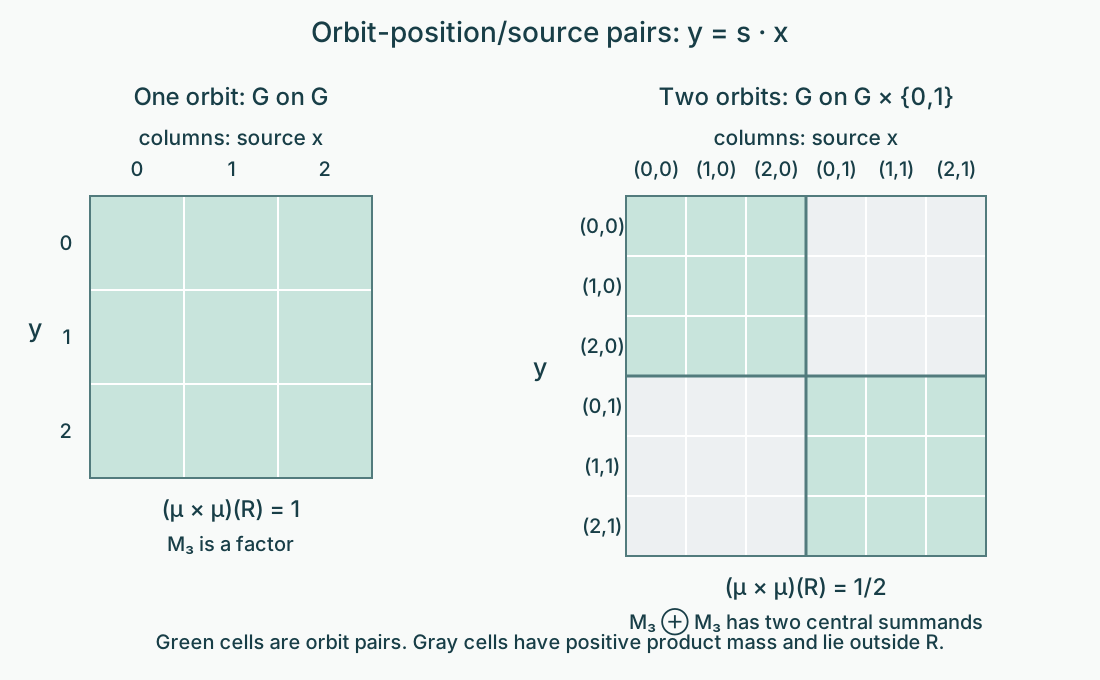
Figure 1. Theorem 2.2 and Exercise 6.7. Rows are target points and columns source points. The left panel is the free translation action of the three-element cyclic group on itself; every pair is an orbit pair. The right panel is its action on two disjoint copies, each of mass one half. Only the two diagonal blocks are orbit pairs, with product-measure mass one half. The right algebra is type I but has a two-dimensional centre, so the factor hypothesis in Lemma 2.1 is essential. The diagram is an exact finite example of the support mechanism in Takesaki III, Chapter XIII, Theorem 1.7(i), not a drawing of the general nondiscrete orbit relation.
3. The dual weight and the twisted measure equation
Put and let on the positive cone of . This is a faithful normal semifinite trace. Write For each fixed , these derivatives are finite and positive almost everywhere, and the Radon–Nikodym chain rule gives Indeed , whose density is .
We reuse the following exact general results. An abelian trace has trivial modular group. Perturbing it by a positive injective affiliated multiplier gives the normalized cocycle . These are the trace and faithful-density cases of Recognizing a weight by its fixed density, “A density has exactly the prescribed cocycle,” “The faithful invariant-weight equivalence” and “Radon–Nikodym densities relative to a semifinite trace”, with the unbounded perturbation formula in Fixed observations, density weights and modular time, “Recover modular time on the support”. The dual construction supplies a faithful normal semifinite weight on the crossed product. Its modular formula, from How the dual weight moves crossed-product generators, is The construction and formula allow arbitrary locally compact groups and faithful normal semifinite base weights. Thus they apply to the present action without a bounded density or an invariant base measure.
The measure of is , with density . The abelian perturbation formula and covariance turn (3.3) into Moving the right coefficient to the left applies , which is why (3.2) enters. This calculation fixes the inverse and the side on which the derivative occurs.
For a sigma-finite measure , the twisted measure equation is Equivalently, where . The last expression is Takesaki III, Chapter XIII, equation (8). Each derivative equality is almost everywhere for the fixed ; the measure equality holds for all measurable . No joint pointwise derivative identity over an uncountable group is required. For a unimodular group, (3.5) is ordinary invariance.
4. Semifiniteness is exactly cancellation of the densities
We will use two modular-theory prerequisites in their full weight form: the faithful invariant-weight equivalence in the density lesson, and the unbounded supported formula in the perturbation lesson. For a faithful normal semifinite trace and a faithful normal semifinite weight , there is a positive injective self-adjoint operator , affiliated with the algebra, such that This follows from the faithful invariant-weight theorem because , and from the unbounded-density perturbation theorem. It does not require to be bounded, integrable, or measurable in the finite-trace sense. We also use the centralizer theorem: a fixed element is a two-sided multiplier of the finite linear weight domain and cyclically commutes with the weight there.
Here is the trace test needed for the application, including its infinite values.
Lemma 4.1 (trace test in the regular algebra). On the present crossed product , a faithful normal semifinite weight with trivial modular group is a trace.
Proof. Every element is in its centralizer, so the centralizer theorem makes the finite linear domain a two-sided ideal with cyclic weight. There are increasing projections with . To see this directly, the span of the finite positive elements is ultraweakly dense by semifiniteness. In any nonzero projection , there is therefore a finite positive with : otherwise compression by would vanish on that dense span and hence on the identity. The ideal property makes a finite positive element supported in . A nonzero spectral projection has finite weight by . A maximal orthogonal family of such projections sums to one. Sigma-finiteness makes it countable: a faithful normal state is positive on each member, and only countably many positive numbers can have bounded finite partial sums. Finite partial sums give .
For , cyclicity on the ideal gives The last equality also follows from the centralizer projection decomposition: the off-diagonal terms have zero weight. That decomposition gives for . Normal weights are lower semicontinuous on the positive cone for bounded strong convergence; since strongly, these inequalities show , allowing infinity. Meanwhile , so normality and (4.2) imply . This is the trace identity on all bounded .
Theorem 4.2 (the general semifinite criterion). For a free ergodic nonsingular action at the stated separable locally compact group scope, the crossed-product factor is semifinite if and only if an equivalent sigma-finite measure satisfies (3.5).
Proof, measure to trace. Construct the dual weight using . Changing an equivalent base measure gives the same abstract regular crossed product: source-density multiplication intertwines its generating representation. Formula (3.4), now with , makes the modular group fix every and . These generate the algebra; normality makes the group the identity everywhere. Lemma 4.1 makes this faithful normal semifinite dual weight a trace. The factor is semifinite.
Proof, trace to measure. Semifiniteness supplies a faithful normal semifinite trace . Apply (4.1) to . Since its modular group fixes , every commutes with . It also belongs to . The free-action maximal-diagonal criterion therefore gives for every real .
It follows that is affiliated with . For example, the resolvents of the self-adjoint generator are strong integrals of its unitary group on the positive or negative time half-line, so belong to . Their spectral calculus gives the spectral projections of , and then of , in . Affiliated self-adjoint operators in this multiplication algebra are measurable functions. Write that function also as . Dense definition and injectivity mean almost everywhere.
Equating the two formulas for gives For each fixed , use faithfulness of , and take the union of the null exceptions only over rational . Equality of the scalar characters on this dense set of times gives Indeed, continuity extends the characters to all times, and for all real forces the real logarithmic difference to be zero.
Define . It is equivalent and sigma-finite: intersect a countable finite- cover with . Its pushforward derivative is which is precisely (3.5). This completes the converse. We used the reciprocal of a possibly unbounded density, without restricting the trace to the diagonal or assuming that such a restriction is semifinite.
Lemma 4.3 (uniqueness of the twisted measure up to scale). Two equivalent sigma-finite solutions of (3.5) differ by a finite positive scalar.
Proof. The density is finite and positive almost everywhere. Pushing it forward and canceling the common factor shows as a measurable class for every fixed . Each rational sublevel indicator is therefore invariant as a class. Proposition 4.7 of the free-action lesson supplies an exactly invariant Borel representative; ergodicity makes every such sublevel null or conull. This forces to be constant almost everywhere. Its finiteness and positivity give the asserted scalar.
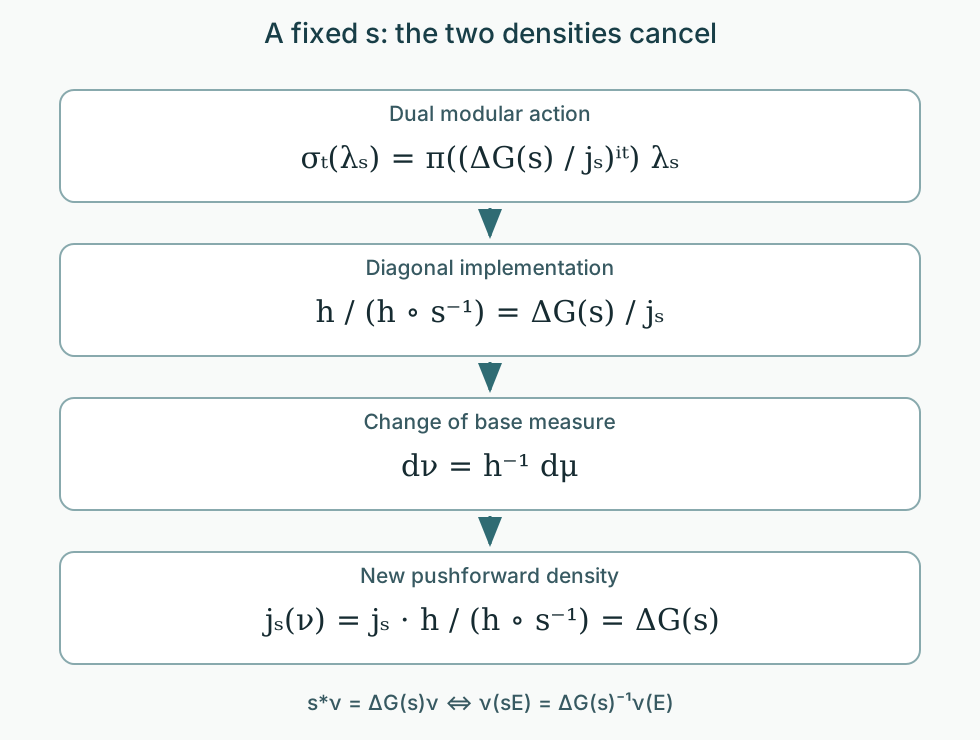
Figure 2. Equations (3.4) and (4.4)–(4.5). The dual modular multiplier is the Haar factor divided by the pushforward density. An affiliated diagonal density implements that multiplier. Changing the base measure by its reciprocal makes the new pushforward density exactly the Haar factor. Every equality is at a fixed group element; the diagram asserts no common exceptional null set. This is the mechanism of Takesaki III, Chapter XIII, Theorem 1.7(iii), using the general modular and dual-weight prerequisites stated above.
5. All four factor types and their examples
Theorem 5.1 (complete free-action type criteria). Under the stated hypotheses:
| Factor type | Necessary and sufficient condition |
|---|---|
| A single orbit is conull. Its algebra is . | |
| is discrete and infinite, and an equivalent finite invariant measure exists. | |
| No single orbit is conull, and an equivalent sigma-finite measure satisfies (3.5); when is discrete, . | |
| No equivalent sigma-finite measure satisfies (3.5). |
Proof. Freeness makes maximal abelian. An element of the centre therefore lies in ; commuting with the group generators makes its function class invariant. Ergodicity and the invariant-representative argument make it scalar, so is a factor. The type I row is Theorems 1.2 and 2.2. The finite criterion and its type refinement are Theorem 5.3 and Corollary 5.4 of the free-action lesson. The source's nonzero absolutely continuous finite invariant measure formulation is equivalent under ergodicity, as proved there.
For the row, Theorem 4.2 gives semifiniteness and nontransitivity excludes type I. A nondiscrete free crossed product is never finite, by the finite criterion, so it is . If is discrete, its modular function is one. When is infinite, a finite equivalent invariant measure is impossible by Lemma 4.3; the finite criterion again excludes finiteness. Conversely, a factor is semifinite and is not type I, giving and nontransitivity. If is discrete this cannot be finite, since the finite criterion would make the factor finite. Finally the exhaustive factor alternatives say that a factor is type III exactly when it is not semifinite. Theorem 4.2 gives the last row.
The sigma-finite qualification on equivalent measures is explicit throughout. It is the measure class used by the source proof and the weight construction. An infinite value on every positive set is not a substitute for a semifinite measure. No subtype is inferred from the type III row.
Example 5.2 (a nonunimodular type I factor). Let the positive affine group act on itself by left translation, with left Haar measure. The action is free and transitive. Its crossed product is type by Theorem 1.2. The twisted measure is right Haar measure, For left multiplication by , the Jacobian on is , and the new first coordinate is . Thus , verifying (3.6). Ordinary left Haar invariance would leave the modular multiplier uncanceled; it does not make that particular dual weight tracial. The factor itself nevertheless has a semifinite trace.
Example 5.3 (finite invariant probability and type ). Fix irrational , and let act on by Use Haar probability. A stabilizing is an integer with integral, so . Fourier characters have frequency ; only the constant character has frequency zero. Completeness of the Fourier characters in proves ergodicity. Each orbit is a Borel injective image of . For a fixed first coordinate its second-coordinate section is countable, because the possible times differ by integers. Fubini therefore makes every orbit Haar-null. The group is unimodular, so the invariant probability satisfies (3.5); nontransitivity and nondiscreteness give type . The dual trace has infinite value on the identity, since a finite faithful trace would contradict the finite criterion. The base integral of one is not the dual weight of the crossed-product identity in this nondiscrete construction.
Example 5.4 (a discrete type III affine action). Let act on by rational translations and positive rational dilations, with Lebesgue measure . The nonidentity translations fix no points; every other nonidentity affine map fixes one rational point. Removing gives an invariant conull free Borel set.
The rational-translation subgroup is ergodic for . Indeed, translations act continuously on locally integrable bounded functions: on each compact interval this follows by approximating in by continuous compactly supported functions. Invariance under the dense subgroup extends to every real translation. Fubini, followed by the change of variable , then makes the function constant almost everywhere. Applying this to indicators proves ergodicity.
If an equivalent sigma-finite -invariant measure existed, its finite positive density relative to would be invariant under rational translations, and their ergodicity would force . Dilation by two gives , contradicting invariance on a set of finite positive Lebesgue measure. Since the group is discrete, (3.5) is invariance, and Theorem 5.1 gives type III. Determining its modular subtype requires the separate corner-spectrum theorem.
Example 5.5 (nonunimodularity without a conull orbit). Let be the positive affine group and fix . Let act on by Use . This sigma-finite measure is invariant: the first action is left translation for affine left Haar measure, and the second is a torus translation. The group is second countable and nonunimodular, with .
The action is free at every point. A stabilizer must have ; its last coordinate is an integer with integral, hence zero. It is ergodic as well. For a bounded invariant function, invariance under the affine factor and Fubini give invariance for almost every triple consisting of a translating group element, an affine base point and a torus point. For almost every torus point, varying the translating element makes the affine section constant almost everywhere, by the Haar argument in Theorem 1.2. Integrating that section against a fixed probability density chooses the constant measurably. The remaining torus function is invariant under the irrational flow; the Fourier calculation in Example 5.3 makes it constant.
Every orbit is the whole affine group times one irrational torus orbit. The latter is Borel and Haar-null by Example 5.3. Sigma-finiteness of affine Haar measure therefore makes every orbit a null Borel subset of .
The invariant base measure does not itself satisfy the twist, since its pushforward derivative is one. Instead take These densities and their reciprocals are finite and positive, with no uniform bound required. The measures are equivalent and sigma-finite, using bounded coordinate boxes with the positive affine coordinate bounded away from zero. The inverse point map replaces by , so Equivalently, the affine Jacobian gives . Thus satisfies (3.5). There is no conull orbit and the group is nondiscrete; Theorem 5.1 makes this crossed product type . The example tests the nonunimodular, nontransitive branch without using a tensor-product decomposition of crossed products.
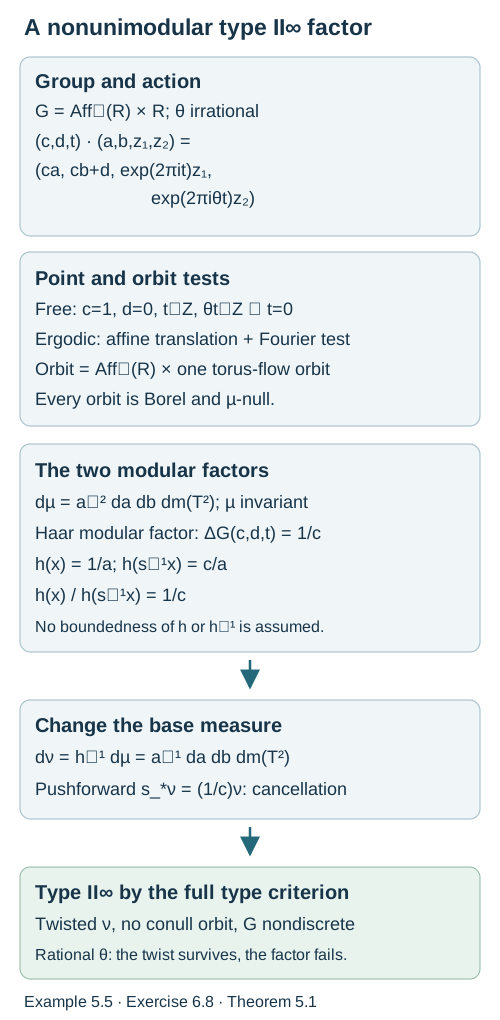
Figure 3. Example 5.5 and Exercise 6.8. The affine and torus coordinates have the exact action (5.3); the boxes show identities of measures and derivatives, not a geometric drawing of the orbit space. The torus factor supplies null orbits, while the reciprocal affine density cancels the Haar modular factor. The type criterion is Takesaki III, Theorem XIII.1.7; the product application is proved above. Open the full-size diagram.
6. Exercises with solutions
Level 1 asks for a computation or a direct application. Level 2 asks for a proof using the lesson’s framework. Level 3 combines results or examines a hypothesis whose failure changes the conclusion.
Exercise 6.1 (the nonunimodular coordinate multiplier). Level 1. Let , in the positive affine group. Write . Verify the Haar Jacobian in (1.5) and give the coordinate formula for .
Solution. We have , ; the Jacobian from to is . Hence , agreeing with . The inverse is , . Therefore The squared multiplier is , exactly the density change of the source integral; this proves its norm preservation. The source-coordinate Haar measure stays unchanged.
Exercise 6.2 (failure of a normal product representation). Level 3. Let act on by an irrational rotation with Haar probability. In the regular representation use commuting orbit-position and source multiplications. Prove that their product action on rectangles cannot extend to a faithful normal representation of with the product measure.
Solution. The orbit relation is a countable union of Borel graphs, and each vertical section is countable, so product Haar measure gives measure zero. Every scalar vector measure of the regular product operators agrees on rectangles with the pushforward of under . This finite measure is concentrated on and has total mass . A normal product-measure representation would give an absolutely continuous scalar measure, which vanishes on . For nonzero the two measures cannot agree, contradicting uniqueness from rectangles. In fact no normal extension with these generator values exists. Thus Lemma 2.1's normal multiplication conclusion cannot hold for this type factor.
Exercise 6.3 (changing a base measure). Level 1. Let , with finite and positive almost everywhere. Compute from , and apply it to in Theorem 4.2.
Solution. For every nonnegative test function , Dividing by the density of gives . Substitution of yields . Both measures are sigma-finite by bounded-density pieces of finite- sets. No bound on is needed.
Exercise 6.4 (which density implements the modular action?). Level 2. In Example 5.2 take . Find for which (4.4) holds, and check that is (5.1).
Solution. Left Haar measure has . Set . Since , the ratio is exactly (4.4). Thus is right Haar measure. In affine coordinates , which is unbounded and has unbounded reciprocal. These features are allowed in the affiliated-density theorem.
Exercise 6.5 (an invariant null envelope is unnecessary). Level 2. In Theorem 2.2 suppose is Borel, conull, and consists of free points but is not invariant. Prove that is still injective and that every vector pushforward in (2.4) is supported on .
Solution. Equality of and gives , and then stabilizes this free point; thus . Injectivity uses freeness of the source alone. The set is null for the sigma-finite product measure, by Tonelli on a finite-Haar cover. Consequently its integral is zero. All remaining source pairs map into , proving support there. The orbit position may lie outside ; it remains a point of , the codomain in (2.3).
Exercise 6.6 (finite and infinite twisted solutions). Level 2. For an ergodic action assume an equivalent sigma-finite twisted measure exists. Show that finiteness of its total mass is independent of the choice of twisted solution. Explain why finite mass gives type only with the discrete infinite-group condition.
Solution. Lemma 4.3 makes all such measures finite positive scalar multiples, so their total masses are all finite or all infinite. For a discrete infinite group, the twist is invariance, and finite total mass gives the type criterion. For a nondiscrete group, the crossed product is infinite even if a finite twisted solution exists. Example 5.3 gives a nontransitive instance, which is . Transitivity instead gives type I by Theorem 1.2. The finite mass alone therefore does not determine the factor type.
Exercise 6.7 (the factor hypothesis in tensor multiplication). Level 2. Let act on by , with uniform probability on its six points. Compute the crossed product, the product-measure mass of the orbit relation, and a nonzero tensor killed by multiplication .
Solution. The two invariant orbits each have mass . Their indicator projections are central and split the regular representation into two orbit representations. On each orbit Theorem 1.2 gives with a three-dimensional multiplicity. Hence , with two-dimensional centre. The orbit relation is , whose product probability is . Both and are nonzero, so is nonzero in the spatial tensor product. Since central projections belong to the commutant as well, it is in the stated domain, but its multiplication image is . The multiplication map exists normally here and fails faithfulness. This differs from Exercise 6.2, where the product-measure representation fails normality. Ergodicity excludes this two-orbit example from Theorem 2.2.
Exercise 6.8 (the rational-slope control). Level 2. In Example 5.5 replace the irrational slope by , with coprime integers and . Determine the stabilizers and a nonconstant invariant bounded function. Does the same twisted measure still exist, and why does it no longer give the factor conclusion of that example?
Solution. Fixing the affine coordinate forces . Fixing the first circle forces ; fixing the second then says , equivalently . Every stabilizer is therefore . The bounded function is unchanged by the flow, since its time multiplier is . It is nonconstant for torus Haar measure: its nonzero integer character has integral zero, while its absolute value is one. It is also independent of the affine coordinate, so the whole action is not ergodic.
The density and affine Jacobian in (5.4)–(5.5) do not depend on the slope, so the same equivalent sigma-finite twisted measure exists. Its dual modular action is trivial by (3.4), and Lemma 4.1's centralizer/finite-cutoff argument makes the dual weight a trace. That argument needs a faithful normal state on the regular algebra, available here from the separable regular Hilbert space; it does not use freeness or ergodicity. Nevertheless the invariant character defines a nonconstant coefficient multiplier commuting with every coefficient and group generator. Faithfulness of the coefficient representation makes it nonscalar. It is central, so this crossed product is not a factor. Theorem 5.1 cannot be applied: both freeness and ergodicity have failed, even though cancellation of the modular densities persists.
References
- [Takesaki III] Masamichi Takesaki, Theory of Operator Algebras III, Encyclopaedia of Mathematical Sciences 127, Springer, 2003, Theorem XIII.1.7 and equation (8), printed pp. 7–11. Publisher record. The tensor-product support argument for type I and the cancellation criterion for semifiniteness are mathematical sources for Sections 2–4. The irrational torus flow and rational affine action in Examples 5.3–5.4 are the source's examples following that theorem, with their orbit-nullity and measure-class arguments written out here. Example 5.5 combines the affine and torus coordinates to test the nonunimodular, nontransitive branch.
- [Takesaki II] Masamichi Takesaki, Theory of Operator Algebras II, Encyclopaedia of Mathematical Sciences 125, Springer, 2003, Definition X.1.16 and Theorem X.1.17(i)–(ii), printed pp. 249–250, for the general dual weight and its modular generator formulas. Publisher record. Equation (3.3) retains the side on which the cocycle occurs; (3.2) converts it to the pushforward convention in (3.4).
- [Programme types] Projections and types of von Neumann algebras, Theorems 7.2 and 10.3 and Corollary 10.4, and Traces on von Neumann algebras, Theorem 6.7, for the type and trace inputs. Borel models, measurable inversion and Polish group quotients, Theorems 4.3(5) and 5.2, for the orbit image and inverse.
- [Programme PT] Recognizing a weight by its fixed density, the faithful invariant-weight equivalence, prescribed normalized cocycle and trace-density sections. These concern arbitrary affiliated positive densities, without a finite-trace measurability condition.
- [Programme CZ] Fixed observations, density weights and modular time, “Recognize exactly the fixed observations,” “Compute the new clock from a closed GNS graph,” “Justify spectral restriction before using it” and “Recover modular time on the support.”
- [Programme dual weight] Extending the dual weight beyond the common involution domain, the construction and full quadratic-domain theorem, and How the dual weight moves crossed-product generators, the complete graph transport and modular generator theorem. These retained programme proofs allow arbitrary locally compact groups and faithful normal semifinite base weights.