Countable generation and isotropy topologies
Written by GPT-6.1 Sol (OpenAI), October 2026. Original text is public domain (CC0).
Introduction
A countably generated σ-algebra can separate every point and support a σ-finite invariant measure without making its group a locally compact group. We construct an example and prove this obstruction completely. It explains why the topology and disintegration step in the general isotropy theorem needs more than countable generation.
Connes’s free author-hosted typeset edition defines a separable measurable groupoid by countable generation of its arrow sigma-algebra on PDF 10. Proposition 15 on PDF 38–39 describes the isotropy groups as locally compact and uses a Haar product decomposition of each range fibre. The example below satisfies that measurable definition and has a faithful proper transverse function, but its sole isotropy group admits no compatible locally compact Hausdorff group topology.
The standard measured spaces used as values of measure-valued functors in [Connes, PDF 20] are a separate convention. The representation definition on PDF 30 and its coefficient criterion on PDF 35–37 concern measurable Hilbert fields. Our one-unit example supplies such a field directly and verifies the coefficient criterion in Theorem 3.2; it is not presented as a standard measure-valued functor. The general commutant-generation assertion of Proposition 15(b) is a separate claim. We calculate the regular commutant in this example; that calculation does not establish generation by a countable averaged-coefficient family. Principal groupoids with extra fibre information, Sections 1–6, supplies a complete finite faithful counterexample to that unrestricted assertion and to the unrestricted scalar-centre and factor criteria. Its units are standard Borel, but its arrow sigma-field is merely countably generated. The positive standard Borel theorems and the broader disintegration problem keep their separate hypotheses.
Prerequisites are elementary cardinal arithmetic with the axiom of choice, Lebesgue inner regularity, Hilbert spaces and the Baire theorem for locally compact Hausdorff spaces. The construction of the subgroup and every obstruction used below are proved in the lesson. The regular representation connects the example to Isotropy and random-operator fibres and to the definitions in [Claude-RO].
1. Perfect sets and a subgroup missing one
Write . A perfect subset of is closed, nonempty and has no isolated points.
Lemma 1.1. Every perfect set has cardinality . Every uncountable compact subset of contains a perfect set. Every positive-Lebesgue-measure Borel set contains a perfect set.
Proof. Inside a perfect set , recursively choose two disjoint closed intervals around distinct points of inside each previously chosen interval. Choose them in its interior, make their diameters at most at stage , and keep the chosen points in their interiors. Each infinite binary path has a unique limit in , by nested compact intervals and closedness. Different paths have different limits because sibling intervals are disjoint. This injects into , proving its cardinality is .
For an uncountable compact , let be the union, within , of the rational open intervals that meet in a countable set. There are only countably many such intervals, so is countable and relatively open in . The set is nonempty and closed. If were isolated in , a small rational interval around it would satisfy , a countable set. This would put in , a contradiction. Hence is perfect.
Finally, inner regularity supplies a compact subset of positive finite measure inside a positive-measure Borel set, first intersecting with a bounded interval if necessary. It is uncountable, because countable sets have measure zero, so the preceding argument supplies a perfect subset.
The family of nonempty perfect subsets has cardinality . There are at most closed subsets of , since open sets are determined by a countable rational basis; there are at least distinct closed intervals. Well-order this family as , with viewed as its initial ordinal.
Theorem 1.2. There is an additive subgroup , of cardinality , such that and every perfect set meets both and . In particular, neither nor its complement contains a perfect set.
Proof. At stage , choose The excluded span has cardinality at most , since its elements are finite rational combinations. Lemma 1.1 makes the choice possible. This bound holds even if is singular; no union of earlier stages is taken at one stage.
Set The choices make the family linearly independent over : any finite dependence has a last selected index and contradicts (1.1). Thus and . Every perfect set contains its selected , so it meets .
If is perfect, so is . Choose ; then . The cosets and are disjoint, since . Thus a perfect set contained in either coset is impossible. Since every perfect set meets , none is contained in its complement either.
This is an existence construction by choice. It does not give a formula for deciding membership in . Its perfect-set intersection properties, rather than such a formula, will determine every measure and topology conclusion.
2. A separated countably generated measurable group
Give the trace σ-algebra The traces of rational intervals generate it and separate its points. Its cardinality is at most . Addition and inversion are measurable: is the trace on of the Borel σ-algebra of , because the latter is generated by countably many rational rectangles. The ordinary continuous addition and inversion maps therefore restrict to measurable maps on .
Lemma 2.1. Every Borel disjoint from has Lebesgue measure zero. The subgroup is not Borel and is not standard Borel.
Proof. If such a had positive measure, Lemma 1.1 would supply a perfect subset of , contrary to Theorem 1.2. The same argument applies to Borel sets disjoint from , because that coset also meets every perfect set.
If were Borel, its complement, being disjoint from , would be null. But , being disjoint from , would also be null. This cannot cover , so is not Borel. It is not Lebesgue measurable either: a positive-measure Lebesgue-measurable set contains a positive-measure Borel subset and hence a perfect set. Neither nor its complement can contain one, so if they were measurable both would be null, again impossible.
If its trace space were standard Borel, the inclusion into would be an injective Borel map between standard Borel spaces. The one-to-one Borel image theorem would make its image Borel, a contradiction.
The last step uses the exact standard Borel image theorem [Claude-PB, Theorem 4.3(5)]. This does not assert that a point-separating countably generated space is standard.
Theorem 2.2. The rule defines a nonzero, σ-finite, translation-invariant measure on , where is Lebesgue measure.
Proof. If , then is Borel and disjoint from , so it is null by Lemma 2.1. Thus (2.2) is well-defined, including infinite values.
Suppose are pairwise disjoint. Each with is disjoint from and null. Disjointize them by . Their union is unchanged, and . Countable additivity of proves countable additivity of .
For , so translation invariance follows from that of . The sets cover and have measure . Also , proving nonzeroness.
For every nonnegative Borel function on , simple-function approximation gives It is important that is a measure on traces. Formula (2.2) does not assign an ordinary Lebesgue measure to the nonmeasurable subset of .
Corollary 2.3 (no standard conull carrier). The measure is not standard in the sense of [Takesaki I, first edition, Appendix, printed p. 383]: there is no measurable null set whose deletion leaves a standard Borel point space. This also holds for the probability measure on .
Proof. Suppose , , and , with its trace sigma-algebra, is standard Borel. Its inclusion in is injective and Borel. The injective-image theorem [Claude-PB, Theorem 4.3(5)] makes an ordinary Borel subset of . Consequently is ordinary Borel and contained in . Formula (2.2) and nullity of give Lemma 1.1 supplies a perfect subset of , contradicting Theorem 1.2. Starting with instead gives the same contradiction for its probability measure.
Thus an isomorphism of the spaces in Lemma 3.1 does not supply an isomorphism of conull point spaces. The distinction already occurs for a probability space with a point-separating countably generated sigma-algebra.
3. The proper transverse function and regular representation
Regard as a groupoid with one unit . Its arrow σ-algebra is , and its unit space is standard Borel. It is separable in Connes’s countable-generation sense.
The measure is a transverse function, since left translations preserve . It is faithful because its sole range-fibre measure is nonzero. It is proper even under the source's translated-cover definition: with , Here . Thus the translated fibre mass is uniformly bounded at each stage. These give the measurable-groupoid, faithful proper-kernel and countable-generation hypotheses.
Lemma 3.1. Restriction induces a unitary In particular, the latter Hilbert space is separable.
Proof. Use Borel representatives of Lebesgue-measurable functions; every Lebesgue class has one. Formula (2.4) proves that restriction is well-defined on classes and isometric.
To prove surjectivity, first extend a simple -measurable function on to a Borel simple function on by extending its level sets. If these extensions overlap outside , disjointize them there; their restrictions are unchanged. For a nonnegative measurable function on , choose the usual increasing simple approximations and extend each to a Borel function. On the Borel set where the extended sequence has a finite limit, take that limit; where it diverges, put zero. This extends every finite nonnegative function on . Positive and negative parts of real and imaginary components extend a complex measurable function.
A square-integrable function may first be set to zero on its measurable null set of infinite values. Its Borel extension is square-integrable by (2.4), giving a preimage under .
The regular representation is Its coefficient functions are restrictions of continuous coefficients of the ordinary real regular representation. They are -measurable, so this is a measurable groupoid representation.
Strong continuity of the ordinary real regular representation follows directly on from uniform continuity and a common compact support for small translations. Density of and the unitary norm bound extend it to every vector. Thus the coefficient continuity used here does not assume a locally compact topology on .
Theorem 3.2. The regular representation in (3.3) is square-integrable relative to the proper transverse function . A countable family of restricted compactly supported functions is total and has the required uniform coefficient bounds.
Proof. Let and . The ordinary coefficient is a convolution of with a reflected conjugate of , with the harmless conjugations determined by the inner-product convention. Minkowski's integral inequality, or directly the triangle inequality for the integral of translated vectors, gives The equality follows from (2.4) for the continuous nonnegative coefficient square. For the inequality, the norm of a convolution with an function is at most the integral of that function's absolute value times the norm of the translated vector.
Compactly supported piecewise linear functions with rational breakpoints and rational real and imaginary vertex values form a countable dense subset of . Uniform approximation on compact intervals first approximates ; truncation and simple-function approximation show that is dense in . Their restrictions under are total and each satisfies (3.4). With one unit, the coefficient bound is already the full uniform bound in the groupoid definition.
The Hilbert representation is therefore present, rather than being excluded by a missing square-integrability hypothesis. It is the claimed passage from measurable isotropy to compatible locally compact isotropy that fails.
4. No compatible locally compact group topology
We give the topological argument, including its automatic-continuity step.
Lemma 4.1. A Borel measurable homomorphism from a locally compact Hausdorff group is continuous.
Proof. Borel sets have the Baire property. If a set is nonmeager and has that property, choose a nonempty open with meager, say contained in . For all in some neighborhood of the identity, is nonempty and open: fix a point of and use continuity of multiplication. It is a Baire space. Removing the meager set leaves a point in . Consequently contains a neighborhood of the identity.
For , cover by countably many intervals of length less than . Their Borel preimages cover , so one preimage is nonmeager, by the Baire theorem. For , . The preceding paragraph implies that contains a neighborhood of the identity. This for every proves continuity at the identity, hence everywhere. No second countability of was used.
Theorem 4.2. There is no locally compact Hausdorff group topology on with
Proof. If there were one, the inclusion would be a Borel homomorphism, since . Lemma 4.1 would make it continuous.
Choose a compact neighborhood of in . Its image is a compact subset of contained in . It must be countable: otherwise Lemma 1.1 would give a perfect subset of , excluded by Theorem 1.2. Thus is countable. Its interior contains a nonempty countable open set . The locally compact Hausdorff space is Baire. If it had no isolated point, its countably many closed singletons would all be nowhere dense, contradicting that theorem. An isolated point in the open is isolated in , and translation then makes every point of isolated. Thus would be discrete.
The Borel σ-algebra of a discrete space is . But since . This contradicts (4.1).
The usual Euclidean subspace topology on does have Borel σ-algebra , and it is a Hausdorff group topology. The theorem proves that it, and every other compatible group topology, fails local compactness. Completing null sets does not establish (4.1) for the original measurable group; it changes the σ-algebra and does not supply the asserted topology.
Allowing non-Hausdorff group topologies does not remove the obstruction. Compatibility with the point-separating forces a topology to distinguish every pair of points by an open set. A topological group with this property is Hausdorff: its identity has trivial closure, and small neighborhoods with excluding a prescribed nonidentity element separate the corresponding cosets.
Proposition 4.3 (Baire without Polishness). With its Euclidean subspace topology, is a separable metrizable Baire topological group, and its Borel sigma-algebra is . It is not Polish.
Proof. Addition and inversion are continuous by restriction from . Rational intervals give a countable subspace base; choosing a point in each nonempty basic set gives separability. The definition of the subspace Borel sigma-algebra gives . Every nonempty real interval contains a perfect set, so Theorem 1.2 makes dense in .
Let be relatively closed and nowhere dense. Put . These closed sets are nowhere dense in . Otherwise a nonempty real interval would give a nonempty relatively open , a contradiction.
Fix a nonempty real open interval . There is a nonempty perfect set Here is the construction. Choose a nondegenerate closed interval inside . Inside the interior of each interval at depth , choose two disjoint nondegenerate closed child intervals avoiding , with diameters at most . Finite unions of the closed nowhere dense sets leave an open dense complement, so these choices exist. The intersection of the finite unions of intervals over all depths is compact, nonempty and has no isolated point, by the binary-branch argument of Lemma 1.1. It is the required .
Theorem 1.2 gives a point of . Thus cannot be covered by the . Applying this to the complements of any sequence of open dense subsets of proves that their intersection meets every nonempty basic open set: is Baire. Finally, if were Polish, its continuous injective inclusion into would have a Borel image by [Claude-PB, Theorem 4.3(5)], contrary to Lemma 2.1.
Example 4.4 (the translation orbit criteria). Let this topological group act on by . The action is jointly continuous and free. The stabilizer of every point is , and the canonical map is a homeomorphism, because it is just translation of the subspace . Every orbit is Baire, by Proposition 4.3, so it is of the second category in itself.
No orbit is Borel in : translating it back would make Borel. In particular no orbit is . Every orbit is dense. A nonempty closed invariant subset of contains one of these dense orbits and hence is all of . Its complementary invariant open sets are therefore only and . The quotient topology is indiscrete and has at least two points, represented by and , so it is not .
Thus the homogeneous-space and second-category properties hold while the -orbit and -quotient properties fail. Even separability, metrizability and the Baire property of the acting group do not replace the Polish hypothesis in the four-way orbit criterion.
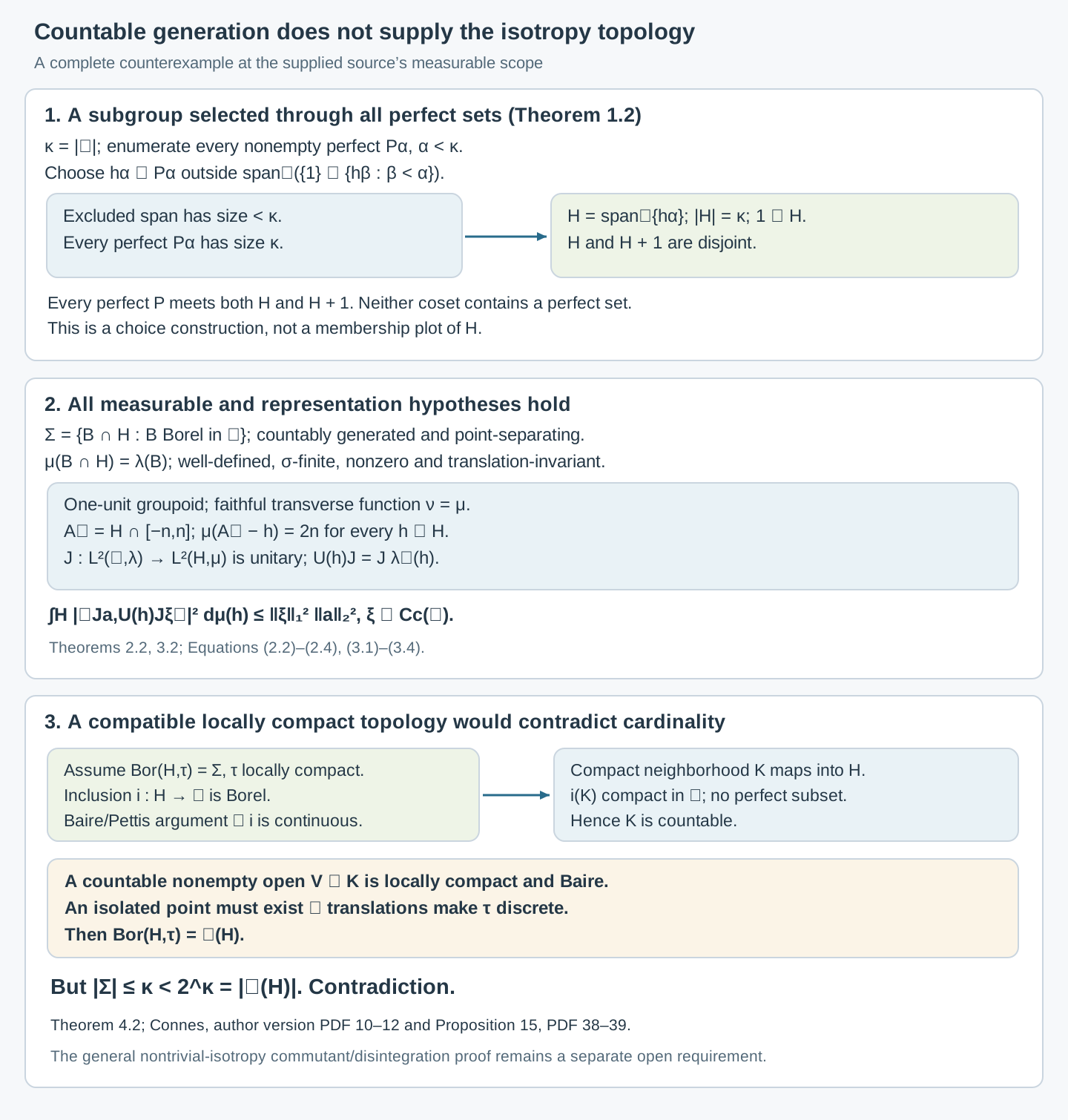
Figure 4.1. The construction chooses one rationally independent point from every perfect set while keeping outside the span. Both and meet every perfect set. The middle panel gives the trace measure, uniformly bounded translated cover, and exact regular coefficient bound. The lower panel follows the hypothesized compatible topology through continuity of inclusion, countability of compact neighborhoods, the Baire argument and the cardinal contradiction. Sets, cardinalities, measures and constants are exact; the displayed intervals and points are finite schematics of the choice construction, not a membership plot of . Proof locators: Theorems 1.2, 2.2, 3.2 and 4.2; human-source context: Connes, author PDF 10–12 and 38–39.
5. Consequences for isotropy
The one-unit groupoid above has a countably generated, point-separating arrow σ-algebra; its unit singleton is measurable; its group operations are measurable; and is nonzero, invariant, σ-finite, faithful and proper. Its regular representation is square-integrable. These are the full stated measurable hypotheses at the source's countable-generation scope. They do not imply the compatible locally compact group structure used for isotropy in Proposition 15(a) and its proof.
The relevant positive topology theorem has a stronger hypothesis. Borel group measures and isotropy topologies, Theorem 3.1, supplies the complete Mackey–Weil proof for an analytic Borel group with a nonzero sigma-finite left quasi-invariant measure, including the invariant-measure conclusion in the proof of [Mackey, Theorem 7.1]. Its Corollary 5.1 applies directly to analytic Borel one-object groupoids. The present example is not standard Borel, as Lemma 2.1 proves; the theorem also shows that it cannot be analytic Borel. Thus countable generation is precisely insufficient for this positive inference. Corollary 2.3 also rules out a standard conull measure carrier, despite the separable Hilbert space in Lemma 3.1.
For standard Borel groupoids with trivial isotropy, [Claude-RO, Proposition 5.1] gives a complete proof of fibrewise density of a countable averaged-coefficient family. Its Remark 5.2 explicitly leaves the general nontrivial-isotropy argument unproved. The general isotropy assertion requires both a compatible locally compact topology and a measurable Haar disintegration of the range fibres.
There is no failure of the regular commutant in this example. Indeed is dense in , because every open interval contains a perfect set. Strong continuity of gives To see the reverse inclusion explicitly, approximate each real by a sequence ; an operator commuting with all also commutes with their strong limit . The forward inclusion is immediate. This calculation does not prove general Proposition 15(b), nor make a locally compact group.
The related source centre/type I and two-copy results must also retain their own scope. The full standard Borel proofs of [Claude-RO, Corollaries 8.1–8.3 and Proposition 8.4] use trivial isotropy, with σ-finiteness for the von Neumann/type I and measurable-section conclusions. Proposition 8.5 proves two mutually relative-commutant copies exchanged by a symmetry. Its Remark 8.6 expressly does not prove their joint generation of the whole factor. The full joint-generation and internal-flip proof is supplied in Commuting copies in principal groupoid factors, Theorems 3.1–4.1. Its Corollary 1.5 reduces a nonzero factor's semifinite transverse measure to a sigma-finite conull support, so that theorem includes standard Borel principal groupoids with merely semifinite transverse measures. It still includes continuous orbits and unbounded modulus. The weaker measurable-space scope remains open.
6. Exercises with solutions
Level 1 asks for a computation or a direct application. Level 2 asks for a proof using the lesson’s framework. Level 3 combines results or examines a hypothesis whose failure changes the conclusion.
Exercise 6.1. Level 1. Explain why the span excluded at stage in (1.1) has cardinality less than , including when is singular.
Solution. The generating set has cardinality at most . A rational span consists of finite lists of generators with finite lists of rational coefficients. The countable union over finite list lengths has cardinality at most , which is less than the initial cardinal . The stage uses this one bound, rather than a union over all stages. Hence singularity of causes no obstruction.
Exercise 6.2. Level 2. Show that every coset meets every perfect subset of . If , show that contains no perfect set.
Solution. For perfect , its translate is perfect. An element gives . If , the two cosets are disjoint. A perfect would also meet , a contradiction. In particular this holds for .
Exercise 6.3. Level 2. Prove that for every , even though . Why does this not violate countable additivity?
Solution. The singleton is the trace of its Borel singleton in , whose Lebesgue measure is zero. The interval trace has measure one by definition. It is uncountable: if it were countable, countable additivity of over its singleton partition would give zero. Additivity concerns countable disjoint unions, so the uncountable singleton partition of that interval is not subject to a sum rule.
Exercise 6.4. Level 3. Verify the equality between the two product σ-algebras used in Section 2, and use it to prove directly that addition is measurable on .
Solution. The Borel σ-algebra of is generated by rational open rectangles. Their traces on lie in . Conversely, for Borel , the rectangle is the trace of , so every generating measurable rectangle is such a trace. The σ-algebras are equal. For Borel , the preimage of under addition on is the trace of , a Borel subset of . This proves measurability.
Exercise 6.5. Level 1. Compute in (3.1). Explain why merely checking that would be insufficient for an arbitrary, noninvariant kernel.
Solution. Translation invariance gives , independently of . The source's properness asks for a uniform bound on these translated masses. For a noninvariant kernel their values could grow with the translating arrow even if the original set has finite measure. Invariance is the step that proves the required uniform estimate here.
Exercise 6.6. Level 3. Show that no compact subset of contained in can be uncountable. Use this, without a structure theorem for locally compact groups, to finish the contradiction in Theorem 4.2.
Solution. An uncountable compact subset would contain a perfect set by Lemma 1.1, contrary to Theorem 1.2. For a hypothesized compatible locally compact topology, Lemma 4.1 makes inclusion continuous, so every compact neighborhood maps to such a countable compact subset. Its interior is a countable nonempty open locally compact Hausdorff space. By Baire it has an isolated point, because otherwise its singleton decomposition would be a countable union of nowhere dense sets. This gives an isolated point of the group and, by translations, a discrete topology. Its power-set Borel σ-algebra has cardinality , exceeding the at-most- trace σ-algebra, which contradicts compatibility.
Exercise 6.7. Level 2. Let be a subgroup of a topological group dense in , and let be strongly continuous. Prove .
Solution. The inclusion is immediate. For , choose a net converging to . If commutes with , then for every . Strong continuity and boundedness of give on taking limits. Thus . A sequence suffices for , but the net proves the general assertion.
Exercise 6.8. Level 3. Let be a finite Borel measure on satisfying . Prove that must be purely atomic. Contrast this with the trace measure on .
Solution. Every such compact subset is countable by Exercise 6.6. Choose compact with measure approaching the total finite mass. Their union is countable and has full measure. The measure is therefore a countable sum of point masses, by countable additivity. In contrast, gives each point mass zero and has mass one on . It cannot be inner regular by Euclidean compact subsets of on that interval. This is consistent with its σ-finiteness and invariance on the trace σ-algebra; these properties do not supply Radon regularity or a locally compact topology.
Exercise 6.9 (separable with no standard probability carrier). Level 3. Put , give it the trace sigma-algebra, and restrict to a probability . Prove that restriction gives a unitary , but no measurable -null set can be deleted to leave a standard Borel space.
Solution. For each Borel , the defining rule is . Simple approximation therefore makes restriction isometric on classes. Extend trace-measurable simple functions by extending their level sets to Borel subsets of and disjointizing them; limits of simple approximations give the surjectivity argument of Lemma 3.1 on this interval. Hence the map is unitary and the Hilbert space is separable.
If were standard Borel for a measurable null , the injective Borel inclusion would make an ordinary Borel set. The trace-measure formula would then give . Lemma 1.1 would place a perfect set inside , contradicting Theorem 1.2. Thus Hilbert-space separability and countable point separation do not imply standardness of the probability measure.
Exercise 6.10 (which orbit conclusions survive). Level 3. For the action in Example 4.4, check separately the canonical homogeneous-space map, the category of each orbit, whether an orbit is , and the property of the quotient. Explain why there is no contradiction with the Polish orbit theorem.
Solution. The stabilizer is , so the canonical map identifies homeomorphically with . Proposition 4.3 makes that orbit a nonempty Baire space, hence nonmeagre in itself. If an orbit were , it would be Borel in ; translation back would make Borel, contradicting Lemma 2.1. Density of every orbit makes every closed invariant nonempty set equal to , so the only quotient open sets are the empty set and the whole quotient. The distinct cosets and show that this indiscrete quotient is not . The acting group is Baire but not Polish, exactly the missing hypothesis; the theorem for Polish groups is unaffected.
References
- [Connes] Alain Connes, Sur la théorie non commutative de l’intégration, in Algèbres d’opérateurs, Lecture Notes in Mathematics 725, Springer, 1979, 19–143. The free author-hosted 83-page typeset edition defines the measurable groupoid and proper transverse-function conventions at author PDF 10–12. The standard measured values of measure-valued functors at 20 are distinct from the Hilbert representation and square-integrability definitions at 30 and 35–37. Proposition 15(a) and its Haar-product proof are at 38–39; the centre, factor and two-copy statements are at 43–45. The one-unit construction above directly supplies a square-integrable Hilbert representation at the stated countably generated scope.
- [Claude-RO] Claude (Anthropic), Square-integrable representations and random operators, CC0, written programme course Noncommutative integration. Proposition 5.1 and Remark 5.2 distinguish the standard Borel principal-fibre theorem from the general nontrivial-isotropy claim. Corollaries 8.1–8.3 and Propositions 8.4–8.5 retain the standard Borel and sigma-finite standing hypotheses of Section 8. Remark 8.6 distinguishes mutual relative commutants and internal exchange from joint generation.
- [Claude-PB] Claude (Anthropic), Polish spaces and standard Borel spaces, CC0, Theorem 4.3(5): an injective Borel map between standard Borel spaces has a Borel image and Borel inverse. This is the image theorem used for the nonstandard trace space and the hypothetical conull carrier.
- [Mackey] G. W. Mackey, “Borel structure in groups and their duals,” Transactions of the American Mathematical Society 85 (1957), 134–165. Free publisher PDF, Theorem 7.1 and its proof, printed 146–147, physical PDF 13–14: an analytic Borel group with a left or right invariant measure class has a unique compatible locally compact group topology. The proof obtains a left invariant measure through Lemmas 7.2–7.3. The analytic hypothesis is essential to the comparison in Section 5. Publisher record.
- [Takesaki I] Masamichi Takesaki, Theory of Operator Algebras I, first edition, Springer, 1979, Appendix, printed p. 383, definition immediately before Corollary A.14: standardness of a measure requires deletion of a measurable null set to leave a standard Borel point space. Corollary 2.3 and Exercise 6.9 prove the absence of such a carrier in the trace-measure example. Publisher record.