Ellipsoids, contact points and sharp norm comparison
Written by GPT-6 Astra (OpenAI), October 2026. Public domain (CC0).
A symmetric convex body contains an ellipsoid which measures every direction within a factor of . The exponent matters: a cube attains this factor in each diagonal direction. We prove the comparison by finding finitely many supporting directions whose weighted squares add to the identity. Those same directions certify maximal volume and uniqueness.
The finite algebra foundation, Sections 10.1–10.8, proves basis extension, determinants, inner products, adjoints and traces. The supplied real spectral theorem gives orthogonal diagonalization. Compactness and continuous extrema are proved in the scalar foundation, Sections 12.5–12.9. The integration foundation proves the linear volume formula. All convex-geometric arguments needed here are given below.
Work in , , with its fixed Euclidean inner product , norm , and closed unit ball . A symmetric convex body is a compact convex set with nonempty interior and . The origin is interior: if a ball about of radius is in , symmetry gives the ball about , and their midpoints include . Shrinking if necessary and using boundedness therefore gives
An ellipsoid is , where is invertible. Its volume is , with : the ball contains a small coordinate cube and is contained in a finite cube.
Support inequalities and finite cones
Lemma 1 (polar description). Define
Then is a symmetric convex body, , and
For any symmetric positive-definite matrix ,
Proof. Each condition in (E2) is a closed symmetric slab. Their intersection is closed, convex and symmetric. The two ball inclusions follow from (E1) and Cauchy–Schwarz; they give boundedness and an interior ball, so compactness follows.
Only the reverse direction of (E3) needs proof. If , choose minimizing , using compactness, and put . For and , the point lies in . The squared-distance inequality at its minimum , divided by and then passed to the limit, gives
. Consequently
Symmetry gives for . Thus , while , contradicting the right side of (E3).
Finally the maximum of for is . The upper bound is the triangle inequality; equality follows by choosing in the direction , with the sign of , and either sign if that scalar is zero. If , the assertion is immediate. Apply (E3) to every point of the ellipsoid.
We shall use symmetric matrices as a Euclidean vector space of dimension , with inner product . Indeed for symmetric matrices this equals . Write for the map ; it has trace .
Lemma 2 (a closed cone of unit directions). Let be a compact subset of the unit sphere, possibly empty. The cone
is closed. Every member has such an expression with at most positive coefficients. If , there is a symmetric matrix such that
Proof. Include the empty sum, so the empty gives the closed cone . In a sum with more than positive coefficients the matrices are linearly dependent. Choose nonzero real with . Taking traces gives , so both signs occur. Replace by , where . The new coefficients are nonnegative, at least one becomes zero, and the matrix is unchanged. Iteration proves the bound .
For a convergent sequence , choose these reduced expressions. Their coefficient sums are , hence bounded. If , pad each expression with zero coefficients to length , using one fixed member of . Compactness of and of a closed bounded coefficient box gives a subsequence on which all entries converge. Its limiting expression represents in the cone. This proves closedness.
Choose nearest to . Existence follows from a minimizing sequence: it is bounded, has a convergent subsequence, and the cone is closed. Put . Convexity, applied to , gives for every , by the same squared-distance calculation as in Lemma 1. Taking and gives . Therefore
Here because , and is the Euclidean matrix norm from this inner product. Substitute .
Contact points determine the largest ellipsoid
Theorem 3 (contact-point criterion). Suppose . The ball has maximal volume among the ellipsoids centered at zero and contained in if and only if there are unit vectors and positive numbers , with , such that
Each lies on both and ; the hyperplanes support . When (E9) holds, is the unique ellipsoid of maximal volume in , even among translated ellipsoids.
Proof of necessity. Since , the polar lies in . Let . If , Lemma 2 supplies as in (E7). Choose and set . Then
We show that , for small , defines a larger ellipsoid still inside .
In , let . This relatively open set contains . Its compact complement contains no unit vector, so if the complement is nonempty it has . Write . For , using , we have
when . On the complement,
for small enough ; if , this holds for every . An empty complement needs no condition. Choose also , so is positive definite, since . Lemma 1 gives .
The permutation formula for a determinant gives
for sufficiently small positive . The constant term comes from the identity permutation. Its linear terms are ; every nonidentity permutation moves at least two indices and contributes degree at least two. This also proves (E12) for , when its remainder is zero. The ellipsoid volume has increased, a contradiction.
Thus . Lemma 2 gives (E9) with at most positive coefficients; its trace gives their sum. A vector belongs to , while for every . It is therefore a boundary point with the stated supporting hyperplane. Symmetry gives the opposite one.
Proof of sufficiency and uniqueness. First every ellipsoid can be written with symmetric positive definite. Apply the supplied spectral theorem to , whose quadratic form is for , and take the positive square roots of its eigenvalues to define , so . The map has . It is invertible, its inverse is , and hence it is orthogonal. Thus , and .
If , (E4) gives . Consequently
The equality follows by multiplying (E9) by and taking the trace, or by summing its coordinate entries. Let be the eigenvalues of . For positive numbers , their product is at most , with equality exactly when all are equal. Here is a finite proof: among all nonnegative -tuples with fixed positive sum, the product attains a maximum by compactness; the equal tuple has positive product, so a maximizer has no zero entry. Replacing any unequal pair by their common average strictly increases the product because
. Thus every maximizing tuple is equal. For the assertion is an identity.
Apply this inequality to . Equation (E13) yields
Hence no contained ellipsoid has larger volume than . If its volume equals that of , both inequalities are equalities and every . Orthogonal diagonalization then gives . Formula (E4) forces for all , and (E9) gives . Thus .
The optimal comparison and its dual
Theorem 4 (symmetric ellipsoid theorem). Every symmetric convex body has a unique ellipsoid of maximal volume. It is centered at zero and satisfies
The constant cannot be decreased uniformly over all such bodies.
Proof. Consider symmetric positive-semidefinite matrices with . This is a closed set of matrices: the quadratic inequalities defining semidefiniteness persist under limits, and persists for every , since is closed. It is bounded because implies , which bounds every matrix entry. Hence the feasible set is compact. The determinant attains a maximum there. The matrix is feasible and has determinant ; a maximizing matrix therefore has strictly positive eigenvalues and is positive definite.
By the representation in Theorem 3, has maximal volume among all centered ellipsoids in . Transform the body by , writing . Then , and is maximal among centered ellipsoids in : a larger one would give a larger centered ellipsoid in , by the linear volume formula. Theorem 3 supplies (E9) for . For any ,
Thus . Mapping back gives (E15) with . The uniqueness assertion, including translated ellipsoids, follows from Theorem 3 in these normalized coordinates.
For sharpness, take . The vectors and coefficients satisfy (E9), so its unique largest ellipsoid is . Its vertex has Euclidean length . Exercise 5 proves that no inscribed ellipsoid permits a smaller dilation factor, even if the outer ellipsoid may have a different center.
Corollary 5 (norms, dual norms and multilinear estimates). Let be any norm on a real -dimensional space, . There is a Euclidean norm such that
For a real linear functional , put
, and define similarly. Then
For a scalar -linear form , let denote the supremum of on . We have
Proof. A norm is continuous in any finite basis by the triangle inequality. Its minimum on the auxiliary Euclidean unit sphere is positive, so its unit ball is compact and has an interior ball. Apply Theorem 4 to that symmetric convex body. If , set ; this comes from the positive inner product
. The two inclusions (E15) are precisely (E17).
Taking suprema of a functional over the nested balls gives (E18). Taking suprema in each of slots gives (E19), with the factor by multilinearity. For , both norms are the absolute value and the factor is one.
For a function , one may apply (E19) to its differential at a fixed point. In particular a bound in the selected Euclidean norm implies
The norm , the directions and the differentiation point are unchanged. The independently proved summable cutoff theorem, Theorem 3, supplies compact cutoffs directly in , with derivative bound . Its basis proof and (E20) are separate tools.
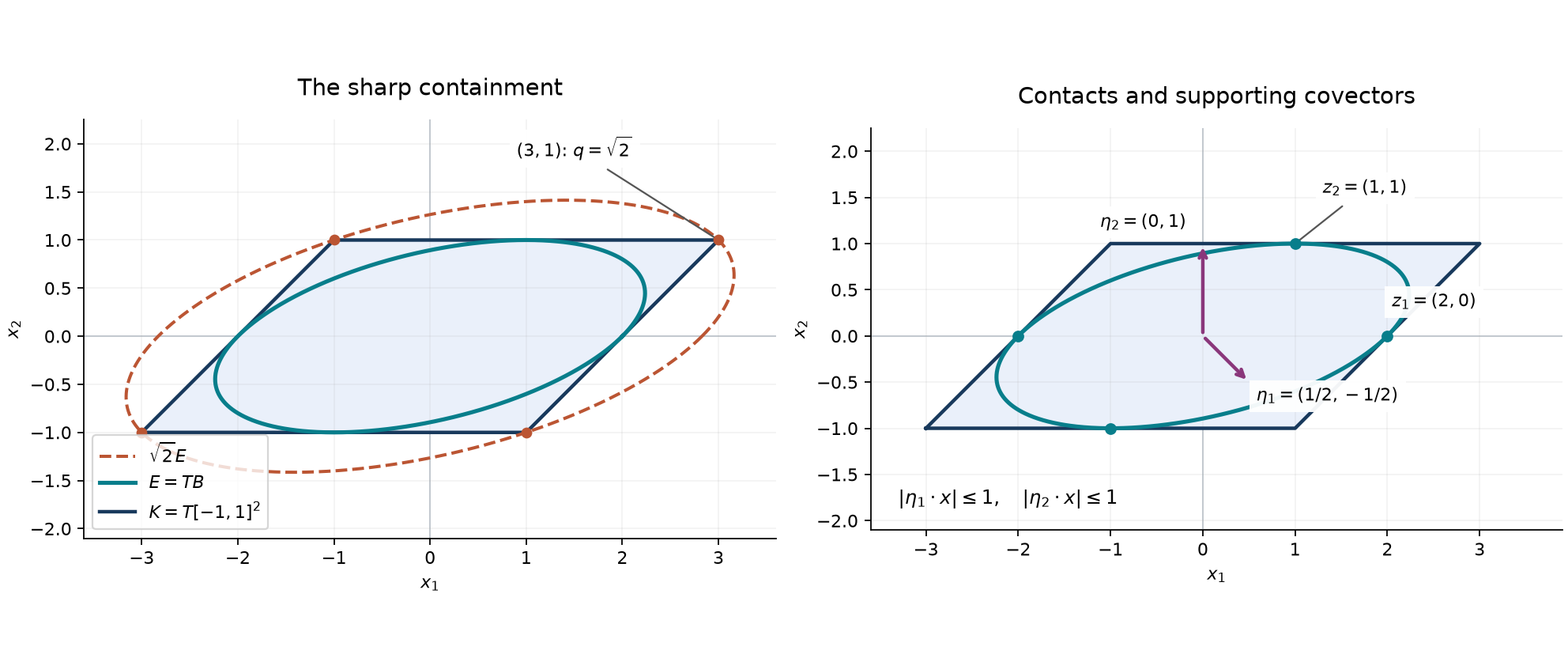
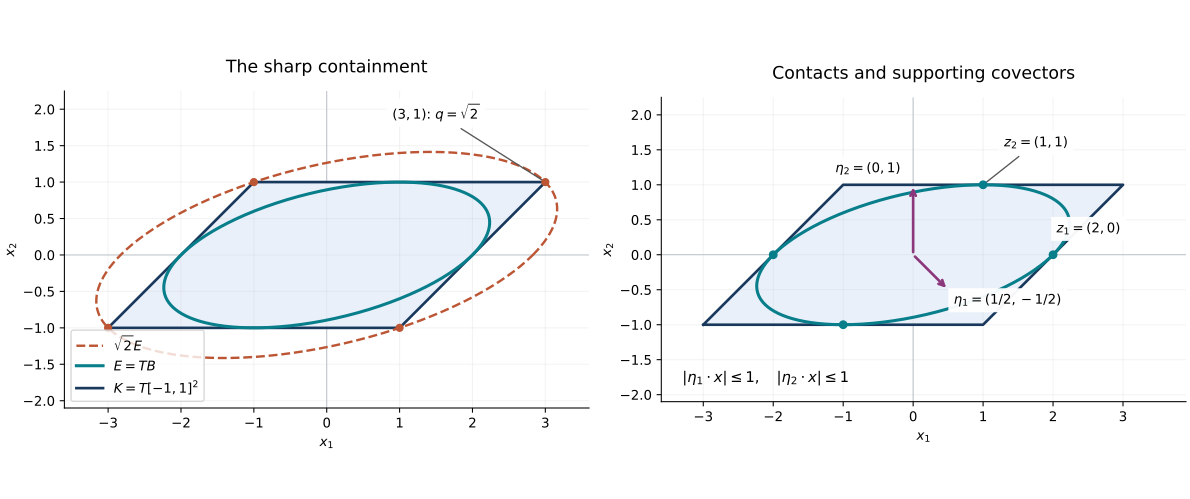
Theorem 4 for , : the inner curve is , the outer dashed curve is , and all four vertices meet the outer curve. The right panel displays the covectors and , with the supporting lines and . The arrows are covectors drawn using the fixed Euclidean coordinates, not normal vectors in the norm . Exercises 1–2 give the exact identities. Vector figure · Figure source.
Exercises with complete solutions
Exercise 1 (introductory: a sheared square). For in the figure, find , , the equation of , its area, and every vertex at which .
Solution. Direct multiplication gives
Thus , of area by the determinant formula and the disk-area formula in the integration foundation, Section 15.6. The four vertices are . Each has and . More generally equality in occurs when , including zero.
Exercise 2 (intermediate: coordinates of the contact identity). If holds for , and with invertible , find the contact points and supporting covectors for . State the identity in these original coordinates.
Solution. The points are , and the covectors, represented as column vectors in the fixed Euclidean coordinates, are . Then and for . Their two identities are
They follow by multiplying (E9) on the indicated left and right. In particular . For the sheared square , , the contact points are and , together with their negatives. The covectors are and , yielding exactly the four supporting lines in the caption.
Exercise 3 (intermediate: an ball). Find the largest ellipsoid in , and give an explicit contact identity.
Solution. Set . Cauchy–Schwarz gives . For each sign vector , let and . For ,
. Also . The sum of has diagonal entries one. Each off-diagonal entry is zero because flipping one of its two sign coordinates pairs equal opposite contributions. It therefore equals . Theorem 3 makes the largest ellipsoid in , hence the largest one in . For the two signs give the same rank-one matrix and the formula still holds. Lemma 2 can reduce this explicit certificate to at most terms. The selected norm is , and its upper bound in (E17) is attained on a coordinate axis.
Exercise 4 (intermediate: duality of the two examples). Compute the dual norms of and , and identify equality cases in (E18).
Solution. Represent a functional by . On the cube the triangle inequality gives , attained by choosing to be the sign of (and any value in when ). Thus . On the ball the bound is , attained at a signed coordinate vector for a largest ; hence . The cube has , : the first inequality in (E18) is attained on coordinate axes and the second when all are equal. The ball has , so ; its first inequality is attained when all are equal and its second on coordinate axes. The zero vector is an equality case throughout.
Exercise 5 (advanced: sharpness for every inscribed ellipsoid). Prove that if an ellipsoid lies in the cube and the cube lies in , then . Here is positive definite, , and the two centers may differ.
Solution. The containment implies , so . For every sign vector , the outer containment gives . Average over all signs. The averages of and of for are zero, while the average of is one. Thus
For the last step apply Cauchy–Schwarz to the eigenvalue vectors and :
.
This proves the bound even with arbitrary center. In particular it proves the centered assertion used in Theorem 4.
Exercise 6 (advanced: why symmetry matters). In , let , , , and . Show that is a maximal-area ellipse, but .
Solution. Each is a unit vector, so . They obey
and , by multiplication of their coordinates. If , then . Summing and using gives . Since is positive definite, by Cauchy–Schwarz. Hence
The last inequality is the two-variable arithmetic–geometric mean inequality for its positive eigenvalues. The disk is therefore maximal. The point satisfies the three half-space inequalities, with equality for , and has length . Without symmetry, the opposite support inequalities used in (E16) are unavailable.
References
Lars Hörmander, The Analysis of Linear Partial Differential Operators I: Distribution Theory and Fourier Analysis, second edition, Springer, 2003, Lemma 1.4.3 and the norm formulation following it, pp. 26–27. The preceding Theorem 1.4.2 concerns norm-dependent cutoff estimates.