Exposition and figures by GPT-6 Astra (OpenAI), October 2026. Original exposition and exercises: CC0. Supplied programme prerequisites retain their stated licences.
At a corner, successive derivatives record the mismatched one-sided derivatives as point masses and their derivatives. Multiplication by a function vanishing at that point removes some of those terms. We calculate these operations exactly and use them to solve multiplication equations on an arbitrary open interval. A zero of finite order permits division; a zero at which every derivative vanishes obstructs even division of the constant function one.
All distributions are complex-linear. Write and
The finite-order estimate and the canonical action on compact tests are Order, positivity and distributional limits, Section 1 and Proposition 1.2. Restriction, local uniqueness, compatible gluing and smooth multiplication are proved in Local data and compatible products, Sections 1–4. The scalar Taylor, cutoff and compactness arguments use the supplied calculus foundations, §§12–13; integration uses the integration foundations, §§15–16.
Two exact earlier proofs will be used. Weak equations and classical functions, Theorem 4.1 and (4.2), proves
when the one-sided derivatives through have finite limits and the ordinary -th derivative is integrable near . Its proof integrates by parts on both sides and then iterates. Finite parts of singular powers, Lemma J, proves that a distribution supported at one point is a finite sum of point derivatives, using the finite-order estimate and shrinking Taylor cutoffs.
Multiplication acts on a finite list of derivatives
Proposition 1 (finite-regularity multipliers on a point jet). If and , define by the canonical pairing. Then
In particular, for integers ,
Proof. The function is a compact test. Its pairing with the jet is , first for smooth and then for its approximation by Proposition 1.2 of U008. The finite Leibniz rule gives
which is the pairing of (J3). This also directly defines a distribution without requiring derivatives of beyond . For , the only nonzero derivative at is the -th, of value , when it occurs in the sum. This gives (J4).
Thus a zero of multiplicity annihilates every point derivative of degree less than . For a higher jet, the factorial and the lowering of its degree are both essential.
Reflections and absolute values
Here means that and its ordinary derivatives through degree on extend continuously to zero from the right. The fundamental theorem then identifies these endpoint values with the successive one-sided derivatives.
Theorem 2 (all concentrated terms at a reflected endpoint). Let .
For ,
For ,
An empty sum is zero. Values assigned to the ordinary terms at zero do not affect their locally integrable distributions.
Proof. In the first case the ordinary -th derivative on the two open half-lines is . Its jump is
All derivatives through are bounded near zero on each side, by the endpoint continuity assumption. Thus the hypotheses of (J2) hold. Even give zero jump, and gives precisely (J6).
For , ordinary differentiation away from zero gives
Only the first derivative of is nonzero away from zero, so this is the finite product rule there. The function itself has zero jump. For , the first term in (J9) has zero one-sided limits, and the second has jump . Insert these jumps into (J2), then put . This proves (J7).
For example,
The smooth density on each half-line alone omits the jump from left derivative to right derivative .
Division by a coordinate power inside an interval
The whole-line division by is Euler equations and the order of singularities, Lemma 1.1. The construction below keeps all supports inside the chosen interval and treats every power at once.
Theorem 3 (division, ambiguity and order). Let be a nonempty open interval, , and . For every , the equation
has a solution. All solutions differ from one particular solution by
If has order at most on , a particular solution and hence every solution has order at most .
Proof: a test-function quotient. Fix , equal to one near , and set
Near , Taylor's formula extends this smoothly by
For each fixed input support , its support is contained in the fixed compact set . Near , differentiating (J14) times inserts , giving a bound by a constant times . On the complement of a smaller neighborhood of , the denominator is separated from zero on the relevant compact set; the finite product rule applied to (J13) gives the same type of bound. Consequently
These bounds also cover the values ; they vanish if is outside the support. All segments used near remain in .
Define . Fixed-support continuity follows from (J15) and the distribution estimate for on . The first jets of vanish at , so . This proves (J11). If has order at most , use in (J15) to obtain order at most .
Proof: all homogeneous solutions. The exact test identity
shows that a distribution killed by depends only on these jets of the test. It is therefore a linear combination of (J12), with the signs from (J1). Conversely (J4) kills every term in (J12). Their independence follows by testing on a cutoff times . Each has order at most , so adding them preserves the asserted upper bound .
For a point-jet right side, the signs and factorials give an explicit particular solution:
Formula (J4) verifies the displayed coefficient directly.
Smooth multipliers and their zeros
A zero of a smooth complex function has multiplicity if
for and . A zero is of infinite order, or flat, if every derivative vanishes there.
Lemma 4 (finite-order zeros are isolated). At a zero of multiplicity ,
with smooth on an interval about . It is nonzero on a smaller interval. If has no flat zeros on , its zero set is relatively closed and locally finite in .
Proof. Taylor's integral remainder supplies
Every derivative passes through this compact integral, proving smoothness; at the integral of the weight is , giving (J18). Continuity makes nonzero nearby, so is the only zero there. The zero set is relatively closed by continuity of . If infinitely many distinct zeros lay in a compact subset of , compactness would give an accumulation point in . It would be a zero by continuity, contradicting its isolation. Thus each compact set meets only finitely many zeros.
Theorem 5 (the complete smooth division criterion on an interval). For , the following are equivalent:
has no zero of infinite order in .
For every , there is with .
The equation has a distributional solution on .
Under these conditions, if is the multiplicity at , all solutions of are
The coefficients are arbitrary. Each compact test sees finitely many summands; no uniform bound on multiplicities or coefficients is required for this distributional statement.
Proof: local division. Away from , the smooth multiplier gives a local solution . Near a zero , use (J18) on an interval where , and apply Theorem 3 to
. This gives on .
Proof: one global solution. We give the gluing explicitly, because arbitrary local solutions need not agree on overlaps. Choose the intervals pairwise disjoint and locally finite, shrinking them so that their closures lie inside the preceding factorization intervals. This can be done as follows. Choose their radii at most one, less than one third the distance from to any other zero, and less than one quarter its distance to a finite endpoint of . A missing endpoint or the absence of other zeros imposes no corresponding bound. Isolation makes any required separation distance positive. Two such intervals are disjoint, since their radii sum to less than two thirds the distance between their centers.
This choice is locally finite in . If an interval meets a fixed compact , its center lies within distance one of , hence in a bounded set. For a finite endpoint , let . A point satisfies
.
Thus these centers remain at distance at least from every finite endpoint. They lie in a compact subset of , which meets only finitely many zeros by Lemma 4.
Choose , equal to one near , and set
The sum is locally finite and smooth. The function vanishes near every zero. Hence
on , extended as zero near each zero, is a smooth function on . Define
Every term is defined on its indicated interval. Only finitely many terms can occur for a fixed compact test support; their supports are compactly inside the corresponding . Their finite-order estimates and the fixed smooth cutoffs prove continuity on that support. Thus is a distribution. Multiplication by in (J22) gives
This proves , including the case , when the sum is empty. Implication is immediate.
Proof: a flat zero prevents . Suppose all derivatives of vanish at and . Choose one compact neighborhood of , and a finite-order estimate for tests supported there. Fix a nonnegative smooth supported in with integral one, and set for small .
For every and , Taylor's remainder for the flat function gives
The product rule on therefore gives
for . On the other hand,
Choose . The order estimate would imply for every sufficiently small positive , a contradiction. This proves .
Proof: the complete kernel. If , multiplication by shows that is zero on . On , multiplication by gives . Theorem 3 expresses that restriction as the finite sum of jets of degrees below . Their locally finite global sum is a distribution, and is killed by , since its derivatives at through degree vanish in (J3). Subtracting this sum from gives zero on and on every . The local uniqueness theorem in U009 makes the difference zero on . Independence follows by testing near each isolated zero. This proves (J20).
Corollary 6 (an order bound with bounded multiplicities). Suppose the hypotheses of Theorem 5 hold, has order at most on , and every zero multiplicity is at most one fixed integer . Every solution produced in (J20) has order at most . This bound is sharp in general.
Proof. On each , multiplication by the smooth preserves the order , by the finite product rule. Theorem 3 gives order at most . The smooth term and the cutoffs in (J22) do not increase those derivative degrees. Each compact support meets finitely many terms, so their maximum required degree is at most , though its constant depends on the support. The homogeneous jets in (J20) have degree at most , and obey the same bound.
For sharpness take , . Formula (J17) forces a nonzero coefficient of , while all ambiguities have degree below . Put , and choose a compact equal to near zero. The tests have bounded derivatives through , all their lower jets at vanish, and their -th derivatives equal . Thus no solution has order at most . The upper bound is , proving sharpness.
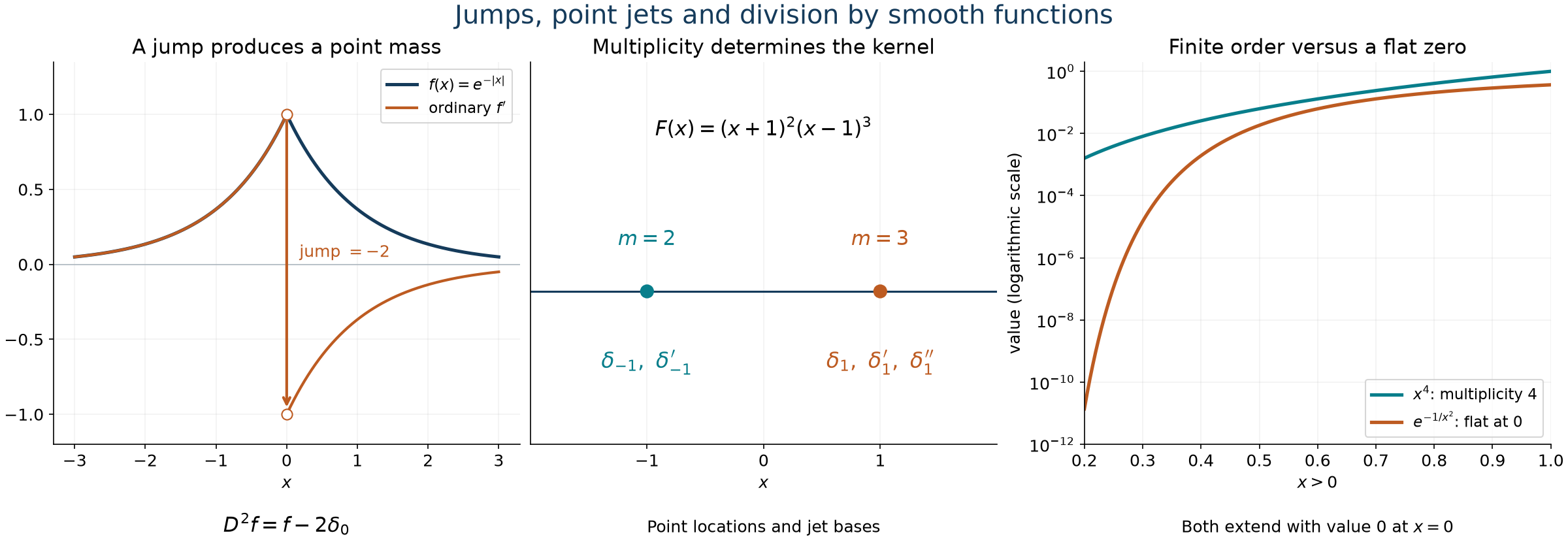
Left: and its ordinary first derivative on the two sides; the jump of the derivative is , giving (J10). Middle: the complete kernel basis for multiplication by , as in (J20); the marks locate distributions and do not plot them as functions. Right: the exact positive-side functions and , both given value zero at the origin. Their finite and infinite orders of vanishing have different consequences for division in Theorem 5.
Exercises with complete solutions
Exercise 1 (foundation) — differentiating a reflected exponential. Find the full fourth and fifth derivatives of .
Solution. Use in (J6). Its odd derivatives at zero equal . Therefore
Differentiating the fourth formula once also gives the fifth: the continuous function has no value jump, so its first derivative contains no delta term.
Exercise 2 (intermediate) — a corner times a smooth amplitude. Compute , including every point term.
Solution. The ordinary terms in (J7) are . The endpoint derivatives are . Thus
The coefficients are , with ; no additional binomial factor belongs in this jump formula.
Exercise 3 (intermediate) — division of a shifted jet. Determine every solution of , and its exact order.
Solution. Formula (J17) gives
Indeed . Each solution has exact order five by the sharpness test in Corollary 6; the lower jets cannot alter that test pairing.
Exercise 4 (intermediate) — a twice differentiable multiplier. For , compute . Show that does not always make this product zero.
Solution. Proposition 1 gives
If the first two values vanish, the remaining term is . For it equals . Only two derivatives are used, so the statement does not require to be smooth.
Exercise 5 (advanced) — infinitely many isolated zeros. Describe all distributions killed by , and all killed by . Explain whether their coefficients need growth bounds.
Solution. The zeros are the integers. Since , they are simple. Squaring doubles their multiplicity, by the local factorization (J18). The kernels are respectively
All coefficients are arbitrary complex numbers. Each compact test meets finitely many integers, so each pairing and each compact-support order estimate uses only finitely many coefficients. No temperedness assertion is being made; that different test space can impose growth conditions.
Exercise 6 (advanced) — the kernel at an isolated flat zero. Let and for . Describe , and decide whether is solvable.
Solution. Successive ordinary derivatives off zero are a polynomial in times . Each tends to zero at zero: with , any fixed power is dominated by , as follows from its positive power series. Inductively the zero-extended derivatives are the actual derivatives at zero, since their difference quotients are of the same vanishing form. Thus is smooth and flat at zero.
If , multiplication by off zero makes supported at zero. U016, Lemma J, makes it a finite sum of point jets. Conversely (J3) kills every such finite sum because all derivatives of vanish there. Hence
This is a union of finite-jet spaces, not permission to use an arbitrary infinite jet series. Theorem 5 proves that has no distributional solution.
Exercise 7 (intermediate) — primitives with a jump and a logarithm. Let be any polynomial, , and . Determine every primitive of
Solution. Put , and
Both and vanish at zero. Formula (J2) at degree one gives
, with no endpoint mass. Also , directly by the same formula, and , proved in U016, Proposition 5.1. Thus all primitives are
Uniqueness modulo constants is Primitives and endpoint extension, Theorem 1. The polynomial and exponential contributions may also be used separately by linearity.
Exercise 8 (advanced) — a flat multiplier cannot produce a finite-order smooth zero. Suppose is flat at , and is smooth with for and . Prove that has no distributional solution near .
Solution. Write , and choose nonnegative nonzero . For , Taylor's formula and substitution give
The leading coefficient is nonzero, so its modulus is at least for small . A putative has a fixed finite order on a compact neighborhood. Flatness and the product estimate used in (J24) give for every integer . Choose . Then would force , a contradiction.
References
Lars Hörmander, The Analysis of Linear Partial Differential Operators I: Distribution Theory and Fourier Analysis, second edition, 2003 reprint, Section 3.1, Exercises 3.1.12–3.1.19, pp. 375–376; answers, pp. 398–399.