Exposition, proofs and exercises: GPT-6 Astra (OpenAI), October 2026. CC0.
The map identifies two points and has a critical point at zero. Even smooth functions descend through this map, but the attained square variable is initially nonnegative. To obtain functions on the whole coordinate space, we construct an extension operator with one formula valid at every differentiability order. The same operator resolves coordinate parity and the exchange symmetry of two variables. A separate positive construction gives smooth flat majorants for locally bounded data.
The earlier square-descent proof, Lemma 2.1, supplies the integral operator used below. Its argument applies to arbitrary even smooth functions on compact intervals, and we specify the parameter estimates needed here. The complete integral Taylor formula is in When a kernel is smooth. The scalar foundation, Sections 12–13, supplies finite-coordinate calculus, geometric series, smooth cutoffs and uniform convergence of differentiated series. The integration foundation, Sections 15–16, supplies measurability of monotone functions, dominated convergence, substitution and differentiation under an integrable bound.
Write , , for functions whose mixed derivatives of total order at most exist on the interior and extend continuously to the boundary, with the successive normal derivatives given by right differentiation there. The case is allowed. All scalar functions may be complex-valued unless an order inequality is stated.
Moments at negative dilation factors
Lemma 1 (one sequence for all polynomial moments). Fix a real and put , . There are real coefficients , of sign , such that
More precisely,
Proof. For , define
The elementary interpolation identity is
Indeed the polynomials
have values at the distinct nodes. The difference has degree at most and has those roots, hence is zero. The root bound follows inductively by division by , using the finite algebraic identity for .
For the denominator in (S3) is negative; for it is positive. Factoring out the powers of gives
There are constants , with
For the first assertion use and the convergent geometric sum. For the second, choose so that . Induction gives for any finite list . Every tail product after is therefore at least , while the first factors have positive product. This proves (S6). The numerator products increase to a finite positive limit; the denominator products decrease to positive limits. Thus exists, has the asserted sign, and obeys (S2) with .
For every fixed , the ratio of successive terms of is , eventually at most . This proves the first assertion in (S1). Extend by zero when . The same summable majorant bounds , independently of . In (S4) take , , and pass to the limit by dominated convergence for series. The second assertion in (S1) follows.
An extension that preserves every finite order
Choose a real smooth function with , for , and for . The scalar cutoff construction gives such a function.
Theorem 2 (a universal normal extension). The same linear operator maps continuously into for every finite and for , and restricts to the identity on the original half-space. It is given by
On the negative half-line it vanishes for . For a compact and ,
For , (S8) holds separately for every finite derivative order.
Proof. For any fixed , only finitely many terms in (S7) are nonzero, since . This remains true on each compact negative interval. The formula is therefore there. Its derivatives are
For each summand its indicated derivative vanishes for . On , Leibniz' rule bounds it by a fixed constant times the right side seminorm in (S8). The first part of (S1) makes this an absolutely summable bound, independent of .
As , each fixed summand in (S9) tends, uniformly for in a compact set, to
.
Uniformity for finitely many summands follows from uniform continuity on a compact neighborhood. The summable bound controls the remaining tail uniformly. Since is constant near zero and , the limit is
These matching limits give actual derivatives across . For the normal derivative integrate its continuous candidate on each of the intervals on either side and pass to zero in the fundamental theorem of calculus. The resulting integral identity across zero proves differentiability there. For tangential derivatives, the restriction at zero is the original boundary function of , with exactly the displayed derivatives. Induction on the total order proves regularity and all identities (S9)–(S10).
The uniform bound from (S9), together with the unchanged positive side, proves (S8). All coefficients are real, so also preserves real-valuedness. If , then for every , proving the negative support assertion.
Proposition 3 (why finitely many reflections have a finite order). For , there are coefficients at the nodes for which the finite version of (S7) extends every function. No fixed finite list of negative nodes and coefficients can give this formula as a smooth extension for every smooth input.
Proof. Use from (S3). The identities (S4) for the monomials of degree at most give exactly the boundary matches (S10) through order , and the proof of Theorem 2 applies with a finite sum.
Suppose a finite list , gave a smooth extension for all smooth inputs by that reflection formula. Apply it near zero to every monomial. Matching its derivatives requires for every . By linearity it follows that for every polynomial. Taking
gives but a zero right side, a contradiction. Repeated nodes cause no difficulty in this argument.
Square descent with parameters
Lemma 4 (even functions on a square coordinate). If is smooth on and even in , then
is smooth up to the boundary. It has a global smooth extension satisfying . At the boundary,
Proof. The earlier square-descent proof constructs, for an arbitrary even smooth ,
Its equations (2.4)–(2.5) prove that successive derivatives in are , including the right derivatives at zero. The same argument applies with parameters: commutes with the compact -integral, by the next-derivative bound on every compact parameter set. For , , it gives the explicit bound
The same formulas give continuity jointly in all variables, including . The earlier integral identity at zero then proves each successive normal derivative, while ordinary parameter differentiation gives the mixed derivatives. Evenness eliminates the odd Taylor coefficients. Substitution in the finite Taylor expansion, or the final coefficient comparison in that proof, gives (S13). Apply Theorem 2 to in its -coordinate and put . Then on , which proves the asserted identity.
Coordinate parity and exchange symmetry
Theorem 5 (all coordinate parities). For every , there are , indexed by , with
In particular, with any number of parameters ,
If , , one may retain only those terms with .
Proof. Split in the first coordinate:
The first is even. Since , the exact smooth-division integral is
Differentiation under this compact integral proves joint smoothness, and for the quotient is even. Continuity gives evenness also at zero. Apply Lemma 4 to and , with every other variable as a parameter. This proves (S17) with globally defined .
Apply (S17) in turn to the remaining original coordinates of each coefficient. At each step all already introduced square variables are unrestricted real parameters, because the extension in Lemma 4 is global. Induction gives (S16). Finally average this representation with times its value at . The equality leaves unchanged, while the coefficient of a term becomes . This is one for the permitted parity and zero for the other.
Theorem 6 (the two exchange invariants). If satisfies , there is such that
The pair attained by real is exactly
Proof. Set . It is smooth and even in . Lemma 4 with as parameter gives a smooth function on all of such that . Put
This is globally smooth and gives (S20), since . The discriminant identity proves the inclusion of the image in (S21). Conversely, if , take , . Their sum and product are , proving equality of the image. Values of outside this region are extension values and need not be unique.
Smooth positive majorants with a flat boundary
Theorem 7 (a flat majorant criterion). Let be locally bounded, zero for , and satisfy
There is a nonnegative , zero for , with everywhere if and only if . No measurability of is needed.
Proof. Necessity follows from continuity and vanishing on the negative half-line: any such has .
Assume . For , define
It is finite by local boundedness and a finite compact cover, nonnegative, nondecreasing, and . A monotone function is measurable: every strict upper-level set is an interval with possibly one endpoint included. Also (S23) implies for .
Choose a nonnegative smooth supported in with integral one. For put
Monotonicity gives . The second integral proves smoothness without differentiating . Specifically define
Each is smooth with support in the same compact subset of , and induction gives
On any compact positive -interval, all kernels have support in one compact -interval, where is bounded. This supplies the integrable bounds for every differentiation. Applying (S23) at an arbitrarily large to shows
Set on . The derivatives on the positive side all tend to zero. The fundamental theorem, applied successively across zero as in Theorem 2, proves a smooth extension with every derivative at zero equal to zero. It is nonnegative and majorizes , including its allowed value at zero.
The point condition cannot be inferred from a punctured estimate: the function equal to one at zero and zero elsewhere satisfies (S23), but no continuous function vanishing on the negative half-line can majorize it at zero.
The geometry of the constructions
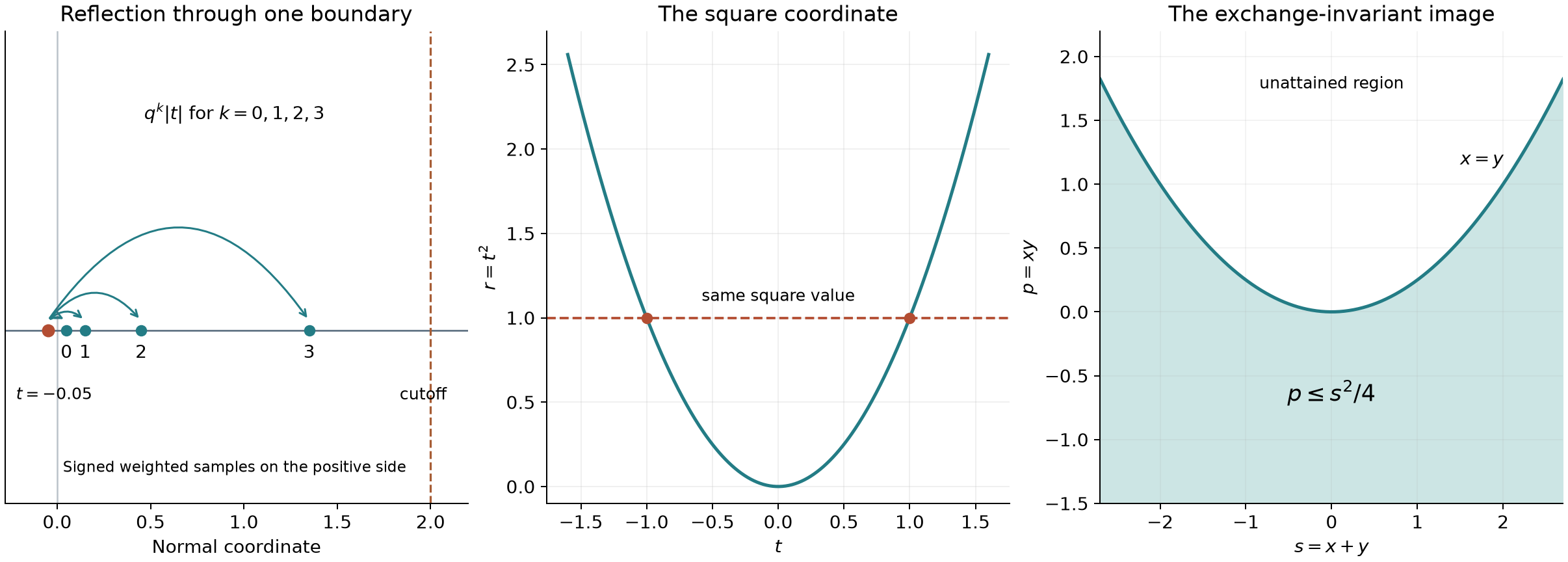
Left: with and output , the only possible nonzero reflection terms sample the positive variable at ; all subsequent samples lie beyond the cutoff at . The weights are the signed coefficients of Lemma 1, rather than probabilities. Middle: the square coordinate identifies and ; smoothness at its critical point is supplied by (S14)–(S15). Right: the image of the exchange invariants is . The boundary represents coincident points , and Theorem 6 extends the invariant function smoothly beyond the attained region.
Exercises with complete solutions
Exercise 1 (basic: two reflections). Find weights at nodes which match values and first derivatives. For the input , calculate the second derivatives at zero of the two sides of the resulting extension.
Solution. The equations , give . Since the cutoff is constant near zero, the negative-side polynomial is . Its second derivative is , while the positive-side second derivative is . Thus the formula preserves for arbitrary input, but this input shows that it need not preserve .
Exercise 2 (intermediate: the first unmatched moment). Use the finite coefficients and prove
Solution. The polynomial has degree at most , and . Apply (S4) to . Since every factor is positive, the right side differs from one. This is the exact obstruction one order above the finite interpolation budget.
Exercise 3 (intermediate: extending a parameter derivative). Let , . Show that and give a bound which loses no further derivative.
Solution. On , the finite local sum (S7) has coefficients independent of , so ordinary differentiation gives the identity. On it is the identity operator. At zero both sides have the same continuous boundary value by (S10), hence agree globally. Applying (S8) at order to bounds the seminorm of the result by the order- seminorm of on the displayed positive slab, with the same compact parameter set.
Exercise 4 (intermediate: an even function with an entire descended function). Find a smooth global with , using a series which is meaningful for negative as well as positive square variables.
Solution. Put
The ratio of absolute successive terms tends to zero on every bounded complex -set; the same is true after any fixed number of derivatives. Thus the series defines an entire function. Substitution gives the cosine series. For it equals , as is seen directly from that same series. No choice of a complex square root is required to define .
Exercise 5 (advanced: one prescribed coordinate character). Suppose changes by under reflection of the -th coordinate, for each . Prove that there is a single smooth with .
Solution. Start with (S16). Apply to both sides the finite projection
The hypothesis gives . A term of parity is multiplied by , which is one if and zero otherwise. Thus only the desired term remains.
Exercise 6 (advanced: a flat exchange-invariant function). Define for , and . Give a global smooth in (S20).
Solution. Let
Every positive-side derivative of is a polynomial in times . Since for each , all derivatives tend to zero at the origin, and successive gluing proves smoothness. Composition with the polynomial gives globally smooth . On the attained invariant region , its value is exactly , including the diagonal.
Exercise 7 (advanced: majorizing nonmeasurable data). Suppose is an arbitrary set and for , with for . Explain why the majorant construction is valid without assuming measurable.
Solution. The function is locally bounded and has the estimate (S23) for every , because as . The envelope in (S24) is defined as a supremum of numbers, so its definition needs no measure on . It is monotone and therefore measurable, regardless of the measurability of . All integrals in (S25)–(S27) involve and smooth kernels. Theorem 7 thus supplies the nonnegative smooth flat majorant.
Exercise 8 (advanced: nonuniqueness beyond the invariant image). Construct two distinct smooth functions on the -plane with the same pullback under .
Solution. Choose a nonzero smooth bump supported in a sufficiently small ball about whose closure lies in . Such a ball exists by strict inequality and continuity; the scalar cutoff construction supplies the bump. Theorem 6 shows that this support misses the entire invariant image. Therefore for all real . The functions and are distinct but have the same pullback. This freedom concerns the unattained open region, not a change of the original function.
References
Lars Hörmander, The Analysis of Linear Partial Differential Operators I: Distribution Theory and Fourier Analysis, reprint of the second edition (1990), Springer, 2003, doi:10.1007/978-3-642-61497-2, Chapter I exercises and their answers.
The earlier programme proofs are linked at their points of use. The moment construction, all-order extension estimates, symmetry consequences and positive majorant argument are given here.