Exposition, proofs and exercises: GPT-6 Astra (OpenAI), October 2026. CC0.
An entire Fourier–Laplace transform can grow faster than every polynomial on the real axes and still represent a compactly carried analytic functional. The appropriate estimate allows every positive exponential error. We construct the functional by rotating Laplace contours, recover all its moments, and determine its convex real carrier. A support function records a convex hull; an example shows why it cannot record holes in a nonconvex set.
For a nonempty compact real set , , put
All pairings are complex-linear. An analytic functional acts on entire functions and satisfies
Its Fourier–Laplace transform uses the sign
Analytic tests and real carriers, Theorems 1, 5 and 8, proves polynomial determination, extension to holomorphic germs near a real carrier, and the necessary estimate
Its Theorem 8 also proves injectivity. Recovering analytic data from harmonic fields, Theorem 6, proves that the intersection of all real compact carriers is itself a carrier. These are the exact functional inputs below.
The supplied Cauchy reading, CX1–CX18 and CMI6–CMI8, proves contour integration, contour deformation, Cauchy bounds and the several-variable Taylor series. The integration foundation, Sections 15–16, supplies absolute integration, Fubini, dominated convergence and differentiation under an integrable majorant. The metric foundation, Sections 12–13, supplies finite-dimensional compactness and calculus. Finite-dimensional linear dependence and basis operations use the algebra foundation, Sections 10.1–10.6.
Moments of an entire function of exponential type
Lemma 1 (a geometric moment bound). Suppose is entire on and
Then, with
there are constants such that
Consequently the multiple Laurent series
converges absolutely and locally uniformly when every .
Proof. Apply the polydisk Cauchy estimate with radius
when , and radius when . It gives
The last inequality uses for positive integers . The zero multi-index is included by the factor . This proves (R7). On a compact subset of the stated Laurent domain, the ratios are all bounded by numbers strictly smaller than one. Summing their product geometric series proves absolute and locally uniform convergence, including every fixed derivative on a smaller domain.
Every satisfying (R4) for some compact satisfies (R5): use , bound , and increase .
Rotating a Laplace ray away from an interval
Let , allowing , and write
For , call a unit complex number admissible if
Lemma 2 (directions and the rotation margin). Every has an admissible direction. Any two admissible directions can be joined by a circular arc of admissible directions of length less than ; the gap in (R11) has a positive minimum along that arc. The same directions and a smaller positive margin remain valid when varies in a sufficiently small neighborhood.
Proof. If is real, take ; if is real, take . If , take , giving gap . If , take .
For each , admissibility says . For two admissible directions , their convex combinations
have a common positive lower bound for these real parts, uniform in and . In particular , so the directions are not antipodal. The normalized combinations trace their shorter circular arc. Since , their gaps are no smaller than the smaller endpoint gap. Continuity and compactness give the neighborhood assertion.
A holomorphic transform outside a real box
Let
Suppose the entire function satisfies, for every ,
For in the product domain
choose admissible from Lemma 2 and set
The factors are the oriented differentials of the rays; they are essential, including when a ray points to the left.
Theorem 3 (the exterior Cauchy transform). Formula (R15) is absolutely convergent, is independent of all the admissible directions, and defines a holomorphic function on . For sufficiently large , it has the Laurent expansion (R8) whenever all , with moments (R6).
Proof: convergence and local holomorphy. Fix a point of . Lemma 2 permits fixed directions on a small product neighborhood, with gaps . For , one has , and the homogeneity of gives
Choose . This is integrable. Each derivative in contributes a monomial in , still integrable against that exponential. Uniform convergence of the truncated holomorphic integrals, or their locally uniformly convergent Taylor series under the same bounds, proves holomorphy.
Proof: independence of one ray. Change only , keeping the other directions fixed. Lemma 2 gives an arc with uniform positive gap, valid on a neighborhood of the point. In the -plane apply the Cauchy contour theorem to the entire function
on the sector bounded by the two rays and the circular arc of radius . The integrals along the two rays have opposite contour orientations. The outer arc has length at most . Bound (R16), uniformly on the arc and in the other 's, bounds its integral by
for some . Its integral in the other variables tends to zero. The rays' tails tend to zero by the same majorant. There is no singularity at the sector vertex, since (R17) is entire; the two initial endpoints cancel. Letting , and using Fubini, proves equality of the two versions of (R15). Change each direction in turn. The local definitions agree on every overlap and give the asserted holomorphic function.
Proof: its moments at infinity. Increase in Lemma 1 so that all interval endpoints have modulus less than . If every , choose all rays positive. Taylor expansion gives
The sum of the absolute values is bounded by
. For strictly larger , multiplication by makes this integrable. Termwise integration is therefore justified. Repeated integration by parts gives
starting from ; the exponential kills the endpoint at infinity. Thus (R15) equals (R8) in this right product half-plane.
Both sides are holomorphic on the product of the connected exterior domains . Apply the one-variable identity theorem in the first coordinate, with all other coordinates initially in their right half-planes; then in the second coordinate, and so on. This extends the equality to that entire product domain.
Recovering the functional by small closed contours
Theorem 4 (range for a real box). Every entire function satisfying (R13) is the Fourier–Laplace transform of a unique .
Proof. Choose in each complex coordinate a positively oriented rectangular contour surrounding , with no point on that interval. For an entire test , define
The product contour is compact in , so this is a finite continuous integral. Its order is immaterial by Fubini.
The integral is independent of the surrounding rectangles. For fixed other contour variables, the integrand in is holomorphic outside . Deform a rectangle to a larger circle surrounding it. The difference of these contours has winding zero on , since both surround every point of that interval once. The full contour theorem (CX18) therefore gives equality on the domain . Two rectangles can both be compared to the same large circle. Repeat one coordinate at a time, keeping the other compact contours fixed. The same argument permits any sufficiently large product of circles.
Now take circles . The locally uniform Laurent series in Theorem 3 permits termwise integration. The elementary circle integral
follows by the parametrization . Thus
Taylor polynomials of converge uniformly on the product contours. Equation (R23) and the entire Taylor series of give
It remains to prove the exact real carrier, rather than only continuity on one large contour. Let be any open complex neighborhood of . Compactness gives such that every point at Euclidean distance less than from lies in . Choose to be the boundary of
Their product lies in : each coordinate is within of its interval. All contours avoid their intervals, also when an interval is a single point. Formula (R21) yields
This is (R2) for every , proving . Uniqueness follows from (R23) and polynomial determination, or the previously proved transform injectivity.
Removing the extra corners of a box
Lemma 5 (convex sets from rotated boxes). A nonempty compact convex set is the intersection of all rectangular boxes containing it whose coordinate axes form orthonormal bases. Degenerate side intervals are allowed.
Proof. Every such box contains . If , minimize over ; compactness gives a minimizer. Differentiating squared distance along , , , gives
Set . It follows that
Complete to an orthonormal basis: adjoin independent standard coordinate vectors until there is a basis, then subtract their projections onto the preceding normalized vectors and normalize. Independence makes each new residual nonzero; the inner-product calculation gives orthonormality.
In these coordinates, take each side interval to be the minimum and maximum of its coordinate on . Compactness gives these finite extrema. This rotated box contains , but (R28) excludes . Every point outside is therefore excluded from the intersection.
Theorem 6 (the exact convex range). For a nonempty compact convex , the Fourier–Laplace transform is a bijection from onto the entire functions satisfying
Proof. Necessity and injectivity are Theorem 8 of the analytic-tests lesson. For existence, first take an ordinary axis-parallel real box . Since , Theorem 4 constructs a functional with transform .
Let be an orthogonal real matrix and let be an axis-parallel box. Put . Orthogonality on both real and imaginary parts gives , and
Theorem 4 gives with transform . Push it forward by the real linear map , using Proposition 7 of the analytic-tests lesson. The result satisfies
Transform injectivity, or equality of all polynomial moments on the compact union of the two carriers, gives .
Thus every rotated box containing is a real carrier of the same functional . The smallest-real-carrier theorem cited above applies, since already has the compact real carrier . Its smallest carrier lies in the intersection of these boxes, which is by Lemma 5. A larger compact set than a carrier is also a carrier: each of its neighborhoods is a neighborhood of the smaller set. Hence , as required.
What a support function cannot distinguish
Proposition 7 (the convex hull and a nonconvex obstruction). For any nonempty compact real set , the functions satisfying (R29) with are exactly the transforms of . They need not be transforms of .
Proof. First, is compact. Any finite convex combination of more than points can be shortened. The augmented vectors are linearly dependent, so there are real , not all zero, with and . After discarding initially zero weights, choose
.
Replacing by retains the combination and the sum of its weights, leaves all weights nonnegative, and makes one zero. Iterate. The convex hull is consequently the continuous image of the compact set times the closed -simplex, allowing repeated points and zero weights. It is compact and convex.
A linear functional on a convex combination never exceeds its maximum on the original points. Therefore
Theorem 6 proves the range assertion.
For a strict example in one dimension take and . Then , so (R29) holds with . The unique analytic functional with this transform is evaluation at zero, . It is not carried by . Indeed, choose a sufficiently small bounded complex neighborhood of the two endpoints so that on . For the polynomials
one has but . The carrier estimate (R2) would give for all , an impossibility. Thus the convexity in Theorem 6 has mathematical content.
Contours and convex geometry
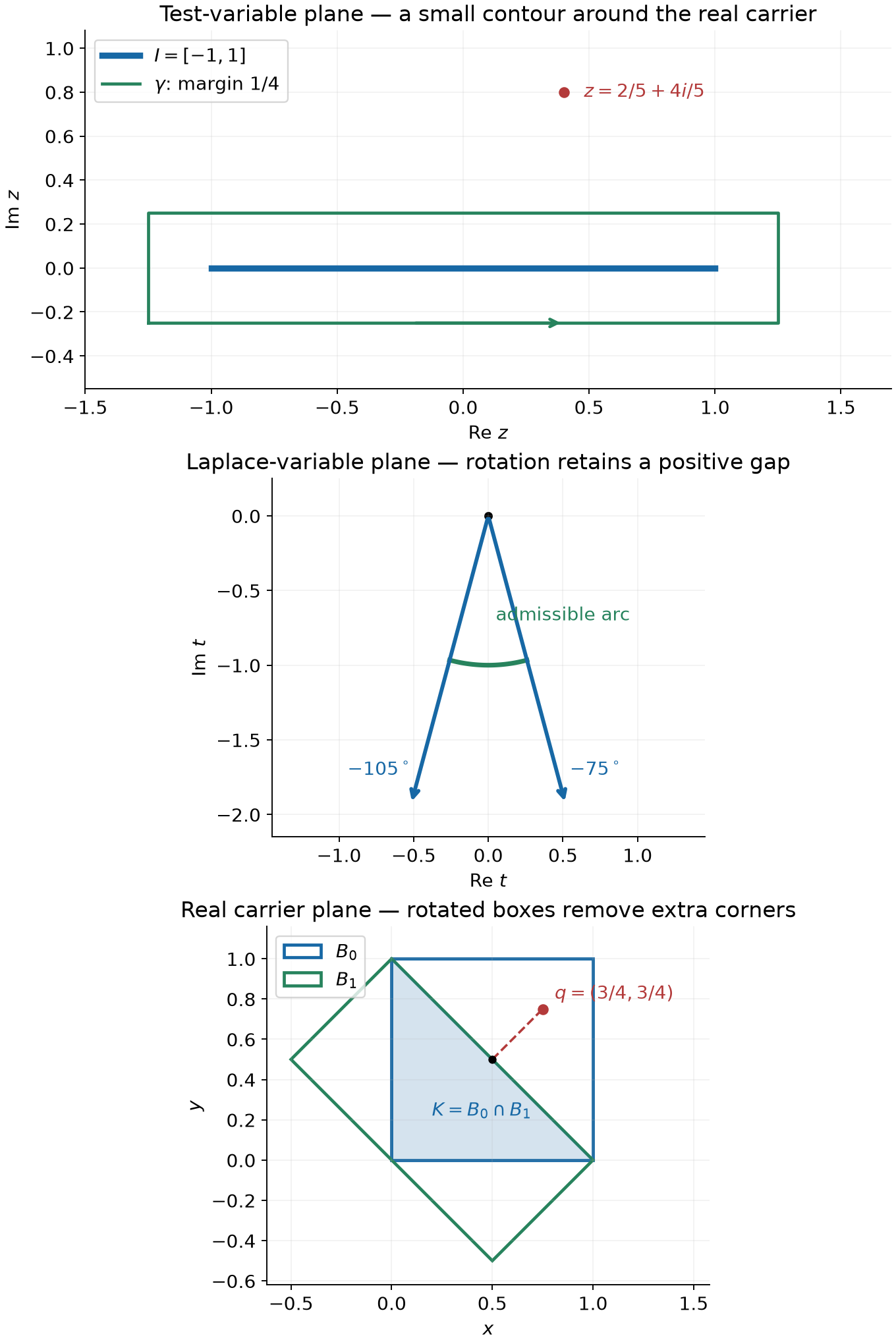
Top: the interval , a surrounding rectangle with margin , and . Middle: in the separate Laplace -plane, the directions with angles and are admissible for this ; the intervening arc stays admissible by Lemma 2. The rays are drawn only to radius . Bottom: the triangle is the intersection of the ordinary box and the rotated box . The point lies only in the ordinary box. Exercise 5 proves the intersection. Vector figure · Reproducible figure source.
Exercises with complete solutions
Exercise 1 (basic) — a numerical nonconvex-carrier bound. In Proposition 7 take to be the union of the open complex disks of radius about and . Give a common in the estimate for .
Solution. If , , then
The same calculation for changes only the sign of the linear term. Thus , while . This supplies an explicit contradiction to every proposed carrier constant for evaluation at zero on .
Exercise 2 (basic) — point derivatives and all signs. For on the real line, find its transform, moments, and exterior Cauchy transform.
Solution. The derivative convention is . Therefore
For the kernel , each -derivative has positive sign, giving
Expanding this at infinity gives precisely the moments in (R35), so Theorem 3 identifies it with the exterior Cauchy transform. The sign of this kernel is different from the sign of its derivative in ; keeping the variable of differentiation explicit prevents confusion.
Exercise 3 (intermediate) — the differential of a left-pointing ray. For , evaluate (R15) in one variable along any direction satisfying . What goes wrong if the factor is omitted?
Solution. Since , direct integration gives
The antiderivative has limit zero at infinity by the strict real-part condition. Omitting instead gives , which depends on the ray. In particular for real , the admissible choice would give the wrong sign.
Exercise 4 (intermediate) — a uniform interval and a product box. Let . Determine its transform, moments and exterior Cauchy transform. Explain the corresponding formulas for the uniform measure on .
Solution. Integrating the exponential, with its removable value at zero, gives
For , define
On compact subsets of that domain the denominator has a positive lower bound, so differentiation under the integral proves holomorphy. For , the geometric series gives its Laurent expansion with exactly the moments in (R38). Thus it is . For real , integration gives ; (R39) specifies its holomorphic continuation without an ambiguous independent choice of two logarithm branches.
Fubini makes all -dimensional formulas products of the one-dimensional ones: the transform is , the moments are products of the interval moments, and the exterior Cauchy transform is . The estimate on the box directly verifies its growth bound.
Exercise 5 (intermediate) — two boxes determine a triangle. Let
Show that is a rotated rectangular box and . Locate the separator for .
Solution. The coordinates and are obtained from an orthogonal matrix. Their ranges in are the intervals and , respectively. Thus is a rotated box. Points in the intersection have and . Conversely these three inequalities give , , and , so they imply membership in both boxes.
The nearest point in the triangle to is . Indeed for any point of the triangle,
, and expansion of shows it is at least . The unit separating vector is . Its support value on the triangle is , whereas its value at is . This is the strict margin used in Lemma 5.
Exercise 6 (advanced) — minimal exponential type without finite order. In one variable let
Verify the growth bound for the singleton carrier , construct its functional directly, and find its exterior Cauchy transform. Show that the functional is not a distribution.
Solution. The series converges on every compact set by its successive-term ratio. Since ,
The last inequality is . Thus (R29) holds with .
For a holomorphic test near zero define
If the closed disk of radius lies in the test domain, Cauchy's bound gives
This proves the every-neighborhood carrier estimate and convergence. Substituting the exponential gives (R41). Its moments are , hence
The full characterization of point-supported distributions in Jets, supported distributions and local operators, Theorem 1.1, says such a distribution is a finite sum of delta derivatives. Its transform would therefore be a polynomial. The series (R41) has infinitely many nonzero coefficients, so is not a distribution. Its smallest real carrier is nevertheless the single point zero.
Exercise 7 (advanced) — differential and translation operations on the range. If for , compact convex, determine the functionals corresponding to and , . Verify the required growth bounds directly.
Solution. The derivative convention gives
. Translation by , defined by , gives
. Their real carriers are respectively contained in and .
For each fixed integer and , the exponential series gives
for , with the degree-zero case immediate. Use the bound for with error and take to absorb the polynomial factor. For translation,
This is exactly the bound for . Uniqueness in Theorem 6 identifies the stated functionals.
Exercise 8 (advanced) — a flat carrier still permits normal derivatives. Take . Construct a nonzero analytic functional carried by whose transform depends on , although .
Solution. Let be the interval functional in Exercise 4 and set . Explicitly,
Cauchy's derivative estimate on a smaller neighborhood of proves (R2) directly, and the transform follows by substitution. The interval integral has modulus at most , while is absorbed into as in Exercise 7. Thus the exact flat-carrier estimate holds. A carrier on a hyperplane does not require the functional to ignore normal derivatives.
References
Lars Hörmander, The Analysis of Linear Partial Differential Operators I: Distribution Theory and Fourier Analysis, reprint of the second edition, Springer, 2003, doi:10.1007/978-3-642-61497-2, §9.1(g), p. 335, for the analytic-functional Fourier–Laplace estimate and range question. Theorem 6 gives the precise convex-carrier range; Proposition 7 explains the limitation for nonconvex compact sets. The Laplace-contour construction, examples, exercises and figure here are independently expressed.
The analytic-functional, harmonic-carrier, Cauchy, integration and algebra proofs used above are available at the exact earlier programme locations linked in the text.